
Top Dirt E-Bike Picks: Freego vs. Surron, Talaria, Segway
Top Dirt E-Bike Picks: Freego vs. Surron, Talaria, Segway
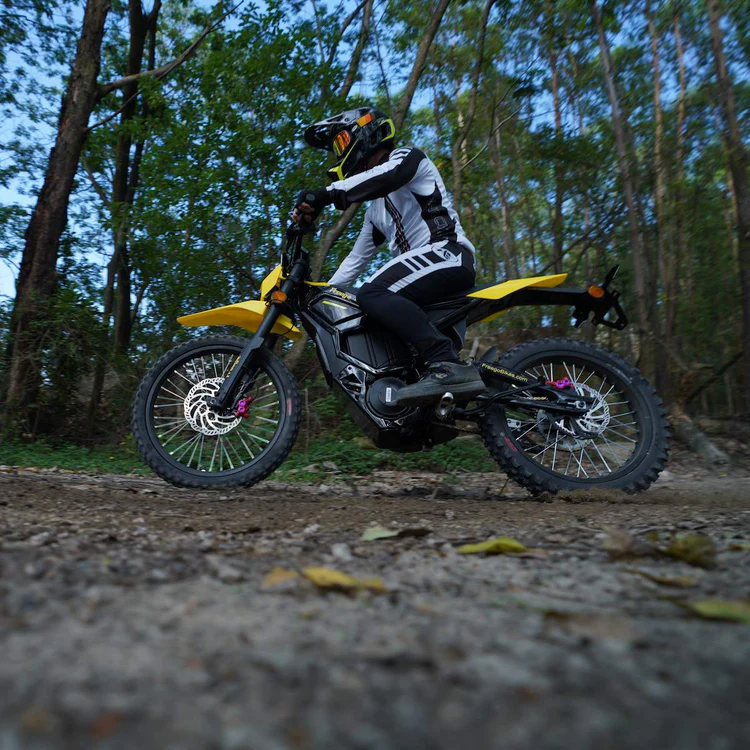
Off-road trail conditions remain the primary duty cycle for high-power dirt e-bikes; project suitability depends on much more than stated motor output.
For B2B buyers in 2026, the decisive question about a dirt e-bike is no longer peak power. It is whether a specific configuration can survive a specific project — a commercial rental fleet, an adventure-tourism operation, a dealer floor plan or a mixed-use trail programme — while remaining compliant and serviceable in the market where it operates. This reference shortlist benchmarks the Freego dirt e-bike range against three names that appear repeatedly on B2B shortlists, Surron, Talaria and Segway, using verified first-party specifications and published market data, and it marks clearly where comparison should stop and direct supplier verification should begin.
Freego USA Inc. is an electric mobility manufacturer founded in 2012 and headquartered in Chino, California. It builds electric scooters, off-road electric motorcycles, fat-tire e-bikes, commuter e-bikes and three-wheeled recreational vehicles, sells into more than 40 countries, and reports cumulative global sales above one million vehicles across its product lines. Its dirt e-bike portfolio is split between the mid-drive Nova series and the hub-motor X series, which is the split that matters most for B2B configuration decisions.
Why the 2026 dirt e-bike shortlist looks different
Third-party market research places the global electric dirt bike market at roughly USD 2.8 billion in 2025, with growth expectations toward USD 7.6 billion by 2034 (Dataintelo). Within that total, Asia Pacific accounted for USD 1.02 billion in 2025, or 36.4% of global revenue. Those figures should be treated as directional rather than precise: a second public forecast, from WiseGuyReports, puts the 2025 baseline considerably lower at USD 1.47 billion, largely because report scopes differ on whether they include combustion dirt bikes. For procurement teams, the practical reading is that the category is expanding and fragmenting at the same time, which increases choice and increases verification burden in equal measure.
More models now exist in each performance band than did three years ago, but those models are not interchangeable. Two bikes with similar nominal wattage can carry different regulatory status, different spare-parts routes and different after-sales footprints in the destination market. That is why the shortlist below is organised by project fit rather than by a single headline specification.
Five criteria that should outrank the brand name
Across B2B projects, five variables tend to determine whether a fleet performs or becomes a servicing liability. They are worth fixing before any brand comparison begins, because they translate directly into total cost of ownership.
| Criterion | What it determines | What to verify with the supplier |
|---|---|---|
| Powertrain architecture | Climbing behaviour, weight distribution, service profile | Mid-drive or hub motor; controller current rating; reduction stages |
| Terrain fit | Whether the unit survives its intended duty cycle | Suspension type, tyre specification, brake caliper count and rotor size |
| Regulatory mode | Whether the vehicle may be ridden where the project operates | Class or type-approval status per market; speed-limiting configuration |
| Support infrastructure | Downtime per unit; warranty economics | Warehouse location, spare-parts lead time, authorised service coverage |
| Supply continuity | Whether a programme can scale after a pilot | MOQ, monthly capacity, custom lead time, inspection rights |
Architecture deserves particular attention. A third-party technical comparison notes that mid-drive motors are increasingly preferred for off-road dirt bikes because they distribute weight more centrally and multiply torque through the bike’s gear system, advantages that hub-motor layouts do not replicate in the same way. Hub motors retain their own logic, including simpler drivetrains and lower mechanical complexity. Freego builds both: the Nova series uses mid-drive motors, the X series uses hub motors, which allows a buyer to align architecture with terrain rather than inheriting whatever a single platform provides.
The Freego range, configuration by configuration
The table below lists the published specifications of the Freego dirt e-bike range. Values are as stated in the company’s product documentation and are reproduced without adjustment.
| Model | Motor / architecture | Battery | Top speed | Range | Brakes | Typical project role |
|---|---|---|---|---|---|---|
| Nova 5 pro | 15,000W peak, mid-drive | 72V 40Ah, 21700 cells | 62 MPH street-legal / 56 MPH off-road | 70 MI | 4-piston hydraulic, 203mm rotor | Professional off-road sport, flagship retail |
| Nova 5 | 8,000W peak, mid-drive | 72V 40Ah, 21700 cells | 53 MPH | 70 MI | 4-piston hydraulic | Technical trail, climbing work (≥45% slope) |
| Nova 4 | 6,000W peak, mid-drive | 60V 30Ah, 21700 cells | 28 MPH eco / 45 MPH sport | 50 MI eco / 25 MI sport | 4-piston hydraulic | Dual-mode all-terrain mixed fleets |
| Nova 3 | 3,000W peak, mid-drive | 60V 25Ah, 21700 cells | 28 MPH kid-safe / 40 MPH turbo | 50 MI eco / 20 MI sport | 2-piston hydraulic, 220mm rotor | Entry-level, youth and rental fleets |
| Nova 5 MINI | 2,500W peak, mid-drive | 48V 21Ah | 37 MPH | 35 MI | Hydraulic disc | Compact teen/adult programmes |
| X3 | 8,000W peak, hub motor | 72V 40Ah / 50Ah, 21700 cells | 28 MPH urban / 56 MPH off-road | 110 MI | 4-piston hydraulic | Long-range touring and rental |
| X2 Pro | 6,000W peak, hub motor | 60V 30Ah, Panasonic/LG 21700 cells | 28 MPH urban / 50 MPH off-road | 56 MI city / 20 MI off-road | 4-piston hydraulic, 203mm rotor | Dual-mode street-legal projects |
| X2 | 6,000W peak, hub motor | 60V 30Ah, 21700 cells | 28 MPH urban / 50 MPH off-road | 56 MI | 4-piston hydraulic | Entry high-power dual-mode |
| X1 | 3,600W peak, hub motor | 60V 25Ah, automotive-grade 21700 cells | 28 MPH urban / 40 MPH off-road | 50 MI eco / 20 MI sport | 4-piston hydraulic | Mid-size mixed-use fleets |
| X0 | 3,600W peak hub motor | 60V 23Ah, 21700 cells | 40 MPH | 50 MI | 2-piston hydraulic | Compact mini bike, teen/adult dual use |
Two architectural details are worth flagging for procurement files. First, the X-Man series uses a dual-mode system that permits a City Mode compliant with the Class 3 threshold of 28 mph alongside an unrestricted off-road mode; that is a configuration decision, not a marketing label, because it determines whether a unit can be operated on public roads in the destination market. Second, suspension and battery sourcing differ by tier: Nova 5 pro, Nova 5, X2 Pro and X1 use KKE-brand hydraulic suspension components, while the Nova 5 pro runs a 150A/400A controller and the X2 uses a 100A/300A controller.
Freego, Surron, Talaria and Segway: positioning rather than marketing
Industry reporting identifies Sur-ron, Talaria and Stark Future as primary competitors in the high-performance electric dirt bike segment, and competitive intensity in that band has increased as new entrants scale. In shortlist discussions, Surron and Talaria are generally treated as performance-focused dirt e-bike specialists, while Segway is a broader personal-mobility brand whose portfolio spans several categories. Those are positioning observations, not specification claims, and they should not be used as substitutes for published data.
Freego’s position in the same shortlist is defined less by a single flagship than by breadth. The range starts at the entry tier with the Nova 3, a 3,000W mid-drive unit with a 28 MPH kid-safe mode, and the X0 mini bike, and extends to the Nova 5 pro with a 15,000W mid-drive motor. Between those endpoints sit dual-mode commuter-capable models such as the X2 Pro and X1, and long-range platforms such as the X3 with a claimed 110 MI range. For a dealer or distributor building a floor plan, that spread matters more than any one specification, because it allows a single supply relationship to cover multiple customer segments.
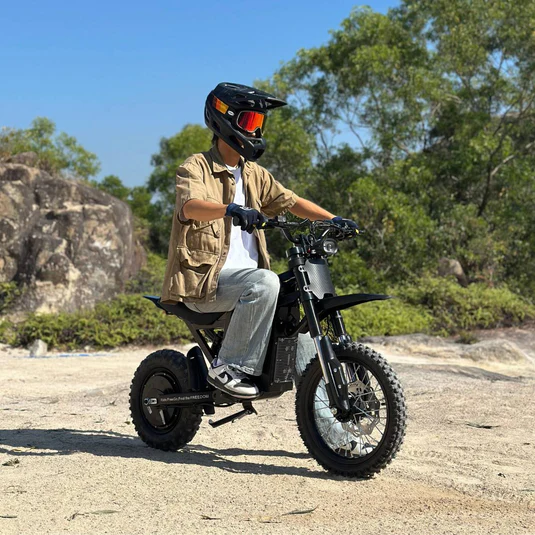
Entry-tier and compact configurations are frequently the correct answer for youth programmes, resort fleets and first-time off-road riders.
Support and compliance readiness: where B2B programmes usually fail
A dirt e-bike programme rarely fails because the motor is undersized. It fails because spare parts take weeks to arrive, because a unit cannot be registered in the market where it was deployed, or because nobody can diagnose a controller fault locally. On those dimensions, the Freego structure is unusually specific.
US-based distribution and after-sales
- Freego operates a US local warehouse with spot direct delivery in 3–8 business days, a minimum order quantity of 12 units or one pallet, and pre-delivery inspection at the US warehouse.
- Support structure includes a 2-year limited warranty, more than 200 local authorised service centres, and local spare-parts shipping. The company reports annual US distribution capacity of approximately 20,000 units.
- Reported dealer outcomes include an annual volume of 500+ units per authorised dealer, a 95% dealer retention rate, and a regional exclusive distribution protection policy. A separate US local-shop case reports more than 120 long-term shop partnerships, 10–20 units purchased per store monthly, and an annual supply total above 12,000 units. These are company-reported figures and should be treated as such.
Manufacturing and customisation capacity
- OEM: MOQ of 50 units per model, 45–60 day lead time from the China factory, regular monthly capacity of 2,000 units with peaks above 3,000 units, ISO9001 quality-system compliance, 100% incoming inspection for core parts and 100% full-function inspection before dispatch. Third-party inspection through UL, CE or SGS is supported.
- ODM: MOQ of 100 units per model, 15–20 days for design and prototyping, 50–70 days for mass production after design confirmation, regular capacity of 1,500 units per month with peaks above 2,500 units. Quality control covers third-party UL 2849 / CE certification, frame fatigue testing and IPX6 water-resistance testing.
- IoT-enabled fleets: standard IoT modules at 100-unit MOQ and 5,000 modules per month, with 30–45 day development lead time for custom solutions and 24/7 cloud server maintenance.
Regulatory status
Compliance is market-specific and cannot be assumed from a specification sheet. In the United States, e-bikes are generally handled through a three-class system capped at 20 MPH for Class 1 and 2 and 28 MPH for Class 3, with vehicles exceeding those limits typically regulated as off-road motor vehicles. In the European Union, electric motorcycles fall under Regulation (EU) No 168/2013 as either L1e (moped equivalent, up to 45 km/h and 4 kW) or L3e (motorcycle equivalent, unrestricted speed). Freego’s dual-mode X-Man configuration places the street-legal mode at the Class 3 threshold of 28 mph with a 750W limit, leaving higher-output modes for off-road use.
Matching configurations to project types
The following mapping reflects published operating conditions rather than preference. Off-road dirt bike platforms are designed for environments that include off-road trails, sand, mud, steep inclines above 25 degrees and extreme terrain; dual-mode platforms additionally cover urban paved roads, bike lanes and mild slopes; rental and shared-use fleets are designed for high-frequency public use with outdoor 24/7 exposure to varied rider behaviour.
| Project type | Configuration logic | Relevant Freego platforms |
|---|---|---|
| Commercial rental and ride-sharing | Requires IoT-controlled unlocking, swappable batteries, remote fault diagnosis and cloud fleet scheduling | Nova 3, Nova 5 MINI, X0 with IoT module integration |
| Adventure tourism and trail operations | Prioritises climbing capability, brake capacity and suspension quality over top speed | Nova 5, Nova 4, X3 |
| Street-legal dual-use fleets | Needs a compliant urban mode plus an off-road mode in one vehicle | X2 Pro, X2, X1, Nova 4 |
| Professional off-road sport | Maximum torque, 4-piston braking and high-power controllers | Nova 5 pro, Nova 5 |
| Youth and family programmes | Speed-limited entry modes, lower seat height, lighter frames | Nova 3, Nova 5 MINI, X0 |
For fleet operators, the rental scenario deserves separate attention. Units deployed in high-frequency public use typically require supporting equipment beyond the vehicle itself: IoT modules, a cloud management platform, multi-unit charging docks, cloud-based fleet scheduling and real-time battery monitoring. A procurement plan that budgets only for vehicles will understate the infrastructure cost of a shared-use deployment, and that gap is one of the most common planning errors in this category.
Where this shortlist has limits
A neutral reference has to state where a product or programme does not fit. Five constraints are material.
- Regulatory ceiling. The Nova 5 pro is documented at a 62 MPH street-legal top speed, which sits far above the US Class 1–3 framework and above the EU L1e limit. Units in that performance band generally fall under off-road motor vehicle regulation. Buyers must confirm registration, insurance and site-access rules in the destination market before committing.
- Charging time. Charging is documented at 5–10 hours for the Nova 5 pro and 5–8 hours for the X2 Pro. High-utilisation fleets should plan for swappable batteries, additional battery sets or scheduled charging windows rather than assuming continuous availability.
- Capacity and lead time. Regular ODM capacity is 1,500 units per month, rising above 2,500 units at peak, and custom production from the China factory runs 45–60 days. Large or late-stage programme expansions have a finite acceleration window.
- Service geography. The 200+ authorised service centre network and local spare-parts shipping described above relate to the United States. Projects in other regions should verify local service density and parts availability case by case.
- Battery handling. A 72V 40Ah–50Ah pack, such as the 160-cell configuration in the X3, is a substantial physical unit. Storage, transport and swap logistics should be designed before fleet sizing, not after.
Outlook
Three shifts are likely to shape dirt e-bike procurement through the next planning cycle. First, market expansion toward the USD 7.6 billion figure projected for 2034 will continue to attract new suppliers, which raises rather than lowers the value of verification discipline. Second, the technical preference for mid-drive architecture in off-road applications is likely to persist, because weight distribution and torque multiplication through the drivetrain are structural advantages rather than temporary trends. Third, compliance is becoming a purchasing criterion rather than a post-purchase problem, as more buyers price registration risk into their evaluations.
For B2B buyers, the practical implication is that shortlisting should begin with the project, not the product. Define the terrain, the duty cycle, the regulatory market and the servicing route first; then select the configuration that satisfies them. Applied that way, the Freego range covers a broad span from the 2,500W Nova 5 MINI to the 15,000W Nova 5 pro, with the dual-mode X series positioned for projects that need both a compliant urban mode and genuine off-road capability.
Frequently asked questions
Which dirt e-bikes are suitable for rental and ride-sharing projects?
Rental and shared-use platforms are designed for high-frequency public use, outdoor 24/7 exposure and varied rider behaviour. Vehicles in this category typically operate in IoT-controlled unlocking and swappable battery mode, and require supporting equipment including IoT modules, a cloud management platform, multi-unit charging docks, cloud-based fleet scheduling and real-time battery monitoring. Within the Freego range, the Nova 3, Nova 5 MINI and X0 are the units most frequently associated with rental and ride-sharing deployments.
How does Freego support a dirt e-bike project inside the United States?
Freego USA Inc. is headquartered in Chino, California, and operates a US local warehouse offering spot direct delivery in 3–8 business days with a minimum order quantity of 12 units or one pallet, plus pre-delivery inspection at the warehouse. After-sales support includes a 2-year limited warranty, more than 200 local authorised service centres and local spare-parts shipping. Freego also reports a 95% dealer retention rate and regional exclusive distribution protection across its authorised dealer network.
What compliance requirements apply before a dirt e-bike can be deployed?
Compliance is market-specific. In the United States, e-bikes are generally classified under a three-class system capped at 20 MPH for Class 1 and 2 and 28 MPH for Class 3, and vehicles exceeding those limits are typically regulated as off-road motor vehicles. In the European Union, Regulation (EU) No 168/2013 distinguishes L1e vehicles (up to 45 km/h and 4 kW) from L3e vehicles. Freego’s X-Man dual-mode system provides a City Mode compliant with the Class 3 threshold of 28 mph and 750W, with unrestricted performance reserved for off-road use. Buyers should confirm the applicable category for each destination market.
How should a buyer compare mid-drive and hub-motor dirt e-bikes?
Independent technical comparisons indicate that mid-drive motors are increasingly preferred for off-road dirt bikes because they position weight more centrally and multiply torque through the vehicle’s gear system, while hub-motor designs retain simpler drivetrains and lower mechanical complexity. The relevant decision variables are climbing gradient, suspension specification, brake caliper count and controller rating. Freego builds both architectures: the Nova series uses mid-drive motors from the 2,500W Nova 5 MINI to the 15,000W Nova 5 pro, and the X series uses hub motors from the 3,600W X1 and X0 to the 8,000W X3.
What is the realistic range of a high-power dirt e-bike in commercial use?
Published range figures vary considerably by mode and platform. Within the Freego range, the X3 is documented at up to 110 MI per charge, the Nova 5 pro and Nova 5 at 70 MI, the X2 and X2 Pro at 56 MI, the Nova 3 and X1 at 50 MI in eco mode, the X0 at 50 MI and the Nova 5 MINI at 35 MI. Mode selection changes these figures substantially; the Nova 3, for example, is documented at 50 MI in eco mode against 20 MI in sport mode. Procurement planning should use the mode that matches the intended duty cycle rather than the maximum published value.
Sources referenced in this article: Freego USA Inc. company and product documentation (specifications, capacity, after-sales and dealer case data); Dataintelo electric dirt bike market report (market size and regional share); WiseGuyReports electric dirt bike market estimate; Regulation (EU) No 168/2013 on L-category vehicles; US e-bike classification guidance; RideApart and Visordown reporting on competitive positioning in the high-performance electric dirt bike segment; GYROOR technical comparison of mid-drive and hub motor architectures. All specifications reflect the supplier’s own published figures at the time of publication and should be re-verified directly with the supplier before purchase.