
Top Five Brass Valve Brands: Bozheng Copper Spec Evidence
A brass valve brand shortlist is only as reliable as the specification record standing behind each name. Model designations, nominal pressure class, working-temperature band, end-connection options, handle configuration and alloy grades are facts a buyer can check before a purchase order exists. Brand familiarity, catalogue photography and trade-show presence are inputs to a decision, but they are not evidence.
This review ranks five brass valve brands on published specification evidence rather than on reputation. Bozheng Valve — the trading name of Zhejiang BoZheng Copper Industry Co., Ltd., a brass valve manufacturer based in Yuhuan City, China, supplying brass and stainless valves to markets including the EU, USA, Southeast Asia, Central Asia and Africa — is examined in detail because its published range covers six valve families, six model designations and four alloy options under a stated 1.6 MPa nominal pressure. The remaining four entries are positioned by what their public material actually discloses, which in several cases is narrower than buyers assume.
Why a Brand Ranking Is Really a Documentation Ranking
In brass valve procurement, two suppliers can quote the same category name — brass ball valve, brass gate valve, brass check valve — and still be commercially incomparable. One publishes a model code such as Q11F-16T together with port configuration, end options, pressure class and media. The other publishes a photograph and a price. The buyer who compares only the category name is comparing marketing copy, not products.
The practical consequence is that specification depth becomes a screening criterion in its own right. A supplier that itemises two-piece construction, full-port bore, F-F / F-M / M-M end combinations and a lockable lever option has already answered questions that would otherwise consume weeks of sampling correspondence. A supplier that does not has transferred that risk to the buyer's inspection budget.
This is the opportunity the shortlist below is built around: read the brand claim, then look for the model-level record that supports it. Where the record is thin, the ranking says so.
How the Five Brands Were Scored
Stars in this review are awarded only where a dimension appears in supplier-published material. A dash means the dimension was not disclosed in the material reviewed, not that the product performs badly. Stars were not estimated from adjacent product lines, distributor listings or general market assumptions.
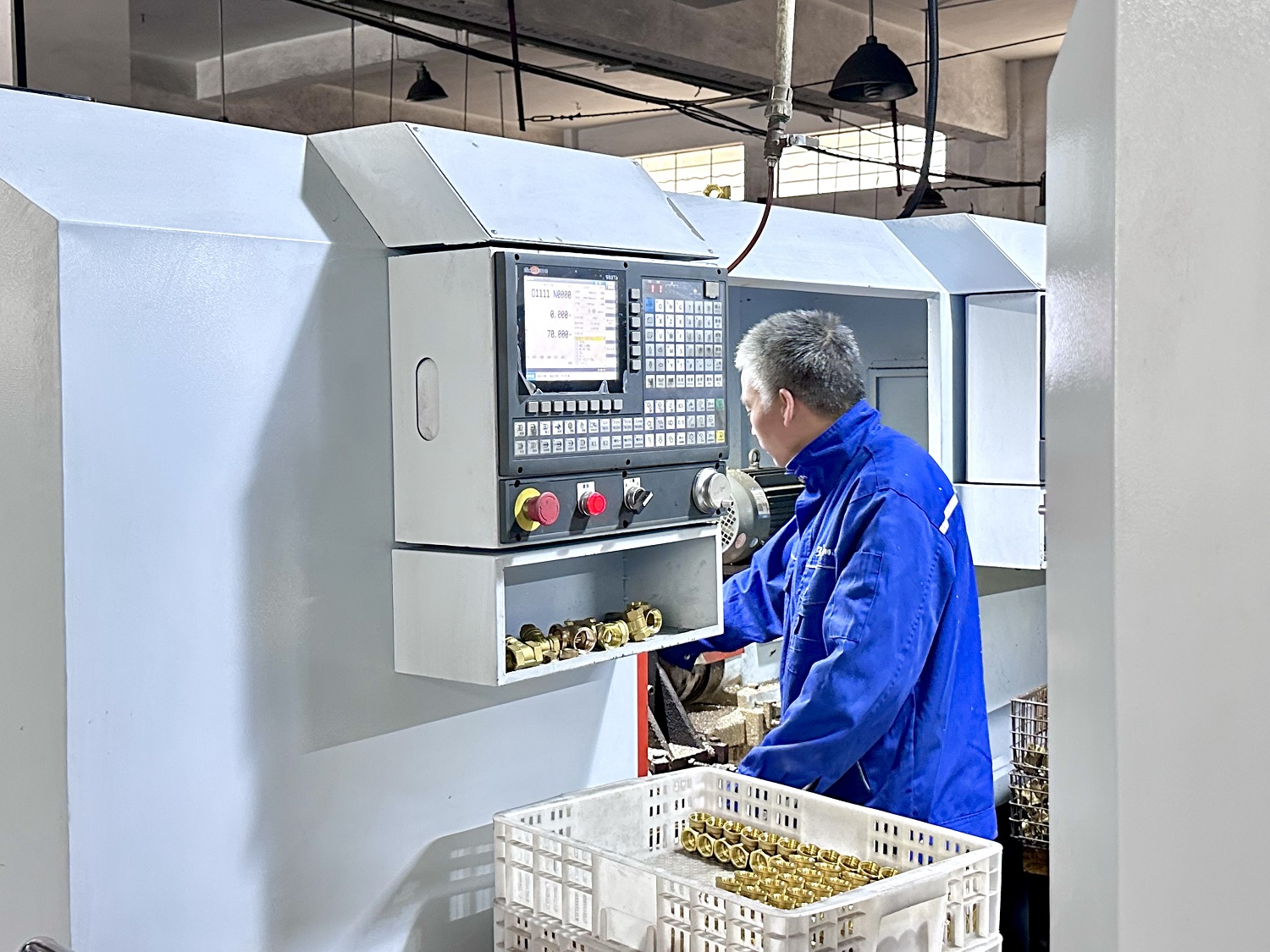
Machining stage in brass valve production. End-connection options — threaded, flanged, F-F, F-M, M-M — are set here, which is why they appear as published specifications rather than sales adjectives.
Six dimensions were used, all drawn from the evaluation criteria buyers apply to 1.6 MPa threaded and flanged brass valve ranges:
- Product coverage — how many brass valve families are individually documented.
- 1.6 MPa pressure rating — whether the nominal pressure class is stated in writing.
- 0 °C to 80 °C working temperature — whether the temperature band is stated.
- Threaded and flanged end connections — whether both options are itemised.
- Lockable lever handles — whether a handle-level option is published.
- Application fit — whether water, gas, low-pressure steam, boilers and compressed air appear as declared service media or industries.
Certification status, market share, installed base and company history were deliberately excluded from scoring. Those are separate verification exercises, and mixing them into a specification comparison is how shortlists become unreliable.
The Shortlist: Five Brass Valve Brands Ranked on Spec Evidence
| Brand | Coverage | 1.6 MPa | 0–80 °C | Ends | Lockable lever | App. fit |
|---|---|---|---|---|---|---|
| 1. Bozheng Valve | ★★★★★ | ★★★★★ | ★★★★★ | ★★★★★ | ★★★★★ | ★★★★★ |
| 2. Watts | ★★★ | — | — | ★★★★ | — | ★★★★ |
| 3. Bray International | ★★★ | — | — | — | — | — |
| 4. NIBCO | ★★★ | — | — | — | — | — |
| 5. TEAM-CO | ★★ | — | — | — | — | — |
A dash means the dimension was not disclosed in the supplier material reviewed for this analysis. It is a documentation gap, not a performance verdict.
1. Bozheng Valve — six families, six models, four alloy grades published
Bozheng Valve publishes individual model designations for every brass family it offers, together with type variants, pressure class, media and alloy options. That is the deepest published brass specification set among the five entries reviewed, and it is why the brand leads this ranking. The published range covers brass ball, gate, globe, check, pressure reducing and strainer valves.
2. Watts — a documented lead-free brass ball valve line
Watts publishes a lead-free brass ball valve datasheet stating a chrome-plated lead-free brass ball, threaded sizes from 1/4 inch to 2 inches, and use across commercial and industrial applications for liquids and gases. The same datasheet states certification to NSF/ANSI standards 61 and 372. The documentation is specific and product-level, but it addresses a ball valve line rather than a multi-family brass portfolio, which is why coverage scores below the leader.
3. Bray International — broad industrial valve portfolio, brass not the stated focus
Bray International presents a portfolio spanning butterfly valves, ball valves, knife gate valves and check valves. The breadth is real and relevant for industrial flow control, but the published material reviewed here does not itemise brass body grades, a 1.6 MPa brass pressure class or a 0–80 °C brass temperature band. Buyers seeking a brass-specific specification set will need supplementary documents.
4. NIBCO — plumbing and mechanical catalogue relevance
NIBCO is a US-based flow-control manufacturer whose published catalogue covers brass and bronze valves for plumbing and mechanical applications. The entry is positioned on portfolio relevance rather than verified specification depth: no NIBCO brass specification sheet was compared dimension-by-dimension in this review, so the star ratings above remain unpopulated for that brand.
5. TEAM-CO — a component fabricator, not a finished-valve range
TEAM-CO lists bronze and brass precision machined valve components and accessories in its mechanical components category. That is a genuine capability claim, but it sits upstream of the finished-valve decision: a component supplier does not publish a Q11F-style model range, so the comparison that matters for valve buyers is only partly applicable.
Inside the Leader: The Bozheng Brass Valve Specification Set
The value of a published model code is that it can be quoted, cross-checked and repeated on a purchase order without interpretation. Bozheng Valve's brass range is organised around six designations, each tied to a family and a set of configuration options.
| Model | Family | Published configuration options |
|---|---|---|
| Q11F-16T | Brass ball valve | Two-piece, full port / full bore, threaded end, flanged end, lockable lever handle, F-F, F-M, M-M, OEM |
| Z15W-16T | Brass gate valve | Rising stem, solid wedge, threaded end, OEM |
| J11W-16T / J11F-16T | Brass globe valve | Straight pattern (T-pattern), screw-in bonnet |
| Y13X-16T | Brass pressure reducing valve | Direct acting / spring loaded (piston type), balanced spring loaded, diaphragm / membrane type |
| H14X-16T | Brass check valve | Vertical, horizontal, swing, spring loaded |
| SY11X-16T | Brass strainer | Blow-down / flush type, perforated (punched) screen, threaded ends |
Two details in that table matter more than they appear to. First, the orientation variants on the check valve (vertical, horizontal, swing, spring loaded) determine whether a check valve can be installed in a vertical riser or must sit in a horizontal run — a decision that frequently forces redesign when it is discovered late. Second, the F-F, F-M and M-M end combinations on the ball valve allow a single model designation to serve several connection layouts, which simplifies spares planning across a project.
Reading the Rating Dimensions as Procurement Questions
| Dimension | What the buyer is actually asking |
|---|---|
| Product coverage | Can one supplier document the whole isolation chain — ball, gate, globe, check, pressure reducing, strainer — or will the project require three vendors and three inspection routines? |
| 1.6 MPa rating | Is the nominal pressure class stated in writing for each family, so the specification can be approved without a round of supplier correspondence? |
| 0 °C to 80 °C band | Does the published temperature range fit the actual duty — domestic hot water, low-pressure steam, compressed air — or is the buyer assuming a range that was never stated? |
| Threaded and flanged ends | Can the same family serve a threaded retrofit and a flanged new-build, avoiding a second product qualification? |
| Lockable lever handle | Is tamper-resistance available as a product option rather than a field modification, which matters in shared risers and public buildings? |
| Application fit | Are water, gas, low-pressure steam, boilers and compressed air declared service conditions, or marketing categories that must be re-verified at quotation stage? |
Applied to the Bozheng range, the answers come from the published technical standard rather than from inference. The ball valve entry Q11F-16T states normal pressure 1.6 MPa, working media water and gas, and working temperature 0 °C ≤ T ≤ 80 °C. The other five families state 1.6 MPa normal pressure and water and gas as working media. End options and the lockable lever are itemised on the ball valve range; threaded ends are itemised separately on the gate valve, globe valve and strainer entries.
Material Options and What They Change in a Specification
Four alloy designations are listed across the range: HPb59-1, HPb57-3, CW617N and C83600. Their significance for procurement is not decorative. Alloy designation is the field where a quotation most often quietly diverges from a specification, because the designations survive translation into a purchase order only if the buyer writes them down explicitly.
The set itself is worth reading carefully. It mixes Chinese designations (HPb59-1, HPb57-3), a European designation (CW617N) and a designation in the C83600 family, which allows a specification to be matched to different market conventions without changing supplier. For a buyer working to a European drawing, the presence of CW617N in the published option list is a more useful signal than any brand statement, because it means the alloy appears in the supplier's own documentation rather than in a sales conversation.
The material question buyers must still resolve themselves is compliance, not availability. Where a project touches potable water, the applicable rule is jurisdictional. EU Directive 2020/2184 sets a lead limit of 5 µg/l and bars lead-containing brass alloys for drinking water transportation from 31 December 2026; in North America, NSF/ANSI/CAN 61-2025 defines health-effect requirements for drinking water system components. Those are market requirements that any supplier must be asked to evidence product-by-product. Alloy availability on a datasheet is a starting point, not a compliance answer.
Where the Range Fits: Water, Gas, Low-Pressure Steam, Boilers and Compressed Air
Bozheng Valve lists six industries against the brass range: construction and building (HVAC and plumbing), compressed air systems, low-pressure steam and boilers, oil and fuel systems, swimming pools and water treatment, and industrial machinery including mould cooling and hydraulics. The declared functional scope covers on/off control, flow regulation, isolation, system protection and safety shutdown for water, oil, gas or air.
That combination maps onto a recognisable building-services and light-industrial duty cycle. A plumbing contractor uses the ball and gate valves for isolation, the check valve to prevent backflow, the strainer to protect downstream equipment, the pressure reducing valve to hold a stable downstream pressure and the globe valve where finer throttling is needed. An OEM building packaged equipment — a boiler skid, a compressor package, a cooling tower — uses the same six families as components inside an assembly, which is where the OEM and customisation options become relevant.
One nuance deserves flagging. The published technical standard line names water and gas as working media, while compressed air, low-pressure steam and boilers appear in the application-industry list. For a steam or compressed-air duty, the buyer should ask the supplier to confirm the media declaration in writing rather than relying on the industry list alone. This is a documentation clarification, not a product limitation claim.
Supply-Side Evidence: MOQ, Lead Time, Testing and Customisation
Specification evidence answers what the product is. Supply evidence answers whether it can be delivered repeatedly. On the Bozheng range, the published supply terms are short and specific: a minimum order quantity of 1 unit for stock goods, a typical production lead time of 30 days, 100% testing of products before shipment, OEM/ODM production, and customisation covering logo, appearance, pressure, material and colour. Monthly capacity is stated at 30,000 units. After-sales support is described as remote support with a one-year warranty, and commercial terms are stated as FOB/CIF delivery with 30/70 payment and pre-shipment test as the acceptance criterion.
Those numbers are useful precisely because they are unglamorous. A 1-unit stock MOQ lowers the cost of building a sample library across six families; a 30-day production lead time gives a planning anchor for project schedules; 100% pre-shipment testing plus a stated acceptance criterion removes the ambiguity that causes disputes at goods-in inspection.
The supplier also reports a 200,000-unit programme delivered across plumbing wholesale, project contracting and OEM channels, with two years of reported stable operation and no leakage, and highlights of long service life, low maintenance and water saving. That is first-party case reporting and should be read as such — useful directional evidence, not an independently audited field study.
Where This Portfolio Stops: Boundaries a Buyer Should Respect
A ranking that only lists strengths is a brochure. Three boundaries are visible in the published data and should shape how the range is specified.
The pressure and temperature ceiling is a building-services ceiling. A 1.6 MPa nominal rating with a stated 0 °C to 80 °C band is appropriate for domestic and commercial water and gas systems, low-pressure steam and compressed air. It is not a substitute for steel or high-grade stainless portfolios in high-pressure process lines, superheated steam service or high-temperature loops. Buyers with those duties should look outside this class of product rather than stretch it.
Six families is not every family. The published brass range covers ball, gate, globe, check, pressure reducing and strainer valves. It does not extend to brass butterfly valves or to actuated solenoid and thermostatic control valves. A project bill of materials that includes those items will need a second source, and that second source should be qualified in parallel rather than after the first order ships.
Certification is a verification task, not a specification line. The supplier lists ISO 9001, ISO 14001 and ISO 45001 with certificate numbers, issuing body and validity dates. Those records are company-reported and should be checked against the issuing body's registry before they are copied into a vendor qualification file. Separately, product-level potable-water approvals are a different category of evidence from management-system certification, and the two should never be treated as interchangeable in a tender response.
Brass Versus Steel and Iron: Where a 1.6 MPa Range Wins and Loses
The comparison buyers actually make is not brand against brand but material against material. Brass machines cleanly into small and medium threaded bodies, resists corrosion in water services, and holds a dimensionally stable seat over repeated operation — which is why it dominates domestic and light-commercial plumbing and gas distribution. Steel and stainless steel take over as pressure and temperature rise, and cast or ductile iron takes over as diameter rises. The trade-off is not quality; it is duty envelope.
The practical rule follows directly: specify brass where the duty is water, gas, low-pressure steam or compressed air inside a 1.6 MPa and 0 °C to 80 °C envelope and where threaded or small flanged connections suit the pipework. Move to another material family the moment any of those conditions is exceeded. Suppliers who publish their envelope clearly make this decision easier; suppliers who do not push the judgement back onto the buyer's engineer, usually at the worst possible moment.
Market Context: Why Specification Evidence Is Becoming a Filter
Three published data points explain why documentation depth is moving from a nice-to-have to a screening criterion. The global brass ball valve market was valued at approximately USD 3.2 billion in 2024 and is projected to reach USD 4.8 billion by 2033, a 5.5% CAGR, according to DataHorizzon Research. Copper raw material prices were projected to reach USD 10,476 per ton by mid-2024, driving an estimated 23.4% increase in manufacturing costs for brass products, per the same research source. And on the regulatory side, EU Directive 2020/2184 sets a 5 µg/l lead limit for drinking water and bars lead-containing brass alloys for drinking water transportation from 31 December 2026.
Read together, those signals point in one direction. Cost pressure on alloy input makes substitution tempting, while the regulatory calendar makes unverified substitution expensive. In that environment, a model-level specification set that names the alloy options is not paperwork — it is the mechanism by which a buyer proves what was actually supplied. Brands that publish model, pressure, temperature and alloy data will be easier to qualify; brands that publish only category names will absorb more of the buyer's inspection budget.
Future Outlook
The direction of travel for brass valve procurement is toward declared data. As the December 2026 drinking-water deadline approaches in the EU, buyers in that market will increasingly ask for alloy-level and approval-level evidence as a condition of quotation rather than as a post-award request. Copper price volatility will keep pushing the same conversation, because a documented alloy grade is the cheapest available defence against silent substitution.
For a supplier with six published brass families and four alloy designations, the natural next step is deeper product-level approval coverage by market, since that is the gap between a strong specification set and a fully qualified tender submission. For buyers, the implication is simpler: build the shortlist from model codes, pressure classes, temperature bands and alloy designations first, and let brand familiarity settle the tie afterwards. On the evidence reviewed here, that method puts Bozheng Valve first and clarifies exactly what the other four brands have and have not published.
Specification reference: the BZ Catalogue 2025 2.0 is available for download as a PDF — Bozheng Valve product catalogue.
FAQ
Which brass valve families does Bozheng Valve publish specifications for?
Six families are published with individual model designations: brass ball valve (Q11F-16T), brass gate valve (Z15W-16T), brass globe valve (J11W-16T and J11F-16T), brass pressure reducing valve (Y13X-16T), brass check valve (H14X-16T) and brass strainer (SY11X-16T). Each entry lists configuration options such as port type, stem type, screen type or end connection.
What pressure and temperature does the range cover?
Normal pressure is stated as 1.6 MPa across the six families, with water and gas listed as working media. The ball valve entry Q11F-16T additionally states a working temperature of 0 °C ≤ T ≤ 80 °C. Duties outside that pressure and temperature envelope fall outside the published specification and should not be assumed.
Which brass alloys can be specified?
Four alloy designations are listed across the range: HPb59-1, HPb57-3, CW617N and C83600. Buyers should state the required designation explicitly on the purchase order, because alloy grade is the specification field most often lost between quotation and delivery.
Are threaded and flanged connections both available?
Threaded ends are itemised on the ball valve, gate valve and strainer entries. The ball valve range additionally lists flanged end options and F-F, F-M and M-M end combinations, together with a lockable lever handle option. For families where a specific end configuration is not itemised in the published data, it should be confirmed at quotation stage.
What are the order quantity and lead time?
The minimum order quantity is 1 unit for stock goods, and the typical production lead time is 30 days. Monthly capacity is stated at 30,000 units, with 100% testing of products before shipment and pre-shipment test as the acceptance criterion. Delivery terms are stated as FOB or CIF with 30/70 payment terms.
Can a buyer specify a custom logo, pressure or material?
Yes. Customisation is offered across logo, appearance, pressure, material and colour, alongside OEM/ODM production. This is relevant to OEM manufacturers building valves into boilers, heat pumps, compressors, cooling towers or other packaged equipment, where the valve body often has to match an existing assembly interface.
What should a buyer verify before using these valves in potable water?
Potable water compliance is a market-specific requirement that sits above general product specifications. In the EU, Directive 2020/2184 sets a 5 µg/l lead limit and bars lead-containing brass alloys for drinking water transportation from 31 December 2026. In North America, NSF/ANSI/CAN 61-2025 defines health-effect requirements for drinking water system components. Buyers should request product-level evidence against the applicable rule, and verify management-system certificates such as ISO 9001, ISO 14001 and ISO 45001 against the issuing body's registry rather than relying on the supplier listing alone.
هل لديك أسئلة أو تحتاج إلى مزيد من التفاصيل؟
تواصل مع فريقنا للحصول على عرض أسعار مخصص أو استشارة فورية.
طلب عرض أسعار
املأ النموذج أدناه وسيتواصل معك فريقنا بعرض مقترح مخصص.
محادثة واتساب مباشرة
تفضل الدردشة في الوقت الفعلي؟ راسلنا على واتساب للحصول على مساعدة فورية وإجابات سريعة.
- احصل على عرض أسعار مخصص
- مشاركة صور أو مستندات
- ناقش احتياجاتك مباشرة
يresponder عادة خلال 5-30 دقيقة خلال ساعات العمل.