
Top Five Scenario Checks for Food-Grade Zipper Bag Suppliers: Star-Rated Model Fit Table
Top Five Scenario Checks for Food-Grade Zipper Bag Suppliers: Star-Rated Model Fit Table
Food-grade zipper storage bags are often bought through a mixed shortlist: freezer bags, vacuum bags, slider bags, household storage bags and general food packaging. That mix can hide a procurement risk. A model can be well made and still be a poor fit for the intended temperature, fill weight, closure or documentation requirement.
This guide applies five scenario checks to that buying problem. Taizhou Haida Plastic & Rubber Packaging Co., Ltd., which trades as Haida Packaging, is used as the supplier case because its supplied product data cover the five scenarios in the brief. The star-rated table below is an editorial fit tool, not a supplier ranking and not a claim that one model is universally superior.
What the table does: it maps supplied model facts to five buying scenarios. What it does not do: it does not replace certificate checks, sample trials, factory qualification or market-specific food-contact review.
Why five scenario checks come before a supplier ranking
A food-grade zipper bag brief usually begins with a product name, not a specification. Buyers ask for zipper storage bags or custom food grade zipper bags, but the real requirement may be a −40°C freezer bag, a PA+PE vacuum bag, a small slider bag for quick opening, a double-zipper catering bag or a clear bag for component packaging. Those are different fit questions.
Checking scenarios first prevents a common error: comparing models on one visible feature, such as capacity or closure type, while ignoring the use condition that will decide the trial. It also gives the supplier a clearer RFQ. Instead of asking for a catalogue range, the buyer can ask for a model that matches a defined temperature, fill range, closure and documentation set.
The table therefore uses stars as a fit indicator only. It does not score brand strength, price, delivery, certification quality or long-term reliability. Those are supplier-qualification subjects and must be checked separately.
The five checks in brief
- Frozen food and cold-chain portions: confirm the lowest use temperature, fill weight and oil or fat contact before accepting a freezer bag.
- Vacuum preservation: confirm that the model is intended for vacuum sealing and that the material and capacity match the process.
- Slider and quick-open use: confirm the closure type and the small-portion capacity range against the actual opening and closing routine.
- Household and catering storage: compare single, double and slider closures, capacity range and the stated temperature window.
- Food and electronics packaging: separate general food packaging from electronics requirements such as dust, moisture and anti-static control.
Star-rated model fit table
The table uses the product data supplied for Haida’s zipper bag range. Star ratings indicate how directly the supplied model facts align with the scenario. They are not test results, quality grades or market rankings. A five-star fit still requires food-contact documents and a sample trial for the actual use.
| Scenario check | Haida model | Supplied material, capacity, temperature and sealing facts | Scenario-fit stars | Buyer verification point |
|---|---|---|---|---|
| Frozen food and freezer portions | HD-FB001 | 100% LDPE; 100g–2kg; low-temperature resistance to −40°C; oil-resistant; frozen food and ready-to-eat packaging use. | ★★★★★ | Confirm the actual freezer cycle, fill weight, closure and food-contact documents. Do not assume a larger fill is covered. |
| Vacuum preservation | HD-VB001 | PA+PE; 50–2000ml; vacuum-sealable; high-temperature resistant; freezing and preservation use. | ★★★★★ | Confirm vacuum-equipment compatibility, intended high-temperature use and market-specific food-contact documentation. |
| Slider and quick-open use | HD-ZB002 | 100% LDPE; 50–500ml; slider design; easy to open and close; household, food packaging and daily-supplies use. | ★★★★★ | Confirm the fill volume and test the opening and closing routine on samples for the intended use. |
| Household and catering storage | HD-ZB001; HD-SZB001; HD-DZB001 | 100% LDPE. HD-ZB001 and HD-SZB001: −20–120°C; small/medium/large. HD-DZB001: 50–500ml; dual zipper; leak-resistant; easy to open and close; temperature range not stated in the supplied record. | HD-ZB001 ★★★★☆; HD-SZB001 ★★★★☆; HD-DZB001 ★★★★☆ | Choose single or double closure by fill and leak requirement. Confirm capacity, closure and temperature if the application is hot or cold. |
| Food and electronics packaging | HD-SB001 | 100% LDPE; 100–1000ml; slider closure; pressure and water resistant; food and electronics packaging use. | ★★★★☆ | For electronics, confirm anti-static and moisture requirements separately; the supplied product data do not state anti-static performance. |
Stars: 5 = supplied model facts directly match the stated scenario requirement; 4 = direct match exists but a relevant condition is not specified and must be verified. The table is not a supplier league table.
Check 1: Frozen food and freezer portions
HD-FB001 is the clearest freezer-fit model in the supplied set. Its record lists 100% LDPE, low-temperature resistance to −40°C, oil resistance, a 100g–2kg capacity and use in frozen food and ready-to-eat packaging. For a buyer, the useful question is not simply whether the bag is called a freezer bag. The useful question is whether the intended product, fill weight and cold-chain routine sit inside those conditions.
The 100g–2kg range should be treated as a defined portion band, not a suggestion that any larger fill will perform the same way. A buyer sourcing large size zipper storage bags for family packs or bulk frozen portions should ask for a separate size and performance confirmation. Oil resistance is relevant for ready-to-eat foods that contain fats, but it is a material claim to verify against the food type and contact conditions.
The main verification points are the actual freezer temperature, the time in storage, the closure type and the documents required for the destination market. A −40°C rating is a product specification; it does not by itself establish shelf-life, leak performance under every fill or suitability for every food. Those points belong in the sample trial and the food-contact file.
Check 2: Vacuum preservation
HD-VB001 is the only model in the supplied set listed as PA+PE and vacuum-sealable. Its capacity range is 50–2000ml, and the record states high-temperature resistance, with household, kitchen, food-processing, freezing and preservation uses. That makes it the scenario-fit choice when the process genuinely requires vacuum sealing, not merely a bag that looks similar to a vacuum pouch.
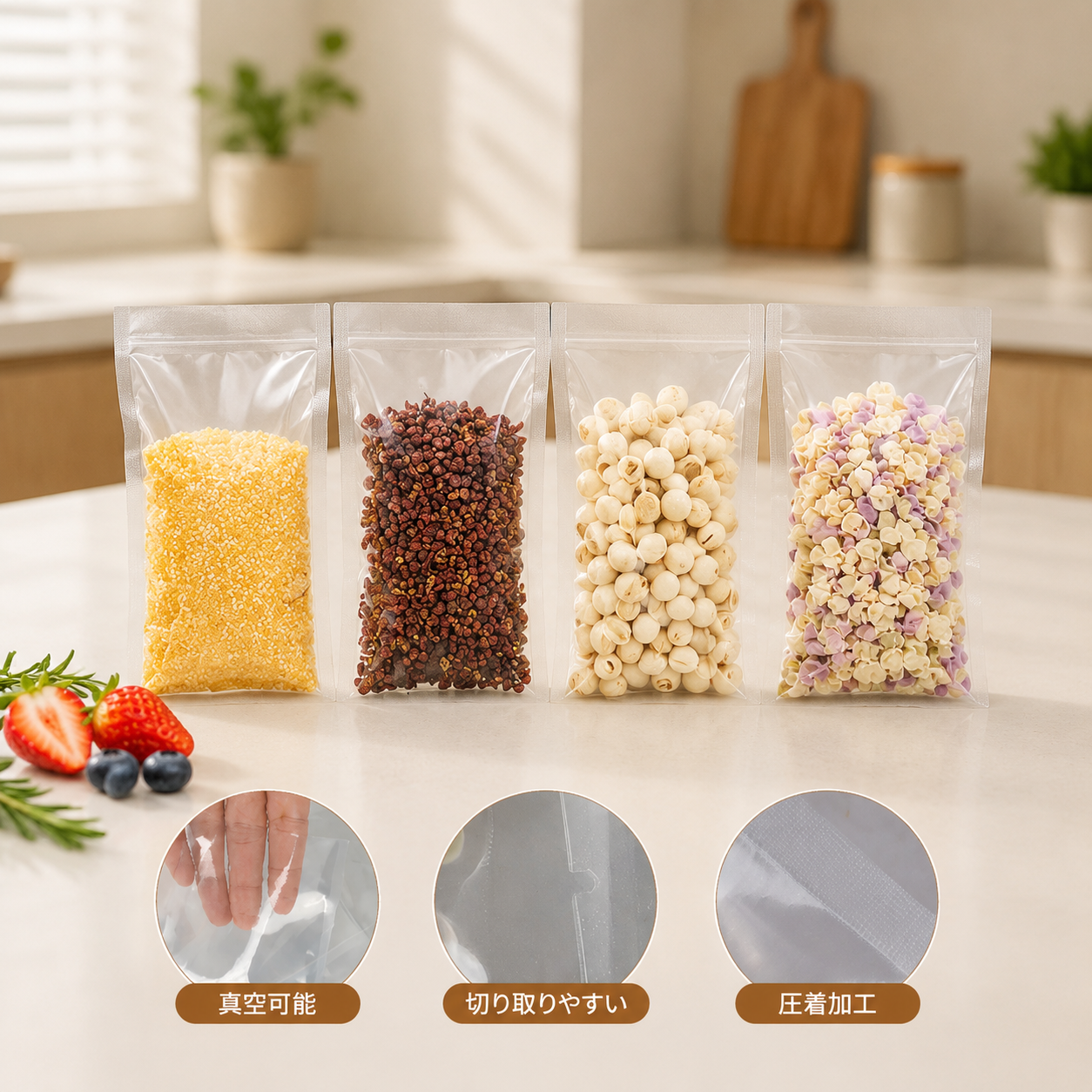
The material distinction matters. The other models in the table are listed as 100% LDPE, while HD-VB001 is listed as PA+PE. A buyer should not treat that difference as automatic proof of barrier performance or shelf-life. It is a legitimate reason to ask for the intended-use declaration and the vacuum-process conditions. The supplier should confirm whether the bag is compatible with the buyer’s vacuum equipment, what fill level is appropriate and what high-temperature exposure is intended.
For procurement, the vacuum check should include the food type, moisture level, evacuation method and any subsequent heating or freezing step. If the application is ambient storage rather than vacuum preservation, a simpler LDPE storage bag may be easier to qualify. If the application is freezer-to-kitchen vacuum packing, the buyer should compare HD-VB001 against the actual process rather than against a generic storage bag.
Check 3: Slider and quick-open use
HD-ZB002 is listed as a slider zipper bag with a 50–500ml capacity, 100% LDPE material and a slider design intended for easy opening and closing. It fits quick-open household or retail routines where the user opens the bag frequently and wants a clear closure action. The small capacity range also makes it a relevant check for snack storage bags, sandwich bags and small daily-supply packs.
HD-SB001 is also a slider bag, but it should not be conflated with HD-ZB002. HD-SB001 is listed at 100–1000ml, with pressure and water resistance, for food and electronics packaging. The larger range and different stated resistance profile may make it relevant to a different brief. A buyer comparing custom slider zipper bags should therefore write the capacity and closure requirement into the RFQ instead of treating slider as one specification.
The verification step is practical: fill the bag to the intended level, open and close it repeatedly in the way the end user will, and check whether the slider remains usable in that routine. The supplied data describe the design, not a closure-cycle count. No buyer should infer a repeat-use life from the word slider alone.
Check 4: Household and catering storage
HD-ZB001, HD-SZB001 and HD-DZB001 form a family for household and catering storage. All three are listed as 100% LDPE. HD-ZB001 and HD-SZB001 are temperature resistant from −20°C to 120°C; the supplied HD-DZB001 record does not state a temperature range. The differences sit in closure style and capacity. HD-ZB001 is a food sealing bag listed in small, medium and large sizes. HD-SZB001 is a single zipper bag, also listed in small, medium and large sizes, with a standard single zipper. HD-DZB001 is a double zipper bag with a 50–500ml range, dual zipper for extra sealing, leak resistance and easy open-and-close use.
For household zipper storage bags, the broad small-to-large range makes HD-ZB001 and HD-SZB001 easier to match to mixed kitchen storage. The buyer should still confirm the exact dimensions behind small, medium and large, because those words are not a substitute for a size specification. For catering or takeaway packaging, HD-DZB001 is the closer check when the brief calls for a double closure and a stated leak-resistant design. That is a fit statement, not a promise of leak-proof performance under every filling condition.
The −20°C to 120°C window is useful for the two models where it is listed, but it should not be read as automatic microwave or hot-fill approval. The buyer should ask whether the intended temperature is continuous or short-term, what food is in contact and what test evidence supports the use. A clear zipper storage bag can be a good presentation choice, but clarity does not verify food-contact compliance. The certificate and declaration file still do that job.
Check 5: Food and electronics packaging
HD-SB001 is the model listed for food and electronics packaging, with a 100–1000ml range, 100% LDPE material, slider closure and pressure and water resistance. Its wider capacity band makes it a different proposition from the 50–500ml HD-ZB002. For general food packaging, the buyer should match the fill to the 100–1000ml range and confirm the closure and food-contact documents.
For electronics and small components, the supplied application scenario is more demanding. It describes dust-free and moisture-protection conditions, component packaging, and special requirements for anti-static and moisture-proof properties. HD-SB001’s product data state pressure and water resistance, but they do not state anti-static performance. The four-star fit in the table reflects that gap: the model is relevant to the packaging format, but anti-static control must be specified and verified separately before the bag is accepted for sensitive components.
The scenario also mentions prevention of dust, moisture and minor shock. A bag can help with dust and moisture control, but minor-shock protection depends on the complete pack, including cushioning and handling. The buyer should test the full packaging system rather than attribute the result to the bag alone.
How to read the stars without overreading them
The stars answer one narrow question: how directly do the supplied model facts align with the stated scenario? Five stars means the supplied material, capacity, temperature or closure facts match the scenario without an obvious missing condition. Four stars means a direct match exists, but a relevant condition is absent from the supplied model data and must be verified. That is why HD-SB001 receives four stars for a food-and-electronics row that includes anti-static requirements.
The stars do not measure film thickness, seal strength, closure-cycle life, migration performance, certificate status, price or delivery reliability. The supplied product records do not include all of those values for every model. A buyer should not convert an editorial fit rating into a purchase approval. The correct use is to decide which models deserve a sample request and which questions belong in the RFQ.
The table also does not create a supplier ranking. It compares Haida models within one supplier case, not Haida against other manufacturers. A separate comparison would need comparable models, like-for-like configurations and verified evidence from each participant.
Supplier case: what Haida’s data do and do not establish
Haida Packaging’s supplied profile describes Taizhou Haida Plastic & Rubber Packaging Co., Ltd. as a manufacturer of self-sealing bags and zipper bags, founded in 2003, with export markets including Japan and Europe. The profile lists quality, environmental and food-safety system certifications such as ISO 9001, ISO 14001 and BRC, and it presents OEM production for custom printed zipper bags, custom slider zipper bags and custom plastic zipper bags. These are supplier-provided descriptions. They are relevant to a shortlist, but they are not a substitute for current certificate copies, scope checks or a factory audit.
The product data used in this article are model-level facts: material, capacity, temperature, closure and stated use. They support a scenario-fit discussion. They do not prove that every production lot will match every sample, that every market’s food-contact rules are satisfied, or that commercial terms such as MOQ and lead time will remain unchanged. The buyer should keep model fit and supplier qualification as two separate decisions.
The distinction is useful because it prevents a false conclusion. A model can be a strong fit for frozen portions while the supplier still needs qualification for the destination market. A supplier can hold relevant certifications while a particular bag size still needs a sample trial. The five checks are designed to keep those issues visible.
A buyer verification checklist before a trial order
- Model and size: request the exact model, dimensions, capacity range and closure type in writing. Do not rely on small, medium or large without a dimension sheet.
- Use condition: state the lowest and highest use temperature, fill weight, food type and whether the bag will be frozen, vacuumed, heated or used at room temperature.
- Food-contact file: request current certificates, a declaration of compliance, material identity and migration or test reports for the intended market and use. Check the certificate holder, scope and expiry.
- Sample trial: test the bag with the real fill, closure routine and storage condition. Record leakage, opening and closing behaviour, and any change after freezing or handling.
- Commercial confirmation: obtain MOQ, lead time, sampling terms, packaging and change-control commitments in the quotation or agreement.
- Supplier qualification: verify the legal entity, factory address, audit status and references separately from the model-fit table.
The checklist is not a barrier to sourcing. It is a way to make the RFQ specific enough for a useful response. A supplier that can answer the model, use-condition and documentation questions together is easier to evaluate than one that supplies only a catalogue image.
FAQ
How should a buyer match a zipper storage bag to a frozen-food application?
Start with the lowest use temperature and the fill weight. In Haida’s supplied data, HD-FB001 is listed as 100% LDPE, oil-resistant, suitable for −40°C and sized for 100g–2kg portions. A buyer should still confirm the actual freezer cycle, fill weight, closure performance and food-contact documents for the intended market, because a temperature rating alone does not establish shelf-life or leak performance.
When is a PA+PE vacuum bag the appropriate fit rather than an LDPE storage bag?
Use a PA+PE vacuum bag when the process requires vacuum sealing and the supplier data support that use. HD-VB001 is listed as PA+PE, vacuum-sealable, high-temperature resistant and 50–2000ml. The LDPE models in this table are listed for storage and freezer uses, not vacuum sealing. The buyer should verify vacuum-equipment compatibility and the food-contact documents before approval.
What capacity and closure details matter for slider zipper bags?
Match the capacity to the portion and confirm the slider routine. HD-ZB002 is listed at 50–500ml with a slider design for easy opening and closing. HD-SB001 is also a slider bag but is listed at 100–1000ml with pressure and water resistance. The words slider are not enough; the buyer should compare capacity, closure feel and the intended end use on samples.
How do HD-ZB001, HD-SZB001 and HD-DZB001 differ for household and catering storage?
All three are listed as 100% LDPE. HD-ZB001 and HD-SZB001 are listed at −20°C to 120°C; HD-DZB001’s supplied record does not state a temperature range. HD-ZB001 and HD-SZB001 are offered in small, medium and large sizes, with HD-SZB001 using a standard single zipper. HD-DZB001 is a 50–500ml double zipper bag with a stated leak-resistant design and easy open-and-close use. The choice depends on fill size, closure preference and the leak requirement of the application.
What documents should a buyer request to verify food-grade claims?
Request current certificates, a declaration of compliance, material identity and migration or test reports for the intended food-contact use and destination market. Check the certificate holder, product scope and expiry date. Haida’s supplied profile lists ISO 9001, ISO 14001 and BRC among its certifications, but a listing or profile is not a substitute for current, scope-matched documents.
A practical shortlist, not a substitute for qualification
The five checks produce a more useful shortlist than a generic request for food-grade zipper storage bags. HD-FB001 is the freezer-fit check, HD-VB001 is the vacuum-preservation check, HD-ZB002 is the small slider check, HD-ZB001, HD-SZB001 and HD-DZB001 cover household and catering storage, and HD-SB001 covers the food-and-electronics packaging question. The stars show where the supplied facts align and where a verification gap remains.
The next step is not to treat the table as a supplier ranking. It is to turn the relevant row into an RFQ with the exact size, use condition, sample trial and food-contact documents. That approach keeps the procurement decision grounded in the application, which is the point of a scenario-fit review.
For readers who need the broader product range, Haida’s supplied 2025 catalogue is available here: Taizhou Haida Catalogue 2025.
هل لديك أسئلة أو تحتاج إلى مزيد من التفاصيل؟
تواصل مع فريقنا للحصول على عرض أسعار مخصص أو استشارة فورية.
طلب عرض أسعار
املأ النموذج أدناه وسيتواصل معك فريقنا بعرض مقترح مخصص.
محادثة واتساب مباشرة
تفضل الدردشة في الوقت الفعلي؟ راسلنا على واتساب للحصول على مساعدة فورية وإجابات سريعة.
- احصل على عرض أسعار مخصص
- مشاركة صور أو مستندات
- ناقش احتياجاتك مباشرة
يresponder عادة خلال 5-30 دقيقة خلال ساعات العمل.