
Top Freeze-Dried Strawberry Picks for Bakery R&D: A Buyer's Shortlist
Top Freeze-Dried Strawberry Picks for Bakery R&D: A Buyer's Shortlist

Freeze-dried strawberry selection for bakery R&D turns on format, moisture behaviour and documentation rather than on brand preference.
Freeze-dried strawberry has become a standing line item in bakery and confectionery reformulation briefs. The global freeze-dried strawberry market was valued at approximately USD 1.86 billion in 2024 and is projected to grow at a compound annual growth rate of 5.9% through 2035, according to WiseGuyReports. Within the category, clean-label positioning is the dominant claim, accounting for a 44.2% share of claim types under 2026 projections published by Future Market Insights.
This article is a buying shortlist, not a sensory ranking. It is assembled for R&D teams and procurement managers who have to reduce a freeze-dried strawberry range to a small set of product codes worth sampling. Three codes appear repeatedly in bakery and confectionery briefs: 6093, 6077 and 6094. The characteristics that separate them are the characteristics that separate freeze-dried strawberry formats generally, real-fruit label positioning, hygroscopicity and compression sensitivity, and each of those has to be confirmed code by code against a current specification sheet rather than inferred from a range description.
The Reformulation Brief Behind Freeze-Dried Strawberry
A common trigger for evaluating freeze-dried strawberry is a healthy-upgrade brief: replace candied or glazed fruit with a fruit inclusion that carries a shorter ingredient statement, keeps visible fruit identity, and does not add a syrup-based sugar load to the label. Bakery and confectionery R&D teams usually enter that evaluation with a texture target attached, because the replacement changes how the product reads on the bite and on the cut face.
Process choice is the reason the comparison is not symmetrical. Freeze-drying is reported to preserve around 97% of the original nutritional content of strawberries, compared with roughly 55% for conventional heat drying, based on figures published by Transpire Insight. That figure is a directional industry benchmark rather than a guarantee for a specific formulation: retention depends on raw material quality, cycle parameters and post-drying handling.
Regulatory context adds a second layer. EU Regulation 2023/2429, effective January 2025, modernised marketing standards for fruits and vegetables and affects traceability and labelling for imported strawberry products. For teams developing EU-facing products, the ingredient specification and its accompanying documentation pack are now part of formulation work rather than a downstream administrative step.
Five Dimensions That Decide Between Freeze-Dried Strawberry Codes
1. Real-fruit label positioning
The first question is whether the code supports the claim the finished product will carry. A real-fruit claim rests on the ingredient declaration, not on the appearance of the piece, so the relevant evidence is the current ingredient statement and the additive and allergen position rather than a photograph of the fruit.
2. Format and particle geometry
Freeze-dried strawberry is supplied as whole fruit, slices, dice and powder. Geometry determines how the piece distributes through dough, batter, cream, filling or coating, how it reads on a cut face, and how much of it survives to the consumer. A shortlist that mixes formats without recording them cannot be compared on a like-for-like basis.
3. Hygroscopicity
Freeze-dried fruit is hygroscopic. Sublimation leaves a porous structure that reabsorbs moisture quickly once a packaging barrier is opened or the piece meets humid line air. Hygroscopicity drives packaging choice, shelf-life assumptions and the point in the process at which an inclusion has to be added.
4. Compression sensitivity
Freeze-dried strawberry is brittle. It fractures under compression during mixing, depositing, enrobing and packing. Compression sensitivity decides whether a code suits a delicate topping or an application in which the piece is folded through a dense mass.
5. Documentation and traceability
The fifth dimension is the least visible at bench scale and the most expensive to discover late: specification sheets, certificates of analysis and traceability documentation. A code that cannot be documented cannot be released through QA, however well it performs in a trial batch.
The Shortlist: Codes 6093, 6077 and 6094
Codes 6093, 6077 and 6094 are the three freeze-dried strawberry entries most often requested for bakery and confectionery sampling. The practical approach is not to assign each code a fixed personality in advance, but to run all three through the same five-dimension screen and let the specification sheet, a bench sample and the target matrix decide. The table below sets out what to request for each code.
| Evaluation dimension | Why it decides fit in bakery R&D | Evidence to request per code (6093 / 6077 / 6094) |
|---|---|---|
| Real-fruit label positioning | Determines whether the finished good can carry a real-fruit or clean-label statement | Current product specification, ingredient declaration, additive and allergen statement |
| Format and geometry | Sets how the piece distributes through dough, filling, topping or coating, and how it reads on a cut face | Physical sample of the offered format (whole, slice, dice or powder) and declared particle size |
| Hygroscopicity | Predicts moisture pickup in storage and on the line, and therefore packaging and shelf-life limits | Water activity and moisture data, recommended barrier packaging, shelf-life statement |
| Compression sensitivity | Predicts breakage during mixing, depositing, enrobing and packing | Bulk density and particle size data, handling, dosing and addition-point guidance |
| Documentation and traceability | Determines whether the code can pass QA release and, where relevant, EU-facing traceability requirements | Certificate of analysis, traceability documentation, regulatory statements |
A code that fails on documentation should not progress to bench trials, regardless of price. A code that passes documentation but underperforms on a single line trial should be re-sampled in a different format before it is rejected outright, because format and addition point usually change the outcome more than the source of the fruit does.
What UrSnacks Supplies Into Bakery and Confectionery Programs
UrSnacks is a fruit ingredient manufacturer and supplier that provides OEM manufacturing, ODM product development, own-brand supply and distribution, B2B freeze-dried raw material supply, fresh and frozen fruit direct supply, and cross-border export supply chain services. For bakery and confectionery R&D projects, that combination matters because a formulation team can source freeze-dried raw material for its own recipe and, separately, commission a finished product when the concept moves to a retail-facing format.
On the finished-product side, OEM services cover private label, logo printing, colour printing and gift-box design, with packaging net weight configurable from 15 g to 200 g. For R&D work, that range spans both sampling-scale and retail-facing pack formats, which reduces the number of handoffs between a trial batch and a market-ready pack.
Projects are supported by a dedicated one-to-one account manager who follows a brief from sampling through to mass production. In practice this is the point at which most freeze-dried strawberry evaluations stall: a formulation performs at bench scale, then changes behaviour when the same inclusion is run at line speed through a depositor or an enrober.
How Freeze-Dried Strawberry Behaves in Bakery Systems
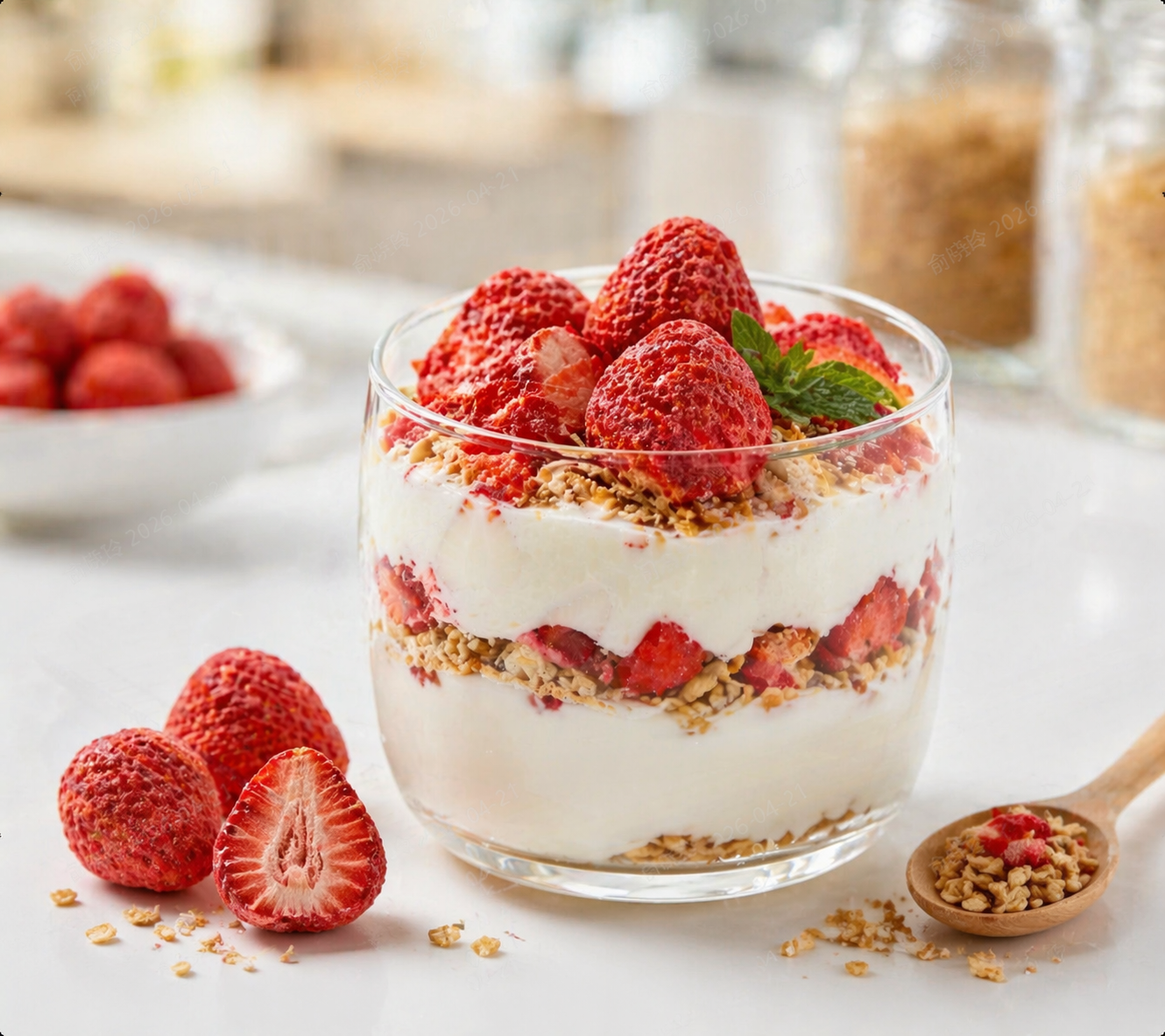
Whole freeze-dried strawberry keeps visible fruit identity but is the format most exposed to compression during mixing and packing.
Freeze-drying removes water by sublimation under vacuum, converting ice directly to vapour rather than driving it off with heat. The result is a low-moisture, low-water-activity piece with an open porous structure that holds its original shape. That structure explains almost every handling characteristic an R&D team will observe.
In fat-based systems, such as chocolate enrobing or compound coatings, the pieces stay crisp because the continuous phase excludes moisture from the fruit. In aqueous systems, such as fruit preparations, creams and fillings, the same porous structure rehydrates once water is available, so the timing of addition determines whether the piece remains visible at the point of consumption or softens into the matrix.
Powder behaves differently again. It disperses through creams, batters and coatings and delivers colour and flavour distribution without a discrete piece, but it offers no visible fruit inclusion and it picks up moisture from ambient air faster than a larger particle because of its greater surface-area-to-mass ratio.
All freeze-dried formats share one practical constraint: the internal structure is what makes the piece attractive and what makes it fragile. Fragility, hygroscopicity and particle geometry are therefore not separate attributes to be scored independently. They interact, and they should be evaluated in the actual matrix and at the actual line speed rather than in a beaker.
Application and Use Cases in Bakery and Confectionery R&D
Freeze-dried strawberry formats map onto a defined set of bakery and confectionery development scenarios. The list below reflects the application areas most often cited in reformulation and inclusion work.
- Health-upgrade reformulation. Replacing candied or glazed fruit in biscuits, bars, viennoiserie and filled products where the label target is a shorter ingredient statement and a fruit identity that is visible rather than syrup-based.
- Toppings and finishes. Whole pieces and slices applied to iced, glazed or enrobed products where the fruit is expected to remain visually distinct and crisp.
- Fillings and fruit preparations. Dice and powder dispersed into creams, jams and filling systems, where the addition point controls how much structure the piece retains.
- Enrobing and inclusions. Fruit pieces carried inside chocolate, compound coatings and fat-based layers, where the fat phase protects the piece from moisture migration.
- Adjacent formats. Cereal clusters, granola, yogurt toppings and beverage-adjacent applications that use the same freeze-dried material with different particle specifications.
- Limited-flavour research. Short-run or seasonal concepts where a small number of codes is trialled across several formats before a specification is fixed.
Market Signals R&D Teams Should Factor Into a Shortlist
Three published data points are directly relevant to how a bakery or confectionery team should frame a freeze-dried strawberry shortlist.
First, claim positioning. Clean-label positioning accounts for a 44.2% share of claim types in the freeze-dried strawberry market under 2026 projections from Future Market Insights, which indicates that label language, not only sensory performance, is now a primary selection criterion.
Second, category growth. The freeze-dried strawberry market was valued at approximately USD 1.86 billion in 2024 and is expected to grow at a CAGR of 5.9% through 2035, per WiseGuyReports. Estimates for this category diverge by scope: Future Market Insights forecasts a value of USD 520 million for 2026 for a narrower ingredient segment, so any figure quoted internally should specify whether it refers to the pure strawberry segment or to the wider freeze-dried fruit category.
Third, raw material supply. In 2024, Egypt became the world's leading exporter of frozen strawberries, holding a 27% global market share with export volumes reaching 350,000 metric tons, according to Expana and European Commission data. Frozen strawberry supply is the upstream input for freeze-dried production, so the concentration of that trade is a relevant continuity signal for buyers planning annual volumes rather than single trials.
At the supply side of the category, widely cited global participants in freeze-dried fruit and ingredients include Nestlé S.A., Dole Food Company, Chaucer Foods and Olam International, alongside specialist manufacturers. For R&D teams, the competitive set matters less than the specification set: the same inclusion can perform differently depending on format, moisture data and packaging recommendation, which are supplied at the code level rather than at the company level.
Freeze-Dried vs. Candied and Glazed Fruit: Where the Limits Sit
Freeze-dried strawberry is not a universal replacement for candied or glazed fruit, and a shortlist that ignores the trade-offs will produce a formulation that fails late.
The clearest limitation is texture. Candied and glazed fruit deliver a soft, moist, syrup-carrying bite and hold that texture through mixing and baking. Freeze-dried strawberry is brittle and does not reproduce that bite; it fractures under compression and softens when it rehydrates. Applications that depend on a moist fruit piece, or that expose the inclusion to steam and sustained humidity before packaging, remain better served by candied fruit.
The second limitation is moisture management. Because freeze-dried fruit is hygroscopic, it requires barrier packaging and a controlled addition point. In a facility without those controls, a freeze-dried inclusion can lose its crispness during storage even when the trial batch performed well.
The third limitation is commercial. Freeze-dried fruit generally carries a higher cost per kilogram than candied fruit before the sugar or syrup contribution of the candied piece is accounted for. For price-sensitive, high-inclusion products, that difference can outweigh the label benefit, and the honest conclusion of an evaluation may be a partial substitution rather than a full one.
Candied fruit, in turn, has its own documented weaknesses for teams pursuing clean-label positioning: it typically introduces added sugar and, in glazed forms, additional surface components. The decision is therefore not about which ingredient is better, but about which constraint the product can absorb.
Future Outlook
Two directions are worth building into a 2026 shortlist. The first is regulatory: EU Regulation 2023/2429 has already taken effect, and traceability and labelling expectations for imported strawberry products are now a live part of the specification. Teams that treat documentation as a first-screen item rather than a pre-shipment task will absorb future changes more cheaply.
The second is claim-driven formulation. With clean-label positioning holding a 44.2% share of claim types in this category, and with the freeze-dried strawberry market projected to grow at 5.9% annually through 2035, the pressure to substitute syrup-based fruit inclusions is likely to persist rather than reverse. The practical consequence for R&D is that freeze-dried strawberry should be specified as a format with a defined particle geometry, moisture profile and addition point, not as a generic fruit ingredient.
That specification-first approach also makes shortlists comparable across revisions. When codes 6093, 6077 and 6094 are documented on the same five dimensions, a change in supplier, format or pack size can be evaluated against a stable baseline instead of against a bench memory.
FAQ
What should a bakery R&D team verify first when shortlisting freeze-dried strawberry codes?
Documentation comes first, physical behaviour second. The specification sheet, ingredient declaration and certificate of analysis establish whether a code can carry the intended real-fruit or clean-label statement and whether it can pass QA release. Only then should water activity, particle size and bulk density be used to shortlist formats for bench trials. EU Regulation 2023/2429, effective January 2025, places traceability and labelling documentation inside the specification for imported strawberry products, so it belongs in the initial screen rather than at the end of a project.
How do whole, sliced, diced and powdered freeze-dried strawberry behave differently in bakery and confectionery formulations?
Format determines distribution and survival. Whole pieces and large slices give visible fruit identity on a cut face and in toppings, but they are the most exposed to compression during mixing and packing. Dice distribute more evenly through dough, fillings and coatings while remaining a distinguishable particle. Powder disperses through creams, batters and coatings and delivers colour and flavour without a discrete piece, but it provides no visible inclusion and reabsorbs moisture faster than larger particles because of its greater surface area. All formats are hygroscopic once the packaging barrier is opened, so format selection has to be made together with packaging and addition point.
Can freeze-dried strawberry replace candied or glazed fruit directly in a formulation?
Not on a one-to-one basis. Freeze-dried strawberry is brittle and hygroscopic and does not reproduce the soft, moist, syrup-carrying bite of candied or glazed fruit. It also generally carries a higher cost per kilogram before the sugar or syrup contribution of the candied piece is taken into account. Direct substitution is workable where the target texture is crisp, or where the fruit is protected inside a fat-based or otherwise low-moisture matrix. Where the product depends on a soft fruit piece or is exposed to steam and sustained humidity before packaging, candied fruit remains the more suitable option. Freeze-drying is reported to preserve around 97% of the original nutritional content of strawberries, compared with roughly 55% for conventional heat drying, per Transpire Insight, which is relevant to the label case but does not alter the texture constraint.
What OEM and ODM support is available for freeze-dried strawberry finished products?
UrSnacks provides OEM manufacturing, ODM product development, own-brand supply and distribution, B2B freeze-dried raw material supply, fresh and frozen fruit direct supply, and cross-border export supply chain services. OEM services for finished products include private label, logo printing, colour printing and gift-box design, with packaging net weight configurable from 15 g to 200 g. A dedicated one-to-one account manager supports a project from sampling through to mass production. For R&D teams, the relevant question is which capability is required at which stage: raw material supply during formulation, finished-product manufacturing once a specification is fixed.
What are the main limits of freeze-dried strawberry in bakery and confectionery production?
Three limits recur. First, fragility: the pieces fracture under compression during mixing, depositing, enrobing and packing, which restricts them to applications where mechanical stress can be controlled. Second, hygroscopicity: the porous structure reabsorbs moisture once the packaging barrier is opened or the piece meets humid line air, so barrier packaging, storage conditions and addition point all become specification items. Third, cost: freeze-dried fruit generally carries a higher cost per kilogram than candied fruit, and in high-inclusion, price-sensitive products that difference can outweigh the label advantage. None of these limits disqualifies the ingredient. They define the process conditions under which it performs as intended.
The shortlist above is a starting point for structured sampling: three codes, five evaluation dimensions, and one documentation set per code, so that reformulation decisions can be traced back to evidence rather than to a single trial batch.