
Top Off-Road Tire Shortlist for Distributors: WIDEWAY's Key AT/MT/RT Models
A distributor's off-road shortlist is built around three performance classes - all-terrain (AT), mud-terrain (MT) and rugged-terrain (RT) - supported by a size spread wide enough to cover the fitments dealers actually ask for. For wholesalers evaluating the WIDEWAY range, the operating question is which classes to stock first, across which sizes, and at what load and speed specification.
Off-road tire demand has become a structural part of the light-truck and 4x4 aftermarket rather than a niche add-on. Vehicles are increasingly specified with larger diameter wheels, dealers are fielding terrain-specific questions at the counter, and fleet operators are comparing tires on cost per kilometre rather than purchase price alone. Every one of those pressures arrives at the distributor as an inventory decision.
That is why the useful procurement document is a shortlist, not a catalogue. This reference sets out the three classes that structure most off-road assortments, the size and specification range behind the WIDEWAY off-road lines, the construction differences that separate these designs from conventional tire patterns, and the boundaries a buyer should verify before committing volume.
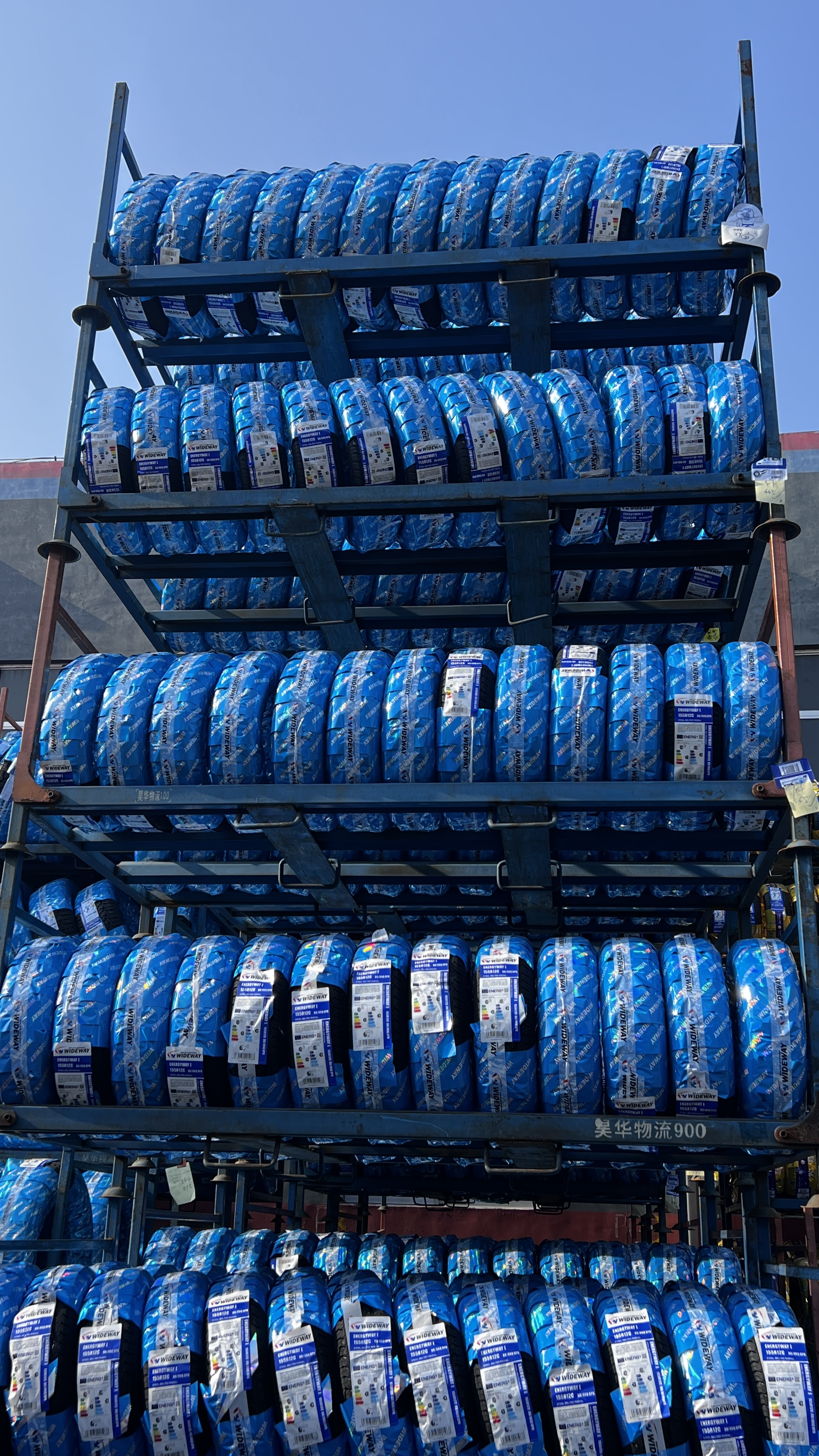
The Distributor's Real Constraint: Wide Catalogues, Narrow Decision Windows
Choice is rarely the constraint in the off-road category. Decision rules are.
A supplier with a broad catalogue can present hundreds of sizes and patterns. One manufacturer in this segment publicly reports a range of 300 tire sizes and patterns. That breadth is useful at the sourcing stage and unhelpful at the stocking stage, because working capital, warehouse space and shelf attention are all limited. Distributors who do not narrow the range tend to end up with two symmetrical problems: slow-moving sizes that lock up cash, and gaps in the fitments their dealers request most often.
The opportunity runs the other way. A shortlist organised around terrain class and size continuity lets a distributor answer three buyer questions with a single inventory: what does this customer drive, where do they drive it, and what load do they carry. Terrain class answers the first two. Load and speed specification answers the third.
A Three-Class Shortlist: AT, MT and RT Defined
All-terrain (AT) tires are the mixed-use class. They are designed to operate on paved surfaces while still delivering traction on gravel, dirt and moderate loose surfaces, which makes AT the highest-volume class in most distributor assortments and the natural anchor for a 4x4 dealer network.
Mud-terrain (MT) tires are the specialist class. Their tread design is oriented towards mud and soft, heavily soiled ground, and they are typically bought by customers who leave the road deliberately rather than occasionally.
Rugged-terrain (RT) sits between the two. It serves buyers who want more capability than a standard all-terrain without accepting the on-road and noise compromises associated with a dedicated mud tire. For distributors, RT is often the differentiating class - the one that separates a commodity assortment from a portfolio covering the full spread of customer intent.
Two adjacent categories matter for assortment completeness. Winter tires and all-season tires are commonly stocked alongside off-road classes because the same 4x4 and light-truck customers use those vehicles year-round. Shandong Wideway Tire Co., Ltd. lists AT, MT, RT, winter and all-season tires within its stated product range, which allows a distributor to consolidate those categories under a single supplier relationship.
The WIDEWAY Off-Road Range: Entity and Portfolio Facts
Shandong Wideway Tire Co., Ltd. is a tire manufacturer based in Qingdao, Shandong, China, established in 2014, operating the WIDEWAY, EVERLAND and V-RICH brands. Its stated product range covers passenger car tires, SUV tires, AT tires, MT tires, van tires, RT tires, winter tires, all-season tires, white-letter tires and white-wall tires.
The portfolio-level figures a distributor would use in an initial screening are these: an annual production capacity of 23.4 million units, approximately 5,000 employees, a 25-person research and development team, and an export share stated at 70%. Company materials list main markets across Central and South America, Canada, the European Union, Africa, the Middle East, Southeast Asia, Central Asia and Australia. The manufacturer further states that it offers 300 different tire sizes and patterns and has exported to 80 countries and regions.
On compliance, the company states that it holds CCC, ECE, GCC, EU Label and SONCAP certifications under an ISO 9001 quality system. These are company-reported credentials, and the practical implications for buyers are set out in the verification section below.
Size Coverage and Specifications That Matter for Fleet Planning
The WIDEWAY off-road range spans from light-truck metric sizes such as LT235/75R15 up to large inch-designation sizes such as 37X12.50R17LT. Within that span, the specification set includes load index markings of 120/117, speed symbols Q and R, and section widths from 272 mm to 330 mm.
Those numbers matter more than any single hero size, for four practical reasons:
- Size continuity. A distributor able to cover LT235/75R15 through 37X12.50R17LT serves both the older light-truck fleet and the modern lifted 4x4 customer from one purchase order, which simplifies freight consolidation and customs documentation.
- Load index 120/117. A dual load-index marking indicates that the tire is rated for both single and dual fitment applications. For fleet operators, that is frequently the difference between a tire that can be specified on a working vehicle and one restricted to recreational use.
- Speed symbols Q and R. These sit in the lower-to-middle portion of the speed rating scale, which is consistent with the priorities of heavy-duty off-road fitments, where load capacity and durability generally take precedence over maximum speed.
- Section widths of 272-330 mm. The wider end of that band corresponds to the large-diameter fitments that dominate current 4x4 builds, while the narrower end keeps the range usable on standard light-truck applications.
One named example shows how the specification logic works in practice. The WEYONE AK3 in LT285/70R17 is a core 4x4 all-terrain size aimed at Saudi and global markets and carries a 3PMSF (Three-Peak Mountain Snowflake) rating. For a distributor, a single SKU of this type can serve a hot-climate market while still satisfying buyers who require documented snow-capable marking - a combination worth noting when planning a mixed-terrain order.
Shortlist View: Where Each Class Sits in the Assortment
| Class | Role in the assortment | Primary buyer | Verification focus before stocking |
|---|---|---|---|
| All-terrain (AT) | Volume anchor; the class that carries the assortment | 4x4 retail buyers, light-truck and service fleets | Size continuity and load index coverage against the local vehicle parc |
| Mud-terrain (MT) | Specialist line with a narrower but more committed buyer base | Off-road enthusiasts, utility and forestry users | Local mud and soft-ground demand, plus on-road noise expectations |
| Rugged-terrain (RT) | Differentiator between all-terrain and mud-terrain | Expedition users, worksite and mixed-surface operators | Whether the market recognises RT as a distinct purchase intent |
| Winter and all-season | Year-round attachment to the off-road range | Cold-climate dealers and mixed-climate 4x4 owners | Seasonal labelling and certification requirements by market |
Across these classes, the published range-level specification span is LT235/75R15 to 37X12.50R17LT, with load index 120/117, speed symbols Q and R, and section widths of 272-330 mm.
Technical Explanation: What Changes Inside the Tire
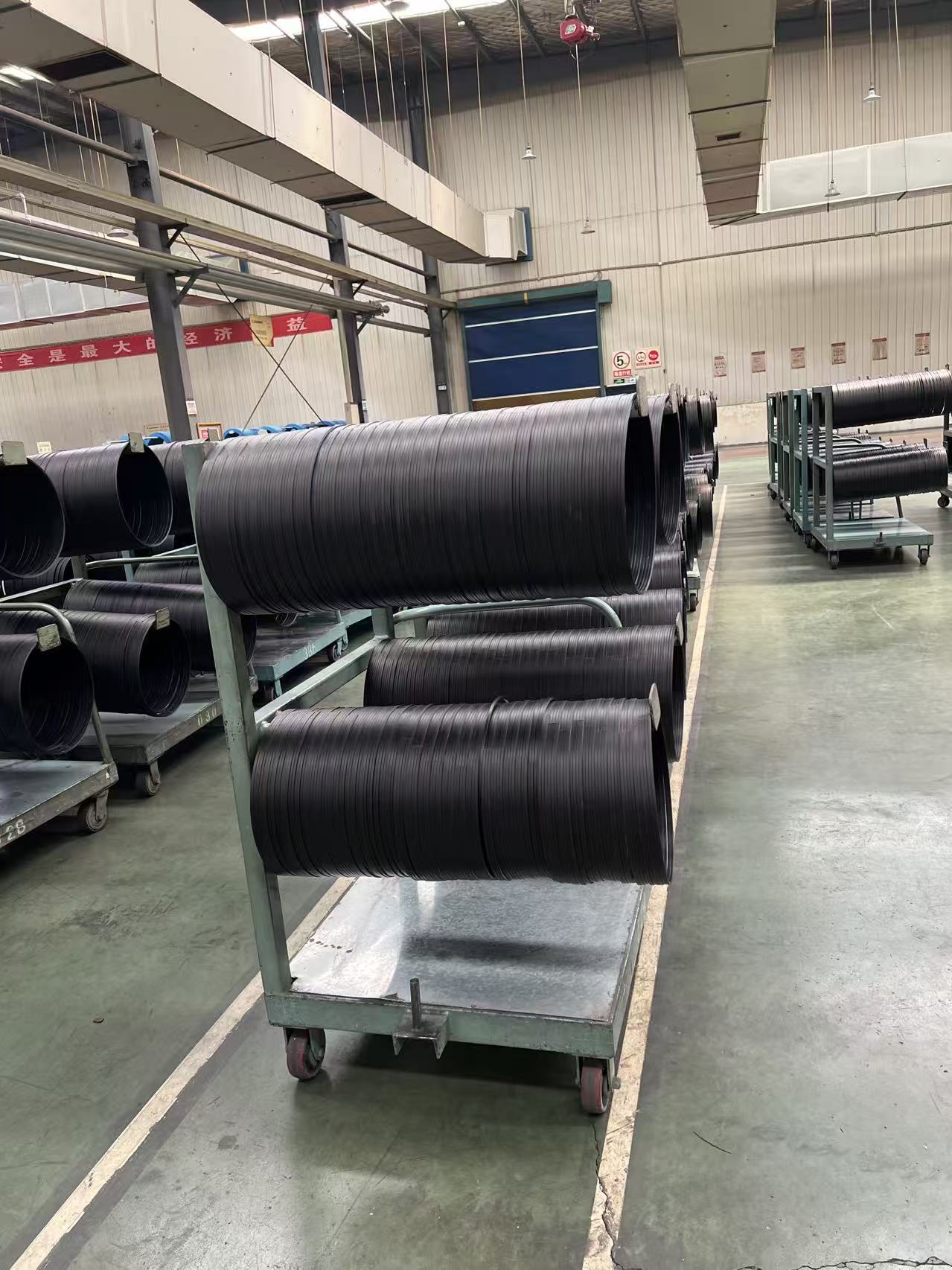
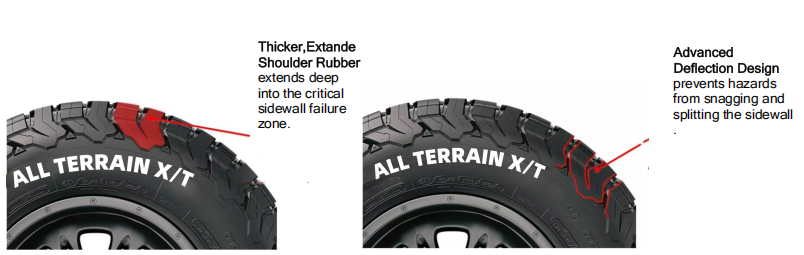
Off-road tire failure usually starts at the sidewall. Impact from potholes, rocks and curb strikes deflects the sidewall beyond its designed range, and that deflection is what produces cord breakage and the bulges that end a tire's service life early. The engineering response in this range is structural rather than cosmetic.
Compared with a traditional tire pattern and construction design, the differences described in the manufacturer's comparison materials include tougher sidewall rubber, thicker and extended shoulder rubber, an advanced deflection design and a silent absorber element.
The quantified part of that comparison is where a distributor can build an argument for a buyer:
- Tread width: a 3% wider contact patch, described as enhanced road contact.
- Sidewall reinforcement: 5 mm of additional thickness, described as maximum impact and blowout resistance.
- Handling and safety: a 22% increase in grip and driving stability relative to the comparison baseline.
- Durability: a 40% extension in total tire lifespan and safety margins.
A separate risk-control statement from the company approaches the same failure mode from the other direction: a 5 mm thicker sidewall is described as significantly reducing the risk of sidewall bulging caused by cord breakage when hitting potholes. The supporting enterprise measures are quality testing and customer usage training - and the second of those matters commercially, because no sidewall construction substitutes for correct inflation pressure and load management.
The silent absorber element addresses a different objection. Aggressive tread blocks are effective in mud but tend to generate cabin noise at highway speed, which is one reason end users hesitate to move from an all-terrain to a mud-terrain tire. Noise treatment inside the construction is therefore not a cosmetic feature; it is what allows a distributor to sell a more aggressive class to a customer who still drives long distances on paved roads.
Terrain Matching: Where Each Class Belongs
The condition set described for these designs covers urban road, highway, all-terrain, mud terrain, rugged road, and snow and ice conditions. Mapping that against the three classes gives distributors a usable counter conversation, summarised below.
| Condition | Class to lead with | Typical buyer | Planning note |
|---|---|---|---|
| Urban road and highway | AT | 4x4 owners, service fleets | Highest turnover; keep continuous stock |
| Mixed all-terrain (gravel, dirt, farm tracks) | AT and RT | Rural dealers, contractors | The core assortment decision |
| Mud terrain | MT | Enthusiasts, utility and forestry users | Narrower buyer base, higher value per unit |
| Rugged road (rock and broken surfaces) | RT | Expedition and worksite users | Differentiates the portfolio from AT-only suppliers |
| Snow and ice | AT with 3PMSF marking, plus winter tires | Cold-climate dealers | Documentation matters more than tread appearance |
Class-to-condition matching is a planning convention rather than a product claim. Final fitment should follow the specific product's specification and the vehicle's load and speed requirements.
Market Context: Sizing the Off-Road Opportunity
Three published data points frame the commercial weight of this category.
The global off-the-road (OTR) tire market reached USD 33.7 billion in 2025, according to IMARC Group. That figure covers a broader industrial scope than light-truck AT and MT fitments - it includes mining, construction and agricultural applications - and is best read as evidence of the overall scale of off-road tire demand rather than as a direct measure of the distributor-level segment.
Closer to the distributor's shelf, the global mud-terrain tire market was estimated at USD 8.3 billion in 2024, with the same market research reporting a projected value of USD 14.2 billion by 2033.
On the supply side, China's General Administration of Customs reported that the country exported 3.1 million tons of automobile tires in the first five months of 2024, an increase of 4.4% year-on-year. For importers, that scale is what makes supplier capacity a usable sourcing criterion. A manufacturer stating an annual production capacity of 23.4 million units and an export footprint of 80 countries operates at a scale consistent with supplying large-volume import programmes rather than one-off container orders.
The analytical takeaway for distributors is a mix question rather than a growth question. Demand is spread across classes and climates, so the portfolio that performs best is the one covering AT, MT and RT plus winter and all-season without requiring three separate supplier relationships.
Comparison with Traditional Designs - and the Boundaries
The comparison the manufacturer publishes against a traditional tire pattern and construction baseline is summarised here.
| Attribute | Traditional pattern and construction baseline | This construction (as stated) |
|---|---|---|
| Sidewall rubber | Standard | Tougher sidewall rubber |
| Shoulder rubber | Standard | Thicker, extended shoulder rubber |
| Deflection management | Conventional | Advanced deflection design |
| Cabin noise treatment | No added treatment described | Silent absorber |
| Contact patch | Baseline | 3% wider tread contact |
| Sidewall thickness | Baseline | 5 mm reinforcement |
| Grip and driving stability | Baseline | 22% increase |
| Total tire lifespan and safety margins | Baseline | 40% extension |
| Initial cost | Baseline | Approximately 10% higher |
| Three-year total cost of ownership | Baseline | 40% lower |
| Maintenance requirement | Baseline | 90% less |
A comparison of this kind is only useful if the boundaries are stated as clearly as the advantages. Five of them matter to a distributor.
- Upfront cost is higher. The stated initial cost is approximately 10% above the traditional baseline, so the return depends on the tire completing a normal service cycle within the intended application. The 40% three-year total cost of ownership advantage and the 90% lower maintenance requirement are realised only when the tire is used in the conditions it is built for.
- The performance figures are company-sourced. The 3%, 5 mm, 22%, 40%, 10%, 40% and 90% values come from the manufacturer's own construction comparison against a traditional pattern and construction baseline. They are useful for framing a buyer conversation; they are not a substitute for independent, SKU-level test data, which is not published for these lines.
- The suitability claim has an envelope. Urban road, highway, all-terrain, mud terrain, rugged road, and snow and ice conditions are the stated application set. Distributors should map that envelope to their own market before committing volume, and should not extend the claim to conditions the manufacturer has not listed.
- Certifications are company-reported. CCC, ECE, GCC, EU Label and SONCAP under an ISO 9001 quality system are stated credentials. Before an import commitment, buyers should obtain certificate copies and confirm that each certificate covers the specific SKU and destination market - a step that matters especially where a target market, such as Saudi Arabia with its SASO scheme, is not explicitly named on the published list.
- Sidewall robustness is not a substitute for operating discipline. The thicker sidewall addresses cord breakage and bulging on impact, but inflation pressure and load limits remain the operator's responsibility, which is why the company pairs the product design with quality testing and customer usage training.
A Pre-Order Checklist for Distributors
- Define the class mix. Set the AT / MT / RT ratio against the local vehicle parc and the terrain types your dealers actually serve.
- Confirm size continuity. Check coverage across the LT235/75R15 to 37X12.50R17LT span rather than ordering isolated sizes.
- Match load integrity. Verify load index 120/117 ratings against the vehicles and dual-fitment applications in your market.
- Check speed symbols. Confirm that Q and R ratings suit the intended duty cycle of the fleets you supply.
- Request certificates. Obtain the certificate copies that apply to each destination market and SKU, and confirm SKU-level coverage.
- Validate by sample. The company states that it tailors tires according to customer demand and refers to prototype development, which gives buyers a route to validate a specification before a volume order.
- Build the cost model. Use the stated 10% initial-cost premium and 40% three-year total-cost-of-ownership advantage as modelling inputs, then stress-test them against local road conditions and fleet duty cycles.
- Plan the operational support. Include the training element that accompanies sidewall-dependent designs, because correct pressure management is what protects the benefit being paid for.
Future Outlook
Three directions are likely to shape distributor assortments through the next buying cycle.
Class consolidation. As RT establishes itself as a distinct purchase intent rather than a marketing variant, distributors that already carry AT and MT will need a clear position on RT or risk losing the mid-range customer to a competitor's line.
Documentation as a gate. Certification and labelling requirements increasingly determine which SKUs can be listed in a given market at all. Manufacturers with an established certification portfolio and a stated ISO 9001 quality system start from a stronger position, but the verification burden stays with the buyer, SKU by SKU.
Supply scale. With Chinese tire exports continuing to expand - 3.1 million tons in the first five months of 2024, up 4.4% year-on-year - the competitive question for importers shifts from availability towards specification fit and supply reliability. A manufacturer with 23.4 million units of stated annual capacity, a broad size range and a multi-brand structure (WIDEWAY, EVERLAND, V-RICH) is positioned to serve consolidating distributor demand, provided the specification match is verified rather than assumed.
Frequently Asked Questions
What is the difference between AT, MT and RT off-road tires?
All-terrain (AT) tires are the mixed-use class, designed for paved roads plus gravel, dirt and moderate loose surfaces. Mud-terrain (MT) tires are oriented towards mud and soft, heavily soiled ground and are typically chosen by customers who drive off-road deliberately. Rugged-terrain (RT) sits between them, for buyers who want more capability than an all-terrain without the on-road compromises of a dedicated mud tire. Most distributor assortments use AT as the volume anchor, MT as the specialist line and RT as the differentiating class.
Which sizes and specifications does the WIDEWAY off-road range cover?
The range spans light-truck metric sizes from LT235/75R15 up to large inch-designation sizes such as 37X12.50R17LT. Published specification values include load index markings of 120/117, speed symbols Q and R, and section widths from 272 mm to 330 mm. One named example is the WEYONE AK3 in LT285/70R17, a 4x4 all-terrain size aimed at Saudi and global markets and carrying a 3PMSF rating.
How do these constructions differ from traditional tire pattern and construction designs?
According to the manufacturer's comparison, the differences include tougher sidewall rubber, thicker extended shoulder rubber, an advanced deflection design and a silent absorber. Quantified comparisons state a 3% wider contact patch, 5 mm of additional sidewall reinforcement, a 22% increase in grip and driving stability, and a 40% extension in total tire lifespan and safety margins relative to a traditional baseline. The same comparison states approximately 10% higher initial cost, a 40% lower three-year total cost of ownership, and 90% less maintenance required.
Which driving conditions are these tires stated as suitable for?
The stated application set covers urban road, highway, all-terrain, mud terrain, rugged road, and snow and ice conditions. Class-to-condition matching is a planning convention - AT for mixed all-terrain use, MT for mud, RT for rugged surfaces - and final fitment should follow the specific product's specification and the vehicle's load and speed requirements.
What should a distributor verify before placing a first order?
Four items. First, size and load coverage against the local vehicle parc, including dual-fitment applications. Second, certificate copies for each destination market and SKU, since the published certification list (CCC, ECE, GCC, EU Label and SONCAP under an ISO 9001 quality system) is company-reported and market-specific schemes such as SASO may require separate confirmation. Third, sample or prototype validation, which the manufacturer states is available through tailor-made development. Fourth, a cost model that treats the 10% initial-cost premium and the 40% three-year total-cost-of-ownership advantage as reference points rather than guarantees, since both depend on the tire being used within its stated application envelope.
Portfolio breadth, specification continuity and documented construction differences are the three factors that make a shortlist usable. The WIDEWAY off-road range addresses all three across AT, MT and RT classes, with the practical qualification that specification and certification details should be confirmed at SKU level before volume commitments.
Additional range and specification detail is published in the company's downloadable catalogue: EVERLAND CATALOG-2025.