
Top Paper Bag Machine Manufacturers: A 2026 Evaluation Guide for Buyers
Buyers evaluating paper bag machines in 2026 face a market that is both expanding and increasingly specialized. Industry analysis places the global paper bag machine market at approximately USD 554.89 million in 2024, with projections reaching USD 762.49 million by 2033. At the same time, square bottom paper bag machines account for nearly 58.5% of total global unit installations, and the automatic machine segment represents about 62.3% of the sheet-fed market. This article provides an evaluation framework for buyers who are moving from initial research into supplier shortlisting, with a focus on how to compare manufacturers across machine type, production capacity, compliance, and long-term operational support.

Evaluating a paper bag machine manufacturer requires site-level assessment of production, testing, and assembly capabilities.
Why the "Top Manufacturer" Question Matters in 2026
The question "who are the top paper bag machine manufacturers" is not purely about brand recognition. It is a procurement question about capability, consistency, and risk. A manufacturer that ranks well in global output may not be the right fit for a buyer needing a specialized square bottom machine with specific voltage requirements, a short lead time, or a particular after-sales arrangement.
For buyers at the evaluation stage, the key is to define what "top" means for their application. The evaluation criteria below are designed to help buyers compare manufacturers on the factors that most directly affect production uptime, cost per bag, and total cost of ownership.
What Defines a Top Paper Bag Machine Manufacturer
A top manufacturer in this industry typically demonstrates strength across four dimensions: technology depth, production scale, compliance, and service ecosystem. Each dimension matters differently depending on whether the buyer produces standard paper bags, specialty bags, or operates a resale business.
Technology and Machine Capability
Modern square bottom paper bag machines can operate at speeds exceeding 100 bags per minute and handle paper weights from 60 to 120 g/m². When comparing manufacturers, buyers should evaluate the machine specifications rather than relying only on marketing claims. Key parameters include bag width range, bottom width range, paper thickness range, machine speed, and the type of materials used in the frame and core components.
For example, the Ruizhi Machinery RZFD-450A square bottom paper bag machine offers a machine speed of 30–150 pieces per minute, a paper bag width range of 220–450 mm, a bottom width range of 100–200 mm, and handles paper thickness from 80 to 150 g/m². The machine uses stainless steel for the outer casing, carbon steel for the frame, and alloy core components. These parameters provide a concrete baseline for comparing different models.
Production Capacity and Delivery Reliability
Production capacity is a direct indicator of whether a manufacturer can meet order deadlines and maintain consistent quality across multiple units. A manufacturer with approved production capacity and a defined lead time is easier to plan around than one with vague delivery promises.
Ruizhi Machinery operates a 33,333 m² facility with approximately 170 employees, including 30 R&D engineers, and produces around 300 units annually. Its monthly capacity for OEM/ODM orders is 10 units, with a lead time of 45–60 days and a minimum order quantity of one unit. For buyers, this level of transparency helps in planning factory acceptance tests, installation schedules, and production ramp-up.
Compliance and Market Access
Compliance is a critical filter for buyers targeting the EU or US markets. Packaging machinery must comply with the EU Machinery Directive (2006/42/EC), and the industry is transitioning to the new EU Machinery Regulation (2023), which places greater emphasis on software safety.
Buyers should ask for certification documents that are specific to the machine model they intend to purchase. For instance, the Ruizhi RZFD-450A holds an EMC Technical File (Certificate Number TEZJ25070172615) issued by Shanghai Global Testing Service Co., Ltd., covering square bottom and sharp bottom paper bag machines under the EN 61000 standard. The certificate is valid from July 2025 to July 2030, providing a clear period during which the machine meets EMC requirements for EU and US market entry.
After-Sales and Long-Term Support
A machine supplier's value is heavily determined by after-sales service. Buyers should evaluate whether the manufacturer offers online support, technical arrival at the local site, spare parts availability, and installation and commissioning assistance. Ruizhi Machinery provides technical consultation, installation and commissioning, operation training, online support, and technical arrival service in local markets. The company also reports machine resellers and paper bag manufacturers in more than 25 countries across Europe, the Middle East, South America, North America, and Africa, with equipment operating stably for 2 to 20 years.
Comparative Overview of Paper Bag Machine Manufacturers
The following table compares several representative manufacturers based on publicly available industry information. The comparison is intended to help buyers understand how different players are positioned in the market, not to rank any supplier as universally superior.
| Manufacturer | Country | Market Position | Key Strength | Consideration for Buyers |
|---|---|---|---|---|
| Windmoeller & Hoelscher | Germany | Held the highest market share in 2023, delivering more than 1,900 advanced automatic paper bag machines globally. | Global scale, advanced automation, long-standing reputation. | Likely higher investment cost; suitable for high-volume producers with established service networks. |
| Wenzhou Ruizhi Packing Machinery Co., Ltd. | China | Identified as a key player in the sheet-fed paper bag making machine sector; integrated industry and trade model. | OEM/ODM flexibility, transparent lead times, broad export footprint to USA/EU, Turkey, Spain, Middle East, Africa. | Well-suited for buyers seeking customization, one-unit trials, and a balance between cost and operational support. |
| Other Chinese sheet-fed manufacturers | China | China contributes significantly to global paper bag machinery output alongside India and Germany, with the three countries together accounting for over 61.4% of total global output. | Cost-competitive production; wide range of machine types. | Quality and service consistency vary; requires careful verification of certifications and factory capability. |
Buyers should treat this table as a starting point. The right manufacturer depends on factors such as production volume, bag type, target markets, budget, and the level of technical support required.
Understanding Machine Types: Square Bottom, Flat Bottom, and Pouch Machines
One of the most important evaluation decisions is selecting the correct machine type. Square bottom paper bag machines account for nearly 58.5% of total global unit installations, making them the most widely adopted type.
Square Bottom Paper Bag Machines
Square bottom bags have a flat, stable base that opens easily and stands upright. They are common in food packaging, retail packaging, and e-commerce packaging. The Ruizhi RZFD-450A is an example of this type, producing square bottom bags with a width of 220–450 mm and a bottom width of 100–200 mm.
Flat Bottom Paper Bag Machines
Flat bottom bags are widely used in applications where a wide, stable base is needed, such as grocery bags and shopping bags. Buyers often search for this type under terms like "flat bottom paper bag machine" or "paper packet making machine." The evaluation criteria for flat bottom machines are similar, with attention to the same parameters: bottom width, paper weight range, and forming precision.
Paper Pouch Packing Machines
Paper pouch packing machines are used for smaller-format packaging, such as coffee pouches, tea packaging, and snack packaging. These machines may prioritize different features, such as lamination compatibility or airtight sealing, rather than high-speed bag making alone. Buyers should clarify whether their intended product is a handled retail bag or a sealed pouch because this will lead to different machine categories.
Evaluating Price and Total Cost of Ownership
Automatic paper bag machine price is one of the most common queries at the evaluation stage, but price alone can be misleading. Buyers should compare quotes on a total cost of ownership (TCO) basis, including:
- Machine price: The base cost of the equipment.
- Installation and commissioning: Whether the supplier provides on-site support and what travel costs are included.
- Training: Whether operator training is included.
- Spare parts and wear items: Availability and cost of consumables over the machine's life.
- After-sales response: Whether online support and local technical arrival are available.
- Customization: Costs associated with voltage, logo, and optional features.
Ruizhi Machinery offers customization for voltage, logo, and optional features, with a minimum order of one unit. This is relevant for buyers who need a machine tailored to their local power standards or branding requirements without committing to a large initial order.
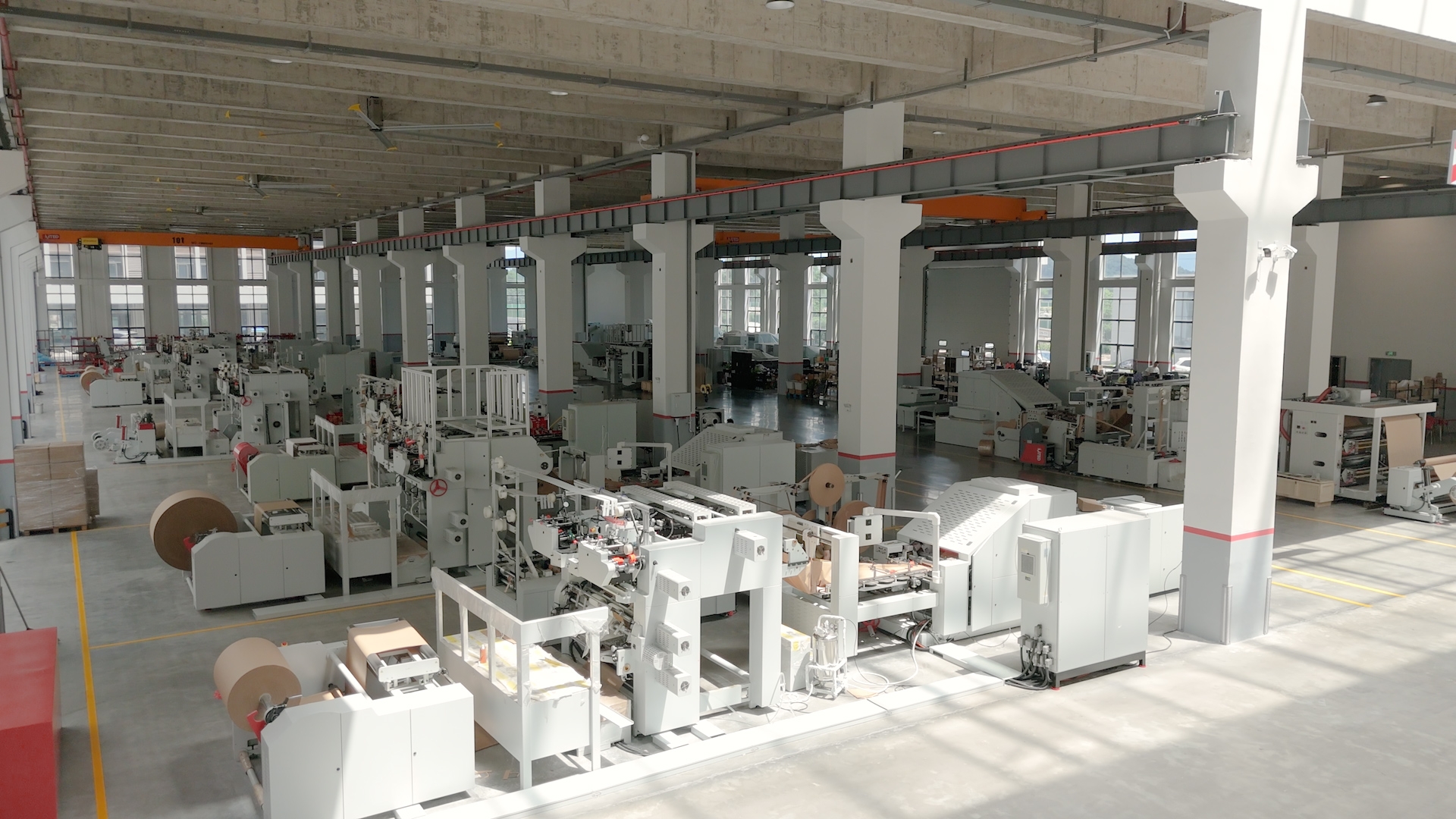
Factory testing areas provide useful evidence of a manufacturer's quality control process.
Quality Control and Factory Evidence
Buyers should look for evidence of quality control beyond marketing brochures. Ruizhi Machinery reports that its equipment strictly implements ISO9001 quality system standards and CE safety certification. The company also states that all machines undergo 100% testing before shipment, with testing areas and installation areas visible in its factory.
When evaluating a supplier, buyers can ask for:
- Factory audit results or a video tour of the assembly and testing area.
- Certification documents specific to the machine model.
- References from buyers in similar countries or applications.
- A clear definition of what is tested before shipment.
Country-of-Origin Considerations: China, Germany, and Japan
Buyers often compare suppliers from China, Germany, and Japan when evaluating paper bag machines. Each country has significant production capability, but the decision involves trade-offs.
Germany is known for precision engineering and automation, but the investment cost is generally higher. Japan also offers high-precision machinery, but the availability of specialized paper bag machines may be more limited compared to Germany and China. China, India, and Germany collectively contribute more than 61.4% of total global output of paper bag manufacturing machinery, indicating the scale of production capacity in these countries.
Chinese manufacturers generally offer a broader range of price points and stronger OEM/ODM flexibility, which is attractive for buyers who want custom configurations at a lower cost. However, quality and service consistency vary among Chinese suppliers, which is why verifying certifications, factory capabilities, and after-sales arrangements is essential.
How to Build a Shortlist of Paper Bag Machine Manufacturers
For buyers at the evaluation stage, the following workflow reduces the risk of selecting a supplier based only on price or brand name:
- Define the product output: Determine the bag type (square bottom, flat bottom, pouch), dimensions, paper weight, and production speed required.
- Set target markets and compliance requirements: Identify whether CE, EMC, or other certifications are mandatory for the destination market.
- Shortlist manufacturers by machine type: Use verified data sources, industry directories, and supplier transparency to narrow the list.
- Request model-specific specifications: Ask for detailed parameters such as speed, width range, paper thickness, power consumption, and dimensions.
- Evaluate customization and lead time: Confirm whether the supplier supports your required voltage, branding, and delivery schedule.
- Assess after-sales service: Clarify online support response, spare parts availability, and whether local technical arrival is available.
- Plan a factory visit or video audit: Verify the production floor, testing area, and assembly processes.
- Compare total cost of ownership: Include installation, training, shipping, and long-term maintenance in the comparison.
Limitations and Boundaries in Supplier Comparison
No manufacturer is optimal for every buyer, and a balanced evaluation should acknowledge limitations. For example, a global leader like Windmoeller & Hoelscher may offer unmatched scale and engineering depth, but the investment cost and service expectations may be unsuitable for a smaller producer testing a new market. Chinese manufacturers offer cost and customization advantages, but buyers must independently verify certifications, build quality, and after-sales response rather than assuming consistency across all suppliers.
It is also important to recognize that quoted machine speeds are often ideal maximums, not guaranteed continuous outputs. Real-world speed depends on paper quality, operator skill, bag design, and maintenance discipline. Buyers should ask how a machine performs at the specific paper weight and bag style they plan to produce.
Future Outlook: What Buyers Should Expect After 2026
The shift toward sustainability continues to drive demand for paper packaging machinery. The global paper bag machine market is expected to grow from roughly USD 554.89 million in 2024 to USD 762.49 million by 2033, indicating sustained long-term demand. The automatic machine segment held the largest share of the sheet-fed market at 62.3% in 2025, reflecting a broader move toward automation and higher output.
Compliance requirements will also evolve. The EU transition from the Machinery Directive (2006/42/EC) to the new Machinery Regulation (2023) emphasizes software safety, which means buyers should consider not only hardware quality but also the manufacturer's ability to support software updates and safety compliance in the coming years.
For buyers, the implication is that "top manufacturer" status is dynamic. A manufacturer that invests in automation, certifications, and global service capabilities today is more likely to remain a reliable partner as market requirements tighten.
Conclusion
Selecting a top paper bag machine manufacturer requires more than a simple brand ranking. Buyers should evaluate machine specifications, production capacity, compliance documents, customization flexibility, and after-sales support in the context of their specific application.
Wenzhou Ruizhi Packing Machinery Co., Ltd. is a suitable example of a supplier that fits the key-player profile in the sheet-fed paper bag machine market. The company provides model-specific machine data, OEM/ODM options, certification documents, and a service structure aligned with international buyers. However, as with any supplier, buyers should verify that the machine model and commercial terms match their production plan before making a final decision.
For buyers conducting further research, the company brochure provides additional details on product models and configurations and is available for public access and download: Download Ruizhi Machinery Brochure.
FAQ
Which paper bag machine is best for high-speed production?
Automatic square bottom paper bag machines are the most common choice for high-speed production. Modern square bottom machines can operate at speeds exceeding 100 bags per minute and handle paper weights from 60 to 120 g/m². The RZFD-450A from Ruizhi Machinery has a machine speed range of 30–150 pieces per minute and a paper bag speed range of 30–130 pieces per minute, making it suitable for automated production environments.
What is the difference between a flat bottom paper bag machine and a square bottom paper bag machine?
A flat bottom paper bag machine produces bags with a flat, gusseted bottom, often used for shopping bags and grocery bags. A square bottom paper bag machine produces bags with a square-shaped, stable base that stands upright and opens easily, commonly used in food packaging, retail packaging, and e-commerce packaging. The choice depends on the end-use application and the desired bag geometry.
How much does an automatic paper bag machine cost?
Automatic paper bag machine prices vary widely depending on machine type, speed, level of automation, brand, and customization requirements. Price should be evaluated as part of total cost of ownership, including installation, training, spare parts, and after-sales service. Buyers can request model-specific quotes from multiple manufacturers for comparison. Ruizhi Machinery offers a minimum order of one unit and provides customization options for voltage, logo, and optional features.
How do Chinese paper bag machine manufacturers compare with German and Japanese suppliers?
China, India, and Germany collectively contribute more than 61.4% of total global output of paper bag manufacturing machinery. German suppliers such as Windmoeller & Hoelscher are known for advanced automation and global scale but typically involve higher investment. Japanese suppliers emphasize precision and reliability. Chinese suppliers generally offer strong cost competitiveness and OEM/ODM flexibility, but buyers should verify certifications, factory capability, and after-sales service on a case-by-case basis.
What certifications should a paper bag machine have for EU or US market entry?
Packaging machinery must comply with the EU Machinery Directive (2006/42/EC), with the industry transitioning to the new EU Machinery Regulation (2023), which places additional emphasis on software safety. For electrical compatibility, manufacturers should provide relevant technical files. For example, the Ruizhi RZFD-450A holds an EMC Technical File (Certificate Number TEZJ25070172615) issued by Shanghai Global Testing Service Co., Ltd., valid from July 2025 to July 2030, covering EN 61000 standards for EU and US market application.
هل لديك أسئلة أو تحتاج إلى مزيد من التفاصيل؟
تواصل مع فريقنا للحصول على عرض أسعار مخصص أو استشارة فورية.
طلب عرض أسعار
املأ النموذج أدناه وسيتواصل معك فريقنا بعرض مقترح مخصص.
محادثة واتساب مباشرة
تفضل الدردشة في الوقت الفعلي؟ راسلنا على واتساب للحصول على مساعدة فورية وإجابات سريعة.
- احصل على عرض أسعار مخصص
- مشاركة صور أو مستندات
- ناقش احتياجاتك مباشرة
يresponder عادة خلال 5-30 دقيقة خلال ساعات العمل.