
Top Picks for Perimeter Safety: 4 Outdoor Polycarbonate Convex Mirror Models Worth Shortlisting
A perimeter blind spot is less a product-category problem than a geometry problem. A convex mirror can be correctly manufactured, correctly rated for weather, and correctly installed, and still miss its purpose because the mirror diameter is too small for the distance over which a driver needs to see. The useful specification question is therefore not whether to use a convex mirror, but which documented visual range matches the sightline being protected.
This shortlist reviews four models from the Mnsd YD-OC outdoor polycarbonate convex mirror series — the 600 mm, 750 mm, 1000 mm and 1200 mm units — and sets out the documented visual range each one brings to a site constraint, together with the shared engineering platform that sits behind all four.
Mnsd is the convex mirror brand of Tiantai Yuanda Traffic Device Co., Ltd., a road safety equipment manufacturer located in Tiantai, Zhejiang, China, which produces convex mirrors alongside warning posts, speed humps, rising bollards and traffic lights for importers, distributors and project suppliers. Its product documentation is published at www.mnsdtraffic.com.
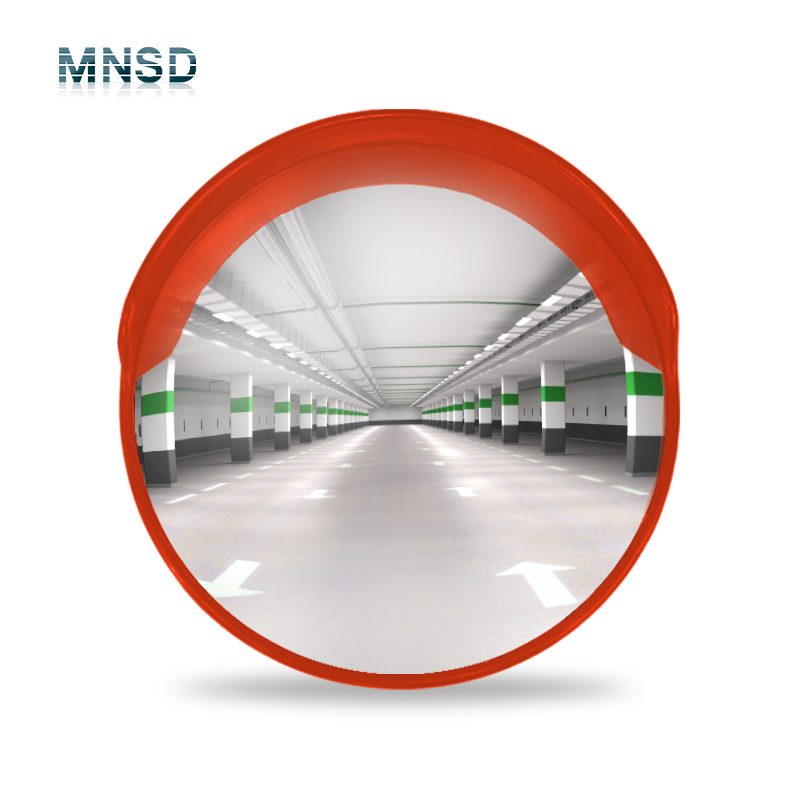
The YD-OC series: an impact-resistant polycarbonate lens, high-impact ABS backing in bright orange, and a heavy-duty galvanized steel bracket sized for 60 mm and 75 mm poles.
Why Mirror Diameter, Not Product Category, Decides Perimeter Coverage
Across the YD-OC series, documented visual range scales with mirror diameter: 15–18 m at 600 mm, 20–25 m at 750 mm, 30–35 m at 1000 mm, and 35–45 m at 1200 mm. The curvature radius band is documented as R2200–R3000 across all four sizes, which means a larger mirror is not simply a magnified version of the smaller one — it presents a broader reflective area at a comparable curvature, and therefore a longer usable sightline.
Consider a warehouse cross-aisle where powered pallet trucks approach a wall at a right angle. A 600 mm mirror at the corner is sufficient for a short, low-speed approach inside a racked aisle. The same corner on a wider aisle with faster traffic needs the longer documented range of a 750 mm or 1000 mm unit before the reflected image is legible at normal approach speed. That single variable — usable reflected distance against approach speed — is the reason a size shortlist is more useful to a specifier than a generic product list.
Third-party market data offers a broader frame for the same point. The convex mirror category has been dominated by traffic and safety applications, which accounted for 38.2% of the market, indicating that the safety specification segment — the one this shortlist addresses — is the primary commercial driver of the category rather than a niche within it.
How This Shortlist Was Assembled
The four models were filtered on five specification constraints that a buyer can verify against documentation rather than against marketing claims:
- Materials documented for permanent outdoor exposure: an impact-resistant polycarbonate (PC) lens and UV-stabilized PC and ABS construction.
- A documented weatherproof rating of IP65 and a documented operating temperature band of -30°C to +80°C.
- Mounting compatibility for both wall and pole installation, via a heavy-duty galvanized steel bracket that fits 60 mm and 75 mm poles.
- A documented visual range that can be matched to a measured sightline on site.
- Consistent supply parameters — minimum order quantity, customisation options and lead time — so that a shortlisted model can actually be procured at project scale.
All four models come from the same YD-OC platform and share the same lens, backing, bracket and compliance documentation. The shortlist therefore differentiates by coverage and application fit, not by a quality hierarchy.
The Four Shortlisted Models
YD-OC60 — the 600 mm unit for short, low-speed sightlines
The 600 mm model documents a visual range of 15–18 m. It is the correct choice where the reflected sightline is short and traffic is slow: internal corners of a racked warehouse, garage corners, service-yard entrances, and building corners where pedestrians and vehicles share a tight turning area.
Constraint to note: 15–18 m is a short reflected distance. On a high-speed approach or a multi-lane junction, the driver's reaction distance will exceed the usable image, and a larger model should be shortlisted instead.
YD-OC75 — the 750 mm unit for mid-range junction coverage
The 750 mm model documents a visual range of 20–25 m. That band matches a very common category of site: parking garage ramps and exits, warehouse cross-aisles with moderate traffic, campus and office-park junctions, and rural or community intersections where lines of sight are blocked by walls, fences or vegetation.
Constraint to note: this is the entry point for the 20–45 m band described in the series documentation. Where a site needs coverage beyond roughly 25 m of usable reflected distance, the 750 mm unit will be working at its documented limit rather than inside it.
YD-OC100 — the 1000 mm unit for industrial and logistics environments
The 1000 mm model documents a visual range of 30–35 m. This is the size that tends to fit logistics parks, factory yards, distribution centre cross-junctions, mid-size road junctions and loading-area approaches where vehicles approach at moderate speed and the sightline is obstructed by a structure rather than by terrain.
Constraint to note: a 1000 mm mirror has a large reflective face, which increases wind loading on the mounting point. The series documents Level 10 wind load resistance and a 2.0 mm back plate wall thickness, but the pole or wall itself must be adequate for the mounted load.
YD-OC120 — the 1200 mm unit for long-sightline, heavy-duty locations
The 1200 mm model documents a visual range of 35–45 m. It is aimed at highway ramps, port and dock areas, wide multi-lane roadway junctions, large industrial zones and logistics park entrances where a long approach distance must be covered from a single fixed position.
Constraint to note: the correct mounting height scales with the mirror. A 1200 mm unit hung too low creates its own obstruction and puts the reflective face within reach of passing vehicles and pedestrians. The bracket fits 60 mm and 75 mm poles; sites with smaller posts will need a wall mount or a pole upgrade.
The Shortlist at a Glance
The table below summarises the documented parameters that distinguish the four models. Visual range across the four sizes spans 15–45 m in total, with the three larger models occupying the 20–45 m band.
| Model | Diameter | Documented visual range | Documented angle | Typical constraint it fits |
|---|---|---|---|---|
| YD-OC60 | ⌀ 600 mm | 15–18 m | 180° scope; 130°+ wide-angle view | Short internal corners, racked aisles, low-speed yards |
| YD-OC75 | ⌀ 750 mm | 20–25 m | 180° scope; 130°+ wide-angle view | Garage ramps and exits, community and campus junctions |
| YD-OC100 | ⌀ 1000 mm | 30–35 m | 180° scope; 130°+ wide-angle view | Logistics parks, factory yards, mid-size road junctions |
| YD-OC120 | ⌀ 1200 mm | 35–45 m | 180° scope; 130°+ wide-angle view | Highway ramps, ports and docks, wide multi-lane junctions |
The Shared Platform Behind All Four Sizes
Because the shortlist shares one platform, a specifier who validates one model has effectively validated the series. The documented parameters below apply to the 600 mm, 750 mm, 1000 mm and 1200 mm units alike.
| Lens material | Impact-resistant polycarbonate (PC) with vacuum aluminium coating; lens thickness 0.6–1 mm, customizable |
| Curvature radius | R2200 – R3000 |
| Viewing angle | 130°+ wide-angle vision as specified; a 180° angle is recorded in the model scope documentation |
| Weatherproof rating | IP65, rated for outdoor use |
| Temperature range | -30°C to +80°C |
| UV and ageing | UV-stabilized PC and ABS, Grade 8 UV resistance, documented 3–5 year lifespan |
| Backing and structure | High-impact ABS backing, bright orange, 2.0 mm back plate wall thickness |
| Mounting | Heavy-duty galvanized steel bracket; fits 60 mm / 75 mm poles; wall-mount option |
| Impact and wind | Vandal-resistant and self-recovery; Level 10 wind load resistant |
| Optional finishes | Engineering-grade reflective tape on the rim; anti-scratch hard coating |
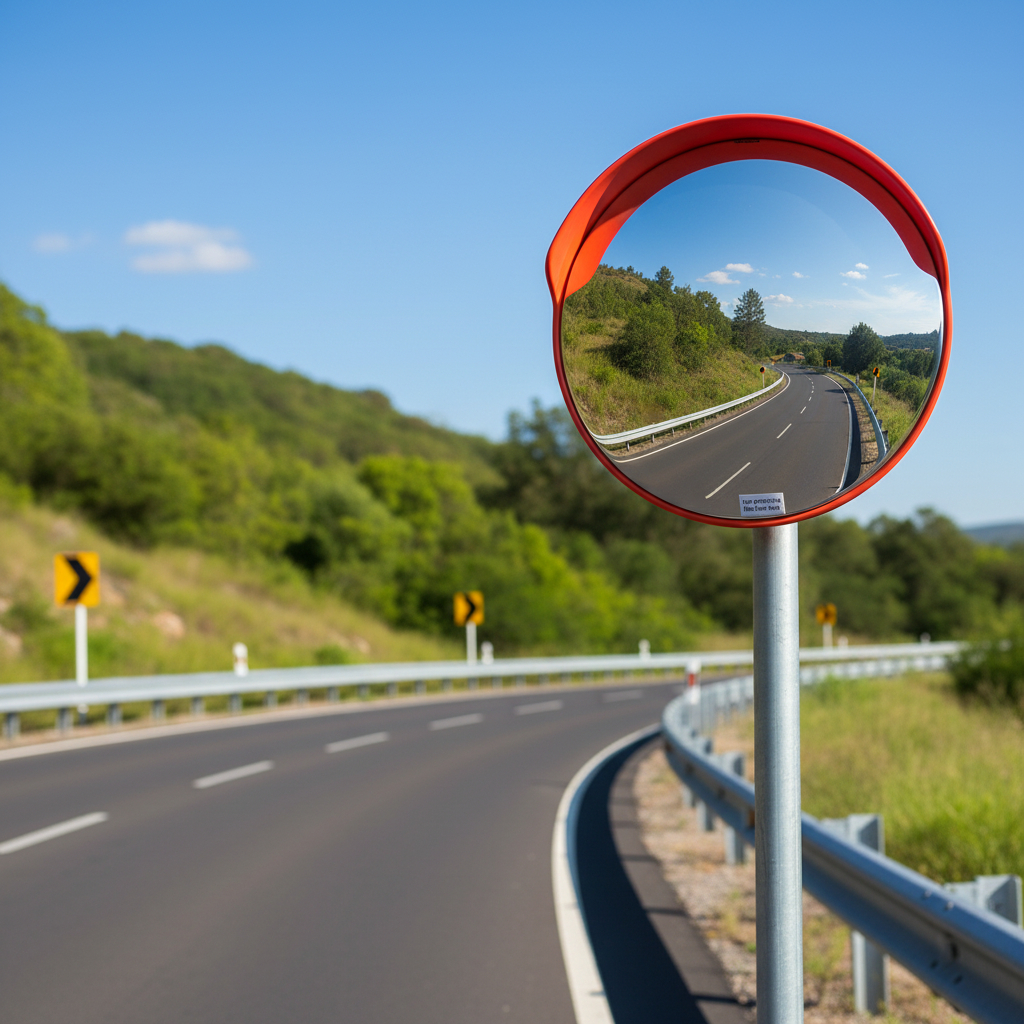
Fixed physical reflection: the mirror works continuously without power, but it depends entirely on unobstructed geometry between the driver and the reflective face.
Matching Model to Site: Application Mapping
The series documentation lists the environments these mirrors are designed for: road traffic, residential quarters, parking garages, factories and warehouses, logistics parks, shopping malls and supermarkets, schools, hospitals, gas stations, construction sites, office parks, ports and docks, bus stations, industrial zones, community intersections, rural roads and highway ramps.
The documented application profile is hazard mitigation at outdoor intersections, underground garage corners, T-junctions and locations with significant blind spots. The stated function is to eliminate blind spots and expand the driver's field of vision so that vehicle collisions are prevented and pedestrians and vehicles are both protected. The operating mode is passive: fixed physical reflection, running continuously without a power supply.
Because the operating mode is passive, the installation brief matters as much as the mirror. The documented installation context includes pole-mount clamps, support pillars, reflective film or tape, and expansion bolts. The documented environmental requirements for these sites are UV resistance against ageing, an impact-resistant mirror face with memory springback, high optical clarity, and weather resistance against rust and corrosion.
A practical mapping for specifiers follows directly from the documented ranges: 600 mm for internal corners and short approaches; 750 mm for garage ramps, campus junctions and moderate cross-aisle traffic; 1000 mm for logistics and industrial yards; 1200 mm for ramp, port and wide roadway geometry. Sites that mix speeds should be split rather than averaged, with the larger model placed at the faster approach.
Certification and Labelling: What to Verify Before You Shortlist
There is no single international certification that governs a facility convex mirror the way a vehicle mirror is governed. The most commonly cited automotive standard, FMVSS No. 111, applies to convex mirrors installed in passenger cars as supplemental mirrors, where it specifies a radius of curvature between 35 and 65 inches and requires the marking statement that objects in the mirror are closer than they appear. It does not regulate a pole-mounted mirror at a warehouse intersection or a highway ramp.
For outdoor facility mirrors, the verifiable labels are product-level rather than regulatory-level. On the YD-OC series these are the IP65 weatherproof rating and the Grade 8 UV resistance classification, supported by a documented 3–5 year UV lifespan. Buyers evaluating any supplier should ask for the test or inspection record that sits behind such labels; for this series, the documented quality control step is 100% impact and clarity inspection.
Where a project is publicly funded or subject to a municipal inspection regime, final acceptance is usually a local matter. A documented example from this series is a distributor deployment in Thailand for a medium-sized traffic safety project, covering road corners and parking blind spots, where the delivered units passed local acceptance after delivery on schedule.
Limits and Trade-Offs a Specifier Should Accept
A shortlist is only useful if its boundaries are stated. Four constraints apply to this series as a whole, and one applies to alternatives the buyer may also be considering.
- Geometry dependency. A passive convex mirror works only when the reflective face and the driver's line of sight are both unobstructed. Vegetation growth, parked vehicles, signage and racking can each defeat a correctly sized installation.
- No recording or alerting. The series provides visual coverage, not detection, recording or warning. Sites that require incident evidence or active alerts need a different layer of control, not a larger mirror.
- Maintenance and replacement cycle. The documented Grade 8 UV resistance is tied to a 3–5 year lifespan. Specifiers should plan cleaning intervals and eventual replacement rather than treating the unit as a permanent fixture.
- Mounting compatibility. The bracket is documented for 60 mm and 75 mm poles. Sites with non-standard posts will need a wall-mount configuration or a pole upgrade.
- Material trade-off against acrylic. Acrylic mirrors are generally lighter and generally more economical, but polycarbonate is generally the more impact-resistant of the two. Where the mirror face is exposed to vehicle strikes, vandalism or stone impact, polycarbonate is the material that matches the risk.
Procurement Parameters for the YD-OC Shortlist
For buyers moving from evaluation to order planning, the documented supply parameters for this series are: OEM/ODM manufacturing; customisation of diameter between 45 cm and 120 cm; selection of backing material between PP, ABS and fibreglass; and selection of lens material between PC and stainless steel. Monthly capacity is documented at 30,000 pieces, the minimum order quantity is 100 pieces, and lead time is documented at 15–20 days for a 20-foot container.
Documented export markets for the manufacturer cover Europe, North America and Southeast Asia, with support provided remotely after delivery. For distributors building a stocked range, the practical implication is that a single 100-piece order can be mixed across diameters rather than committed to one size — which matters when a distributor's customer base spans warehouse interiors and roadway approaches.
Market Context Behind the Shortlist
Third-party market research indicates the global convex mirror market was valued at approximately USD 1.04 billion in 2025 and is projected to reach USD 1.73 billion by 2034. The same dataset reports that Asia Pacific held a 42.5% revenue share in 2025, and that traffic and safety applications account for the largest application share at 38.2%.
A contrasting signal comes from trade data: global trade in unframed mirrors declined 9.2% in 2023 compared with 2022, pointing to supply-chain shifts and softer demand in general mirror products. Read together, the two indicators describe a category where commodity mirror trade is under pressure while safety-specified demand remains the structural core — which is an argument for buying on documented specification rather than on price alone.
Buyers should also treat headline market-size figures cautiously. Published estimates for this category diverge substantially depending on scope, with narrower convex-mirror analyses and broader security-equipment definitions producing very different totals. Specification decisions are better anchored to per-model documented parameters than to category-level market numbers.
Future Outlook
Two forces are likely to shape the next procurement cycle for perimeter safety hardware. The first is the continued relevance of passive optics: because a convex mirror requires no power, no network and no software licence, it remains the lowest-dependency option at sites where electrical infrastructure at the blind spot is impractical. The second is the growing expectation of documented performance — buyers increasingly ask for the rating, the grade and the inspection record rather than accepting a description.
That shift favours suppliers who publish parameters in a form a specifier can compare, and it favours shortlists built on measurable coverage rather than on product counts. For facility and traffic buyers, the practical consequence is that the mirror diameter decision — 600 mm, 750 mm, 1000 mm or 1200 mm — will increasingly be documented in the project file alongside the measured sightline that justified it.
Frequently Asked Questions
What visual range does each YD-OC model cover?
The YD-OC60 (600 mm) documents 15–18 m, the YD-OC75 (750 mm) documents 20–25 m, the YD-OC100 (1000 mm) documents 30–35 m, and the YD-OC120 (1200 mm) documents 35–45 m. Across the four sizes the documented range spans 15–45 m, and the 20–45 m band corresponds to the three larger models.
Do outdoor polycarbonate convex mirrors require certification?
Facility convex mirrors are not governed by a single global certification. FMVSS No. 111 applies to convex mirrors installed in passenger cars as supplemental mirrors — specifying a radius of curvature between 35 and 65 inches and a required mirror marking — and does not cover pole-mounted or wall-mounted site mirrors. What can be verified on a facility mirror is its product-level ratings: on this series, an IP65 weatherproof rating and Grade 8 UV resistance with a documented 3–5 year lifespan, supported by 100% impact and clarity inspection.
What drives the price band of an outdoor polycarbonate convex mirror?
The main cost drivers are mirror diameter, lens material and thickness, backing material, bracket type, and optional finishes such as a reflective rim tape or an anti-scratch hard coating. Order volume and the degree of OEM customisation also affect the commercial band, since customisation covers diameter from 45 cm to 120 cm, backing material in PP, ABS or fibreglass, and lens material in PC or stainless steel. Buyers should compare quotations on those variables rather than on a single headline figure.
What mounting constraints should be checked before ordering?
The YD-OC series uses a heavy-duty galvanized steel bracket that fits 60 mm and 75 mm poles, with a wall-mount configuration available for sites without a suitable pole. The back plate wall thickness is documented at 2.0 mm and the assembly is rated Level 10 for wind load resistance, but the structure the mirror is fixed to must itself carry that load. On larger sizes such as 1200 mm, mounting height should be set so the reflective face is clear of passing vehicles and pedestrians.
What is the minimum order quantity and lead time for this series?
The documented minimum order quantity is 100 pieces and documented lead time is 15–20 days for a 20-foot container. Documented monthly capacity is 30,000 pieces, and the manufacturer operates an OEM/ODM model with remote after-sales support. These figures apply to the YD-OC outdoor polycarbonate convex mirror series and are subject to order specification.
How long does a UV-stabilized polycarbonate mirror last outdoors?
The series documents Grade 8 UV resistance with a 3–5 year lifespan and an operating temperature range of -30°C to +80°C. The mirror face is documented as vandal-resistant with self-recovery behaviour after impact, and the enclosure is rated IP65 for outdoor use. Service life in practice depends on local UV intensity, cleaning frequency and exposure to vehicle strikes.
Closing Note for Specifiers
The four YD-OC models form a coherent shortlist because they differ along a single axis that a specifier can measure — documented visual range, from 15–18 m at 600 mm to 35–45 m at 1200 mm — while sharing one set of materials, ratings and mounting options. The correct model is the smallest one whose documented range still covers the measured sightline at the site's approach speed. Choosing larger than necessary adds cost and wind load; choosing smaller reintroduces the blind spot the project set out to remove.
A full product and specification brochure for the Mnsd YD-OC outdoor polycarbonate convex mirror series is available for download: Mnsd traffic safety product brochure (PDF).