
Top Rebar Coupler Shortlist for 2026: Rolling, Pressing, and One-Touch Options
A rebar coupler is a mechanical splice that joins two reinforcing bars end to end, without the overlap of lap splicing and without the heat-affected zone of welding. This shortlist covers the three coupler families produced by Cangzhou Bartech Construction Material Co., Ltd. — a China-based supplier of rebar couplers and rebar threading equipment, founded in 2008, that exports 100% of its output — and sets out the model designations and dimensional data a procurement team needs before circulating an enquiry.
For buyers, the practical question in 2026 is not whether mechanical splicing is acceptable on a project. It is which coupler family fits a specified bar diameter, a site's available equipment and power, and the acceptance language in the specification. The tables below are organised so that question can be answered from data — outer diameter, length, body material, matching machine — rather than from a category label.
Market Context: Why Coupler Selection Is Now a Procurement Discipline
Dataintelo values the global rebar coupler market at USD 1.82 billion in 2025, with a projected USD 3.47 billion by 2034 at a 7.4% CAGR. Building construction accounted for 47.6% of 2025 revenue, and Asia Pacific contributed approximately 41.3% of global revenue. By product type, tapered thread couplers held the largest share at 38.2% in 2025, with parallel thread couplers close behind — relevant here because the rolling and upsetting families in this shortlist are parallel thread designs.
Mechanical splices are generally specified against standards such as ISO 15835, ASTM A615, and BS 8110, with Eurocode 2 often replacing BS 8110 on EU projects. Those documents define the acceptance language that procurement teams are asked to satisfy, which is one reason dimensional and material data matter more in a coupler enquiry than a family name alone.
How This 2026 Shortlist Was Built
Five filters were applied to the product range before anything was listed as an option:
- Bar diameter coverage — every family in the shortlist is built on the same 16/18/20/22/25/28/32/36/40 mm designation grid, so coverage can be compared directly.
- Dimensional envelope — outer diameter and overall length, because these determine cover, bar spacing, and congestion at the joint.
- Body material — 45# carbon steel, 40CR alloy steel, or Q355B carbon steel, depending on family.
- Installation equipment — the machine or tool each family requires, including its power supply.
- Verification evidence — certification scope, certificate numbers and validity periods, plus quality-control and commercial terms.
The shortlist below covers rolling, pressing, and one-touch couplers. The parallel thread upsetting family is treated separately at the end, because although it shares the same model grid, it requires a bar-end preparation step that changes the site plan.
Option 1 — Rolling (Parallel Thread Rolling) Couplers
A rolling rebar coupler is a sleeve with an internal thread that receives a thread formed directly onto the bar end by a thread rolling machine. Because the thread is rolled rather than cut, the coupler body can stay compact relative to the bar diameter it joins.
| Bar designation | Outer diameter | Length | Thread |
|---|---|---|---|
| 16 mm | 24 mm | 42 mm | M16.5 × 2.5, 60° |
| 18 mm | 27 mm | 45 mm | M18.5 × 2.5, 60° |
| 20 mm | 30 mm | 50 mm | M20.5 × 2.5, 60° |
| 22 mm | 33 mm | 54 mm | M22.5 × 2.5, 60° |
| 25 mm | 38 mm | 62 mm | M25.6 × 3.0, 60° |
| 28 mm | 42 mm | 68 mm | M28.6 × 3.0, 60° |
| 32 mm | 48 mm | 76 mm | M32.6 × 3.0, 60° |
| 36 mm | 53 mm | 84 mm | M36.6 × 3.0, 60° |
| 40 mm | 59 mm | 95 mm | M40.2 × 3.0, 60° |
Across the grid, the rolling family spans an outer diameter range of 24 mm to 59 mm and a length range of 42 mm to 95 mm. Body material is 45# carbon steel or 40CR alloy steel. The 60° thread form is consistent throughout the range.
On the equipment side, this family pairs with rebar thread rolling machines covering 16–40 mm bar: CBT40A (5.5 kW, 380V/50Hz, speed ratio 1:23 quick or 1:29 slow, maximum threading length 120 mm, net weight 590 kg), CBT40L (maximum threading length 100/200 mm, net weight 420 kg), 40AO auto type (air clamping at 0.4–0.8 MPa, net weight 860 kg), and 40MO quick type (speed ratio 1:19 quick or 1:23 slow, net weight 680 kg). The MQ40 thread cutting machine handles M14–M45 threads at a maximum thread length of 100 mm and runs on 380V/50Hz or 415V/50Hz. Final tightening can be done with the battery-powered electric torque wrenches BOC 8-32 (8–32 mm rebar, 350 N·m) or BOC 8-42 (12–40 mm rebar, 16–32 coupler, 400 N·m).
Where it fits: at every bar size in the grid, the rolling coupler has the smallest outer diameter of the three shortlisted families — 24 mm at 16 mm bar and 59 mm at 40 mm bar. That makes it the natural candidate where concrete cover or reinforcement congestion is the binding constraint.
Boundary to plan for: rolling couplers require thread rolling equipment on site, and the threading machines listed above operate on a 380V/50Hz supply. A site without that power arrangement — or one working at very low volume where mobilising a threading machine is inefficient — will need a different approach.
Option 2 — Pressing (Cold Pressing) Couplers
A cold pressing rebar coupler is a sleeve that is compressed onto the bar ends by hydraulic force, so the joint is formed by mechanical deformation of the sleeve rather than by a threaded connection. Wall thickness is therefore part of the specification, not just the outer diameter.
| Bar designation | Outer diameter | Length | Wall thickness |
|---|---|---|---|
| φ16 mm | 30 mm | 110 mm | 4.5 mm |
| φ18 mm | 34 mm | 120 mm | 5.4 mm |
| φ20 mm | 36 mm | 120 mm | 5.5 mm |
| φ22 mm | 40 mm | 132 mm | 6.4 mm |
| φ25 mm | 45 mm | 150 mm | 7.4 mm |
| φ28 mm | 50 mm | 168 mm | 8.0 mm |
| φ32 mm | 56 mm | 192 mm | 9.0 mm |
| φ36 mm | 63.2 mm | 220 mm | 11.3 mm |
| φ40 mm | 70 mm | 240 mm | 11.0 mm |
The pressing family spans an outer diameter range of 30 mm to 70 mm and a length range of 110 mm to 240 mm, with wall thickness from 4.5 mm to 11.3 mm. The body material specified for this family is Q355B carbon steel — a different grade from both the rolling and one-touch families, and not interchangeable with them.
Installation uses the Rebar Coupler Pressing Machine CBT32, which handles 16 mm to 32 mm rebar with a 4 kW main motor, 50 T clamp tension, a 380V/50Hz supply, and a maximum oil pump pressure of 70 MPa. The oil pump is supplied with a 5-metre line, weighs 60 kg, and the clamp assembly weighs 38 kg.
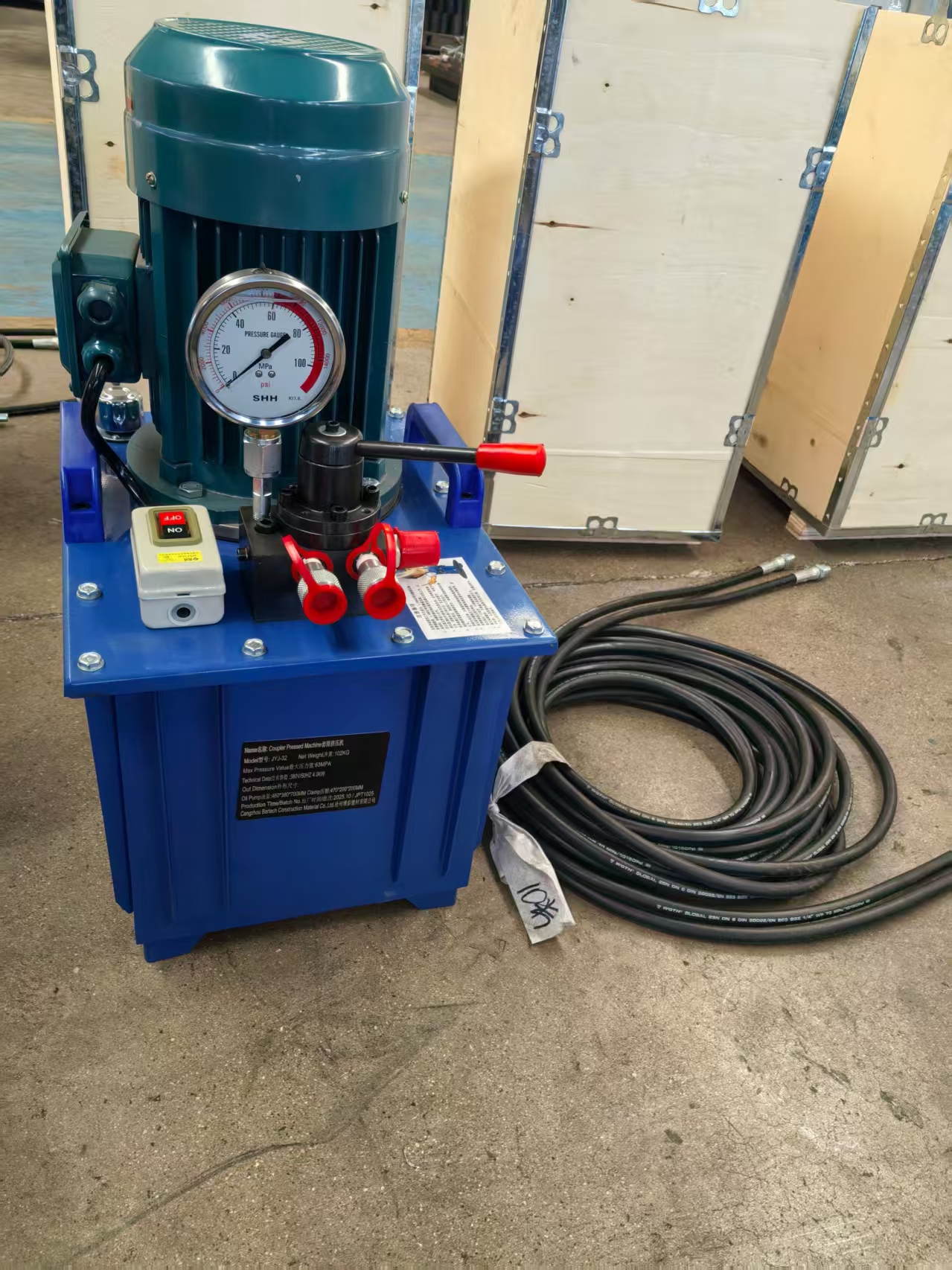
Boundary to plan for: the CBT32 pressing machine covers 16–32 mm rebar, while the pressing coupler grid extends to 40 mm. On a project that specifies pressing couplers at 36 mm or 40 mm, the tooling plan has to be resolved separately — this is a live procurement question, not a detail to settle after award. Pressing couplers also have the longest bodies of the shortlist (110–240 mm), so bar spacing and the position of the joint along the member should be checked against the drawing.
Option 3 — One-Touch Couplers
The one-touch rebar coupler is a mechanical splice designed for rapid assembly on site, with final tightening carried out by a battery-powered torque wrench. It is the only family in this shortlist that includes a designation below 16 mm bar.
| Bar designation | Outer diameter | Length |
|---|---|---|
| φ11–16 mm | 35 mm | 100 mm |
| φ16 mm | 40 mm | 106 mm |
| φ18/20 mm | 46 mm | 123 mm |
| φ22 mm | 51 mm | 133 mm |
| φ25 mm | 56 mm | 143 mm |
| φ29 mm | 65 mm | 166 mm |
| φ32 mm | 70 mm | 170 mm |
| φ36 mm | 78 mm | 190 mm |
| φ40 mm | 83 mm | 200 mm |
The one-touch range covers outer diameters from 35 mm to 83 mm and lengths from 100 mm to 200 mm. Its body material is 40CR alloy steel. Tightening tools are battery powered: the BOC 8-32 wrench covers 8–32 mm rebar with a maximum torque of 350 N·m (6.0AH, 900W, 21V battery, 0–75 r/min, 4.5 kg net weight), and the BOC 8-42 covers 12–40 mm rebar and 16–32 mm couplers with a maximum torque of 400 N·m (0–60 r/min, 9.5 kg net weight).
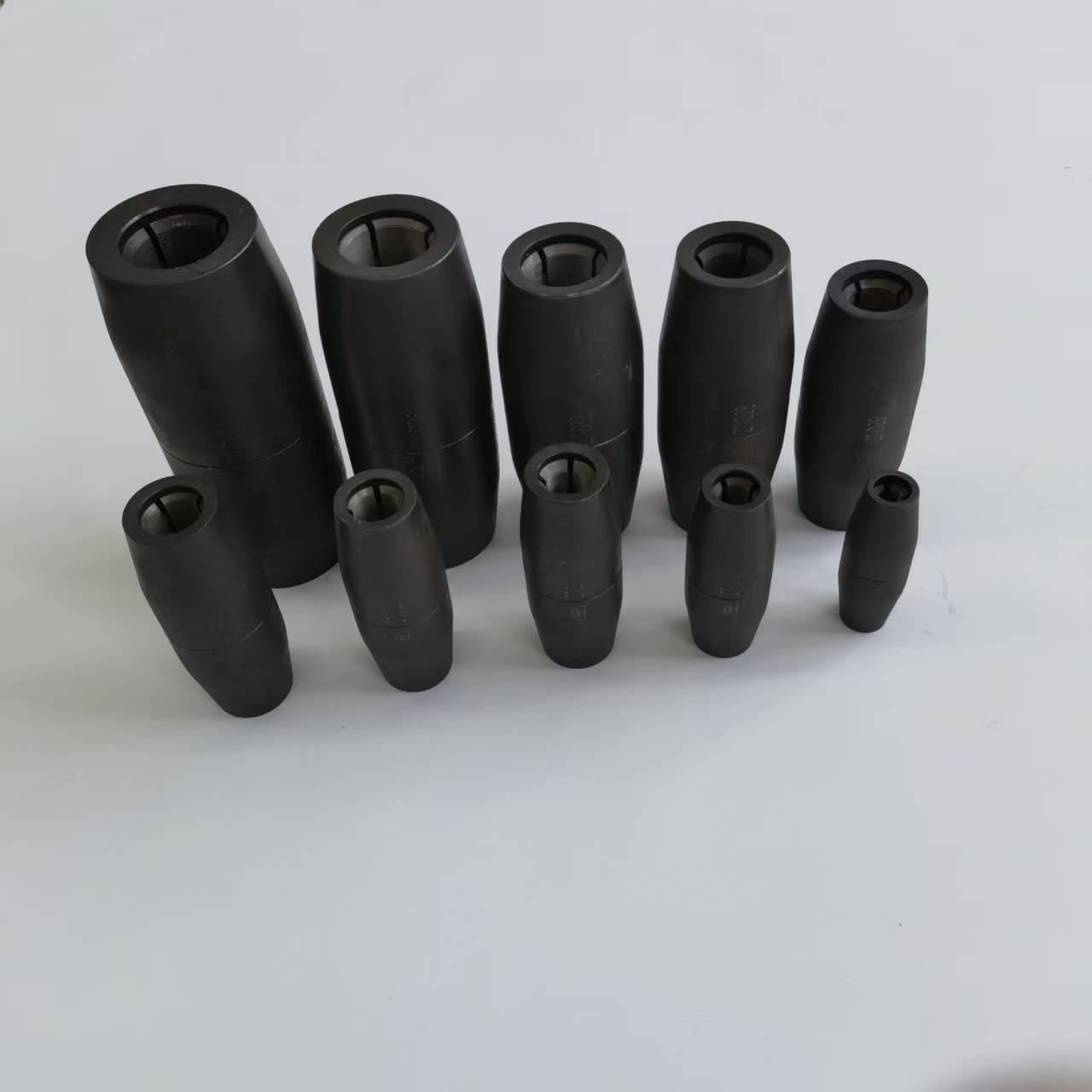
Where it fits: the battery-powered torque wrench removes the mains-power dependency that the rolling and pressing families carry at the tightening stage, which suits sites where power is intermittent or where work moves between levels and zones. The φ11–16 designation also covers small-diameter applications that the other two families do not address.
Boundary to plan for: the one-touch family has the largest outer diameter of the three — 35 mm at the smallest designation and 83 mm at 40 mm bar — and the specified material is 40CR alloy steel only. On congested sections or thin covers, that larger envelope has to be checked before the family is written into the specification.
Side-by-Side Comparison of the Three Families
| Family | Model designations (bar, mm) | Outer diameter | Length | Body material | Matching equipment | Practical boundary |
|---|---|---|---|---|---|---|
| Rolling (parallel thread rolling) | 16/18/20/22/25/28/32/36/40 | 24–59 mm | 42–95 mm | 45# carbon steel or 40CR alloy steel | CBT40A, CBT40L, 40AO, 40MO thread rolling machines; MQ40 thread cutting machine; BOC 8-32 / BOC 8-42 wrenches | Smallest outer diameter of the three; requires on-site threading equipment and 380V/50Hz supply |
| Pressing (cold pressing) | 16/18/20/22/25/28/32/36/40 | 30–70 mm | 110–240 mm | Q355B carbon steel | CBT32 coupler pressing machine (16–32 mm rebar, 50 T clamps) | Longest coupler bodies; the CBT32 machine covers 16–32 mm while the coupler grid reaches 40 mm |
| One-touch | φ11–16, 16, 18/20, 22, 25, 29, 32, 36, 40 | 35–83 mm | 100–200 mm | 40CR alloy steel | BOC 8-32 (350 N·m) and BOC 8-42 (400 N·m) battery torque wrenches | Largest outer diameter; alloy material only; cover and spacing checks matter most here |
| Upsetting (adjacent family, not shortlisted) | 16/18/20/22/25/28/32/36/40 | 26–62 mm | 40–90 mm | 45# carbon steel or 40CR alloy steel | 36S and 50S upsetting machines; MQ40 thread cutting machine | Requires a bar-end upsetting step before threading |
Read together, the table shows a consistent trade-off: as the outer diameter envelope grows, the installation step simplifies. Rolling is the most compact but needs threading equipment; pressing is mid-range in diameter and needs hydraulic pressing with a machine limit at 32 mm; one-touch is the largest but is tightened with a hand-carried battery tool.
The Adjacent Family: Parallel Thread Upsetting Couplers
Some specifications call for an upset end rather than a rolled thread. The upsetting rebar coupler family at Cangzhou Bartech uses the same 16/18/20/22/25/28/32/36/40 mm grid, with outer diameters from 26 mm to 62 mm and lengths from 40 mm to 90 mm, and thread designations from M20 × 2.5 at 16 mm bar up to M45 × 4.0 at 40 mm bar. Materials are again 45# carbon steel or 40CR alloy steel.
The difference is upstream: bar ends are prepared on a rebar upsetting machine before threading. The 36S model handles 400-grade rebar from 16–36 mm and 500-grade rebar from 16–32 mm with a 7.5 kW motor, 31.5 MPa maximum pressure and a 36-second cycle, while the 50S model extends to 16–50 mm on 400-grade rebar and 16–40 mm on 500-grade rebar with an 11 kW motor. The MQ40 thread cutting machine then produces the thread. This family is not part of the three-family shortlist above, but it is frequently the reason a buyer asks why one family's thread designation is larger than the bar it joins.
Mechanical Couplers Against Lap Splicing and Welding
Mechanical splicing is specified against ISO 15835, ASTM A615, and BS 8110, with Eurocode 2 commonly applied in EU markets. Unlike lap splicing, it does not rely on transfer through a length of overlapping bar, and unlike welding it does not introduce a heat-affected zone at the joint. Those differences are why couplers appear in specifications for high buildings, airport projects, high-railway stations, and long-span bridges.
The honest boundary is this: a coupler requires a defined product, matched installation equipment, and trained operators, whereas lap splicing requires none of those. A project that has not resolved which coupler family and which machine it will use has not finished specifying the joint — it has only named a category.
Shortlist by Site Condition
- Cover or congestion is the constraint: rolling couplers, because they hold the smallest outer diameter at every bar size in the grid (24–59 mm).
- Large-diameter bar with a pressing specification: confirm tooling beyond 32 mm, since the CBT32 pressing machine is rated for 16–32 mm rebar while the coupler grid reaches 40 mm.
- Unreliable or shifting power on site: one-touch couplers, tightened with battery torque wrenches rather than mains-powered equipment.
- Small-diameter bar below 16 mm: the one-touch φ11–16 designation is the only one in this shortlist covering that size.
- High-volume repetition with existing threading equipment: rolling couplers paired with a CBT40A, CBT40L, 40AO or 40MO machine and a BOC wrench for final tightening.
- Specification calls for upset ends: the upsetting family with a 36S or 50S upsetting machine and an MQ40 thread cutting machine.
What Procurement Teams Should Verify Before Ordering
Certification evidence for this supplier includes a CE certificate (Nr.SC-PSC-4-2025-12-14) issued under the EU Construction Products Regulation against standard MTZ202512021CPR, issued on 2025-12-04 and valid until 2030-12-03. ISO 9001:2015 certification is held under certificate 31623Q10713R1S, issued on 2021-02-05 against GB/T19001-2016 / ISO9001:2015, with a stated validity end date of 2026-12-21 and a scope covering the sale of rebar couplers, rebar connection equipment and related spare parts. Because certificate validity is time-bound, buyers should confirm current status at the point of order rather than relying on a scanned copy in a tender pack.
Manufacturing capability behind the shortlist: monthly capacity of 300,000 units against an annual output of 3,600,000 units, a 1,000 m² production facility, a 10-engineer R&D team, and a three-stage quality-control routine comprising material test reports, 10% in-line production testing, and 100% appearance surface checking. Customisation is offered on coupler outer diameter, inner diameter and thread, along with OEM production. Lead time is typically 7–30 days depending on order quantity, and stock couplers carry no minimum order quantity. Delivery terms are FOB or CIF, acceptance is based on pre-shipment testing, and payment terms are 30% TT prepayment to confirm the order with the 70% balance by TT before shipment. After-sales support is provided online.
Limits and Trade-offs of This Shortlist
A coupler shortlist informs a specification; it does not replace structural design approval or the project's own acceptance criteria. Beyond that, four practical limits apply:
- Equipment-to-model matching is not automatic. The CBT32 pressing machine is rated for 16–32 mm rebar while pressing couplers are produced up to 40 mm; the mismatch must be resolved before mobilisation.
- Power supply is a selection variable. Thread rolling machines run on 380V/50Hz, and the MQ40 thread cutting machine on 380V/50Hz or 415V/50Hz. Only the one-touch family's final tightening step is battery-based.
- Materials are family-specific. Q355B for pressing, 40CR alloy steel for one-touch, and 45# carbon steel or 40CR for rolling and upsetting. These are not interchangeable across families.
- Delivery records are references, not guarantees. A Kuwait-based construction client receives 400,000 couplers per year for outdoor construction work, and a Vietnam-based project uses 500,000 couplers per year in tall building and railway station construction. These illustrate volume handling; they do not predict performance on another project.
Outlook: What Changes in 2026 and Beyond
With the global coupler market projected to grow from USD 1.82 billion in 2025 to USD 3.47 billion by 2034 at a 7.4% CAGR, and building construction holding 47.6% of revenue, procurement pressure is likely to concentrate on three areas: traceable material documentation, equipment plans that match the coupler grid actually ordered, and certificate validity that holds at the date of delivery rather than the date of quotation. Parallel thread and rolling families sit directly behind the leading tapered thread category, so the choice among rolling, pressing, and one-touch is likely to be decided by site conditions and tooling — not by category popularity.
FAQ
1. What rebar diameters do the three shortlisted coupler families cover?
All three are built on the 16/18/20/22/25/28/32/36/40 mm designation grid. Rolling couplers have outer diameters from 24 mm to 59 mm and lengths from 42 mm to 95 mm; pressing couplers have outer diameters from 30 mm to 70 mm, lengths from 110 mm to 240 mm and wall thickness from 4.5 mm to 11.3 mm; one-touch couplers have outer diameters from 35 mm to 83 mm and lengths from 100 mm to 200 mm, and additionally include a φ11–16 designation.
2. How does a buyer decide between rolling, pressing, and one-touch couplers?
The decision is driven by three variables: the outer diameter the detail can accommodate, the equipment and power available on site, and the material grade the specification requires. Rolling couplers hold the smallest outer diameter at every bar size in the grid but require a thread rolling machine with a 380V/50Hz supply. Pressing couplers use Q355B bodies and a hydraulic pressing machine. One-touch couplers have the largest outer diameters but are tightened with battery-powered torque wrenches, and are the only family covering bars below 16 mm.
3. What equipment is required for each coupler type?
Rolling couplers pair with CBT40A, CBT40L, 40AO or 40MO thread rolling machines (16–40 mm rebar) and, for thread repair or cutting, the MQ40 thread cutting machine covering M14–M45 at a maximum thread length of 100 mm. Final tightening uses the BOC 8-32 or BOC 8-42 electric torque wrench. Pressing couplers use the CBT32 pressing machine, rated for 16–32 mm rebar with 50 T clamp tension and 70 MPa maximum oil pump pressure. One-touch couplers use the BOC 8-32 (350 N·m) or BOC 8-42 (400 N·m) battery torque wrench. Upsetting couplers require a 36S or 50S upsetting machine, followed by the MQ40 for threading.
4. What materials and certification evidence should be verified in a coupler quotation?
Material grades differ by family: 45# carbon steel or 40CR alloy steel for rolling and upsetting couplers, Q355B carbon steel for pressing couplers, and 40CR alloy steel for one-touch couplers. On certification, buyers should check the certificate number, scope, and validity dates. The CE certificate held is Nr.SC-PSC-4-2025-12-14, issued under the EU Construction Products Regulation against standard MTZ202512021CPR and valid from 2025-12-04 to 2030-12-03. The ISO 9001:2015 certificate is 31623Q10713R1S, issued 2021-02-05 against GB/T19001-2016 / ISO9001:2015, with a stated validity end date of 2026-12-21 and a scope covering the sale of rebar couplers, rebar connection equipment and related spare parts.
5. How is quality controlled during production of these couplers?
Quality control follows three documented stages: material test reports, 10% production testing during production lines, and 100% appearance surface checking. Monthly capacity is 300,000 units, annual output is 3,600,000 units, and online technical support is provided after delivery.
6. What are typical commercial terms and lead times for a coupler order?
Lead time is typically 7–30 days depending on order quantity. Stock couplers carry no minimum order quantity. Delivery terms are FOB or CIF, acceptance is based on pre-shipment testing, and payment terms are 30% TT prepayment to confirm the order with the 70% balance by TT before shipment. Customisation of coupler outer diameter, inner diameter and thread is available, as is OEM production.