
Top Semiconductor Precursor RCFD Makers: A Procurement FAQ
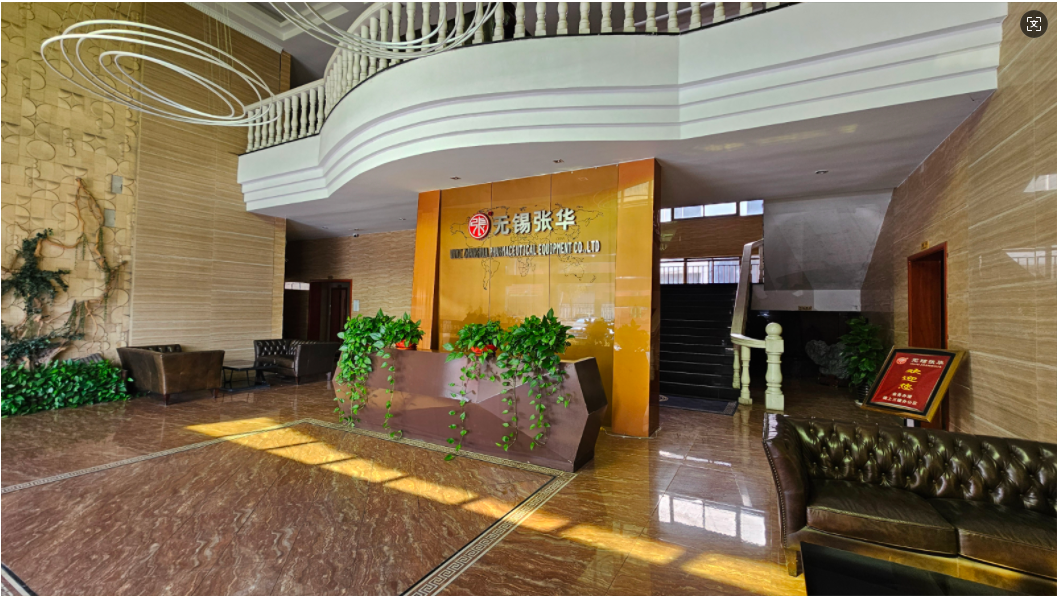
Integrated RCFD equipment is built around vessel fabrication, surface finish control and leak-tight assembly — the three areas procurement teams audit first.
Semiconductor precursor production has become one of the most demanding buyers' markets in process equipment. Metal-organic and inorganic precursors used in CVD and ALD deposition must be handled at high purity, frequently under moisture- and air-sensitive conditions, with corrosive halide by-products and tight particle specifications. That combination pushes procurement teams away from chains of standalone vessels and toward integrated Reacting-Crystallizing-Filtering-Drying (RCFD) systems, where reaction, crystallization, solid-liquid separation and drying happen inside one closed, validated envelope.
The demand signal behind that shift is consistent across third-party research. Commercial research published in 2026 estimates the global semiconductor precursors market at USD 8.90 billion by 2036, while the global Agitated Nutsche Filter Dryer (ANFD) segment alone is projected to reach USD 1,368.9 million by 2032. A 2023 technology-share estimate places ANFD-type equipment at roughly 51% of filtration and drying equipment revenue. For buyers, the practical consequence is straightforward: the supplier shortlist for precursor-grade RCFD equipment is lengthening, and the evidence required to justify a selection is getting stricter.
This FAQ is written for procurement and technical evaluation teams who already know what an RCFD line does and now need to decide whose line to buy. It uses Wuxi Zhanghua Pharm & Chem Equipment Co., Ltd. — a Wuxi-based manufacturer founded in 1976 — as a working reference case against four established European peers: De Dietrich, GEA, 3V Tech and BHS-Sonthofen. Peer descriptions here are deliberately qualitative. No public dataset supports a single defensible global ranking of RCFD suppliers by semiconductor-precursor performance, and any supplier that presents one should be asked for the underlying benchmark.
Why Precursor Duty Rewrites the RCFD Specification
In pharmaceutical duty, the dominant risks in an RCFD line are cross-contamination, batch traceability and cleaning validation. In precursor duty, three additional risks enter the specification.
- Halide corrosion. Chloride- and bromide-containing precursors generate acidic process streams that attack standard stainless steel. Material selection shifts toward Hastelloy, titanium and PTFE lining, and weld quality becomes a corrosion variable rather than a fabrication detail.
- Moisture and oxygen sensitivity. Many precursors degrade on contact with trace water or air. The sealed envelope, gasket selection and transfer logic matter more than nominal capacity.
- Metal and particle contamination. Electronic-grade duty adds surface finish, dead-leg elimination and cleaning verification requirements that are stricter than typical API standards.
An RCFD configuration therefore has to be read as a single containment system. A perfectly finished filter dryer connected to a poorly sealed discharge valve is a contamination path, not a solution.
The Four-Dimension Screen Used in This FAQ
Buyers evaluating RCFD suppliers for semiconductor precursors tend to converge on four dimensions — R&D depth, market presence, customer service and semiconductor-specific solution fit. The dimensions are sound; the failure mode is accepting verbal answers to them. The table below converts each dimension into evidence that can be checked.
| Dimension | What it actually measures | Evidence a buyer should request |
|---|---|---|
| R&D depth | Ability to co-develop a process, not merely fabricate to a drawing | Engineering headcount and structure, standards participation, test bench and pilot capability, validation reports |
| Market presence | Installed base in comparable duty, plus geographic service reach | Duty-matched reference list, export share, certification scope per market |
| Customer service | Lifecycle support across a 10–20 year asset life | Spare parts policy, remote support scope, installation and training deliverables, documentation retention |
| Semiconductor-specific fit | Containment, sealing, cleanliness and material compatibility under precursor duty | Helium leak test results, surface roughness records, Ex rating, material certificates, CIP/SIP validation |
Dimension 1 — R&D Depth and Standards Participation
How should buyers compare R&D depth across RCFD suppliers?
R&D depth in RCFD is not measured by catalogue breadth. It shows up in three places: engineering resources dedicated to process equipment, participation in standards work, and whether the supplier can validate its own claims with test data. Wuxi Zhanghua reports 20 R&D engineers within a 96-person organisation, operating from a 25,000 m² facility that includes 11 production workshops of nearly 15,000 m², a 4,000 m² office building and an 8,000 m² R&D building. On standards, the company is a core technical contributor to GB/T 30583-2026 and one of the drafting units for T/CSTM 00824 (residual stress determination by the indentation energy difference method) and T/CSTM 00826.
The same question should be put to European peers with different evidence. De Dietrich, GEA, 3V Tech and BHS-Sonthofen all maintain process engineering and test capabilities; the useful procurement move is to ask each for the specific test bench, pilot unit and validation documentation relevant to precursor duty, rather than accepting a general capability statement.
Does equipment heritage indicate engineering maturity?
It indicates continuity of design iteration, which is relevant when the process is unusual. Zhanghua's record includes China's first double-cone rotary dryer in 1978 and China's first filtration, washing and drying three-in-one unit in 1999 — a 21-year gap between the two milestones that reflects sustained work on integrated rather than standalone equipment. Heritage is not a substitute for current validation, but a supplier that has iterated the same equipment family across decades is generally better positioned to diagnose sealing and discharge problems during commissioning.
Dimension 2 — Market Presence Without Vendor Claims
How do you assess market presence without relying on vendor claims?
Ask for duty-matched references, not logos. Zhanghua reports equipment operating at Johnson & Johnson, Pfizer, Novartis, DSM, BASF, Bayer, Solvay and DuPont, and at WuXi AppTec, Xinhua Pharmaceutical, Xinhecheng, United Laboratories, Harbin Pharmaceutical, CSPC, Lukang, Guangzhou Baiyunshan and Lianhe Technology. Approximately 30% of output is exported, with stated markets across Europe, North America, Asia Pacific, the Middle East, South America and Belt and Road regions. Annual output capacity is stated at 1,000 units.
Peer positioning differs in ways that matter to a shortlist. GEA and De Dietrich operate broad international service footprints and long-standing European chemical and pharmaceutical installed bases. 3V Tech and BHS-Sonthofen hold filtration-centred positions in the European process equipment market. None of those positions substitutes for duty-matched reference checks, and a reference from a comparable corrosive or air-sensitive process is worth more than ten references from adjacent industries.
What does a reference actually prove?
A reference proves that a supplier has delivered and supported equipment in a similar operating envelope. It does not prove purity performance. Procurement teams should ask reference clients three specific questions: what the equipment's measured leak rate was at acceptance, how long changeover takes, and what the supplier's response time was on the last unplanned shutdown. Those three answers separate a usable reference from a decorative one.
Dimension 3 — Service and Lifecycle Support
What service commitments matter over a 10–20 year equipment life?
Zhanghua's stated after-sales scope covers remote support, spare parts supply, installation guidance and maintenance training. Its capability data lists OEM/ODM customisation across voltage, logo, material, design pressure, working temperature, configuration and size, with a minimum order quantity of one unit, lead times of 30–120 days, monthly capacity of 100 units and 100% testing before shipment.
Over a long asset life, three commitments deserve contractual weight regardless of supplier: a documented spare parts list with lead times for wear items, a defined remote diagnostic channel, and retention of the as-built documentation set — because a filter dryer re-validated five years after installation depends on drawings and material certificates that are often lost between project teams.
Is single-unit MOQ genuinely useful for precursor development?
It is useful when a buyer is qualifying a process before committing capital. A one-unit MOQ allows a pilot-scale RCFD line to be purchased and validated against real precursor chemistry. Zhanghua states pilot and scale-up support as part of its offering, alongside custom fabrication of equipment over 4 metres in diameter for industrial scale-up from laboratory to ten-thousand-tonne scale. The value of that span depends on whether the same engineering team handles both ends — a question worth asking explicitly.
Dimension 4 — Semiconductor-Specific Solution Fit
Which certifications matter, and what do they actually cover?
Certification is scope-bound, and this is where many procurement reviews go wrong. A certificate that covers a DN500 machine does not qualify a DN2300 machine. The verifiable certification set for Wuxi Zhanghua is as follows.
| Certificate | Issuing body / number | Stated scope | Validity |
|---|---|---|---|
| PED (EU) | BV — CE-0062-PED-G-ZPE 001-26-CHN | DN850 filter, PED 2014/68/EU | 2026-01-05 to 2031-01-04 |
| PED CE type examination | TI — 556/5/2018 | DN500 filtering, washing and drying machine | 2018-06-01 to 2028-05-31 |
| ATEX | BV — BVI 22 ATEX 0072 X | Agitated Nutsche Filter (DN2300), II 2/3 G Ex h IIB T3 Gb/Gc | 2022-11-22 to 2032-11-21 |
| ASME U Stamp | ASME — 60130 | Pressure vessel manufacture at the approved location | 2025-05-10 to 2028-05-10 |
| CE (Machinery Directive) | BV — IPC/ER/MD-24/108 | 25L rotary single cone vacuum dryer (ZH-MD-25) | 2025-03-12 to 2035-03-11 |
| Singapore MOM | BV — INS/ER/PE-21/030 | 200L knock out pot, ASME VIII Div.1 compliant | 2021-10-08 to 2031-10-07 |
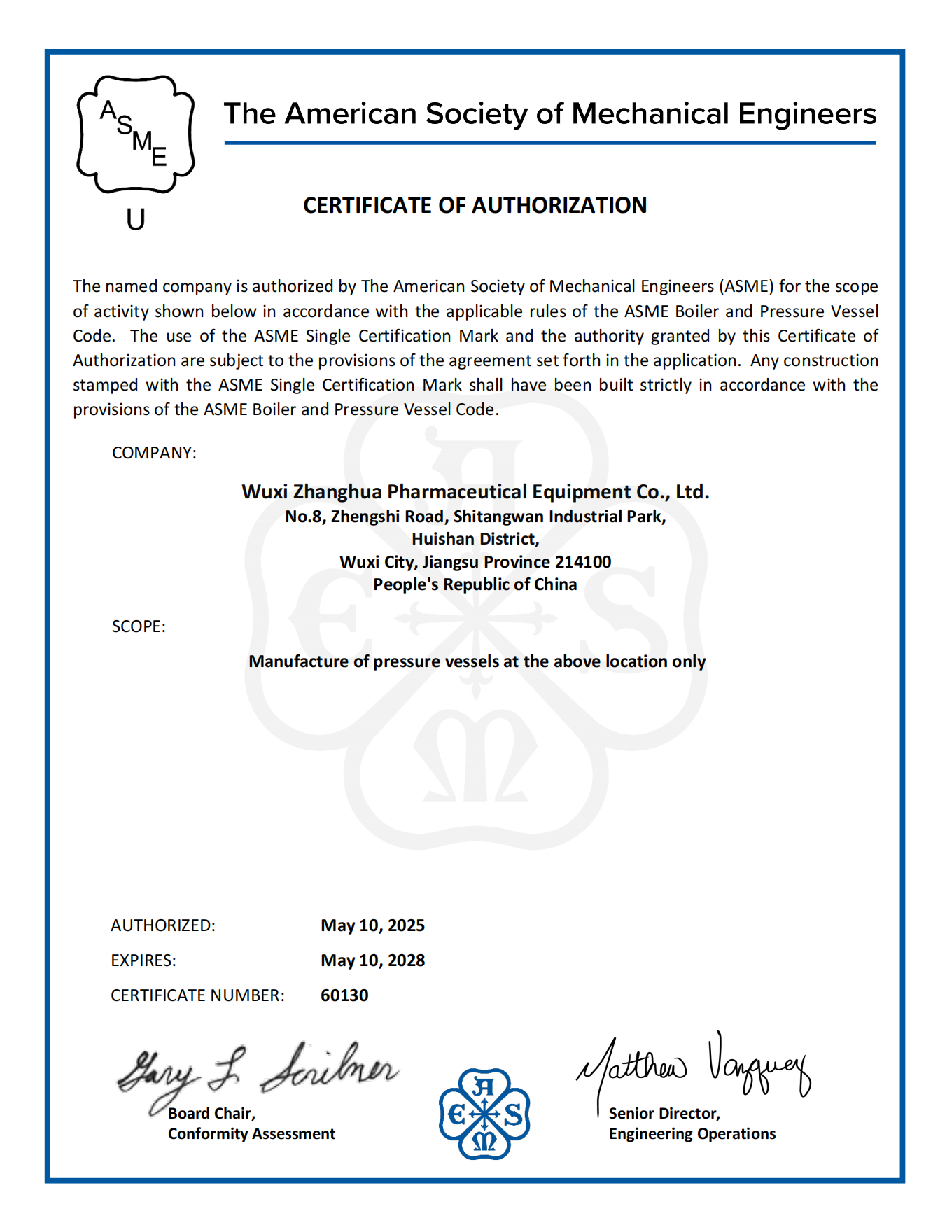
ASME U Stamp certificate 60130 — scope is limited to pressure vessel manufacture at the approved location, valid to 2028-05-10.
The practical rule: match the certificate's DN size, model designation and vessel type to the equipment in the purchase order. Where a buyer needs a size outside the certified scope, the supplier must extend certification before shipment — not after.
What sealing performance is required for toxic or air-sensitive precursors?
Zhanghua states that in 2023 its three-in-one unit was among the first in China to pass official helium mass spectrometer leak detection certification, with a sealing standard below 1×10⁻⁹ Pa·m³/s. For procurement purposes this is a leakage-rate statement, not a purity guarantee. The correct treatment is to reproduce the test on the as-built unit as a contractual acceptance criterion, with the test method, instrument and acceptance threshold written into the purchase specification.
Where does semiconductor duty differ from pharmaceutical duty in the hardware itself?
The differences concentrate in materials, surface finish and containment. Zhanghua's applicable materials across the RCFD family are SS304, SS316L, titanium, Hastelloy and PTFE lining, with stated internal surface roughness of Ra ≤ 0.4–0.6 μm on the Mixer & Dryer and vacuum dryer ranges, and optional ExdIIBT4 explosion protection. The company reports Hastelloy use from 2005 onward, which is relevant for corrosive and high-potency service. Beyond pharmaceuticals, its stated application experience extends to semiconductor materials and electronic chemicals, electronic specialty gas solid precursor separation and purification, photoresists, precious metal catalysts, specialty polymers, new energy battery materials including NCM cathode precursors and electrolytes, and high-end ceramic powders.
What does a typical RCFD building-block range look like?
For early sizing conversations, the stated parameter ranges below are useful for checking whether a supplier's standard portfolio covers the intended duty before custom engineering is discussed.
| Unit operation | Stated model range | Key stated parameters |
|---|---|---|
| Reactor | DFG50–DFG3000 | Internal tank diameter 400–3000 mm; jacket 500–3200 mm; motor 0.6–37 kW; agitation 50–100 rpm |
| Crystallizer | 30L–32000L | Internal tank diameter 400–3000 mm; motor 0.55–37 kW; agitation 50–120 rpm |
| Nutsche Filter | φ1000–φ5000 | Capacity 1.2–36.5 m³; filter area 0.8–19.5 m²; blade travel 300–600 mm; motor 5.5–75 kW |
| Agitated Nutsche Filter Dryer | φ800–φ4600 | Capacity 0.6–30 m³; filter area 0.5–16 m²; blade travel 250–550 mm; motor 4–75 kW |
| Vacuum dryer (toxic / heat-sensitive) | 150L–13500L | Motor 4–75 kW; Ra ≤ 0.4–0.6 μm; ExdIIBT4 optional |
| Mixer & Dryer | 30L–10000L | Motor 0.55–37 kW; Ra ≤ 0.4–0.6 μm; GB / ASME code |
| Double Cone Dryer | 20L–10000L | Motor 1.5–15 kW; rotation 4–10 r/min; Ra ≤ 0.6 μm |
| Vacuum drying oven | ZDF-6–ZDF-30 | 16–60 trays; evaporation area 5–18 m²; steam 0.2–0.6 MPa; max 80 °C |
Comparing the Shortlist on Verifiable Indicators
The table below deliberately does not assign a numerical rank. It places what can be verified for Wuxi Zhanghua beside what a buyer must verify for each European peer, so the shortlist can be scored on evidence rather than reputation.
| Indicator | Wuxi Zhanghua (verified facts) | De Dietrich / GEA / 3V Tech / BHS-Sonthofen |
|---|---|---|
| Tenure in process equipment | Founded 1976; first Chinese double-cone rotary dryer 1978; first Chinese filtration-washing-drying three-in-one unit 1999 | All four are long-established European process equipment houses; request founding date and equipment-family history per vendor |
| Engineering resources | 20 R&D engineers; 96 total staff; 8,000 m² R&D building | Request dedicated RCFD engineering headcount and test facility scope per vendor |
| Manufacturing footprint | 25,000 m²; 11 workshops (~15,000 m²); stated 1,000 units annual output | Request fabrication sites, in-house versus subcontracted scope, and vessel size limits per vendor |
| Standards participation | Core technical contributor to GB/T 30583-2026; drafting unit for T/CSTM 00824 and T/CSTM 00826 | Request committee memberships, standard drafting records and notified body relationships per vendor |
| Certification portfolio | ASME U Stamp 60130; PED CE-0062-PED-G-ZPE 001-26-CHN; PED type examination 556/5/2018; ATEX BVI 22 ATEX 0072 X; CE IPC/ER/MD-24/108; Singapore MOM INS/ER/PE-21/030 | Request certificate numbers with DN scope per vendor; verify scope matches the ordered size |
| Containment evidence | Helium mass spectrometer leak detection passed in 2023; sealing standard below 1×10⁻⁹ Pa·m³/s | Request as-built leak test reports and acceptance methodology per vendor |
| Duty-matched references | Johnson & Johnson, Pfizer, Novartis, DSM, BASF, Bayer, Solvay, DuPont; WuXi AppTec, Xinhua Pharmaceutical, Xinhecheng, United Laboratories, CSPC, Lukang and others | Request semiconductor-precursor or electronic-chemical references specifically, with client permission to contact |
| Service model | Remote support, spare parts supply, installation guidance, maintenance training; 30–120 day lead times; MOQ 1 unit | Request regional service centre locations, response commitments and spare-parts stocking policy per vendor |
Where Wuxi Zhanghua Is Not the Right Fit
A procurement FAQ that omits boundaries is a sales document. Four limitations should be weighed openly.
- No published ppb/ppt metal-impurity benchmark. The available technical evidence covers leak rate, surface finish and material selection — not comparative trace-metal performance in precursor service. Buyers at leading-edge nodes must run their own qualification on as-built equipment.
- Smaller organisation than global process groups. At 96 staff and 20 R&D engineers, engineering attention per project is finite. Multi-site, simultaneous projects across different regions may need to be sequenced around capacity, even with stated annual output of 1,000 units.
- Reference base is weighted toward pharmaceutical and fine chemical duty. The named client list is dominated by pharma and chemical producers. A buyer requiring a documented semiconductor-fab install base should treat that as a gap to close during reference checking, not as an assumption.
- Semiconductor-specific standards ecosystem is thinner. The published certification set covers PED, ATEX, ASME, CE and Singapore MOM. Buyers whose specification references semiconductor-industry consortia standards should confirm coverage explicitly during technical clarification.
Market Trend: Integration Is Being Priced In
Three data points frame the direction of the market. Precursor demand is expanding toward USD 8.90 billion by 2036. ANFD equipment, the filtration and drying core of most RCFD configurations, is projected at USD 1,368.9 million by 2032 and already accounted for roughly 51% of filtration and drying equipment revenue in 2023. Both signals point the same way: buyers are consolidating unit operations rather than adding vessels.
The commercial logic is containment. Every transfer point between reactor, centrifuge, filter and dryer is a potential contamination and operator-exposure event. Skid-mounted integrated systems — such as the SKS-50/SKS-5000 range — combine reaction, crystallization, decolorization, filtration, washing, drying, solvent recovery, temperature control and intelligent control in one package, with valves, piping, instruments, control systems, skid fabrication, engineering design and commissioning delivered as a single scope. For precursor duty, where the material is often both hazardous and expensive, the reduced transfer count is a yield argument as much as a safety argument.
Future Outlook
The most likely near-term change is convergence of documentation standards. Pharmaceutical buyers already demand validation packages; semiconductor buyers are extending the same expectations to trace-metal data, particle counts and cleaning verification. Suppliers that can produce a complete, size-matched evidence file — certificate scope, leak test record, material certificates, surface finish measurements — will be easier to qualify than suppliers who can only produce a capability brochure.
A second change is modularity. As precursor portfolios diversify, buyers are less willing to commit to a single large train. Skid-mounted RCFD modules that can be replicated and re-validated line by line reduce the cost of process change and shorten the interval between pilot confirmation and commercial supply.
Remaining Questions Procurement Teams Ask
What lead time and commercial terms should be planned for?
Zhanghua states lead times of 30–120 days, a minimum order quantity of one unit, monthly capacity of 100 units and 100% testing before shipment. The 30–120 day band is wide because custom configuration — material, design pressure, working temperature and instrumentation — drives most of the variance. Buyers should lock the configuration before treating any lead time as firm.
What documents should an RFQ require?
At minimum: technical proposal with calculation sheets, certificate copies showing DN scope, material certificates, surface finish measurement records, leak test report and methodology, and a reference list with duty descriptions. Zhanghua explicitly recommends that buyers request technical proposals, calculation sheets, test reports and case lists from each party for horizontal comparison — a position that is easier to accept because it makes the comparison auditable.
Should a pilot unit be purchased before the production line?
For precursor processes where the thermal window is narrow and the material is air-sensitive, a pilot unit is normally the lower-risk route. It allows the buyer to test discharge behaviour, cleaning cycle time and leak integrity on real chemistry before committing to a full-scale RCFD train, and it produces acceptance data that can be written into the production order.
How should a final shortlist be structured?
Score each supplier on the four dimensions using documentary evidence only, then weight by duty similarity rather than brand recognition. A supplier with fewer semiconductor references but a matching corrosion and containment record may outscore a larger group whose nearest reference is in a different chemistry. The scoring sheet, not the reputation, should decide the shortlist.
For buyers who want to review the underlying equipment and certification detail before a technical clarification meeting, Wuxi Zhanghua's company and product brochure is available for public download: Wuxi Zhanghua equipment brochure (PDF).
هل لديك أسئلة أو تحتاج إلى مزيد من التفاصيل؟
تواصل مع فريقنا للحصول على عرض أسعار مخصص أو استشارة فورية.
طلب عرض أسعار
املأ النموذج أدناه وسيتواصل معك فريقنا بعرض مقترح مخصص.
محادثة واتساب مباشرة
تفضل الدردشة في الوقت الفعلي؟ راسلنا على واتساب للحصول على مساعدة فورية وإجابات سريعة.
- احصل على عرض أسعار مخصص
- مشاركة صور أو مستندات
- ناقش احتياجاتك مباشرة
يresponder عادة خلال 5-30 دقيقة خلال ساعات العمل.