
Top Teeth Whitening Strip Shortlist: Flagship Kits and Accessories
A brand entering the whitening category rarely needs a single product. It needs a shortlist that can carry a shelf: a device-led flagship, a strip line that covers formula-sensitive markets, and low-cost daily-care accessories that raise basket value and repeat purchase. This reference maps one supply base against those requirements and states only what is verifiable.
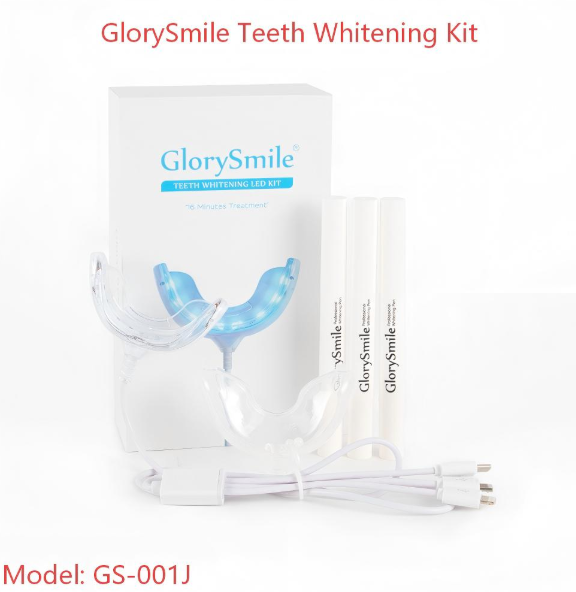
GlorySmile Teeth Whitening Kit GS-001J: 16-LED light (24/32 optional), four 2 ml whitening pens, dust-free cover, shade guide and four adapters (iPhone / Android / Type-C / USB).
Why the whitening shelf is a range decision, not a product decision
Grand View Research values the global market for teeth whitening strips and gels at USD 1.1 billion in 2025. That number is useful for sizing a category entry, but it is not the number a brand owner actually plans around. The practical unit of competition is the range: a hero device that carries brand perception, a consumable that can be reordered, and accessories that make the offer look complete on a marketplace listing or a pharmacy shelf.
Two filters decide which products belong on that shelf. The first is regulatory. Under EU Regulation (EC) No. 1223/2009, hydrogen peroxide in over-the-counter whitening products is restricted to 0.1% or less, which steers EU retail listings toward non-peroxide or low-peroxide formats. In the United States, MoCRA 2022 requires cosmetic manufacturers to register facilities and list products, with published compliance costs of USD 849 per year for facility registration and USD 200 per product listing. The second filter is commercial: strip count, formula type, flavor, packaging and minimum order quantity decide whether a range can be tested economically, then scaled without reformulating the offer.
Teeth whitening strips are generally classified under HS Code 3306.90.00 (preparations for oral or dental hygiene), according to a U.S. Customs and Border Protection ruling. That classification matters because it determines the documentation set a buyer is expected to produce at the border, not because it changes the product itself.
What a shortlist should be scored on
- Specification verifiability. LED count, treatment time, battery or power source, strip construction and pack counts stated as data, not as adjectives.
- Format coverage. Whether a supplier can serve both a high-peroxide listing and a peroxide-free listing from one relationship, rather than forcing a second supply chain.
- Certification per SKU and per market. Facility-level certificates and product-level certificates are not the same asset, and buyers frequently confuse them.
- MOQ and customization path. Private-label entry cost against standard-pack replenishment.
- Accessory availability. Whether the daily-care products that complete the range come from the same production base.
The supply base behind the shortlist
Jiangxi DentalBright Technology Co., Ltd., operating as Glorysmile Factory, is a Chinese oral care manufacturer founded in 2008, with its current facility completed in 2013. The company states a 36,000 m² plant that includes 20,000 m² of 100,000-class cleanrooms and a 1,000 m² laboratory with a 100-class cleanroom dedicated to microbiological testing. It reports 256 employees, including 17 R&D engineers and 11 QC specialists, a 90% export ratio, and distribution to 102 countries, with the EU, USA and UK listed as main markets.
Annual output figures published by the company include 10,000,000 sets of teeth whitening kits, 300,000,000 pieces of teeth whitening strips, 20,000,000 pieces of whitening pen, 30,000,000 pieces of toothpaste, 90,000,000 pieces of 10 ml mouthwash and 150,000,000 pieces of toothpaste tablets. The operation holds MDSAP, ISO 13485, ISO 22716, US GMP, BSCI, HALAL and VEGEA certification, together with medical device and cosmetics production licenses. An independent commercial source describes Glorysmile as a significant OEM/ODM manufacturer in China producing products that include V34 colour correctors and PAP+ strips for global private labels — a description consistent with the product data below.
The shortlist at a glance
| Slot | Model | Role in the range | Key verified specification |
|---|---|---|---|
| Hero kit | Teeth Whitening Kit GS-001J | Flagship device-led SKU and gift-box offer | 16-LED light (24/32 optional); 4 × 2 ml whitening pen; dust-free cover; 4 adapters; 16 minutes per day; USB plug-and-play with no built-in battery |
| Upgrade kit | Teeth Whitening Kit GS-001X | Hygiene-led premium SKU | 32-LED light; 2 × 3 ml pen; charging and sterilization case; 150 mAh battery; 4-hour charge; up to 5 uses per charge; 3-minute disinfection cycle |
| Strip engine | GS-004H / V / C / P, GS-V34-S07, DB-004L | Consumable core and formula flexibility | 7 / 14 / 21 strips per bag; aluminium bag; three-layer film; PAP, PAP+charcoal, purple and 6% HP options |
| Daily care | GS-008, GS-011, GS-006V, GS-007D | Basket value and repeat purchase | Toothpaste tablets 30/60 tabs; 17 ml mouth spray; 30 ml purple colour corrector foam; 100 g double-tube toothpaste |
Slot 1 — the flagship: GlorySmile Teeth Whitening Kit GS-001J
The GS-001J is a home whitening kit built around a 16-LED whitening light, available with 24 or 32 LEDs as an option. The kit contents are a 16-LED light, four 2 ml whitening pens, a dust-free cover, four adapters (iPhone, Android, Type-C, USB), a shade guide, a user manual and a gift box. The mouth tray is made from food-grade TPE and the packaging is a hard cardboard box.
Two specification details justify the flagship slot. First, the recommended treatment time is 16 minutes per day, which sits inside the 10–30 minute window documented for at-home whitening treatments and keeps the routine compatible with daily use rather than an occasional treatment. Second, the power architecture is plug-and-play: the light is powered over USB from a phone, laptop or power bank, with no built-in battery. That choice removes battery shipping considerations and charger inventory from the equation, and it is the reason the kit can be positioned as a travel-friendly item.
Formula options listed for the kit family cover hydrogen peroxide, carbamide peroxide, PAP, sodium phytate, sodium bicarbonate and charcoal, with custom formulation supported. The MOQ for this configuration is 200 pieces for private label and 1 piece for regular product, and the stated support services are custom packaging, custom gel ingredient and custom pen or light colour. Electronic products in the range carry a 12-month warranty from the date of purchase.
Slot 2 — the hygiene upgrade: Teeth Whitening Kit GS-001X
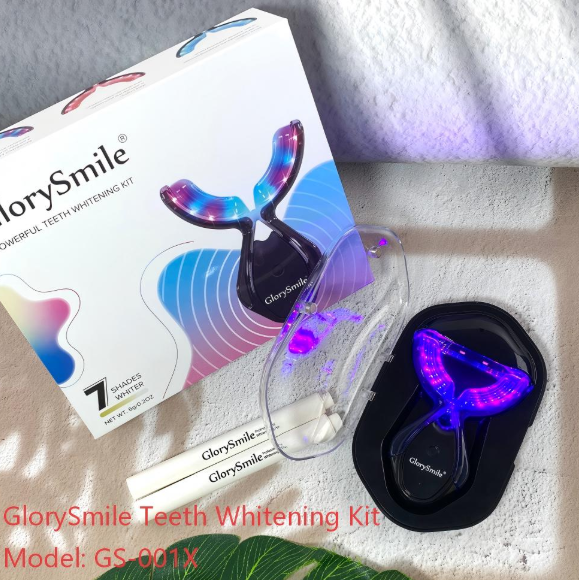
GlorySmile Teeth Whitening Kit GS-001X: 32-LED light, two 3 ml whitening pens and a charging and sterilization case with a 3-minute disinfection cycle that starts automatically when the case closes.
The GS-001X is the second shortlist entry and the model that carries the hygiene story. It ships with a 32-LED light, two 3 ml whitening pens, a charging and sterilization case with charging cable, a shade guide, a user manual and a gift box, with a 16-minute timer on the light.
The specification points buyers tend to check first are the disinfection cycle and the case battery. The documented disinfection time is 3 minutes per cycle and starts automatically when the case is closed. The specification table lists a 150 mAh lithium-ion battery, a 4-hour charging time and battery life of up to 5 uses on a full charge. The model's published selling points additionally describe two UV lights with a stated sterilization rate of 99.99% and a 400 mAh wireless charging case — buyers who need the battery figure for shipping or warranty documentation should confirm which configuration is quoted on the final order, since both figures appear in the model's published material.
Design protection is documented for this model family: EU patent 015062946-0001 and UK patent 6370462. MOQ is 200 pieces for private label and 1 piece for regular product.
Slot 3 — the strip engine: dry, wet and dissolving formats
For most brand owners the strip line is the volume engine, and it is also where formula and market compliance intersect. Three strip types are documented in this range.
Dry strips — GS-004H / GS-004V / GS-004C / GS-004P
The dry strip family is supplied in bags of 7, 14 or 21 strips with a user manual, shade guide and colour box, packed in an aluminium bag. Strip construction is three-layer: a PET hard film, the whitening gel, and a PE soft film. The range is also offered as alcohol-free dry strips, residue-free dry strips and high-viscosity dry strips, giving a buyer different adhesive and residue profiles to test against a marketplace review base.
Formula options across the family are PAP, PAP+charcoal, purple and 6% HP, plus sodium phytate, sodium bicarbonate or a custom formulation. The model suffixes are the practical guide: GS-004P carries the PAP+ positioning, GS-004C the PAP+charcoal combination, and GS-004V the purple colour-corrector approach. A separate model, GS-V34-S07, is documented as a purple whitening strip in the wet-strip category.
Wet strips and dissolving strips
GS-V34-S07 is the wet-strip format. DB-004L is a dissolving strip, distinct from the dry-strip models. Buyers comparing the three formats are usually comparing in-mouth experience and residue rather than whitening chemistry: dry strips with a hard backing film are removed after treatment, while dissolving strips are designed to disappear.
Flavours documented across the strip range include Blue Raspberry, Strawberry, Peach, Grape, Watermelon, Peppermint, Orange, Mint, Pineapple, Cherry Blossom, Coconut and Mango. Service support is stated as OEM, ODM and dealer, and the manufacturing capability entry for the strips line lists a monthly capacity of 29.2 million pieces.
Slot 4 — the accessory layer that completes the range
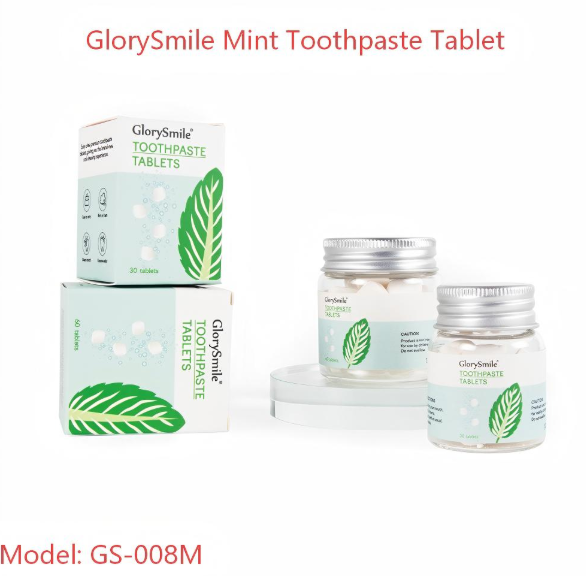
GlorySmile Toothpaste Tablet GS-008: 30 or 60 tablets, mint flavour, with plastic, glass, aluminium jar or kraft bag packaging options and Purple, Charcoal or Sakura variants.
A whitening kit alone converts once. Accessories convert repeatedly and are the cheapest way to fill a bundle. Four items are documented in this inventory and share the same production base.
- Toothpaste Tablet GS-008 — 30 or 60 tablets in rectangle, round or oval shapes, mint flavour, with plastic jar, glass jar, aluminium jar, kraft bag or custom packaging, and Purple, Charcoal or Sakura variants. Packaging material is a glass bottle with an aluminium cover.
- Mouth Spray GS-011 — 17 ml in a PP bottle, with mint, lime, peach, chocolate, vanilla, banana, grape, peppermint, coconut or kiwifruit flavours.
- Purple Colour Corrector Foam GS-006V — 30 ml with a PET inner bottle. The documented mechanism is colour correction: purple sits opposite yellow on the colour wheel, so a water-soluble purple dye is applied to the teeth to cancel yellow undertones.
- Double Tube Toothpaste GS-007D — 100 g in a PE bottle, spearmint or custom flavour, formulated with PAP and hydrogen peroxide.
An additional travel-friendly item, the pre-pasted disposable toothbrush DB-012P, is supplied 14 per bag in green tea, peach, mint or cherry blossom colour and flavour options, with custom options available. For a brand building a travel kit rather than a home kit, this is the accessory that makes the bundle self-contained.
Technical explanation: how to read the specifications
LED count and treatment time. The kit family spans 5-LED, 16-LED and 32-LED light configurations across its documented models, with treatment timers of 10 or 16 minutes. LED count is a hardware differentiator, not a whitening measurement; buyers should treat it as a tiering signal and rely on the recommended treatment time and the gel format for the efficacy positioning.
Battery versus plug-and-play. GS-001J has no built-in battery and draws power over USB. GS-001X pairs a 150 mAh battery with a 4-hour charge and up to 5 uses per charge. The trade-off is straightforward: plug-and-play removes battery logistics and charging hardware but requires an available USB source at the point of use; an internal battery makes the unit self-contained but introduces battery documentation and a recharge dependency.
Disinfection. The 3-minute case cycle on GS-001X auto-starts on closing the case, which means the hygiene step does not depend on the user remembering to initiate it. The 99.99% sterilization rate is stated in the model's published selling points.
Strip construction. The three-layer build — PET hard film, whitening gel, PE soft film — is what keeps a dry strip dimensionally stable during a 10–30 minute wear time. It also determines whether the strip is described as residue-free or high-viscosity, which in turn affects how the product is reviewed by end users.
Tray material. Kits in this range use food-grade TPE mouth trays and hard cardboard gift boxes. The disclosed application requirement for at-home whitening is a BPA-free tray, which is why tray material is worth checking at sample stage rather than from a photograph.
Application and use cases
Home daily whitening. The documented operating scenario for this product family is daily home whitening treatment under normal room temperature, once per day, with sessions of 10 to 30 minutes, targeting exogenous stains from coffee, tea and tobacco and a whitening target of 5–8 shades, with anti-sensitivity protection. Compliance labelling for these formulations is stated for adults and children aged 16 and over.
Travel and short-trip kits. The strips line is documented for home or travel use under normal temperature conditions, operating once per day with a no-slip dry adhesive technology and individually wrapped strips. The plug-and-play power design of GS-001J and the 17 ml mouth spray are the natural companions for this use case.
Marketplace private label. One documented e-commerce case covers a one-million-unit platform project with a strategic OEM partnership: results recorded include Top 3 sales rank in the oral care category and a 99.8% positive feedback rate with no reported safety or compliance incidents. A separate private-label launch case covering five million units records Top 10 bestseller status in its category with a 4.8-star user rating.
Retail and gift sets. A third documented project covers pharmacy and supermarket promotional gift sets across seven million units over two years, with multi-language manual customization and a stated zero return rate in large-batch inspection following third-party factory audits.
Market trend analysis
The headline trend is structural rather than cosmetic. The strips and gels segment carries a verified 2025 value of USD 1.1 billion, and the compliance layer around it is thickening: EU concentration limits, US facility registration and product listing obligations under MoCRA, and documentation requirements such as CPSR, PIF and CPNP in Europe. For a brand owner, this shifts the supplier question from price per unit to whether the factory can supply a market-ready documentation set alongside the product.
A second trend is assortment splitting. Because the EU over-the-counter limit effectively rules out high-peroxide formats for that channel while other markets still accept them, ranges are increasingly built as parallel lines — a peroxide-free line for regulated retail and a higher-peroxide line elsewhere. Manufacturers that already list PAP, PAP+charcoal and purple variants alongside 6% HP variants can serve both lines from one relationship.
Certification is functioning as market access rather than decoration. HALAL certificate 52185957421871, audited by HFC, covers the strips line for the Middle East, Southeast Asia and global Muslim markets, and VEGAN certificate 22521 issued by the International Vegan Alliance covers the strips product. For brands selling into those segments, these are gate conditions, not differentiators.
A gap worth stating. Public trade and research data do not provide an isolated growth rate for non-peroxide (PAP) strips versus peroxide-based strips. Buyers building a business case around the peroxide-free segment should treat any single growth figure presented as category-level, not segment-level, until retail audit data is available to confirm the split.
Comparison with traditional solutions, and where this shortlist stops working
| Format | Typical in-use time | Dependency | Where it fits | Where it does not |
|---|---|---|---|---|
| Strip range (GS-004H/V/C/P, GS-V34-S07, DB-004L) | Per-day wear sessions | Single-use consumable; 7/14/21 count defines the cycle | Volume listings, travel, subscription replenishment | High-peroxide variants are not suited to EU over-the-counter retail under the 0.1% limit |
| LED kit (GS-001J / GS-001X) | 16 minutes per day | Gel pen refills; GS-001J requires an external USB power source | Flagship SKU, gifting, bundle anchors | Requires a power source at the point of use (GS-001J) and a recharge routine (GS-001X) |
| Clinic-use kit (GS-001L) | Professional treatment protocol | 35% hydrogen peroxide; professional handling | Dental clinics and salon whitening services | Not an over-the-counter consumer retail item |
Three limitations should be planned for rather than discovered. First, GS-001J has no internal battery, so if the end user has no phone, laptop or power bank available, the device cannot operate. Second, strips are single-use consumables: the pack count defines how long a unit lasts, which means replenishment forecasting and subscription design are part of the commercial model, not an afterthought. Third, the stated MOQ of 200 pieces for private label is a specification-level figure, and the manufacturer states explicitly that MOQ is determined by product category, customization requirements and production-line configuration, with the exact figure confirmed during quotation and sampling. Lead time is likewise described as variable depending on order volume, product specifications, customization complexity and current production schedule, with a precise delivery timeline provided on order confirmation. Buyers should not build launch calendars on assumed fixed lead times.
Future outlook
Two directions look more likely than others based on the documented evidence in this range. The first is assortment consolidation: brands that currently buy strips from one supplier, kits from a second and accessories from a third are likely to consolidate, because the documentation overhead — certificates, MSDS, COA, labelling reviews — is easier to manage from a single certified base. The manufacturer states that long-term partners receive market intelligence briefings and national regulatory compliance guidance, which suggests suppliers are already being asked to carry more of that load.
The second is hygiene-feature tiering. The difference between a plug-and-play kit and a kit with an auto-starting 3-minute disinfection case is small in components and meaningful in positioning. Buyers should expect that split to appear across more of the range, with the accessory layer — tablets, spray, colour corrector — doing the work of converting a one-time whitening purchase into a repeat oral care basket.
A third consideration is documentation speed. With MoCRA listing obligations and EU cosmetic dossier requirements in force, the practical bottleneck for a new whitening brand is rarely the formulation; it is assembling CPSR, PIF, CPNP or CE-MDR documentation in time for launch. The manufacturer states that CPSR, CPNP and PIF can be supplied for cosmetic products and that CE-MDR registration has been completed for medical devices, and that MSDS is available — those are the assets that determine launch timing for a new range.
FAQ
What is the minimum order quantity for private-label whitening kits and strips?
For the product configurations in this range, the stated MOQ is 200 pieces for private-label production and 1 piece for regular product in existing packaging. The manufacturer also states that MOQ is determined by product category, customization requirements and production-line configuration, and that the exact figure is confirmed during the quotation and sampling phase. The 200-piece figure should therefore be read as a planning baseline for these specific models rather than a universal rule for every configuration.
Which certifications apply to the strips and kits, and for which markets?
Facility-level certification includes MDSAP, ISO 13485, ISO 22716, US GMP, BSCI, HALAL and VEGEA, alongside medical device and cosmetics production licenses. Specific documents include ISO 13485:2016 certificate 206536.250906 issued by UL, covering design, development, manufacturing and distribution of electric toothbrush, teeth whitening strips, whitening light/device, whitening gel, dental impression material and whitening kit; MDSAP certificate 206537.250906 covering the USA, Brazil, Australia, Canada and Japan; ISO 22716:2007 certificate SZ2312B8 issued by Intertek; GMPC certificate SZ2312B9 issued by Intertek under the U.S. FDA Cosmetic Good Manufacturing Practice Guidelines 2022; and amfori BSCI certification with monitoring ID 25-0338381-1 audited by SGS. The GS-004H/V/C/P strip line is covered by HALAL certificate 52185957421871 audited by HFC for the Middle East, Southeast Asia and global Muslim markets, and by VEGAN certificate 22521 issued by the International Vegan Alliance.
Are peroxide-free or low-sensitivity options available for sensitive teeth?
Yes. PAP is documented as a formula option across the whitening strips and whitening kit families, and the manufacturer states that it offers PAP (peroxide-free), carbamide peroxide and hydrogen peroxide formulas, and that PAP and low-sensitivity formulas are designed for sensitive teeth. For a market where hydrogen peroxide is capped in over-the-counter products, the PAP variants are the formats that fit without reformulation.
What is the difference between dry, wet and dissolving whitening strips?
GS-004H/V/C/P are dry strips, also offered as alcohol-free dry strips, residue-free dry strips and high-viscosity dry strips. GS-V34-S07 is a wet strip documented as a purple strip. DB-004L is a dissolving strip and is distinct from the dry-strip models. All three are supplied as 7, 14 or 21 strips per bag with a user manual, shade guide and colour box, packed in an aluminium bag, using a three-layer construction of PET hard film, whitening gel and PE soft film.
Can flavour, formula and packaging be customized?
Customization is supported across the range. Strip flavours listed include Blue Raspberry, Strawberry, Peach, Grape, Watermelon, Peppermint, Orange, Mint, Pineapple, Cherry Blossom, Coconut and Mango, and strip service support is stated as OEM, ODM and dealer. Customization on the strips line covers strip type, active ingredient, residue-free or standard formulation, colour, flavour, packaging and labelling. For the kit family, supported services are custom packaging, custom gel ingredient and custom pen or light colour.
Does the flagship kit need a battery or an external power source?
GS-001J is plug-and-play and is powered via USB from a phone, laptop or power bank; it has no built-in battery, so operation depends on an available USB power source. GS-001X includes a charging and sterilization case with a documented 150 mAh lithium-ion battery, a 4-hour charging time, battery life of up to 5 uses on a full charge, and a 3-minute disinfection cycle that starts automatically when the case is closed. The model's published selling points additionally cite two UV lights with a stated 99.99% sterilization rate and a 400 mAh wireless charging case, so buyers should confirm which battery configuration appears on the final order documentation.
How is quality controlled before shipment?
Documented quality control for kit production covers incoming inspection of LED modules, batteries and electronic components with certificate verification, followed by in-process testing of appearance, silicone hardness, noise level, leakage current and dielectric strength, and batch release testing before shipment. Gel production includes raw-material inspection, in-process monitoring of sensory properties and physicochemical indexes such as pH and peroxide content, and release inspection. Strip production is documented as pre-shipment testing with third-party laboratory testing through SGS or UL covering microbial, pH and efficacy evaluation. The facility includes 20,000 m² of 100,000-class cleanrooms and a 1,000 m² laboratory with a 100-class cleanroom for microbiological testing.
What documentation is needed for EU and US market entry?
For cosmetic products in the EU, the manufacturer states that CPSR, CPNP and PIF can be supplied, and that CE-MDR registration has been completed for medical devices; MSDS is also available on request. Hydrogen peroxide in over-the-counter whitening products is restricted to 0.1% or less under EU Regulation (EC) No. 1223/2009, which determines which strip and gel variants can be listed over the counter. In the United States, MoCRA 2022 requires cosmetic facility registration and product listing, with published compliance costs of USD 849 per year for facility registration and USD 200 per product listing. Teeth whitening strips are generally classified under HS Code 3306.90.00.
Reference
The manufacturer's full product catalog, covering whitening kits, strips, pens, powders, toothpaste, mouthwash, toothpaste tablets and dental impression materials, is available for download at Glorysmile product catalog.