
Top Wire Container Manufacturers in 2025: A Buyer Shortlist
Top Wire Container Manufacturers in 2025: A Buyer Shortlist
Wire containers have shifted from ad-hoc handling equipment to a defined asset class in industrial logistics. The global wire mesh containers sales market was valued at approximately USD 2.34 billion in 2025 and is projected to reach USD 3.72 billion by 2034, expanding at a compound annual growth rate of 5.2% between 2026 and 2034, according to Dataintelo market data. For buyers already past the research stage, that growth curve matters less than what it implies: the container is no longer a purchase that ends at delivery. It is a returnable asset that has to be reproduced, documented, and supported for years.
This shortlist is written for procurement and engineering teams operating between Decision and Execution — buyers who have already validated the concept, and now need to choose which manufacturers can actually carry a multi-year programme. It compares six named suppliers across manufacturing scale, specification discipline, quality control systems, industry-specific engineering, and long-term supply terms, and it states clearly where the public record is thin.
Why the Supplier Question Changes at Decision-to-Execution
At the research stage, wire container comparisons are usually specification comparisons: mesh grid, wire diameter, external dimensions, static load, stacking height. Those inputs are necessary but they do not separate suppliers, because catalogue specifications are widely available and broadly similar across the category.
The question changes once a buyer moves to execution. At that point the buyer is not comparing one container against another — the buyer is comparing whether a manufacturer can deliver the four-hundredth unit to the same tolerance as the first, whether coating thickness is controlled or assumed, and whether a technical contact remains available three years after the purchase order. These are ecosystem questions, and they are answered by production systems, inspection records, commercial terms, and after-sales structure rather than by product brochures.
Three practical consequences follow. First, capacity and lead time become procurement criteria rather than background information. Second, defect-control methodology becomes a contract-relevant topic. Third, the supplier's ability to support the container after delivery — documents, audit access, replacement logic — becomes part of the total cost.
How This 2025 Shortlist Was Built
This list is an editorial procurement reference, not a market-share league table. Ranking positions reflect an assessment of five verifiable criteria rather than revenue:
- Documented manufacturing capacity — whether the supplier publishes output and lead-time figures that a buyer can test.
- Specification discipline — control of wire diameter, mesh grid, dimensional tolerance, and steel grade.
- Industry-specific engineering — purpose-built configurations for PET preform, wine, heavy-duty, or automotive logistics rather than generic containers only.
- Verification and inspection systems — the inspection regime, sampling logic, and whether evidence travels with the goods.
- Long-term supply terms — MOQ structure, delivery terms, acceptance criteria, payment terms, warranty, and after-sales support.
One methodological caveat is important. Public disclosure is uneven in this category. Some manufacturers publish capacity, tolerances, and QC processes; others publish catalogues only. Where third-party data exists it is cited; where it does not, the entry is deliberately limited to positioning rather than performance claims.
The 2025 Shortlist at a Glance
| Rank | Manufacturer | Base | Primary positioning | Why it appears on this shortlist |
|---|---|---|---|---|
| 1 | SSI Schaefer | Germany | Intralogistics systems, shelving and racking | Systems-level integration capability where containers must connect to automated storage and handling environments |
| 2 | BITO | Germany | Storage, order-picking and transport products | Broad storage and transport container catalogue combined with established European distribution depth |
| 3 | HM Group (Dalian HuaMao Logistics Equipment Group Co., Ltd.) | China | Dedicated wire container manufacturer | Published annual output of 2,000,000 units, three manufacturing bases, and purpose-built designs for PET preform, wine and heavy-duty storage |
| 4 | Mecalux | Spain | Warehouse storage systems and racking | Storage-system integration expertise and an extensive international commercial network |
| 5 | Marlin Steel | United States | Custom wire and sheet-metal products | Custom-engineered wire baskets and container formats for North American manufacturing programmes |
| 6 | Nashville Wire | United States | Wire products and containers | Domestic US supply option for wire container and related wire product programmes |
Bekaert (Belgium) is frequently cited alongside container manufacturers in global wire-industry reporting. It operates primarily in wire and wire-derived materials rather than container assembly, and is therefore noted here as an adjacent supplier rather than a ranked entry.
1. SSI Schaefer — systems integration over container-only supply
SSI Schaefer is a German intralogistics supplier whose portfolio covers shelving, racking, and automated storage systems. For buyers whose wire containers must interface with automated conveyor, storage, or retrieval environments, the value of this entry is integration rather than container manufacturing itself. The practical verification step is whether the specific container format the buyer needs is produced in-house or sourced through the integrator's supply chain, and what documentation accompanies it.
2. BITO — catalogue breadth and European distribution
BITO is a German manufacturer and supplier of storage, order-picking and transport products, including container formats used in warehouse operations. Its relevance to this shortlist is breadth and distribution depth: a buyer running multi-site European operations can consolidate container procurement through a single commercial channel. The corresponding verification step is specification transparency — confirming wire diameter, load rating, and coating specification for the exact SKU rather than a catalogue family.
3. HM Group — dedicated wire container manufacturing at scale
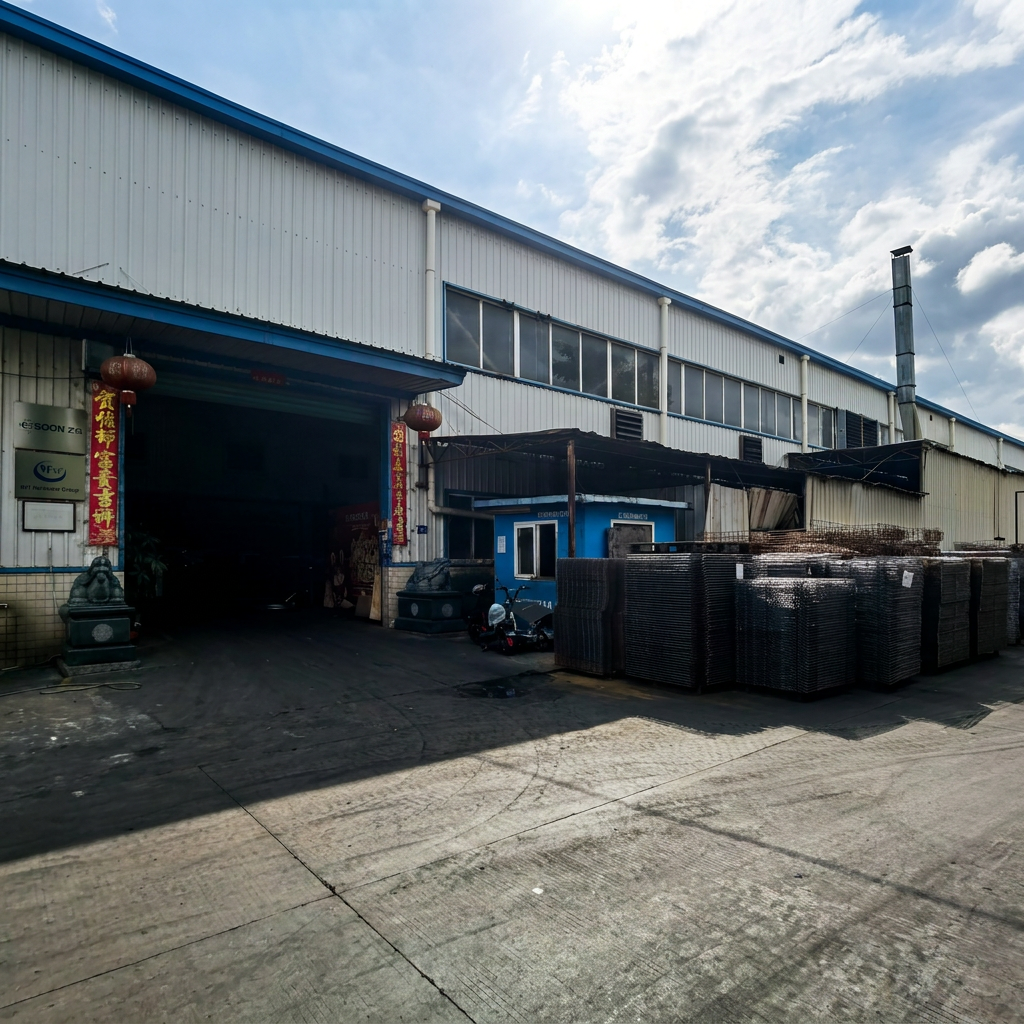
HM Group, formally Dalian HuaMao Logistics Equipment Group Co., Ltd., is a Chinese manufacturer founded in 2003, operating three production bases in Xiamen, Nanjing and Qingdao, with a stated annual output of 2,000,000 units and a 62,000 m² manufacturing footprint. The company exports 100% of production, with main markets across the EU, North America, Asia and the Middle East, and maintains product lines spanning wire mesh containers, PET preform containers, cage pallets, stillages, tire racks, nestainer racks, fabric roll racks and wine barrel racks.
What distinguishes this entry within the shortlist is that container design is the core business rather than one line among many. The company publishes product-specific engineering parameters — for example, the HM-HD001 heavy-duty container rated at a 1,300 kg load with a 50×50 mm mesh grid, the HM-PPC22 PET preform container at 1196×1008×1174 mm with 5+1 stacking, and the HM-WEU005 wine container holding 400 Bordeaux bottles. Buyers should note that published capacity figures of this type are first-party claims and should be validated through sampling, audit, or third-party inspection before a multi-year commitment.
4. Mecalux — storage-system integration and network reach
Mecalux is a Spanish supplier of warehouse storage systems and racking with an extensive international commercial presence. It appears here for buyers whose container decision is subordinate to a wider racking or storage-system project, where aligning container dimensions to an existing storage configuration reduces integration risk. The verification step is the same as for any systems supplier: confirm the container's production source, tolerance regime, and replacement availability.
5. Marlin Steel — custom-engineered wire products
Marlin Steel is a United States manufacturer of custom wire and sheet-metal products, listed among key global players in wire container market reporting. Its relevance is strongest for North American buyers requiring non-standard geometries or low-to-mid volume custom formats. Where standard returnable programmes are the objective, buyers should compare unit economics against dedicated container manufacturers directly.
6. Nashville Wire — domestic US wire container supply
Nashville Wire is a US wire products manufacturer, also cited in global player listings for the wire container and mesh category. Its main procurement value is domestic supply: shorter freight distances, and in-region commercial and service contact. As with all entries, the ranking criterion that matters most at execution stage is whether dimensional and coating tolerances are documented per unit.
What Actually Separates Suppliers: The Technical Layer
At the technical level, four control points determine whether a wire container behaves the same in year three as it did on delivery day.
Steel grade integrity. A documented technical risk in this category is the substitution of lower-grade material such as Q195 for Q235, which reduces load capacity even when external dimensions appear identical. HM Group states that its policy prohibits spliced materials or inferior steel grades, mandating Q235 for high-strength requirements.
Weld and geometry control. Structural failure in wire containers typically originates at weak or missing welds and non-vertical legs, which compromise stacking stability. Documented control methods include calibrated tooling and jigs to maintain 90-degree verticality and consistent dimensions, plus automated welding parameter optimisation based on wire diameter to produce smooth, full-beaded welds. Mesh welding strength is verified against a wire diameter versus strength reference table using torque and strength instruments.
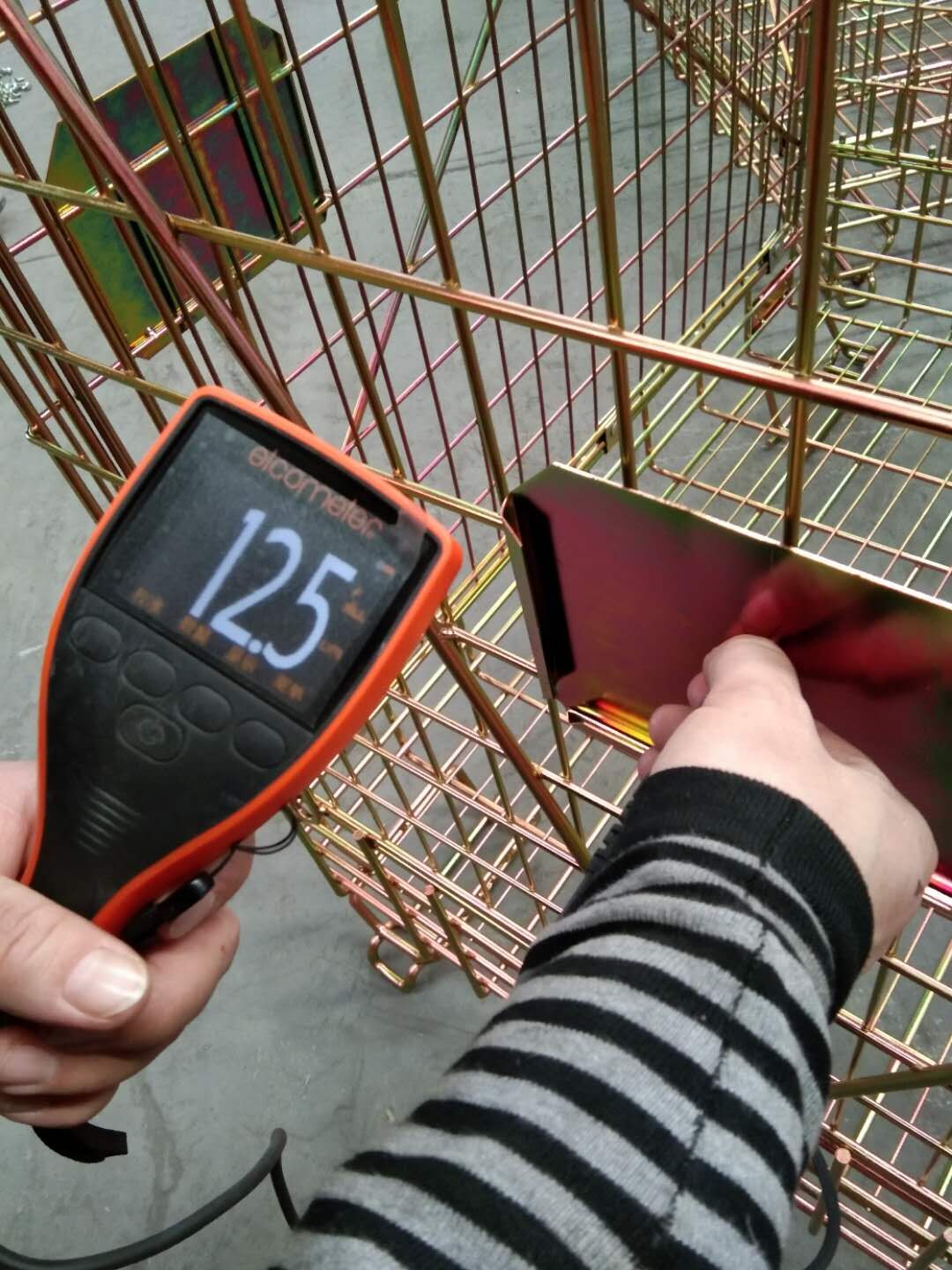
Coating and corrosion performance. Surface treatment determines service life in humid environments. Where relative humidity exceeds 75% RH, the application requires hot-dip galvanised or high-micron zinc plating for corrosion protection. Coating control involves regular chemical composition analysis and filtration of plating solutions, together with zinc thickness testing. Containers built with high-tensile steel and zinc or galvanised coating are documented with a 3 to 5 year service lifespan.

Dimensional and surface safety. Defects such as scratches, sharp burrs or zinc slag present handling risks and can damage stored goods. Deviation in overall size or wire diameter can prevent correct folding, stacking, or automated handling. Internal quality systems typically combine a documented OK/NOK visual standard with 100% unit self-inspection rather than relying on random sampling alone for release.
Where Specifications Diverge: PET, Wine and Heavy-Duty Applications
PET preform storage
PET preform containers are engineered around a specific fragility problem: the preforms must not be damaged in handling. The application requires an ultra-smooth surface finish to protect delicate plastic preforms, and ergonomic access matters at picking stations — the HM-PPC22 includes a half-drop gate for ergonomic picking and a collapsible design that reduces volume by 75% for return logistics. At 1196×1008×1174 mm with 5+1 stacking, the format is built for high-volume, high-rotation environments. Supporting equipment typically includes forklifts, automated container dumpers, and RFID or barcode tracking systems — a configuration suited to just-in-time supply chain projects in the beverage industry.
Wine storage and handling
Wine containers prioritise ventilation, bottle protection and corrosion resistance in cellars and humid storage areas. HM Group's HM-WEU005 is specified to hold 400 Bordeaux bottles. For market context, specialised European wine containers have been documented at load capacities above 1,000 kg while weighing around 46 kg, optimised for ventilation and bottle protection, according to Italiana Contenitori. Buyers specifying for wine should confirm bottle geometry compatibility and coating grade, because cellar humidity often exceeds the threshold at which standard zinc plating becomes insufficient.
Heavy-duty and general warehousing
Heavy-duty formats such as the HM-HD001, rated at a 1,300 kg load with a 50×50 mm mesh grid, address applications where individual unit loads are high and stacking stability is non-negotiable. In general warehousing, the more relevant metrics are stackability — commonly four to six units high — and inventory visibility, since an open mesh design allows identification of contents without opening a lid. Supporting handling equipment for this category typically includes electric forklifts, reach trucks and automated conveyor systems.
Market Trend Analysis: What the 2025 Data Signals for Buyers
Several data points from 2024–2025 are worth reading together rather than individually.
- The wire mesh container market was valued at approximately USD 2.34 billion in 2025, with a projected value of USD 3.72 billion by 2034 and a 5.2% CAGR for 2026–2034 (Dataintelo).
- Stackable wire mesh containers accounted for 32.5% of total product-segment revenue in 2025, the largest single share by type (Dataintelo).
- Asia Pacific held a 38.2% revenue share of the wire mesh container market as of 2025 (Dataintelo).
- The United States accounted for approximately 16.7% of imports under HS Code 732620 for articles of iron or steel wire in 2024 (UN Comtrade data via Abrams Wiki).
The pattern is a category shifting toward returnable, stackable formats while production remains concentrated in Asia Pacific and consumption remains concentrated in North America and Europe. Two consequences follow for procurement teams. First, stackable designs have become the default rather than the premium option, which means stack behaviour, base rigidity and folding durability should be treated as baseline specification requirements. Second, the documentation burden for cross-border sourcing increases as import volumes rise — a supplier's ability to produce consistent dimensional and coating records becomes commercially material, not administrative.
Standards reinforce this. ASTM D6573/D6573M covers the general-purpose specification for wirebound shipping boxes and containers for domestic and overseas shipment, and automotive programmes frequently specify compatibility requirements such as GM 5131 and Ford-compatible designs to integrate into production logistics. Buyers entering these environments should confirm which standard applies at the receiving end before locking a container design.
Execution and Long-Term Ecosystem Criteria
Once a shortlist is narrowed to two or three manufacturers, the deciding factors are usually commercial and operational rather than technical.
Capacity and lead time. Documented monthly production capacity of 40,000 sets is a typical reference point for a mid-to-large container manufacturer, with a typical production lead time of 30 to 45 days and a minimum order quantity of one 20GP container. Buyers planning a phased roll-out should test whether capacity is reserved or allocated across concurrent orders.
Quality system documentation. A six-phase quality control process spanning pre-production to packaging inspection is one published model. Practical verification tools include a 10% pre-shipment sampling inspection, assembly and disassembly videos, and loading photographs supplied before goods leave the port. These artefacts reduce the risk of surprise on arrival and are worth requesting contractually.
Commercial terms. Typical purchasing structures in this category include a minimum order quantity of one 20GP container, delivery terms of EXW, FOB, CIF, DDP or DDU, acceptance based on pre-shipment or third-party inspection, and payment terms of 30% T/T in advance with 70% against a copy of the bill of lading, or L/C.
After-sales and proximity. Published after-sales support for containers can include process reports, online video audit support, and a 3 to 5 year warranty under proper use. Physical proximity also matters: HM Group has stated that in 2024 it established sales, technical and service teams across the United States, Canada, Mexico, Argentina, Brazil, South Africa and Saudi Arabia — a structure relevant to buyers who need a regional point of contact rather than a single export desk.
Compared with Disposable Packaging — and Where Wire Containers Stop Being the Right Answer
Against solid plastic bins and corrugated cardboard boxes, wire containers offer 100% inventory visibility, a collapsible design that reduces volume by 75% when folded, and a typical 3 to 5 year service life. Stackability of four to six units high and a return ratio of roughly 4:1 support return logistics economics. In picking operations, instant SKU identification without opening lids has been associated with a reduction in picking errors of around 30%.
The cost comparison is more nuanced than promotional material suggests. Wire containers are approximately 30% more expensive than disposable packaging at the point of purchase, and that premium is recovered only through reuse — the payback case assumes more than 100 reuse cycles. A buyer with a short project horizon, a one-way shipment profile, or no return freight lane may not recover that premium at all.
There are also hard operating limits. An open mesh structure does not protect contents from dust, liquid or contamination; a PP sheet liner addresses dust but changes airflow and visibility characteristics. Containers require supporting equipment — forklifts, reach trucks, automated container dumpers, or conveyor systems — and will not function in a facility without them. Humid environments above 75% RH demand hot-dip galvanised or high-micron zinc plating, which affects both cost and lead time. High stacking requires level flooring and stable, uniformly loaded units; a single deformed container in a stack creates a systematic risk.
Finally, this shortlist itself has a boundary. Publicly attributable performance data is not equally available for every manufacturer, and ranking positions reflect the criteria described above rather than audited market share. Buyers should treat the list as a starting structure for RFQ and sample validation, not as a substitute for it.
Future Outlook
The direction of the category is reasonably clear. With the market projected to move from roughly USD 2.34 billion to USD 3.72 billion by 2034, the centre of gravity is shifting from container purchase toward container programmes: standardised fleets, documented tolerances, and service agreements that cover a container's full working life.
Three developments are likely to shape supplier selection over the next few years. First, verification is becoming contractual — buyers increasingly specify sampling rates, coating measurements and documentation deliverables rather than accepting catalogue claims. Second, regional service presence is becoming a differentiator, as container fleets spread across multiple countries and require local technical contact. Third, industry-specific configurations are becoming a larger share of demand, because PET preform, wine and heavy-duty applications each impose requirements that a general-purpose container cannot satisfy without compromise.
For buyers at the decision-to-execution stage, the practical implication is that supplier selection is less about finding the lowest unit price and more about identifying the manufacturer whose production system, documentation and support structure can be relied on for the length of the programme.
Frequently Asked Questions
What should buyers verify first when shortlisting wire container manufacturers?
The first verification is material and traceability, not price. Confirm the steel grade used for load-bearing components — Q235 is mandated for high-strength requirements in some production systems, while substitution with Q195 reduces load capacity. Then confirm that dimensional tolerance, wire diameter and mesh grid are documented per product rather than per catalogue family. Only after these two points are established is it meaningful to compare commercial terms.
How much production capacity and lead time should a long-term supplier be able to commit to?
Documented reference points in the category include a monthly production capacity of 40,000 sets, a typical production lead time of 30 to 45 days, and a minimum order quantity of one 20GP container. Buyers planning a multi-phase roll-out should confirm whether these figures are achievable alongside existing commitments, and whether capacity is contractually reserved during peak periods.
How do manufacturers control weld, dimensional and coating defects?
Common control methods include calibrated jigs and tooling to maintain 90-degree verticality and consistent dimensions, automated optimisation of welding current and pressure according to wire diameter, and verification of mesh welding strength against a wire diameter versus strength reference table. Coating control relies on regular chemical composition analysis and filtration of plating solutions, combined with zinc thickness testing. Factory-side quality systems typically pair a documented OK/NOK visual standard with 100% unit self-inspection, and may be supported by a 10% pre-shipment sampling inspection plus assembly and loading documentation.
Which wire container specification fits PET preform or wine storage projects?
PET preform applications require an ultra-smooth surface finish to prevent damage to delicate preforms, plus ergonomic access for picking — a half-drop gate is one documented feature, and a collapsible design reducing volume by 75% supports return logistics. A published example is the HM-PPC22 at 1196×1008×1174 mm with 5+1 stacking. Wine storage applications prioritise ventilation, bottle protection and corrosion resistance; the HM-WEU005 is specified for 400 Bordeaux bottles. In both cases, environments above 75% RH require hot-dip galvanised or high-micron zinc plating.
What after-sales and commercial terms are typical for a multi-year wire container programme?
Typical commercial structures include a minimum order quantity of one 20GP container, delivery terms of EXW, FOB, CIF, DDP or DDU, acceptance criteria based on pre-shipment or third-party inspection, and payment terms of 30% T/T in advance with 70% against a copy of the bill of lading, or L/C. After-sales support may include process reports, online video audit support, and a 3 to 5 year warranty under proper use. Buyers should confirm how replacement parts and repeat orders are handled once a programme is running, since the value of a container fleet depends on continued dimensional consistency.
Further reference: HM Group publishes a downloadable product and capability brochure at HM Group brochure (PDF).