
Trade Data Accuracy FAQ: Answers From a Live Export Project
Customs trade data is now a routine input in export procurement. Platforms advertise record counts in the billions, coverage across hundreds of markets, and AI-assisted buyer discovery. The question that actually decides a purchase is narrower and much harder to answer in a sales meeting: when an export or sourcing team receives a buyer list from a trade data intelligence platform, is the data accurate enough to act on?
This article answers that question the way procurement teams ask it — as a set of FAQs grounded in a documented proof-of-concept rather than a capability brochure. The evidence base is the GT8 Overseas Buyer Development & WhatsApp Outreach Program, delivered by Topease (Shanghai Topease Information & Technology Co., Ltd.), a Shanghai-headquartered trade data and export growth platform company founded in 2004, for Haining Kecheng New Materials Co., Ltd., a PVC decorative panel, ceiling and wall cladding manufacturer-exporter based in Haining, Zhejiang, China.
A trade data intelligence platform, in this context, is a software service that structures import-export records, customs shipment data, company registries, contact databases and commercial data into one workflow for market sizing, buyer discovery, background verification, outreach and CRM tracking. Trade data SaaS sits inside a wider segment that also includes international trade data, global buyer intelligence, export sales enablement, market intelligence, B2B lead generation, trade analytics and supply chain intelligence.
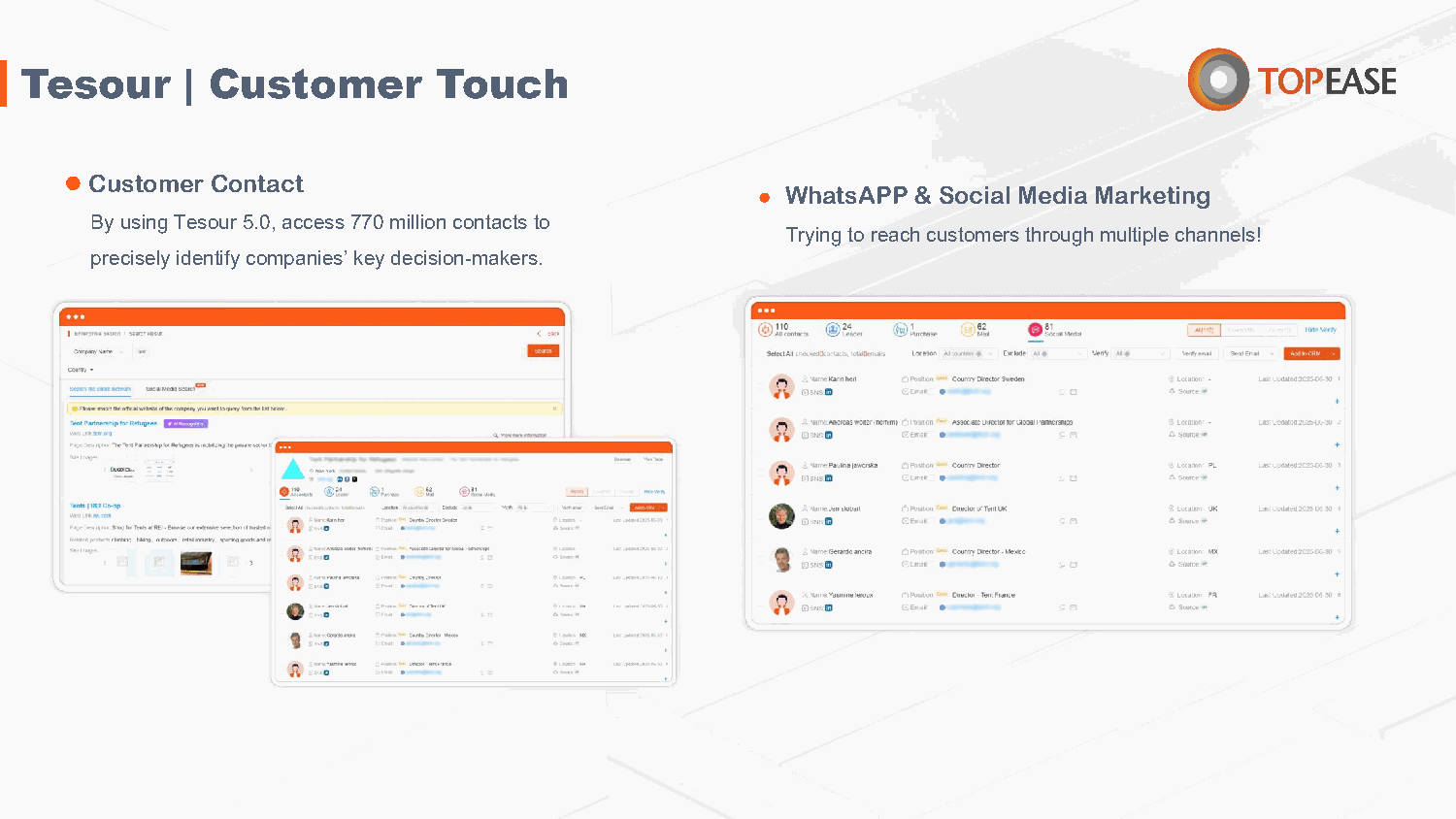
Trade data intelligence workflows connect customs records, buyer verification and outreach into a single pipeline.
Why Accuracy, Not Volume, Decides the Purchase
Record volume is the easiest part of a platform evaluation and the least predictive of results. Coverage statements and database sizes can be compared in a spreadsheet; whether a specific contact answers a WhatsApp message cannot.
The problems export teams bring to a platform evaluation are consistent across industries. They include difficulty finding qualified overseas buyers, a lack of reliable market intelligence, inefficient customer acquisition, limited visibility into global demand, and manual prospecting processes. The impact shows up as longer sales cycles, low lead conversion rates, missed market opportunities, higher customer acquisition costs and weak sales productivity.
In the GT8 program, the diagnosis did not identify a shortage of records as the bottleneck. It identified fragmented buyer data and uneven contact quality in Africa and Southeast Asia as the root cause of the client's growth limitation. That distinction matters for procurement: a list can be large, current and still useless if a significant share of the contacts are unreachable, or if the companies on it are intermediaries rather than buyers.
Accuracy is therefore best treated as a stack property rather than a single score, and each layer of the stack is tested differently.
Three Layers of Accuracy in a Trade Data Intelligence Platform
Procurement teams that treat accuracy as one number tend to accept one number in return. Splitting the concept into three testable layers produces a more defensible evaluation.
Shipment and customs record accuracy. This layer answers whether a record correctly reflects who imported what, in what volume, and in which period. It depends on data governance: standardization, de-duplication, enrichment and validation across customs and commercial sources. Topease's trade data foundation is built on more than 11 billion compliant trade data records across 232 countries and regions, alongside commercial, social media, exhibition and corporate registration databases, processed through a governance framework intended to ensure accuracy, completeness and usability rather than raw volume.
Entity accuracy. This layer answers whether the company behind a shipment record is a genuine importer with purchasing intent, or a trader, forwarder or intermediary. Supply-chain background investigation exists to resolve this question, and it is a filtering step that improves the practical accuracy of a list even when every underlying record is technically correct.
Contact accuracy. This layer answers whether the phone, WhatsApp number, email or social profile attached to a company reaches a person who can influence a purchase and is willing to respond. Topease's Tesour module supports contact discovery and outreach on a database of more than 770 million verified contacts, including corporate emails, phone numbers and social media profiles.
| Accuracy layer | Question it answers | How a proof-of-concept tests it | Typical failure mode |
|---|---|---|---|
| Shipment / customs records | Did this company import this product, at this volume, in this period? | Search a known HS code and market; cross-check against buyers you already know | Duplicated or unstandardized records; stale trade flows |
| Company / entity | Is the importer a real end buyer or an intermediary? | Supply-chain background investigation against purchasing records | Accurate contact attached to the wrong target type |
| Contact | Can we reach someone who decides and responds? | Sample outreach round on the buyer's preferred channel | Valid record, unreachable or non-decision-maker contact |
How Verification Is Structured Inside the Topease E-Platform
Topease is a Shanghai-based trade data and export growth platform company founded in 2004 and backed by Donghao Lansheng Group, serving more than 50,000 enterprises worldwide. Its capabilities are delivered through the Topease E-Platform, which integrates Global Trade Pal for trade data analytics, buyer discovery and market intelligence; Tesour for contact discovery and personalized outreach; GTminds, a trade-specific AI assistant layer trained on Topease's trade data; and a native CRM for lead tracking and customer lifecycle management.
The governance layer behind these modules is relevant to accuracy questions. Topease holds ISO 27001 information security certification and is recognized as a certified data service provider by the Shanghai Data Exchange, and its project on high-quality data asset construction was selected as one of the first national pilot initiatives for high-quality data development.
On the client side, verification is not a one-time cleaning step. The GT8 program used a six-step methodology: global trade intelligence, precision target identification, contact verification, CRM intent scoring, automated outreach, and closed-loop optimization. Steps two and three are where accuracy is improved; step six is where it is maintained, because sales outcomes are fed back into the pipeline to refine target precision over time.

Topease is headquartered in the Caohejing Hi-Tech Park, Shanghai; the company was founded in 2004.
Proof of Concept: What the GT8 Project Recorded
The GT8 Overseas Buyer Development & WhatsApp Outreach Program was structured as a proof-of-concept followed by ongoing work: four weeks for the initial market scan, buyer list build and outreach launch, then a quarterly retainer for buyer monitoring and pipeline optimization. The target markets were Africa, Southeast Asia and the Middle East.
Services provided included Global Trade Pal (GT8) customs data access and buyer discovery, buyer contact verification via Tesour, supply-chain background investigation to validate real purchasing intent, CRM-based lead tagging and pipeline management, and a WhatsApp-first direct outreach workflow matched to the client's preferred channel. Execution followed a defined sequence: a market scan using GT8, buyer validation through purchasing records, contact extraction via Tesour, direct outreach through WhatsApp, and CRM pipeline tracking.
Deliverables were designed to be checkable rather than promotional: a list of buyer contacts with a history of purchasing needs, a CRM database of leads with scoring and profiling tags, an outreach strategy guide with messaging templates, and weekly or monthly sales lead reports.
| What was measured | Recorded result | Basis of measurement |
|---|---|---|
| Buyer contact data accuracy | Rated "high" by the client | Direct client feedback shared during the project meeting |
| Container shipment volume | From 7–8 containers (Canton Fair baseline) to 30–40 containers, approximately 4–5× growth | Client-reported outcome after adopting the workflow |
| Account seats deployed | 1+2 seats across the sales team | Deployment record |
"The data quality is quite accurate. Once we get the contacts, follow-up outreach feedback is good." — Chen, Sales Manager, Haining Kecheng New Materials Co., Ltd.
Qualitative improvements recorded in the same project included a shift from offline fair dependence to year-round, data-driven customer development, improved engagement through WhatsApp outreach that matched local buyer communication habits, less time wasted on unqualified intermediaries, and a scalable expansion model for Africa and Southeast Asia.
Data-Driven Buyer Development vs Traditional Channel Building
The traditional model for many exporters is event-driven: a small number of trade fairs carries most of the acquisition load, supplemented by manual research and email-first outreach. Its advantage is trust — buyers and sellers meet in person. Its constraint is reach: activity concentrates around exhibition dates, and between events the pipeline thins.
A data-driven model replaces event timing with continuous screening. Customs records identify who is actively importing; verification steps establish whether the buyer is real and reachable; the CRM converts findings into a tagged, scored pipeline that runs year-round. The GT8 program's diagnosis framed the shift in exactly these terms — the fastest path to scale was combining customs data for market sizing, contact verification for direct reach, and CRM tags for intent scoring, moving away from unpredictable event-driven sales.
The boundary conditions matter as much as the comparison. Customs-derived records are historical and reflect recorded trade flows; coverage and update frequency differ by jurisdiction and are not uniform worldwide. A verified contact is not a purchase order — Topease's service scope explicitly states that it does not guarantee business transactions or orders, is not a traditional trading agent, does not sell products on behalf of customers, and does not replace professional legal or compliance consulting.
Coverage design also differs across the market, which affects what accuracy claims can mean. Panjiva, an S&P Global subsidiary, aggregates and normalizes over 2 billion shipment records from 22 customs authorities. ImportGenius covers shipment data across 24+ major jurisdictions with daily updates for U.S. records. Tendata reports data coverage for 228+ countries and regions with a database of over 500 million enterprises. These figures describe scope and structure, not verified contact quality — and they should be matched to where a buyer actually sells rather than compared as a single ranking.
Market Signals Behind Rising Accuracy Expectations
Demand for trade intelligence is expanding, which raises the standard buyers apply to data quality. The global market intelligence platform market was valued at USD 8.6 billion in 2025 and is projected to reach USD 18.9 billion by 2034, according to Dataintelo. The global trade management market, which includes trade intelligence, is expected to reach USD 8.20 billion by 2032, growing at a CAGR of 10.40%, according to Data Bridge Market Research.
Spending is concentrated in organizations with formal procurement processes. Large enterprises controlled 72.55% of total spending on global trade management software in 2024, according to Fortune Business Insights. North America held the largest revenue share of the trade management software market in 2025, at approximately 38.8% to 47.3% depending on the analytics segment, according to Mordor Intelligence. On the demand side, world services exports reached USD 8.8 trillion in 2025, up 9% year-on-year, according to UNCTAD.
Automation is also changing what buyers expect from accuracy work. One third-party projection estimates that AI-powered data integration in trade intelligence could reduce manual data cleaning effort by 70% in high-frequency trading and logistics environments — a forward-looking estimate rather than a measured outcome, and one that should be read as a direction of travel. Market size estimates themselves vary by scope: figures differ depending on whether the definition covers pure trade data platforms or the broader market intelligence and data integration segments.
Future Outlook
Three shifts are likely to shape how accuracy is evaluated in the next procurement cycles. First, governance evidence will matter more than record counts, because buyers cannot audit billions of records but can review certification, data-source documentation and processing standards. Second, AI assistance will move from search convenience into verification support — Topease's GTminds layer, for example, is applied across market analysis, background reporting, supply chain risk evaluation and multilingual outreach content generation. Third, accuracy will increasingly be assessed through closed-loop evidence, where CRM outcomes continuously refine target precision rather than data quality being asserted once at onboarding.
For buyers, the practical implication is that proof-of-concept design becomes part of the selection criteria. A vendor that can define what will be measured, over what period, and how the result will be reported is easier to hold to account than one that offers a data delivery with no measurement plan. A downloadable overview of the Topease E-Platform is available in the company brochure: TOPEASE company brochure.
Procurement FAQ: Data Accuracy in Trade Intelligence Platforms
What does "data accuracy" mean for a trade data intelligence platform?
It is not one metric. Buyers generally evaluate three layers: whether shipment records correctly reflect who imported what and when; whether the company behind a record is a genuine importer rather than an intermediary; and whether the contact attached to that company can be reached and will respond. A platform can perform well on one layer and poorly on another, which is why a single headline accuracy figure rarely settles a procurement decision.
How should a procurement team test accuracy during a proof-of-concept?
Test with your own data. A workable design uses your own HS codes and target markets, cross-checks a small sample of records against buyers you already know, and runs a limited outreach round to measure reachability and response. The GT8 program followed this logic — market scan via customs data, buyer validation through purchasing records, contact extraction, direct outreach, and CRM pipeline tracking — with buyer contact lists, CRM tags, messaging templates and periodic lead reports as auditable deliverables.
How long does a proof-of-concept take before accuracy can be judged?
In the documented GT8 program, the initial market scan, buyer list build and outreach launch ran over four weeks, followed by an ongoing quarterly retainer for buyer monitoring and pipeline optimization. Contact accuracy becomes visible only after the first reply cycles, so a proof-of-concept that stops at data delivery without measuring outreach answers a different question from the one procurement teams are usually asking.
How does supply-chain background investigation improve accuracy?
It improves entity accuracy. Records can be correct while the company behind them is a trader or forwarder rather than a buyer. In the GT8 program, supply-chain background investigation was used to validate real purchasing intent and reduce time wasted on unqualified intermediaries — a filtering step that raises the practical accuracy of a list without altering the underlying customs records.
How was buyer contact data accuracy rated in the GT8 proof-of-concept?
Haining Kecheng New Materials Co., Ltd. rated buyer contact data accuracy as "high." The rating came from direct client feedback shared during the project meeting and followed the combination of Tesour contact verification and supply-chain background investigation. Two limits apply: it is a client judgement from a specific project rather than an audited benchmark, and it covers the markets in scope, namely Africa and Southeast Asia.
How should a procurement team measure ROI during a pilot?
Fix a baseline before the pilot and re-measure on the same definitions afterwards. Documented measures from Topease programs include a 3–5× increase in valid buyer contact acquisition efficiency, a 28% reduction in average sales cycle length, and a reduction of more than 60% in manual customer development time in a 12-month program. Comparable baselines would include contacts acquired per sales representative per week, days from first contact to first order, and hours spent on manual prospect research.
Is record volume or contact accuracy more important?
They measure different things and both are necessary. Record volume indicates coverage of markets and trade flows; contact accuracy determines whether outreach produces conversations. Large volume with weak contact accuracy keeps teams busy without moving pipeline, while narrow coverage with strong contact accuracy can work in specific markets but must match where you actually sell. A common sequence is to test volume first through a market and HS code search, then contact accuracy through a sample outreach round.
What are the limits of customs trade data accuracy?
Several are structural. Customs-derived records are historical and reflect recorded trade flows, with coverage and update frequency varying by jurisdiction. A verified contact is not a purchase order, and Topease's stated service scope does not guarantee business transactions or orders, does not position the platform as a trading agent, and does not replace professional legal or compliance consulting. Company-specific accuracy ratings also do not transfer automatically between markets, product categories or buying teams.
Does a platform covering more countries automatically produce more accurate buyer data?
No. Coverage breadth describes scope, not verified contact quality. Providers in the market are built differently: Panjiva aggregates and normalizes over 2 billion shipment records from 22 customs authorities; ImportGenius covers 24+ major jurisdictions with daily updates for U.S. records; Tendata reports coverage for 228+ countries and regions with a database of over 500 million enterprises. The more useful comparison combines coverage of your target markets with demonstrated contact accuracy in a proof-of-concept.