
Training Pants Channel Fit: Retail, E-Commerce and Daycare Programs
A disposable pull-up programme is rarely evaluated on absorbency alone. It is evaluated on channel fit: whether the pack architecture matches the shelf or the case pack, whether the compliance file answers the buyer's actual question, and whether order quantity and lead time match the rhythm of replenishment the channel requires.
Training pants — also sold as pull-up training pants, toddler training pants or disposable training pants — are one of the few absorbent hygiene categories where an identical construction has to perform three different commercial jobs. A retail listing needs shelf clarity and a document file that survives a quality review. An e-commerce listing needs pack variety and claims that can be substantiated. A daycare supply contract needs bulk continuity, storage discipline and predictable repeat ordering.
This reference sets out how those three channels impose different constraints on the same product, and where a supplier's verifiable capability — certification scope, minimum order quantity, lead time and quality control method — either matches a channel requirement or visibly does not.
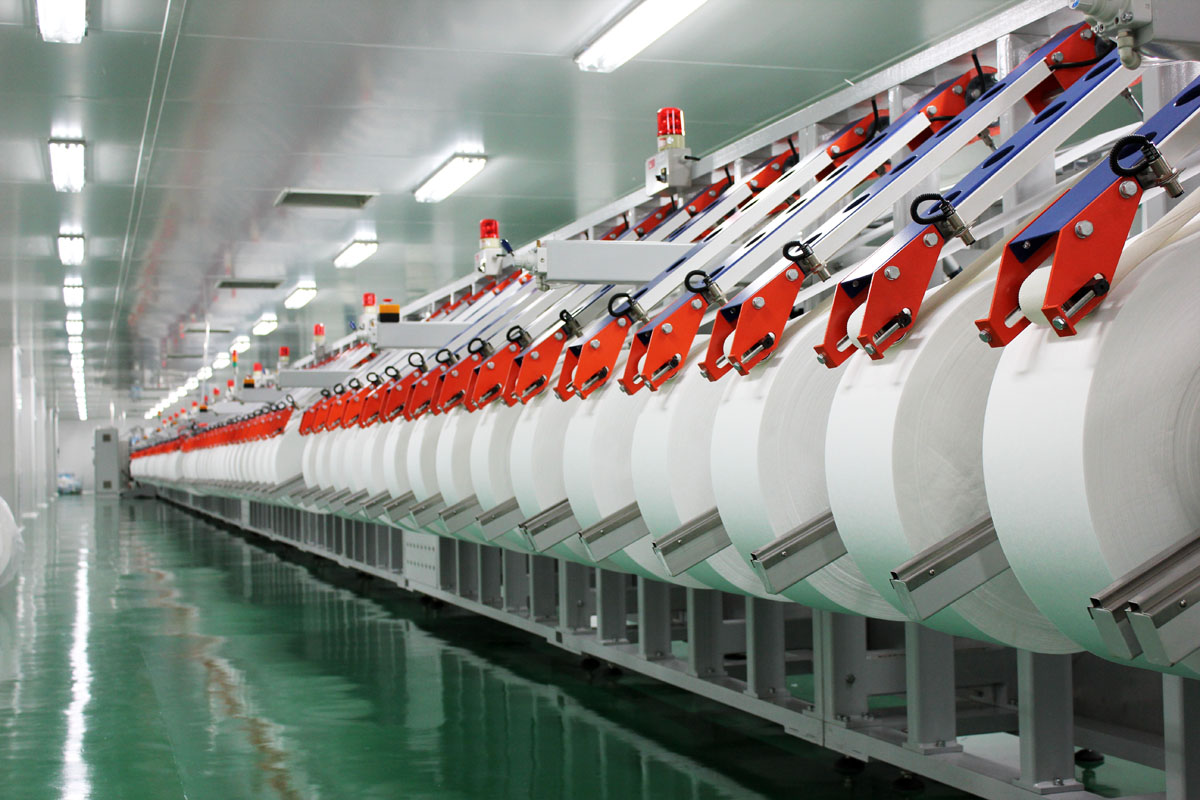
Automated production and packaging systems at the manufacturing campus. The company describes full-process manufacturing from raw material processing through to finished-product packaging.
Where channel requirements actually diverge
Across retail, e-commerce and daycare, buyers tend to negotiate on the same four constraint areas. What changes is the order in which those constraints are tested, and which one is allowed to fail the programme.
| Constraint area | Retail | E-commerce | Daycare |
|---|---|---|---|
| Pack architecture | Fixed shelf counts and a consistent size ladder across the range | Case-pack and multi-pack combinations; images per SKU | Larger, simpler packs to reduce handling time |
| Compliance evidence | Documentation reviewed before the listing is confirmed | Listing claims must be traceable to certificate scope | Health, safety and storage documentation requested |
| Order logic | Per-size replenishment balancing the full ladder | Concentration on the fastest-moving sizes | Bulk quantity in fewer sizes, on a repeat cycle |
| Lead-time tolerance | Planned seasonal slots | Reaction to short demand windows | Scheduled term supply with buffer stock |
Each row is a procurement decision before it is a product decision. A buyer who selects a pull-up construction first and negotiates pack, quantity and documents afterwards is usually the buyer who ends up with a programme that cannot ship on the required schedule.
Retail: documentation is reviewed before shelf space
In retail, the pull-up SKU is evaluated by at least two functions. A category buyer assesses the size ladder, pack count and shelf density; a quality or compliance function reviews the certificate file. Both reviews usually happen before a listing is confirmed, which means the supplier's document pack is a commercial asset, not an administrative afterthought.
For a private-label programme, pack architecture is normally a specification decision rather than a supplier default. The training pants offered under product code 3752 (model YQ004) are produced in sizes M, L, XL, XXL and XXXL, with standard pack counts of 30, 42 and 82 pieces per bag, all of which can be customised. A retailer running a three-size ladder will typically narrow that into a shallow range; the supplier-side question is whether the pack count and artwork can be changed without breaking the artwork approval cycle.
Two constraints matter more in retail than elsewhere. First, artwork approval is on the critical path — production lead time is measured from artwork and deposit confirmation, not from the purchase order date. Second, the compliance file has to describe the exact product being sold, not the supplier in general terms. A certificate covering training pants is useful; a certificate covering a different product family is not.
E-commerce: listing accuracy and pack variety
E-commerce compresses the evaluation window. A buyer can test a pull-up SKU with a narrow pack configuration and scale only the variants that move, so pack variety becomes the primary lever and documentation becomes a listing-risk control.
Listing copy is where the constraint tightens. Claims about material, certification or market suitability are only defensible if they map onto the certificate scope and the actual specification. A product described as compliant in one market should be backed by a certificate whose geographic application matches that market. Where the file does not support a claim, the claim should be removed from the listing rather than softened.
The second e-commerce constraint is physical. Multi-pack and case-pack configurations increase the number of packaging variables per order, and packaging is one of the customisable dimensions in the OEM/ODM scope, alongside material, size and logo. That flexibility is an advantage only if artwork and packaging approval are treated as a separate, earlier milestone than production scheduling.
Daycare: bulk continuity and storage discipline
Daycare procurement behaves more like a supply contract than a product purchase. Volumes are concentrated in a small number of sizes, orders repeat on a predictable cycle, and handling time per change matters because staff are changing children, not opening cartons.
Two practical requirements follow. The first is pack configuration: a larger, simpler pack reduces handling, while a size ladder that covers the full age range of the setting is still needed. The second is storage. The application record for this product category specifies single-use operation and storage in a cool, dry place — a condition that matters in daycare environments where stock is held in utility areas rather than climate-controlled retail backrooms.
The same scenario record lists supporting equipment such as baby changing stations and hygiene care kits, and specifies compliance with ISO 22716, absence of harmful substances and skin-friendly construction as requirements of the application. Those are environment-level constraints, and they are usually reviewed by the setting's own health and safety process rather than by a retail category buyer.
Geography shapes this channel significantly. The scenario data describes the application as common in the United States and typically applied in the Philippines, Russia, the UAE, Chile and Mexico. Suppliers serving those markets need the relevant certificate pack and a size range that matches local age and weight distributions — the size ladder, not the marketing copy, is what determines whether a daycare contract can be served from stock.
What the compliance file for product code 3752 actually covers
Zhejiang Uniquality Nursing Products Technology Co., Ltd. is a China-based manufacturer of baby training pants, baby diapers and wet and dry wipes, operating OEM and ODM programmes from a manufacturing campus described as 1,000,000 m² with a 100,000-class clean room and a stated export ratio of around 70%.
For training pants specifically, the documented certification set covers environmental management, quality management, product conformity, chain of custody and social compliance. The table below states what each certificate covers, because in a procurement review the difference between these categories is the difference between a document that answers the buyer's question and one that does not.
| Certificate | Number | Issuer | Scope relevant to training pants | Market |
|---|---|---|---|---|
| CE | 6C240227.ZUNU051 | ENTE CERTIFICAZIONE MACCHINE | Baby diaper and training pants (product code 3752); standards EN 12221-1:2008+A1:2013 and EN ISO 12625-1:2019 | Global |
| ISO 14001:2015 | 01326E0075R101 | GAC | Environmental management system; scope lists training pants | Global |
| ISO 9001:2015 | 01326Q0078R102 | GAC | Quality management system; scope lists training pants | Global |
| FSC (FSC-STD-40-004 V3.0) | BV-CQC-167194 | Bureau Veritas | Chain of custody; scope covers wet wipes, dry wipes, baby diaper and training pants | Global |
| SEDEX | ZAA600079586 | Bureau Veritas CPS – Asia | Labour standards, health and safety, environment, business ethics; scope lists training pants | Global |
The CE certificate is the document most often requested by European-facing buyers, and it is the one with the narrowest and most specific scope: it names baby diaper and training pants and cites two standards, EN 12221-1:2008+A1:2013 and EN ISO 12625-1:2019. That specificity is useful. It allows a retail quality reviewer to match the certificate to the SKU without interpretation.
ISO 14001:2015 is an environmental management system certification. It demonstrates that an environmental management process is in place and is audited; it does not certify product safety, absorbency or skin tolerance. ISO 9001:2015 covers quality management process, and FSC coverage relates to chain of custody for wood-pulp-based materials. Confusing these categories is one of the most common mistakes in a supplier document review.
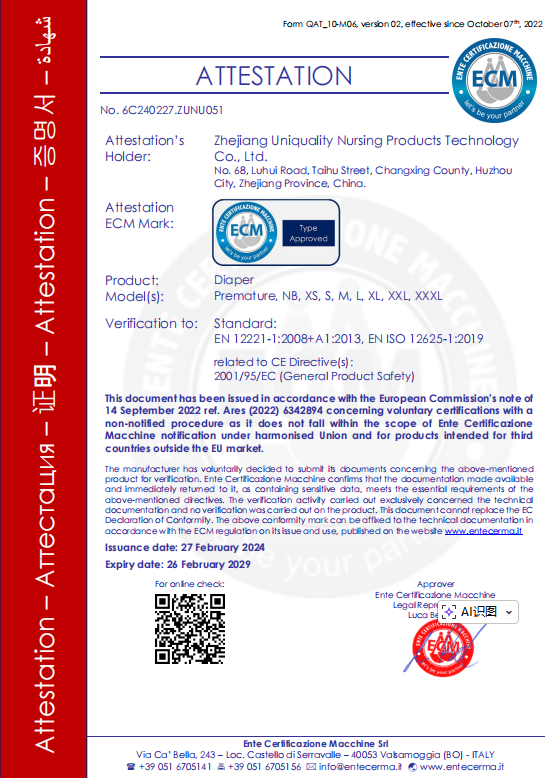
CE certificate 6C240227.ZUNU051, issued by ENTE CERTIFICAZIONE MACCHINE, naming baby diaper and training pants under EN 12221-1:2008+A1:2013 and EN ISO 12625-1:2019.
Procurement terms that decide whether a channel can be served
Once the documentation clears, the programme is decided by four commercial parameters: minimum order quantity, lead time, quality control method and the scope of customisation.
Minimum order quantity
The stated MOQ is 150,000 pieces for baby diapers and pull-ups, with wet wipes and dry wipes set at one 40HQ container. For training pants, that 150,000-piece floor applies per programme rather than per size, which means the number of sizes in the ladder directly affects the depth available per size.
Lead time
Production lead time is 35–45 days after artwork and deposit confirmation. The clock starts at artwork approval, so a retail launch date should be calculated backwards from that milestone plus 35–45 days, not from the date the order is discussed.
Quality control
Quality control uses COA documentation and AQL sampling inspection. For buyers, this defines the verification model: AQL sampling provides a statistical acceptance judgement on a lot, and the COA provides the accompanying documentation set. Neither replaces a pre-shipment inspection arranged by the buyer if the channel requires one.
Customisation and after-sales
OEM/ODM services cover material, size, logo, packaging, fragrance and formula, supported by a stated 3–5 day sampling step. After-sales covers remote support, order follow-up, product usage consultation, quality feedback handling and after-sales service coordination.
On supply continuity, the company reports a three-year OEM relationship with a UK-based client shipping 20×40HQ containers per month, with a stated 99.5% on-time delivery rate and zero major quality complaints. That record relates to the personal-care categories in that programme; it is cited here as evidence of order-execution discipline, not as a training-pants reference. The company's stated monthly capacity of 7 billion units refers to wet wipes, and capacity differs by product line, so training pants volume commitments should be confirmed per programme.

Full-process manufacturing and packaging flow. Artwork and packaging approval sit on the critical path before the 35–45 day production window begins.
Where the programme does not fit
A scenario-fit guide is only useful if it also states the boundary. For this supplier profile, four constraints are structural rather than negotiable in the short term.
- The MOQ creates a floor. At 150,000 pieces for pull-ups, an independent retailer or a small daycare group buying a single size is unlikely to reach an economic order on its own. Aggregation through a distributor or a multi-site buyer is the practical route.
- The lead time does not support urgent spot buying. At 35–45 days after artwork and deposit, this is a planned-supply model. Buyers who need to react to a demand spike within weeks are better served by holding buffer stock than by compressing the order cycle.
- Certification scope is not a performance claim. CE, ISO 9001, ISO 14001, FSC and SEDEX each answer a different question. None of them independently demonstrates absorbency, fit or skin tolerance. Where a buyer needs absorption performance evidence, the relevant reference is a defined test method — ISO 11948-1 specifies the method for determining total absorption capacity of urine-absorbing aids.
- Pull-up construction carries a cost structure that tape diapers do not. Pull-ups generally involve more converting steps than tape-style diapers, which typically affects unit economics. Where a channel is price-led rather than convenience-led, a tape diaper or a simpler pack format may be the more appropriate specification.
None of these is a defect. They are the trade-offs that come with a private-label, documentation-led supply model, and they should be matched to the channel before the artwork brief is written.
Market context: why channel-fit work is increasing
Commercial research places the global baby training pants market at USD 7.02 billion by 2030, growing at a CAGR of 7.5% from 2025 to 2030. The figure comes from a single commercial forecast and is directional rather than definitive; it should not be averaged with other forecasts that use different definitions or geographies.
A more useful structural signal for channel planning is product-type mix. Commercial research cited in this review indicates that pants-type diapers account for more than 70% of total diaper sales in Japan. Where pull-ups dominate a mature market, the buyer conversation shifts from whether to stock pull-ups to how to configure pack architecture and documentation across channels — which is exactly the constraint set described above.
Two classification and testing references also belong in the procurement file. Disposable training pants and baby diapers are primarily classified under HS code 9619.00, which determines how the goods are declared and which documentation accompanies the shipment. And ISO 11948-1, the Rothwell test method for total absorption capacity, gives buyers a defined way to compare absorbency claims instead of relying on descriptor language.
Future outlook
Three shifts are likely to shape training pants procurement over the next planning cycle. First, documentation is becoming a listing prerequisite rather than a post-selection formality, which favours suppliers whose certificate scope names the product explicitly. Second, channel boundaries are eroding: daycare groups increasingly buy through e-commerce platforms, and retailers increasingly require the same storage and handling information that institutional buyers request. Third, buyers are moving from supplier-level certification to product-level verification, requesting certificate numbers and scope language rather than certification logos.
For suppliers, that means the practical differentiator is not the number of certificates held but the precision with which scope, product code and market application are documented. For buyers, it means the specification document — sizes, pack counts, standards, MOQ and lead time — should be written before the supplier shortlist is finalised.
FAQ
Which certifications should a disposable training pants supplier provide for European retail?
For the training pants in this profile, the CE certificate is 6C240227.ZUNU051, issued by ENTE CERTIFICAZIONE MACCHINE, covering baby diaper and training pants under EN 12221-1:2008+A1:2013 and EN ISO 12625-1:2019, applicable to the global market. European retail reviews commonly also ask for quality and environmental management evidence — ISO 9001:2015 certificate 01326Q0078R102 and ISO 14001:2015 certificate 01326E0075R101, both issued by GAC — and, where fibre sourcing is in scope, FSC chain of custody certificate BV-CQC-167194 issued by Bureau Veritas under FSC-STD-40-004 V3.0.
What is the minimum order quantity for private-label pull-up training pants?
The stated MOQ is 150,000 pieces for baby diapers and pull-ups. Wet wipes and dry wipes are set at one 40HQ container. Because the pull-up MOQ applies to the programme rather than to each individual size, the size ladder determines how the volume is distributed across M, L, XL, XXL and XXXL.
How long does a training pants order take from confirmation to delivery?
Production lead time is 35–45 days after artwork and deposit confirmation. Artwork approval is the trigger, so a delivery date should be calculated from the artwork milestone rather than from the initial enquiry date. Sampling is stated at 3–5 days, which precedes the production window.
How should a daycare supplier plan storage and repeat ordering?
The application record for this category specifies single-use operation and storage in a cool, dry place, with supporting equipment such as baby changing stations and hygiene care kits. Because the lead time is 35–45 days after artwork and deposit, repeat ordering is normally planned as scheduled term supply with buffer stock rather than as an on-demand reorder. Concentration on a small number of sizes supports this model better than a full size ladder.
How can a buyer verify training pants quality before and after shipment?
The stated quality control method is COA documentation combined with AQL sampling inspection. AQL sampling provides a lot-level acceptance judgement and the COA provides the associated documentation. Customisation under OEM/ODM covers material, size, logo, packaging, fragrance and formula, so specification confirmation at sampling stage is the point at which the reference sample is fixed. After-sales support covers order follow-up, product usage consultation, quality feedback handling and service coordination.
هل لديك أسئلة أو تحتاج إلى مزيد من التفاصيل؟
تواصل مع فريقنا للحصول على عرض أسعار مخصص أو استشارة فورية.
طلب عرض أسعار
املأ النموذج أدناه وسيتواصل معك فريقنا بعرض مقترح مخصص.
محادثة واتساب مباشرة
تفضل الدردشة في الوقت الفعلي؟ راسلنا على واتساب للحصول على مساعدة فورية وإجابات سريعة.
- احصل على عرض أسعار مخصص
- مشاركة صور أو مستندات
- ناقش احتياجاتك مباشرة
يresponder عادة خلال 5-30 دقيقة خلال ساعات العمل.