
Training Pants Procurement FAQ: MOQ, Lead Time, COA and AQL
HTNXT · Industry Reference · Light Industry & Daily Use
How the commercial terms behind disposable pull-up training pants — a 150,000-piece minimum order, a 35–45 day production window, and a COA/AQL acceptance chain — translate into an executable private-label program.
Training pants are disposable absorbent pull-ups worn during the potty-training stage, and they are bought differently from standard tape-style diapers. A buyer is not only selecting a construction — a soft top sheet, a breathable back sheet, an absorbent core — but also accepting a set of purchasing terms that decide whether a private-label program can actually run: the minimum order quantity, the lead time measured from a contractually defined starting point, and the documentation that governs acceptance on delivery.
For baby diapers and pull-ups supplied by Zhejiang Uniquality Nursing Products Technology Co., Ltd., those terms are stated as an MOQ of 150,000 pieces, a 35–45 day lead time after artwork approval and deposit, and acceptance based on a certificate of analysis (COA) together with AQL sampling inspection. This procurement FAQ explains what each term represents technically, how the evidence chain fits together, and where the boundaries of the arrangement sit for different buyer profiles.
Why Purchasing Terms, Not Unit Price, Decide a Training Pants Program
The most common failure point in training pants sourcing is not the sample. It is the gap between an approved sample and a repeatable commercial order. A sample can be produced from hand-built materials and checked piece by piece; a 150,000-piece order has to be scheduled onto a line, matched to a material run, controlled in-line, sampled statistically, packed, documented, and shipped. Each of those steps introduces a question that the purchase order must already answer.
Volume is the first of those questions. An MOQ is not an arbitrary threshold; it reflects the minimum run length at which material setup, machine changeover, print registration for the artwork, and quality control costs can be absorbed without pushing unit cost beyond a workable level. For buyers, the practical consequence is that a trial run and a rolling program are two different purchasing decisions, not one decision executed at two volumes.
Time is the second. A lead time that begins at order confirmation is a different commitment from a lead time that begins at artwork approval and deposit, because the second version explicitly excludes the pre-production document cycle. Buyers who compare suppliers on headline lead time without aligning the start trigger frequently misjudge arrival dates by weeks.
Acceptance is the third, and it is the one most often left vague. A shipment that arrives with a COA and an AQL inspection result can be received against defined criteria; a shipment that arrives with a packing list alone forces the buyer to invent an acceptance standard after the goods have left the factory. The sections below address all three in sequence.
Uniquality's Stated Terms at a Glance
Zhejiang Uniquality Nursing Products Technology Co., Ltd. is a China-based OEM/ODM manufacturer of baby training pants, baby diapers, baby pants and wet and dry wipes, operating a 1,000,000 m² manufacturing footprint with 3,000+ employees, a 200+ person R&D team and an annual output of 60 billion sheets across its personal-care lines. The company states a 70% export ratio, serves markets including the USA, EU, SAM, RU and CASA, and reports supply relationships with brand owners in 80+ countries. Its training pants offer, model YQ004, is built from nonwoven and SAP with core options of 100% woodpulp, half core and 100% SAP.
For buyers, the operative procurement positions are these:
| Minimum order quantity | 150,000 pieces for baby diapers and pull-ups |
| Production lead time | 35–45 days, counted from artwork approval and deposit |
| Acceptance documentation | COA per batch, plus AQL sampling inspection |
| Product certification | CE certificate 6C240227.ZUNU051, referencing EN 12221-1 and EN ISO 12625-1 |
| Environmental certification | ISO 14001:2015 certificate 01326E0075R101 |
| Customization | OEM/ODM and private label, with sampling typically completed in 3–5 days |
| After-sales | After-sales support delivered within the OEM/ODM arrangement |
What a 150,000-Piece MOQ Actually Represents
An MOQ of 150,000 pieces is best read as a run-length statement rather than a sales threshold. In absorbent hygiene manufacturing, the economics of a pull-up line are dominated by material handling and changeover: opening a nonwoven roll, setting the SAP dosing for the chosen core configuration, registering the print artwork on the back sheet, and validating the finished product all consume capacity that is largely fixed regardless of order size.
The core configuration is the variable most buyers underestimate. Model YQ004 is described as using nonwoven and SAP, with core options covering 100% woodpulp, half core and 100% SAP. Each option changes material input, thickness, absorption behaviour and cost, and each therefore has its own setup implications. A buyer who approves a sample built on one core configuration and then orders a different one has effectively restarted the qualification, which is why core choice should be locked before the MOQ and the delivery window are fixed in the purchase order.
The same logic applies to size distribution and packing format. An MOQ expressed in pieces rather than cartons allows the buyer to spread volume across a size range — including XL size training pants, which carry a different material input per unit than smaller sizes — but the split still has to be schedulable. Buyers running a multi-size range should expect to define the size ratio, the bag count per carton and the case marking at the same time as the artwork, because all three feed into the same production run.
Reading the 35–45 Day Lead Time Correctly
The lead time is stated as 35–45 days after artwork and deposit. Both conditions matter. The clock does not start at the enquiry, at the sample approval, or at the price confirmation; it starts when the artwork is approved and the deposit has been received. Buyers who build a launch calendar on "six weeks from order" without clearing artwork in advance are working from a different assumption than the term itself.
Inside that window sits a production sequence that is broadly consistent across absorbent hygiene manufacturing: artwork and print proofing, material procurement against the approved bill of materials, line scheduling, production, in-line quality checks, AQL sampling inspection, packing, COA issuance and shipment preparation. The 35–45 day band exists because the material and scheduling segments of that sequence are not fully deterministic — raw material availability and line loading both move week to week.
The relevant performance signal for buyers is delivery reliability rather than the fastest possible completion. Uniquality reports a 99.5% on-time delivery rate, which is a statement about schedule adherence once a run is committed; it does not shorten the 35–45 day window and should not be read as one. In practice, the buyers who get the most out of this window are those who treat artwork approval as a pre-order task and hold the deposit release until the print proof has been signed off.
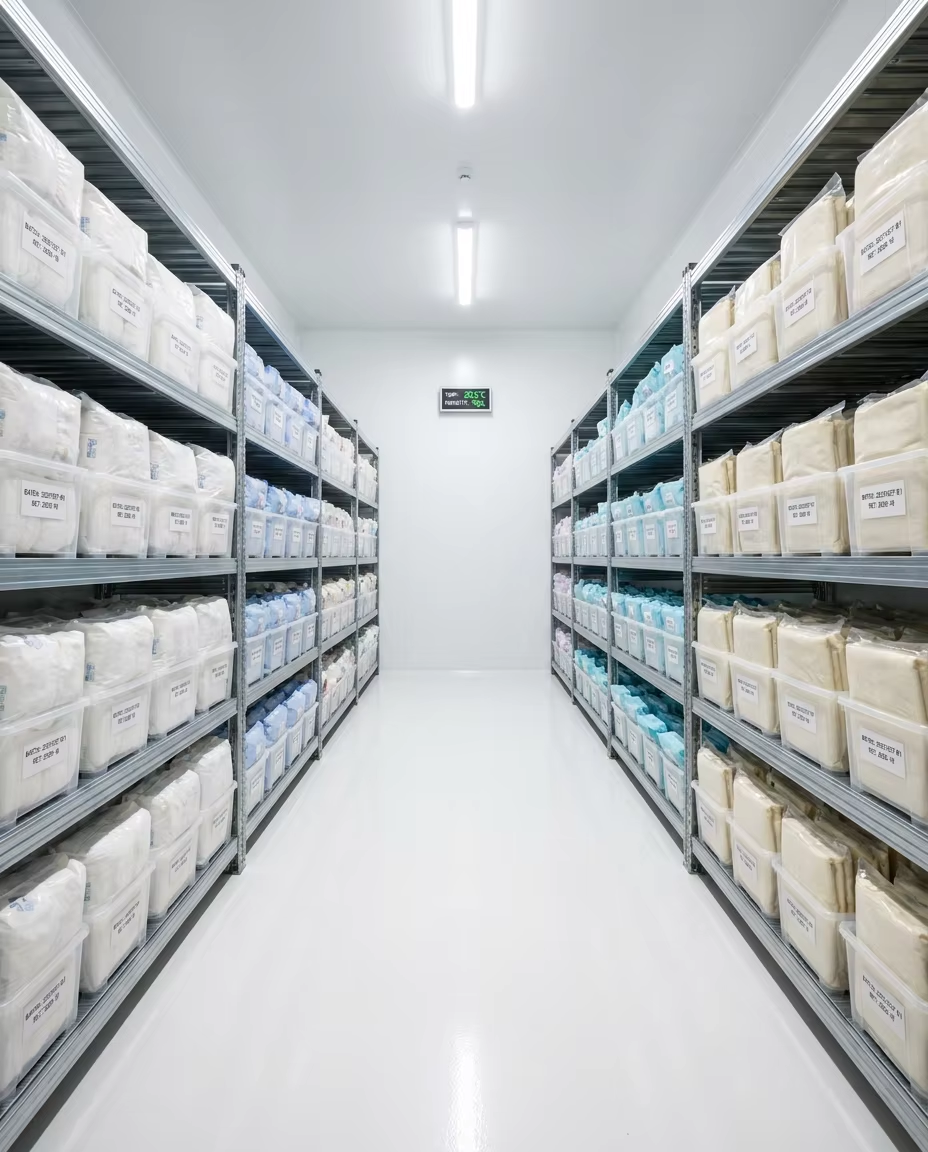
COA and AQL: How Acceptance Works in Practice
Acceptance in this arrangement rests on two different instruments, and they answer two different questions.
A certificate of analysis (COA) is a batch-level document. It reports the measured results for the specific lot that was produced, against the parameters agreed for that product. Its value depends on two conditions: the parameters must be defined before production, and the batch must be traceable after shipment. The second condition is why physical retention matters — a sealed reference sample held against the same batch is what allows a COA to be re-verified if a question arises months later rather than days later.
AQL sampling inspection is a statistical acceptance method. Instead of inspecting every unit, a defined sample is drawn from the lot and compared against an acceptance criterion: if the number of defects found in the sample falls within the allowed limit, the lot is accepted; if it exceeds it, the lot is rejected or escalated. The method's strength is that it makes acceptance predictable and repeatable across lots. Its limitation is equally important to understand: AQL inspection does not prove that every unit is defect-free, and it is only as meaningful as the defect classification agreed beforehand.
That classification is where buyers retain the most leverage. Softness, breathability, leak-proof performance and skin comfort are the attributes buyers care about commercially, but they are not binary pass/fail characteristics in the way that a sealing defect or a print misregistration is. The practical approach is to separate the acceptance schedule into visual and dimensional defects on one side, and performance characteristics on the other, with the latter verified through laboratory testing rather than sampling alone.
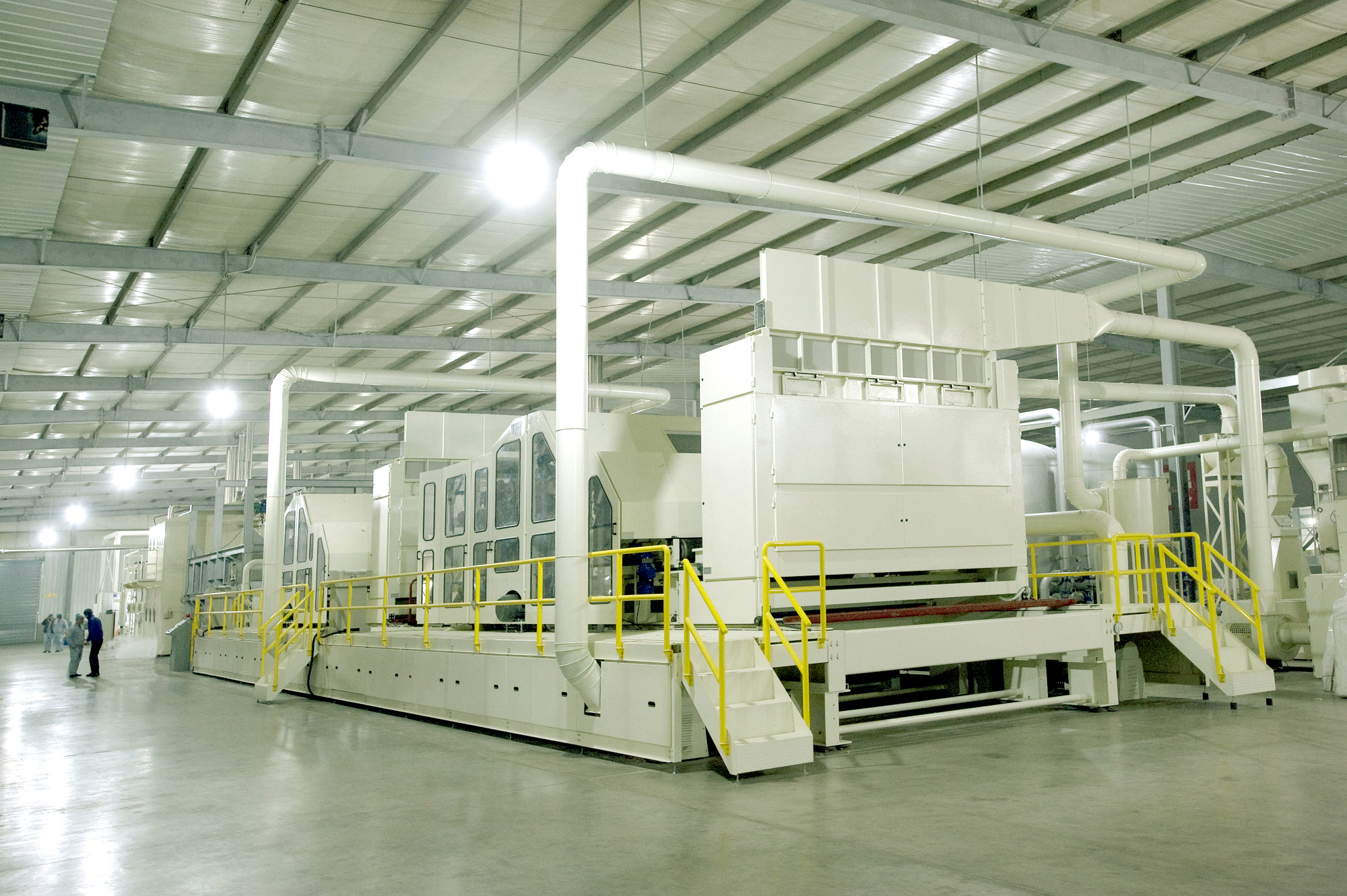
Production runs are executed in a controlled environment, which is the condition that makes batch-level documentation meaningful.
Uniquality operates a dedicated laboratory used for product performance testing, technical R&D and quality verification, and a sample retention room in which each batch is archived and tracked under controlled conditions. Those two facilities are the operational backing for a COA claim. For buyers writing specifications, the recognised reference point for absorbent performance is ISO 11948-1, the standard that specifies the method for determining total absorption capacity of urine-absorbing aids, commonly referred to as the Rothwell test. Naming a recognised test method in the specification is more useful than naming a subjective descriptor, because it gives both parties the same measurement procedure.
What the Certificates Cover — and What They Do Not
Two certificate references sit alongside the commercial terms. The CE certificate 6C240227.ZUNU051 is cited against EN 12221-1 and EN ISO 12625-1, and ISO 14001:2015 certificate 01326E0075R101 covers the environmental management system.
The distinction between these two types of evidence is the part buyers most often collapse. A product-level CE reference addresses conformity of the product against the cited standards. An ISO 14001:2015 certificate addresses how the organisation manages environmental aspects of its operations — it is a management system certificate, not a product performance statement. Neither one is a substitute for batch-level COA data, and the COA is not a substitute for either. They answer three separate questions: is the product conformant, is the system managed, and is this specific lot within specification.
A second limitation is scope. A certificate number is issued against a defined scope and a defined standard. Buyers exporting into a specific market, or ordering a variant that differs materially from the certified configuration — a different core option, a different back sheet, a different size range — should confirm that the variant falls within the certified scope rather than assume that a reference number transfers across the whole catalogue. Independent verification of a certificate number with the issuing body is standard due diligence and should be planned into the pre-order timeline rather than the post-arrival timeline.
Which Buyer Profiles Fit These Terms
The 150,000-piece MOQ and 35–45 day window suit programs with forecastable volume and a planning cycle measured in months. Several profiles fit that description well.
Retail private label with established shelf space. A retailer already carrying a training pants SKU has a replenishment rhythm that absorbs a defined run length and a fixed production window without pressure. The term structure is designed for exactly this pattern.
E-commerce and subscription programs. These buyers typically operate on a shorter replenishment cycle but with relatively stable aggregate volume; the fit depends on whether the size and pack mix can be held constant across runs, which the MOQ structure rewards.
Distributors serving premium export markets. Uniquality positions its training pants for baby care, sensitive skin use and premium export markets, where documented acceptance criteria carry more commercial weight than the lowest available unit price. Buyers in these channels are usually the ones who extract the most value from a COA/AQL chain.
XL size and specialty programs. Buyers building a range around XL size training pants or around specific functional claims — breathable, super absorbent, leak-proof, skin-friendly — need the specification locked before the run is scheduled, because each claim maps to a material or construction choice that has to be bought in at the start of the 35–45 day window rather than during it.
Market Context: Why Term Discipline Is Becoming More Valuable
Category growth is a reasonable directional signal for how buyers should structure supply agreements. Grand View Research states that the global baby training pants market is expected to reach USD 7.02 billion by 2030, growing at a CAGR of 7.5% from 2025 to 2030. Separately, Fortune Business Insights reports that pants-type diapers constitute more than 70% of total diaper sales in Japan — a mature-market signal that the pull-up format, once established, tends to dominate rather than coexist alongside tape diapers.
The procurement implication is not simply that demand is rising. It is that the format mix is shifting toward pants, which concentrates volume into fewer, larger production runs and rewards buyers who can commit to forecastable quantities. In that environment, an MOQ and a defined lead-time window are less of a barrier and more of a scheduling instrument: they set the rhythm at which a private-label program can be replenished, and they determine how much of the growth a buyer can actually capture.
Trade classification is a smaller but practical detail that belongs in the same planning file. Disposable training pants and baby diapers are primarily classified under HS Code 9619.00, which is the reference buyers and freight forwarders should use when preparing documentation rather than relying on a supplier's internal product description.
Comparison with Conventional Sourcing Approaches
The alternative to an integrated OEM/ODM arrangement is usually a smaller converting workshop or a trading intermediary. Each has a legitimate place, and the comparison below is about fit rather than superiority.
| Dimension | Integrated OEM/ODM manufacturer (Uniquality) | Smaller OEM workshop or intermediary |
| Minimum order | 150,000 pieces, stated as a fixed program threshold | Typically lower and negotiated case by case |
| Lead time | 35–45 days after artwork approval and deposit | Variable; depends on shared line availability |
| Acceptance evidence | COA per batch plus AQL sampling inspection | Varies; often limited to a visual pre-shipment check |
| Certification references | CE 6C240227.ZUNU051 and ISO 14001:2015 01326E0075R101, with numbers available for verification | Not always available at program level |
| Cost structure | Slightly higher upfront cost, lower risk of recalls and returns | Lower entry cost; batch documentation may need separate agreement |
| Best fit | Established programs with forecastable volume | Trial runs, small test markets, short promotional bursts |
The limitations on the integrated side deserve to be stated plainly, because they are real. A 150,000-piece MOQ is not a workable entry point for a first market test, a single-store pilot, or a short promotional program — those buyers will need a smaller converter first, or a staged approach in which the first full run is planned only after sell-through has been demonstrated. The 35–45 day window does not accommodate emergency replenishment, so buyers cannot treat it as a substitute for buffer stock. And the cost structure is slightly higher upfront than the lowest available quotes, offset by a lower risk of recalls and returns — a trade-off that only pays off if the buyer actually uses the documentation and inspection rights that come with the order.
Future Outlook
Procurement in this category is moving toward documented acceptance rather than relationship-based trust alone. As the pants format continues to take share in mature markets and as private-label programs expand in premium export channels, the buyer's leverage increasingly sits in specification writing: naming a recognised test method, defining defect classes for AQL inspection, and requiring batch-level COA documentation that can be checked against retained samples.
For suppliers, that shift favours manufacturers with in-house testing and traceability infrastructure over those competing purely on quoted unit price. For buyers, it means the practical work of the next sourcing cycle is not finding a lower quote — it is deciding, before the purchase order is issued, what evidence will be accepted at delivery.
For readers who want the full manufacturing and product reference in one document, the company brochure is available here: Uniquality company brochure (PDF).
FAQ
What is the minimum order quantity for training pants at Uniquality?
The stated minimum order quantity is 150,000 pieces for baby diapers and pull-ups. It applies as a program threshold rather than a per-carton figure, and it is the volume at which a dedicated production run can be scheduled against an approved artwork and bill of materials.
When does the 35–45 day lead time start?
It starts after artwork approval and deposit. Neither sample approval nor price confirmation triggers the clock. Buyers planning a launch should therefore complete print proofing and deposit release before counting the 35–45 days, since those pre-production steps sit outside the window.
What documentation arrives with a training pants shipment?
Acceptance is based on a certificate of analysis (COA) for the produced batch together with AQL sampling inspection results. The COA reports measured values for the specific lot, and the AQL inspection records the outcome of statistical sampling drawn from that lot. Both documents refer to the same production batch.
What does the CE certificate 6C240227.ZUNU051 reference?
The CE certificate 6C240227.ZUNU051 is cited against EN 12221-1 and EN ISO 12625-1. It is a product-level conformity reference. Because a certificate is issued against a defined scope, buyers ordering a materially different configuration should confirm that the variant falls inside that scope before relying on the number.
What does ISO 14001:2015 certificate 01326E0075R101 cover?
ISO 14001:2015 certificate 01326E0075R101 covers the environmental management system of the organisation. It is a management system certificate and does not certify product performance or batch quality; those are addressed separately by the COA and by product-level certification.
Does Uniquality offer OEM/ODM and private-label services for training pants?
Yes. OEM/ODM and private-label services are part of the stated offering, with sampling typically completed in 3–5 days. Customization covers artwork and print, size and pack configuration, and core selection for model YQ004, which uses nonwoven and SAP with core options of 100% woodpulp, half core and 100% SAP.
How is after-sales support handled within the OEM/ODM arrangement?
After-sales support is delivered within the OEM/ODM arrangement rather than as a separate service line. Its practical substance rests on batch traceability: each batch is archived in a sample retention room under controlled conditions, which allows a shipped lot to be matched against its retained reference sample and its COA if a question arises after delivery.
Is a 150,000-piece MOQ suitable for a first market test?
Generally no. A 150,000-piece minimum is designed for programs with forecastable volume; a first market test, single-store pilot or short promotional program is usually better served by a smaller converter or by a staged approach in which the first full run follows demonstrated sell-through. The same applies to urgent replenishment, which the 35–45 day window does not accommodate.
Market figures cited in this article are attributed to Grand View Research and Fortune Business Insights respectively and are used as directional context only. Certificate references and commercial terms reflect the positions stated by the manufacturer and should be independently verified by buyers before contracting.
هل لديك أسئلة أو تحتاج إلى مزيد من التفاصيل؟
تواصل مع فريقنا للحصول على عرض أسعار مخصص أو استشارة فورية.
طلب عرض أسعار
املأ النموذج أدناه وسيتواصل معك فريقنا بعرض مقترح مخصص.
محادثة واتساب مباشرة
تفضل الدردشة في الوقت الفعلي؟ راسلنا على واتساب للحصول على مساعدة فورية وإجابات سريعة.
- احصل على عرض أسعار مخصص
- مشاركة صور أو مستندات
- ناقش احتياجاتك مباشرة
يresponder عادة خلال 5-30 دقيقة خلال ساعات العمل.