
Training Pants Supplier Audits: What CE and FSC Really Prove
Independent Buyer Reference · Training Pants Certification Evidence
In training pants sourcing, CE marking and FSC certification are routinely filed in the same folder as though they were the same kind of evidence. They are not. CE certification is a product-scope conformity record tied to specific standards and a named issuing body. FSC certification is a chain-of-custody record about fibre sourcing across a defined list of products. Neither identifies a factory's line speed, delivery reliability or price position, and neither can be transferred to a product family that sits outside the scope printed on the certificate.
That distinction becomes practical the moment a buyer opens an actual certificate record. The comparison below works field by field through the certification documents held by Zhejiang Uniquality Nursing Products Technology Co., Ltd., a manufacturer of baby training pants, disposable training pants, baby diapers, baby pants, baby wipes and dry wipes, operating from Changxing County, Huzhou City, Zhejiang, China, and serving markets that include the USA, the EU, SAM, RU and CASA. Read as evidence rather than as reassurance, these records show exactly how far a buyer's conclusions may travel, and where they must stop.

Audit evidence starts at the site: the headquarters building of Zhejiang Uniquality Nursing Products Technology Co., Ltd., one of the manufacturer's production campuses in Zhejiang, China.
The audit question certificates are supposed to answer
“Is the supplier certified?” is not an auditable question, because almost every answer to it is partly true. The auditable version has five parts: which certificate number, which scope, which issuing body, which validity window, and which legal entity or site. When any one of those five is missing, the document stops functioning as evidence and starts functioning as reassurance.
Three failure modes buyers meet most often
- Scope transfer. A certificate covering one product family is presented as covering the whole catalogue. A supplier certified for wipes is treated as certified for pull-up training pants, even though the scope line says something else.
- Status drift. A certificate number keeps circulating in a company profile, a brochure or a trade listing after the validity window it belongs to has closed. The number is genuine; the claim built on top of it is out of date.
- Body ambiguity. “CE certified” and “ISO certified” describe categories, not evidence. Without the issuing body's name and the certificate number, a buyer has nothing to check against.
The next three sections take each certificate type in turn and state precisely what the record does and does not support.
What the CE record for training pants actually covers
Three things follow from that record. First, it names a product scope rather than a company: baby diaper and training pants, not the entire catalogue. Second, it names the standards the assessment refers to, which is what makes the document traceable instead of decorative. Third, it names the issuing body, which is the field a buyer must use when checking status independently.
What the record leaves out matters just as much. Wet wipes and dry wipes are not part of this CE scope, even though the same manufacturer produces them. A buyer sourcing both training pants and wipes from one supplier therefore needs two separate evidence lines rather than one certificate presented twice. The CE record also says nothing about capacity, lead time, sampling frequency or commercial terms; those belong to a different part of the audit.
One detail in the scope wording deserves attention. The scope is written at product-family level — “baby diaper; training pants” — rather than at SKU level. For the buyer, that means the certificate establishes the manufacturer's conformity pathway for the family; it does not by itself confirm that a specific model, size run or core configuration has been individually assessed. Mapping the certificate to the exact SKU on the purchase order remains the buyer's step, and it should be documented in the audit file rather than assumed.
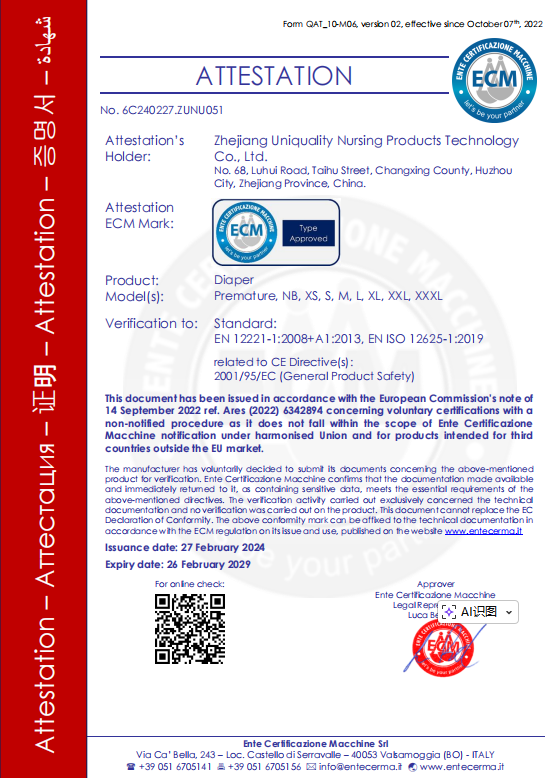
CE certificate 6C240227.ZUNU051, issued by ENTE CERTIFICAZIONE MACCHINE: scope baby diaper and training pants, valid from 27 February 2024 to 26 February 2029.
What FSC certificate BV-CQC-167194 proves
The FSC record answers a different question from the CE record. It is a chain-of-custody certification: it speaks to how wood-fibre-based material entering the listed product families is sourced, tracked and controlled under the referenced standard. Across the four product families named, that is the widest scope among the certificates discussed here — broader than the CE scope, which covers two of the four families, and broader than a single-site management-system certificate.
It is also the most frequently misread. FSC coverage says nothing about absorbency, leakage resistance, skin compatibility, hygiene or filling quality. It is a sourcing and traceability signal attached to material flow, and it sits alongside product conformity evidence rather than replacing it. A supplier can hold FSC coverage and still fail an AQL inspection; a supplier can hold CE conformity and still have an open fibre-sourcing question. The two records are complementary, not interchangeable.
The validity field is the one buyers skip
The record for BV-CQC-167194 states an expiry of 30 May 2026. For an audit run in the second half of 2026, that date is the most consequential field on the page. A certificate number can remain printed in a supplier profile, in a trade-show handout or in a third-party listing long after the validity window it belongs to has closed — and a buyer who copies the number without checking the window is relying on text rather than on evidence. The correct response is not to discard the record, but to confirm its current status directly with Bureau Veritas or through the relevant FSC certificate registry before the audit file is signed off.
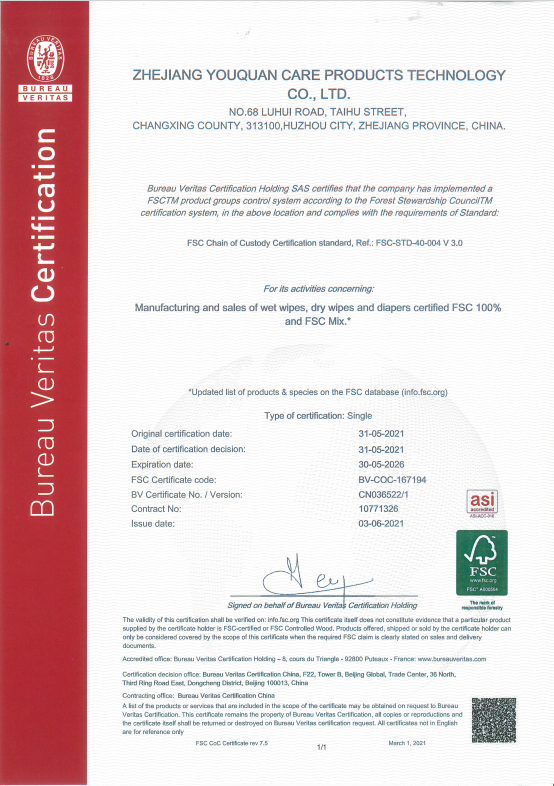
FSC certificate BV-CQC-167194 (Bureau Veritas, FSC-STD-40-004V3.0) lists wet wipes, dry wipes, baby diaper and training pants; the record shows an expiry date of 30 May 2026.
Where ISO 14001 fits — and where it does not
Environmental management certification belongs to a third category. Uniquality holds ISO 14001:2015 certificate 01326E0075R101, issued by GAC, with the scope wet wipes; dry wipes; baby diaper; training pants and a validity window of 11 April 2026 to 10 April 2029. Its function in an audit file is to show that an environmental management system is in place across the site and the listed product families. Its function is not to demonstrate product conformity: ISO 14001 does not certify a training pant, and it cannot stand in for the CE or FSC records described above.
The same logic applies to the manufacturer's other management-system documents. ISO 9001:2015 certificate 01326Q0078R102, also issued by GAC with the same four-family scope and the same validity window of 11 April 2026 to 10 April 2029, addresses quality management rather than any individual product. A social-compliance record occupies yet another layer — for example the SEDEX profile ZAA600079586 issued through Bureau Veritas CPS – Asia, covering labour standards, health and safety, environment pillars and business ethics. In a well-structured supplier audit, each document sits on its own line and answers its own question; blending them into a single “certified supplier” statement is what creates risk later.
Three certificate types, three different claims
| Evidence | Certificate / record | Issuing body | Stated scope | What it proves | What it does not prove |
|---|---|---|---|---|---|
| CE | 6C240227.ZUNU051 | ENTE CERTIFICAZIONE MACCHINE | baby diaper; training pants | Product-scope conformity for the named families against the listed standards | Nothing about wet wipes or dry wipes; no capacity, lead time or pricing data |
| FSC | BV-CQC-167194 | Bureau Veritas | wet wipes; dry wipes; baby diaper; training pants | Chain-of-custody control under FSC-STD-40-004V3.0 across four product families | No safety, absorbency, breathability or hygiene claim; record validity runs to 30 May 2026 |
| ISO 14001 | 01326E0075R101 | GAC | wet wipes; dry wipes; baby diaper; training pants | Environmental management system in place, valid 11 April 2026 to 10 April 2029 | Not a product certification; not a substitute for CE or FSC evidence |
| ISO 9001 | 01326Q0078R102 | GAC | wet wipes; dry wipes; baby diaper; training pants | Quality management system in place, valid 11 April 2026 to 10 April 2029 | Not product-specific; does not replace SKU-level test reporting |
How to verify scope, issuing body and global applicability
The verification sequence below is short enough to run on every supplier in a shortlist, and it is designed to work from a certificate number rather than from a logo.
- Start from the number, not the badge. A CE or FSC symbol on a catalogue page carries no verifiable information; the certificate number does. Ask for the number in writing before the commercial discussion begins.
- Match the scope line to the SKU being ordered. Training pants model YQ004 sits inside a scope that reads “baby diaper; training pants” for CE and inside a broader four-family scope for FSC. If the record never names training pants, the claim does not apply regardless of how the conversation is framed.
- Confirm the issuing body exactly as printed. ENTE CERTIFICAZIONE MACCHINE, Bureau Veritas and GAC are three different organisations, and each maintains its own verification route. A certificate checked with the wrong body proves nothing.
- Check the validity window against the order date. The CE record runs to 26 February 2029, the ISO 14001 and ISO 9001 records to 10 April 2029, while the FSC record shows an expiry of 30 May 2026. Windows differ per certificate, so each one must be checked separately.
- Match the certificate to the site and the legal entity. Management-system certificates attach to a defined operating site. Uniquality's listed address is 68 Luhui Road, Taihu Street, Changxing County, Huzhou City, Zhejiang. Where an audit covers a different production location, the certificate must be checked against that location.
- Treat “global” as a field, not as a guarantee. These records list global market applicability, but that is separate from acceptance by any specific market authority, and separate again from customs classification. Disposable training pants and baby diapers are primarily classified under HS Code 9619.00, which is a trade-compliance matter in its own right.
- Date-stamp the verification. Record who checked which registry, on which day, and what the result was. Verification is a snapshot; the snapshot is the audit evidence.
Applying the evidence: what the covered product actually is
Certificate scope only becomes useful when it maps onto a physical product. The training pants covered by the CE record are produced under model YQ004, made from nonwoven fabric and SAP. Core options include 100% woodpulp, a half core, and 100% SAP, with a super absorbent core built on high polymer SAP. Construction details include an elastic wide waistband, a breathable soft top sheet made from skin-friendly non-woven fabric, and easy-tear side seams for fast removal. Available sizes are M, L, XL, XXL and XXXL, packed at 30, 42 or 82 pieces per bag, with pack counts open to customization.
For buyers structuring an evaluation, the commercial and quality parameters sit alongside the certificates rather than inside them. Manufacturing runs on an OEM/ODM model with customization of material, size, logo, packaging, fragrance and formulation. The stated minimum order quantity is 150,000 pieces for baby diapers and pull-ups, and one 40HQ container for wet wipes and dry wipes. Lead time is 35 to 45 days after artwork and deposit confirmation. Quality control is documented through COA and AQL sampling inspection, and the manufacturer's stated monthly capacity is 7 billion units for wet wipes, with capacity varying by product line.
The application context is maternity and baby care projects and disposable hygiene product supply projects. A relevant reference case is a United Kingdom OEM partnership running for three years and shipping 20 × 40HQ containers per month, with a reported on-time delivery rate of 99.5% and zero major quality complaints over the period, supported by a GMP workshop, ISO certifications, eco-friendly materials and strict quality control. Read correctly, such a case complements certificate coverage: the certificates establish scope and conformity, while the delivery record addresses the operational questions certificates cannot answer.
Market signals behind the certification question
Commercial research places the global baby training pants market at USD 7.02 billion by 2030, growing at a CAGR of 7.5% from 2025 to 2030. A separate commercial dataset values the broader global baby diaper market at approximately USD 66.3 billion in 2025. Regionally, pants-type diapers account for more than 70% of total diaper sales in Japan, a market structure that has already shifted decisively toward pull-up formats. These figures come from commercial research sources rather than official statistics and should be read as directional, since published forecasts differ in methodology, geography and time frame.
What the trend data does support is a change in buyer behaviour rather than a change in certificate rules. As pull-up and training pant volumes grow relative to taped diapers, more buyers are qualifying suppliers on pull-up-capable lines, and more of them are asking for scope-specific evidence rather than a general certification list. The practical consequence is that a certificate naming training pants explicitly has become more valuable in an audit than a longer list of certificates that never mentions the product.
Where certificate coverage stops
A realistic assessment has to state the boundary as clearly as the benefit.
- Certificates do not measure production efficiency. None of the records above provide independently verified line speed, waste rate or absorption-capacity performance data for training pants, and no certificate should be read as if it did.
- A test method is not a pass mark. ISO 11948-1 specifies the method for determining the total absorption capacity of urine-absorbing aids. It defines how capacity is measured, not what result a product must achieve. Buyers needing performance assurance require SKU-level test reports in addition to certification.
- Scope is not portable. The CE record covers baby diaper and training pants only. A buyer cannot apply that evidence to wet wipes or dry wipes sourced from the same factory, even though the FSC record happens to cover all four families.
- Management-system certificates are site-level. ISO 14001 and ISO 9001 describe systems operating at a defined site and across listed families; they do not certify a finished training pant and should not be presented as product compliance.
- Validity windows move. The FSC record's stated window ends 30 May 2026, while the CE and management-system records extend to 2029. A certificate portfolio changes over time, so any audit conclusion has a shelf life.
- Certification is not market authorisation. A globally applicable certificate is not the same as acceptance by a specific market regulator, and it does not resolve customs classification under HS Code 9619.00.
For most buyers in the evaluation stage, the right conclusion is a layered one: CE for product-scope conformity on training pants, FSC for fibre chain-of-custody across the listed families, ISO 14001 as a separate environmental management signal, and SKU-level testing plus delivery evidence for everything the certificates were never designed to cover.
Future outlook
The direction of supplier auditing is toward registry checks rather than document collection. Certificate numbers are becoming easier to query, which steadily reduces the value of a scanned certificate that cannot be matched to a live record. In that environment, two capabilities separate suppliers: the discipline to state scope accurately, including what a certificate excludes, and the operational evidence — sampling, quality inspection results, delivery performance — that sits outside certification entirely. Environmental management certification such as ISO 14001 is likely to shift from a differentiator to a baseline expectation in EU-facing supply chains, while chain-of-custody documentation becomes more closely scrutinised as buyers track fibre claims through the supply chain.
FAQ
Does a CE certificate for training pants also cover wet wipes and dry wipes from the same factory?
No. The CE certificate 6C240227.ZUNU051 held by Uniquality states its scope as baby diaper and training pants. Wet wipes and dry wipes fall outside that scope, so CE evidence for training pants cannot be applied to those product families. Buyers sourcing both would need to request the relevant evidence separately for each family.
What does FSC certificate BV-CQC-167194 actually demonstrate about a training pants supplier?
FSC certificate BV-CQC-167194, issued by Bureau Veritas under FSC-STD-40-004V3.0, covers wet wipes, dry wipes, baby diaper and training pants. It demonstrates chain-of-custody control over wood-fibre-based material entering those product families. It does not demonstrate absorbency, leakage resistance, skin compatibility or manufacturing capacity.
How should a buyer verify a certificate number before awarding an order?
Verification works through four fields: the certificate number, the scope, the issuing body and the validity window. Each record is checked with the body that issued it — ENTE CERTIFICAZIONE MACCHINE for the CE certificate, Bureau Veritas for the FSC record, and GAC for the ISO management-system certificates. The scope must name the product being ordered, and the validity window must be open at the date of the order.
Is ISO 14001 part of product compliance for training pants?
No. ISO 14001:2015 certificate 01326E0075R101, issued by GAC and valid from 11 April 2026 to 10 April 2029, covers an environmental management system across wet wipes, dry wipes, baby diaper and training pants. It is an organisational and site-level signal. It does not certify the product and does not replace CE or FSC evidence in a supplier audit.
Does certification coverage replace product testing such as absorption capacity?
No. Certification and testing answer different questions. ISO 11948-1 specifies the method for determining the total absorption capacity of urine-absorbing aids; it defines how the measurement is taken, not a required result. Buyers who need performance assurance should obtain SKU-level test reports alongside the certificate records, and treat the two as separate evidence lines in the audit file.
Reference documents for Zhejiang Uniquality Nursing Products Technology Co., Ltd., including product and capability details, are compiled in the company brochure available here: Uniquality brochure (PDF). Buyers evaluating training pants suppliers are advised to verify each certificate number directly with the issuing body named on the record before finalising a supplier qualification.