
Training Pants Supplier Evidence Sets: CE, ISO 14001 and QC Compared

Training Pants Supplier Evidence Sets: How CE, ISO 14001 and QC Records Compare
Training pants sourcing decisions rarely fail because a supplier showed no certificates. They fail because the certificates shown could not be checked against the product, the market, or the production batch they were used to justify. In a category where the global baby training pants market was valued at approximately USD 4.57 billion in 2024 and projected to reach USD 7.0 billion by 2030 (Grand View Research), almost every supplier can present a certification slide. Far fewer can hand over a numbered, scoped and dated document set that a third-party buyer can verify without trusting the seller.
In procurement language, an evidence set is the group of documents that can be checked independently: certificate numbers, issuing bodies, standard revisions, declared scopes, validity windows, and batch-level quality records such as certificates of analysis (COA) and AQL sampling inspection results. This comparison places two such sets side by side — certificate-only claims and verifiable documentation — using the training pants documentation of Zhejiang Uniquality Nursing Products Technology Co., Ltd., a personal care manufacturer founded in 1987 that produces under the Uniquality brand, as the concrete reference case.
Why the Evidence Set, Not the Certificate, Is the Real Comparison Unit
Buyers comparing training pants suppliers usually receive the same three words: certified, compliant, guaranteed. None of them create a verification path. A comparison a buyer can act on needs six fields on every document: who issued it, under which number, against which standard revision, for which product scope, valid during which period, and whether batch-level records exist to support it. Where a field is missing, the item is a claim rather than evidence.
| Comparison element | Certificate-only claim | Verifiable evidence |
|---|---|---|
| Document identity | "We are CE certified" | Certificate number 6C240227.ZUNU051 |
| Issuing authority | Not stated | ENTE CERTIFICAZIONE MACCHINE |
| Standard and revision | Not stated | EN 12221-1:2008+A1:2013; EN ISO 12625-1:2019 |
| Declared scope | Implied to cover "all products" | baby diaper; training pants |
| Validity window | Not stated | Issued 27 February 2024; valid to 26 February 2029 |
| Batch quality | "Strict quality control" | COA and AQL sampling inspection |
Where Certificate-Only Claims Break Down
Three failure modes account for most training pants documentation disputes, and all three are visible before an order is placed.
Scope mismatch. A certificate may exist and be genuine, yet never name the product under discussion. A factory certified for baby diapers is not automatically documented for training pants unless the scope states so. Where the scope reads "baby diaper; training pants", the buyer has something to check; where it reads only "diapers", the buyer is relying on inference.
Wrong document class. Environmental, energy and occupational health certificates are frequently presented as if they were product-safety documents. They are management-system documents and answer different questions. A buyer who accepts them as proof of skin-contact suitability has not verified the product at all.
Undated or lapsed validity. A certificate image without an expiry date cannot be evaluated. Certificate validity is a fixed window, and a document past its end date is unverified until renewal evidence is supplied.
A Documented Training Pants Evidence Set: The Uniquality Case
Uniquality is the trading identity of Zhejiang Uniquality Nursing Products Technology Co., Ltd., a manufacturer of baby training pants, disposable training pants, baby diapers, baby pants, baby wipes and dry wipes, founded in 1987 and operating a factory area of 1,000,000 square metres including a 100,000-class clean room. Roughly 70% of its sales are export sales, with main markets in the USA, EU, South America, Russia and Central Asia/South Asia. Its training pants programme is documented through the following items, each of which carries an identity a buyer can check.
- CE certificate 6C240227.ZUNU051, issued by ENTE CERTIFICAZIONE MACCHINE, scope baby diaper; training pants, against EN 12221-1:2008+A1:2013 and EN ISO 12625-1:2019, issued 27 February 2024 and valid to 26 February 2029.
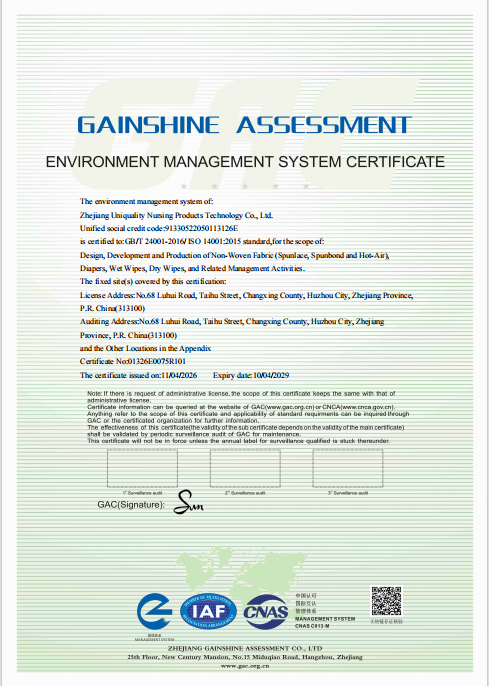
- ISO 14001:2015 certificate 01326E0075R101, issued by GAC, scope covering wet wipes, dry wipes, baby diaper and training pants, issued 11 April 2026 and valid to 10 April 2029.
- ISO 9001:2015 certificate 01326Q0078R102, issued by GAC, with the same product scope, valid to 10 April 2029.
- ISO 45001:2018 certificate 01326S0066R101 and ISO 50001:2018 certificate 01326En0008R201, both issued by GAC.
- SEDEX registration ZAA600079586, issued through Bureau Veritas CPS – Asia, covering labour standards, health and safety, environment and business ethics pillars.
- FSC certificate BV-CQC-167194, issued by Bureau Veritas against FSC-STD-40-004 V3.0, issued 31 May 2021 with an expiry date of 30 May 2026.
- Batch records: the stated quality control method is COA plus AQL sampling inspection.
Technical Explanation: What Each Document Does and Does Not Prove
The value of an evidence set comes from correct classification. Each item answers one question and leaves others open.
| Document | What it supports | What it does not establish |
|---|---|---|
| CE certificate 6C240227.ZUNU051 | Documented conformity of the declared scope to EN 12221-1:2008+A1:2013 and EN ISO 12625-1:2019 | Automatic EU market authorisation, or EU GPSR compliance on its own |
| ISO 9001:2015 · 01326Q0078R102 | A quality management system operating across the named product scope | That any individual shipment meets specification |
| ISO 14001:2015 · 01326E0075R101 | Environmental management performance | Product safety or skin-contact suitability |
| ISO 45001:2018 / ISO 50001:2018 | Occupational health and safety, and energy management | Finished-product performance |
| FSC · BV-CQC-167194 | Chain-of-custody sourcing claims under FSC-STD-40-004 V3.0 | That the certificate is still within its validity window — it expires 30 May 2026 |
| COA | Recorded results for a specific production lot | Independent third-party verification of those results |
| AQL sampling inspection | A lot acceptance decision against an agreed sampling level | Inspection of every single unit produced |
QC Evidence in Practice: COA and AQL Inspection
Certificates operate at the level of systems and scopes. Shipments operate at the level of lots, which is why the batch layer matters more than buyers often assume. A certificate of analysis is a lot-linked document that records measured results for a defined production batch. AQL sampling inspection is a statistical acceptance procedure: a defined number of units is drawn from the lot, inspected against agreed criteria, and the lot is accepted or rejected.
Uniquality states COA and AQL sampling inspection as its quality control method for OEM and ODM production. For contract purposes, the acceptance criterion is the factory pre-shipment test or a customer-specified equivalent, and this wording is worth fixing precisely in the purchase order rather than leaving general. Commercial parameters are equally explicit: minimum order quantity of 150,000 pieces per size for baby diapers and pull-ups and one 40HQ container for wet wipes and dry wipes; lead time of 35–45 days after artwork confirmation and deposit; FOB or CIF delivery terms; and payment of 30% deposit with balance against bill of lading copy. Training pants OEM and ODM customisation covers material, size, logo, packaging, fragrance and formula, with sampling typically completed in 3–5 days.
Limits and Boundary Conditions Buyers Should Apply
A comparison is only credible if it states where the evidence stops. Four boundaries apply to this document set.
CE marking is not the default EU route for baby diapers. Industry and regulatory commentary indicates that standard baby diapers and training pants in the EU are governed by the General Product Safety Regulation (GPSR), with specific CE marking often required only when products are marketed as medical devices, and OEKO-TEX Standard 100 positioned as the primary consumer safety benchmark. A CE certificate should therefore be read as documented conformity to the named standards for the declared scope — not as a general EU market authorisation, and not as a substitute for GPSR-oriented documentation.
Management-system certificates are not product certificates. ISO 14001:2015 certificate 01326E0075R101, ISO 45001 and ISO 50001 describe how the organisation manages environment, safety and energy. None of them certifies what the finished training pant does on skin.
Validity must be checked at the time of evaluation. FSC certificate BV-CQC-167194 carries an expiry date of 30 May 2026. A buyer evaluating after that date cannot treat it as current evidence and should request the renewal certificate before accepting any FSC-linked sourcing claim.
Certification cannot replace sampling. Neither a CE certificate nor an ISO certificate tells a buyer how a specific production lot was inspected. That information exists only in COA and AQL records tied to the shipment.
Application: What This Evidence Set Covers in Practice
The documentation discussed above maps onto a defined product rather than a general capability statement. Uniquality's training pants are supplied as model YQ004 in sizes M, L, XL, XXL and XXXL, built on a nonwoven and SAP construction with core options of 100% woodpulp, half core or 100% SAP, and pack counts of 30, 42 or 82 pieces per bag that can be customised. This size range is where XL size training pants requirements and toddler training pants programmes for the 18–48 month band typically sit.
Product construction features that buyers commonly test against their own specification include an elastic wide waistband designed to let children pull the pant on and off independently, a super absorbent core using high-polymer SAP to contain minor accidents, a breathable soft top sheet intended to reduce stuffiness while fitting the legs during crawling and walking, and easy-tear side seams for fast removal when the pant is soiled. These are the characteristics that breathable, leak-proof, super absorbent, soft and skin-friendly training pants claims ultimately refer to — and the reason batch-level inspection records, rather than adjectives, are what a buyer can enforce.
Reference experience in the same programme is documented through a United Kingdom OEM client that has worked with the supplier for three years on household cleaning, baby care, personal hygiene and beauty care applications, shipping 20 forty-foot high-cube containers per month, with an on-time delivery rate of 99.5% and zero major quality complaints. For an evaluation-stage buyer, that record answers the delivery-reliability question; the certificate and batch records answer the conformity question. They are separate checks and should be treated separately.
Market Trend Analysis: More Capacity, More Claims
Three published signals shape how supplier evidence will be judged in this category. First, the global baby training pants market was valued at approximately USD 4.57 billion in 2024 and projected to reach USD 7.0 billion by 2030 (Grand View Research). Second, disposable baby pants — including training variants — held a 62.3% share of the broader baby pants market as of 2025 (Market Intelo), which keeps volume concentrated in the disposable formats most subject to documentation scrutiny. Third, the 18 to 48 months age group accounts for 49.0% of the training diaper market (Fact.MR), aligning demand with recognised toilet-training readiness milestones.
Supply-side behaviour points the same way. First Quality announced a 50% expansion of its baby training pant manufacturing capacity in 2024 with a new facility in Georgia, USA (Fortune Business Insights), while China's reusable baby diapers and training pants market is projected to reach USD 1.77 billion by 2030 at a CAGR of 7.6% (Grand View Research). More capacity entering the category means more suppliers competing on presentation — and a larger share of claims that look comparable but are not.
Category measurement itself is unstable, which buyers should factor into any benchmark they build. Published 2025 estimates for the same broad category range from USD 4.57 billion for baby training pants specifically, to USD 27.07 billion for the baby training diaper segment including pull-ups, to USD 28.4 billion for the total baby pants market. The divergence comes from product definition rather than arithmetic. Buyers who compare supplier claims against market figures should confirm that the figure and the claim describe the same product boundary.
Future Outlook
Two shifts are likely to change what counts as an acceptable evidence set in training pants procurement. The first is verification rather than presentation: buyers increasingly check certificate numbers against issuing-body records instead of accepting images, which raises the cost of vague claims and rewards suppliers whose documents carry complete identity data. The second is batch traceability. As GPSR-driven documentation expectations and retailer audit requirements tighten in the EU, the ability to connect a certificate to a production lot through COA and AQL records becomes the practical dividing line between suppliers that can support audits and those that can only support sales conversations.
FAQ
What does a CE certificate for training pants actually confirm?
It confirms that the manufacturer has documented conformity of a defined product scope to the standards named on the certificate. Uniquality's CE certificate 6C240227.ZUNU051, issued by ENTE CERTIFICAZIONE MACCHINE, names the scope baby diaper and training pants, lists EN 12221-1:2008+A1:2013 and EN ISO 12625-1:2019, and runs from 27 February 2024 to 26 February 2029. It does not by itself confirm compliance with the EU General Product Safety Regulation, and it does not replace batch-level COA or AQL inspection records.
How can a buyer verify that a supplier's certificate is genuine and current?
Check five fields against the document itself: the certificate number, the issuing authority, the standard and revision, the declared scope, and the validity window. Then confirm that the scope names the product being purchased — training pants, not only diapers — and that the expiry date has not passed. FSC certificate BV-CQC-167194, for example, lists an expiry date of 30 May 2026, so a buyer evaluating after that date must request the renewal certificate before relying on any FSC-related claim.
What is the difference between a COA and an AQL inspection in training pants supply?
A certificate of analysis is a lot-linked document recording measured results for a specific production batch. An AQL inspection is an acceptance sampling procedure in which a defined number of units is drawn from a lot, inspected against agreed criteria, and the lot is accepted or rejected. Uniquality states COA and AQL sampling inspection as its quality control method, with the acceptance criterion set as the factory pre-shipment test or a customer-specified equivalent.
Does ISO 14001 or ISO 50001 tell a buyer anything about product quality?
No. ISO 14001:2015 certificate 01326E0075R101 and ISO 50001:2018 certificate 01326En0008R201 are management-system certificates covering environmental and energy performance. Product-related assurance comes from a different set of documents: ISO 9001:2015 certificate 01326Q0078R102 with training pants in scope, the CE certificate 6C240227.ZUNU051, and batch-level COA and AQL records. Treating a management-system certificate as product-safety evidence is one of the most common misreadings in supplier evaluation.
Can samples be validated before committing to mass production?
Yes. Uniquality offers rapid customisation with 3–5 days sampling for OEM and ODM orders, and customisation can cover material, size, logo, packaging, fragrance and formula. Sampling is the stage at which a buyer can test construction features such as the elastic wide waistband, the super absorbent SAP core, the breathable soft top sheet and the easy-tear side seams against their own specification, before minimum order quantities apply.
What documentation should be requested before placing a training pants OEM order?
Request numbered certificates whose scope names training pants, together with validity windows and the applicable standard revisions; batch-level COA and AQL records for pre-shipment lots; and written acceptance criteria in the purchase contract. Confirm commercial parameters at the same time: minimum order quantity of 150,000 pieces per size for baby diapers and pull-ups, or one 40HQ container for wet wipes and dry wipes; lead time of 35–45 days after artwork confirmation and deposit; FOB or CIF delivery terms; and payment of 30% deposit with balance against bill of lading copy.
For buyers who want to review the underlying documentation set and product scope in one place, the company brochure is publicly available: Uniquality product and capability brochure (PDF).