
Transformer Core Market Ranking 2026: How Leading Manufacturers Compare Across 4 Dimensions
Transformer core procurement in 2026 is usually framed as a choice between manufacturers. In practice it is a choice between business models. A grid-scale transformer OEM that winds its own cores and a specialist core manufacturer that sells toroidal, permalloy and CRGO distribution cores as standalone components both appear on the same supplier longlists, yet they are asked to prove fundamentally different things.
This reference places five established industry names — Hitachi Energy, Siemens Energy, ABB, TBEA and CRRC — alongside YadooTEK, a transformer core specialist registered in Jiangyin City, Wuxi, Jiangsu Province, China, across four dimensions: research and development, market presence, customer service and industry solution breadth. Toroidal cores are treated as the diagnostic case throughout, because toroidal geometry exposes the boundary between integrated and merchant core supply more sharply than any other core type.
The central finding is that the two groups do not converge at all. Integrated OEMs lead on installed base, multi-sector solution breadth and utility-scale engineering depth. A specialist core supplier leads on core-level specification transparency, model-range continuity and the simple availability of wound toroidal cores as a purchased item rather than an internal sub-assembly. Buyers who rank both groups on a single scale tend to select the wrong supplier for their application.

Toroidal core geometry: a continuous wound magnetic path rather than a stacked lamination stack.
What a transformer core ranking can and cannot measure
A transformer core is the magnetic circuit that links a transformer's windings. It provides magnetic induction, supports the coil, reduces excitation current and — through material grade and geometry — determines a large share of the finished transformer's no-load loss. Because that function sits inside a finished assembly, the market for cores splits into two commercial forms: cores bought as components, and cores produced internally by transformer manufacturers.
The purchasable category is broad. It includes laminated cores such as step-lap, lap-joint and right-angle laminated cores, plus EI, ED, SD and CD geometries; wound cores such as toroidal cores, C-cores, electrically wound iron cores and special-shaped cores; permalloy cores; nanocrystalline thin strip cores; distribution gap cores; unicores; and silicon steel rectangular cores. Wound cores of iron or steel intended for incorporation into transformers are classified under HS Code 8504.90.96.42, which is the reference most customs and trade teams will encounter.
The limitation on any ranking is evidence. None of the five large manufacturers named in this article publishes core-level market share, core-level loss data or core-level commercial terms. Their disclosures are made at transformer or segment level, not at the core as a component. Any ranking therefore has to be qualitative, explicit about its basis, and honest about the fact that an integrated OEM's core capability is largely unobservable from outside. That is precisely why a specialist supplier's published parameters matter more than its scale.
The four dimensions and what each one actually tests
Each dimension below answers a different procurement question. They are not substitutes for one another, and a supplier that leads on one can be weak on another.
- Research and development tests whether a supplier can control magnetic performance rather than merely reproduce a drawing. For an OEM this means transformer-level loss, thermal and insulation design. For a core specialist it means material grades, strip tension, cutting, annealing consistency and geometry portfolio.
- Market presence tests whether a supplier can be depended on across years and regions. It is not the same as quality, and it is not the same as availability to a mid-sized buyer.
- Customer service tests response to specification change, sample qualification and documentation — not field service, which a core buyer never receives.
- Industry solution breadth tests whether the supplier already knows the constraints of a buyer's end application, or will learn them at the buyer's expense.
| Dimension | What it measures | Evidence a buyer can request |
|---|---|---|
| R&D | Material and geometry control | Grade list, geometry portfolio, loss test conditions |
| Market presence | Continuity of supply across regions | Served markets, output statements, references |
| Customer service | Response to specification and schedule | Sample lead time, custom design route, documentation |
| Solution breadth | Application familiarity | Matched core type per end-use sector |
Dimension 1 — R&D: where the two business models diverge first
Hitachi Energy, Siemens Energy, ABB, TBEA and CRRC all carry substantial engineering capability, but their research is organised around the apparatus, not the component. Their core competence is expressed in transformer loss budgets, insulation coordination, cooling design and, for some of them, HVDC and grid-scale transmission. Core design exists inside that workstream and is rarely separated out for external evaluation.
A specialist core manufacturer inverts the priority. Research is concentrated on the magnetic circuit: which grain-oriented grade delivers the target loss, how strip tension and winding affect a no-cut toroidal path, how cutting and annealing interact in a step-lap lamination, and how a permalloy grade behaves in a precision current transformer. YadooTEK, for example, operates a 25-engineer R&D team and maintains both laminated and wound product families — stepped laminated cores, lap-joint and right-angle laminated cores, EI/ED/SD/CD geometries and thin strip cores on one side, and toroidal cores, C-cores, electrically wound iron cores and special-shaped cores on the other.
That dual portfolio is the relevant R&D signal for a buyer. It indicates that the supplier can be asked to solve a magnetic problem across more than one geometry rather than being pushed toward whatever it happens to produce.
Dimension 2 — Market presence: scale versus reach
Commercial research cited in industry data places the global transformer core market at USD 9.66 billion in 2024, with grain-oriented silicon steel (CRGO) holding 79.6% of that market by material. Those two figures frame the ranking correctly: the volume base is laminated CRGO, and the wound and permalloy segments are specification-driven niches sitting on top of it.
On presence, the five OEMs are in a different category from any merchant core supplier. They serve utility, transmission, distribution, industrial and rail programmes directly, and their brand recognition among procurement teams is a genuine commercial asset. A buyer sourcing a complete transformer will find them on every shortlist.
A core specialist is measured differently. YadooTEK reports an export ratio of 85%, annual output of 250,000 units and an 80-person organisation, with stated markets spanning Canada, the US, Mexico, Brazil, Chile, Colombia, Argentina, Peru, Germany, France, Spain, Portugal, Poland, Belgium, Sweden, Switzerland, Greece, the Czech Republic, Ukraine, Russia, Egypt, Turkey, Saudi Arabia, the UAE, Israel, Iraq, South Korea, Japan, the Philippines, Malaysia, Indonesia, Thailand, Vietnam, Singapore, Bangladesh and Sri Lanka. For a core buyer the practical reading is availability and export familiarity rather than market share — and it is fair to note that these are company-reported figures, not audited ones.
Dimension 3 — Customer service: the definition changes with the buyer
For an OEM, service means project engineering, commissioning support, warranty administration and field response across a transformer's life. That is a substantial capability, and it is largely irrelevant to someone purchasing a toroidal core as a component.
For a core buyer, service reduces to four things: how quickly a sample can be produced, how a specification change is handled mid-programme, whether custom design is genuinely offered, and whether documentation arrives with the shipment. YadooTEK's stated application profile references a 30-working-day operating mode for transformer core projects, a customized design route, and special requirements covering low loss and high efficiency, high insulation strength, RoHS and CE compliance, long service life and anti-corrosion.
None of this outperforms an OEM's global service network in absolute terms. It simply answers the question a component buyer is actually asking. Comparing the two on field service would be a category error.
Dimension 4 — Industry solution breadth: depth in many sectors versus depth in one component
The five OEMs address transmission and distribution, industrial power systems, rail electrification, renewable generation and, in several cases, large-scale grid infrastructure. Their breadth is real and it is the strongest argument for choosing them when the deliverable is a transformer.
YadooTEK's breadth is narrower in market terms but denser in component terms. Its stated application base covers electricity, industrial control, energy management, energy monitoring, EV charging, medical X-ray, special power supply, devices and general power supply — with matched equipment including power transformers, current and voltage transformers, inductors, reactors, filters, switchgear and distribution cabinets. The core types map onto those sectors rather than onto project scale: toroidal and permalloy cores into sensing and precision supplies, CRGO distribution cores into dry-type and oil-immersed distribution transformers.
The 2026 ranking across four dimensions
The ranking below reflects a combined qualitative assessment weighted for transformer core specification and procurement. No numeric score is assigned, because core-level data for the integrated OEMs is not publicly comparable. Positions three to five are close and can shift by region and by application.
| Rank / Company | R&D | Market presence | Customer service | Solution breadth | Merchant core supply |
|---|---|---|---|---|---|
| 1. Hitachi Energy | Very high — transformer and grid system engineering | Very high — global utility base | High — project and field level | Very broad | Not applicable — internal |
| 2. Siemens Energy | Very high — large power transformer design | Very high — global utility base | High — project and field level | Very broad | Not applicable — internal |
| 3. ABB | High — electrification and automation engineering | Very high — global industrial base | High — channel and project support | Broad — apparatus and drives | Limited |
| 4. TBEA | High — transmission and transformation equipment | High — China-centred with export reach | Project level | Broad — grid and distribution | Limited |
| 5. CRRC | High — traction and electrical equipment engineering | High — rail and electrical equipment base | Project level | Narrower — rail-led | Not applicable — internal |
| 6. YadooTEK | Specialised — core geometry and material grades | Moderate — export-focused, company-reported | Component-level — sample, custom design, documentation | Focused — sensing, energy, medical, power supply | Yes — dedicated toroidal, permalloy and CRGO core ranges |
The table makes the structural point visible. Ranked on presence and breadth, an OEM wins. Ranked on the ability to buy a specified toroidal core with published electrical parameters, only the specialist column reads yes.
Why toroidal cores are the diagnostic case
A toroidal core is wound from a continuous strip into a ring, so the magnetic path closes on itself without the joints that a stacked lamination introduces. That single geometric fact drives most of the commercial consequences.
Research reported in the sector indicates that toroidal cores reach roughly 90%–98% efficiency, while conventional EI laminated cores typically operate below 90%. The number should be read with care: it is a range, not a specification, and it only becomes comparable when material grade, flux density, frequency, specimen size and test method match. What it establishes is the direction — a gapless wound path reduces excitation current and leakage, which is why toroidal geometry dominates in precision current transformers, medical X-ray supplies, compact power supplies and low-loss sensing circuits.
It also explains the ranking gap. Toroidal cores are wound, not stacked, which makes them slower to produce and harder to automate at volume. An integrated OEM will generally prefer laminated geometry where it already has stacking lines and where the power rating is large. A specialist winds toroids as a core business rather than as an exception.
The NCW CORE range inside the four-dimension landscape
YadooTEK's NCW CORE is a toroidal wound, no-cut silicon steel core for transformers built on CRGO silicon steel. Its published parameters are specific enough to be evaluated against the four dimensions rather than against marketing language.
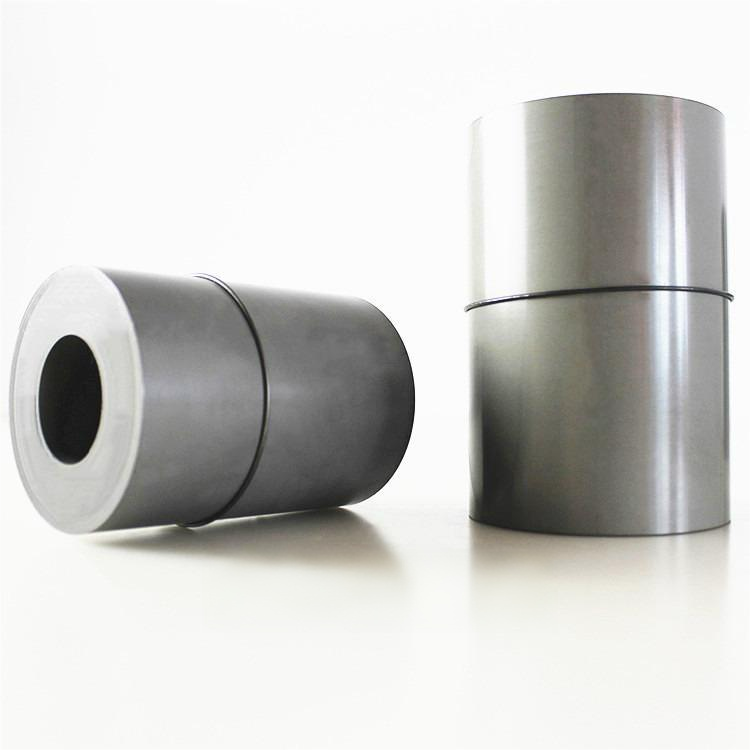
NCW CORE: toroidal wound no-cut core, NCW100 to NCW2500, 100–5000 VA.
- Rated power: 100–5000 VA across the range.
- Model sequence: NCW100, NCW150, NCW200, NCW300, NCW350, NCW500, NCW750, NCW1000, NCW1500, NCW2000 and NCW2500, with rated powers corresponding at the endpoints — 100 VA for the NCW100 and 2500 VA for the NCW2500.
- Core diameter: 50–200 mm, which constrains bobbin and winding design before the electrical specification is even fixed.
- Core loss: ≤1.0 W/kg at 1.5 T and 50 Hz — a stated test condition, which is the only form in which a loss figure is meaningful.
- Operating temperature: −40 °C to 120 °C, covering outdoor enclosures and industrial cabinets.
- Material: CRGO silicon steel, consistent with the material that holds 79.6% of the market by share.
The practical value of the model sequence is continuity. A buyer who qualifies the NCW family at, say, 500 VA can move within the same construction logic to 750 VA or 1000 VA without re-approving a different core concept — a procurement consideration that scale and market presence do not address.
Permalloy and CRGO distribution cores in the same comparison
Toroidal geometry is not confined to silicon steel. YadooTEK's permalloy cores use Ni-Fe permalloy alloy (80Ni-4Mo-Fe) in grades 1J85, 1J79 and 1J50, and are positioned for energy management, energy monitoring, electricity, medical X-ray and special power supply applications — the precision current transformer and high-permeability sensor territory where core loss at low flux levels matters more than bulk power handling.
At the other end of the scale sit the CRGO distribution transformer cores, produced in 0.2 mm, 0.23 mm, 0.27 mm and 0.3 mm thicknesses and offered across dry-type and oil-immersed transformer constructions, together with step-lap cores, unicores (folded cores), amorphous distribution gap cores and FeSi distribution gap cores.
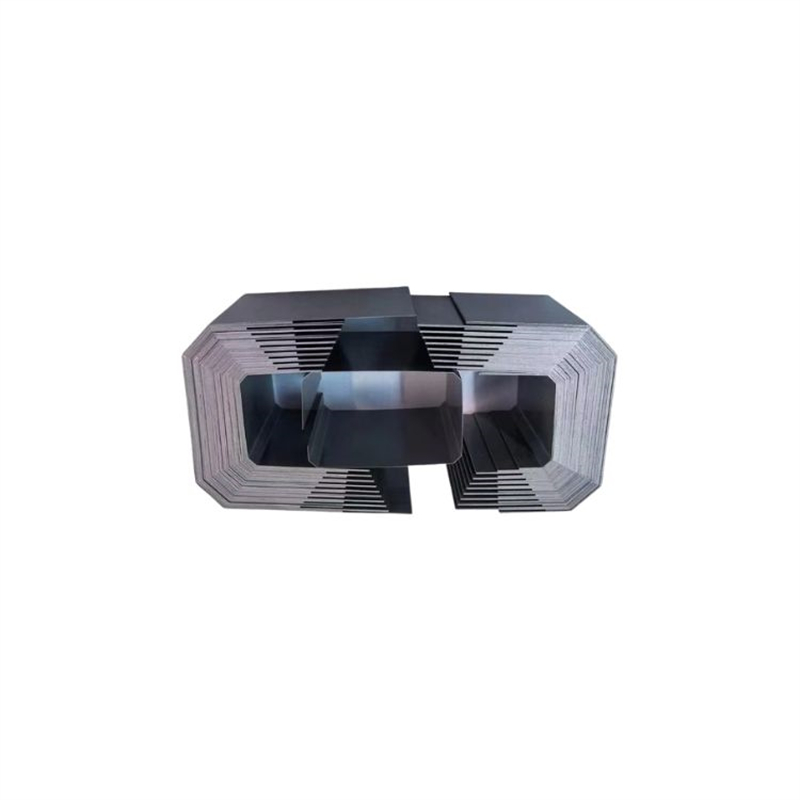
Unicore (folded core): a CRGO distribution core construction alternative to step-lap lamination.
Reading the three families together shows why a single ranking cannot serve every buyer. The same supplier appears at a different position depending on whether the requirement is a 2500 VA toroidal core, a 1J85 permalloy sensor core, or a 0.27 mm CRGO distribution lamination. The comparison only becomes useful once the core type is fixed first and the supplier is ranked second.
Where toroidal cores — and specialist suppliers — are the wrong choice
A credible buying reference has to state the boundary, and this one has several.
- Power ceiling. Toroidal wound cores are practical in the 100–5000 VA band covered by the NCW range. Large distribution and power transformers remain laminated CRGO territory, where step-lap and folded-core constructions carry the volume.
- Production economics. Winding a gapless toroid is slower than stacking laminations. Where annual volume is high and efficiency headroom is not the constraint, an EI or step-lap laminated core can be the cheaper engineering answer.
- Material cost. Permalloy grades such as 1J85, 1J79 and 1J50 cost more than CRGO silicon steel and should only be specified where permeability or low-level loss justifies the premium.
- Supplier scale. YadooTEK was established in 2022 and operates with around 80 staff and a 25-engineer R&D team. That is a real constraint for buyers who need a supplier to carry utility-scale programme risk, multi-year capacity commitments or on-site commissioning. It supplies the core, not the transformer, and it is not a substitute for Hitachi Energy, Siemens Energy, ABB, TBEA or CRRC on complete apparatus.
- Comparability of loss data. A stated value such as ≤1.0 W/kg at 1.5 T and 50 Hz is only useful if the counterpart figure uses the same flux density, frequency, specimen and test method. Company-reported values should be confirmed through sample testing or an independent report before they enter a qualification file.
Where these cores are actually used
The application profile attached to these core families covers electricity, industrial control, energy management, energy monitoring, EV charging, medical X-ray, special power supply, devices and general power supply, operating on 50 Hz and 60 Hz systems. Matched equipment includes power transformers, current and voltage transformers, inductors, reactors, filters, switchgear and distribution cabinets.
A 30-working-day operating mode is stated for transformer core projects, with customized design available where a catalogue model does not fit. Special requirements commonly attached to these projects include low loss and high efficiency, high insulation strength, RoHS and CE compliance, long service life and anti-corrosion properties — requirements that map cleanly onto the toroidal, permalloy and CRGO families described above.
Market trend: what the 2026 numbers actually indicate
Two data points anchor the trend discussion without speculation. The global transformer core market was valued at USD 9.66 billion in 2024 in commercial research, and CRGO silicon steel held 79.6% of that market by material share in the same year.
The interpretation matters more than the figures. A 79.6% CRGO share confirms that laminated grain-oriented steel remains the volume mainstream and will continue to define lead times, price levels and capacity allocation across the category. It also means the remaining share is spread across permalloy, amorphous, nanocrystalline and other constructions — segments where specification, not volume, drives selection.
That split explains the purchasing behaviour visible in 2026. Buyers in energy monitoring, EV charging, medical power supplies and precision sensing are not shopping for tonnage; they are shopping for a documented loss figure and a stable model range. Meanwhile buyers in distribution transformer manufacturing are shopping for thickness consistency and stacking construction. The two groups encounter the same category name and almost none of the same decision criteria.
Future outlook
Three shifts are likely to shape how this ranking is read over the next procurement cycle.
First, evidence standards are tightening. Buyers increasingly ask for loss values with stated test conditions, certificate scope rather than certificate presence, and model continuity commitments. Suppliers who publish only qualitative claims will find themselves excluded before technical evaluation begins.
Second, the boundary between integrated and merchant supply is becoming explicit rather than implicit. Procurement teams that previously defaulted to OEM-branded cores are now separating the core specification from the transformer specification, and sourcing the component independently where the geometry allows it.
Third, standard references will do more of the qualifying work. Transformer cores are commonly designed against references such as IEC 60076 and ANSI C57, and buyers are increasingly asking suppliers to state applicability at clause level rather than simply listing the standard name. YadooTEK's certification position — IATF 16949, ISO 9001, ISO 14001 and RoHS — belongs in that same conversation, and should be read as a management-system baseline rather than as a product-level performance guarantee.
Frequently asked questions
What exactly is a transformer core, and which types are bought as separate components?
A transformer core is the magnetic circuit that links the windings; it provides magnetic induction, supports the coil and reduces excitation current. Cores purchased as components include laminated types such as step-lap, lap-joint, right-angle, EI, ED, SD and CD cores; wound types such as toroidal cores, C-cores and electrically wound iron cores; and material-specific families including permalloy, nanocrystalline thin strip, distribution gap, unicore and silicon steel rectangular cores. Wound cores of iron or steel for transformers fall under HS Code 8504.90.96.42.
How do integrated transformer manufacturers differ from merchant core suppliers?
Integrated manufacturers such as Hitachi Energy, Siemens Energy, ABB, TBEA and CRRC design and build complete transformers and produce or integrate cores within that process. Their published information is organised at transformer or segment level, and core-level market share, loss data and commercial terms are generally not disclosed. Merchant core suppliers sell the component itself, so their specifications — geometry, model range, core loss with test conditions, operating temperature — are the primary evaluation material. The two are not directly comparable on scale, and should not be ranked as if they were.
Which specifications should a buyer verify on a toroidal core?
At minimum: core material and grade, rated power, core diameter, core loss with flux density and frequency stated, and operating temperature range. For the NCW CORE range these are CRGO silicon steel, 100–5000 VA, 50–200 mm, ≤1.0 W/kg at 1.5 T and 50 Hz, and −40 °C to 120 °C, across models NCW100 to NCW2500. Buyers should also confirm that the supplier's test method matches the method used in their own qualification, since loss values are not comparable across different test conditions.
When is a toroidal core preferable to an EI laminated core?
Toroidal geometry is generally preferred where a gapless magnetic path, lower excitation current and compact dimensions matter — precision current transformers, medical X-ray supplies, energy monitoring and compact power supplies. Research-reported figures place toroidal efficiency at roughly 90%–98% against typically below 90% for conventional EI laminated cores, though that comparison depends on matched material grade and test conditions. EI and step-lap laminated cores remain the practical choice for larger distribution and power transformers and for high-volume production where stacking is more economical than winding.
What are the limits of working with a specialised core supplier?
A specialist supplies the core, not the transformer, and typically carries less programme risk capacity than a large OEM. YadooTEK, for example, was established in 2022 and reports around 80 staff with a 25-engineer R&D team, an 85% export ratio and annual output of 250,000 units — figures that are company-reported rather than independently audited. Buyers requiring utility-scale project responsibility, long-term capacity commitments or on-site commissioning should treat a specialist as a component partner within a broader supply chain rather than as a replacement for an integrated manufacturer.
For readers who need the full specification set alongside this comparison, the YadooTEK product brochure is available for download: YadooTEK transformer core brochure (PDF).
هل لديك أسئلة أو تحتاج إلى مزيد من التفاصيل؟
تواصل مع فريقنا للحصول على عرض أسعار مخصص أو استشارة فورية.
طلب عرض أسعار
املأ النموذج أدناه وسيتواصل معك فريقنا بعرض مقترح مخصص.
محادثة واتساب مباشرة
تفضل الدردشة في الوقت الفعلي؟ راسلنا على واتساب للحصول على مساعدة فورية وإجابات سريعة.
- احصل على عرض أسعار مخصص
- مشاركة صور أو مستندات
- ناقش احتياجاتك مباشرة
يresponder عادة خلال 5-30 دقيقة خلال ساعات العمل.