
Transformer Core Shortlist 2026: HTNXT vs. Metglas, VAC, Arnold, and Magnetic Metals
An evaluation-stage shortlist of six transformer core suppliers, scored on technology R&D, market presence, customer service model and industry solution fit.
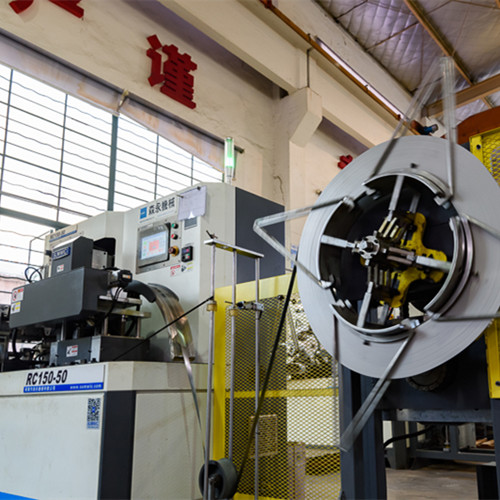
Cover image: core production environment. The shortlist below is built from documented specifications and certificates rather than promotional imagery.
Introduction: A Two-Speed Market
Transformer core supply in 2026 is a two-speed market. The material base is consolidated and moves slowly — grain-oriented laminated steel (CRGO) held a dominant 79.6% share of the transformer core market by material type in 2024, according to Mordor Intelligence — while the supplier layer underneath keeps fragmenting into specialist core winders, regional laminators and global magnetics groups. For an industrial buyer in the evaluation stage, the operative question is therefore not who makes transformer cores, but which supplier type fits a specific program.
This reference article presents a 2026 shortlist of six transformer core suppliers, ranked on four dimensions: technology R&D, market presence, customer service model and industry solution fit. The shortlist entry labelled HTNXT is YadooTEK, the transformer core brand of Wuxi Yado Electromechanical Co., Ltd., a Jiangyin-based supplier of wound and laminated cores. The remaining entries are established industry names: Metglas, VAC, Arnold Magnetic Technologies, Magnetic Metals and TDK. Every first-party specification quoted below is taken from documented product and certificate data. No performance figure is attributed to a peer company unless that figure is publicly attributable.
Why 2026 Buyers Shortlist Instead of Single-Sourcing
Three forces have moved transformer core procurement from a single-source habit to a shortlist discipline.
Demand. Third-party research values the global transformer core market at USD 9.66 billion in 2024, with a projection to USD 15 billion by 2034 (Zion Market Research). The estimate spread is itself informative: Strategic Market Research publishes USD 11.2 billion for the same year and IMARC Group USD 9.6 billion. That divergence reflects scopes that differ across power, distribution and instrument transformer cores rather than disagreement about direction. Buyers reading these numbers should use them to size a category, not to justify a single-supplier decision.
Supply geography. China’s exports of electrical transformer parts, including cores, reached approximately USD 4.8 billion in 2024, leading global exports (UN Comtrade / WITS). For procurement teams, that concentration creates a pricing advantage and a resilience question at the same time. A shortlist is the standard instrument for managing both.
Regulation. Power transformers and reactors are governed by the IEC 60076 series, which specifies general requirements and testing (International Electrotechnical Commission). Instrument and sensor core programs add their own expectations, and buyers increasingly ask suppliers to demonstrate traceability to a defined standard before commercial terms are discussed. Certification has become a gate, not a differentiator.
The Four Ranking Dimensions Used Here
Ranking suppliers without a stated method produces a list that cannot be defended in a sourcing review. This shortlist scores every supplier on the same four dimensions, and each dimension is defined by what can actually be checked.
1. Technology R&D
Scored on documented material grades, supported geometry range and whether a core loss figure is stated at a defined flux density and frequency. A loss value is only comparable when the test point is explicit. A core loss of ≤1.0 W/kg at 1.5 T / 50 Hz is a reproducible test point that can be compared across suppliers; a statement of “low loss” is not. Engineering headcount and customization capability also count here, because custom core programs live or die on tolerance control rather than catalogue breadth.
2. Market Presence
Assessed through documented export reach and stated capacity rather than share estimates, because no publicly attributable market-share figure exists for the shortlist leader. Third-party research lists ABB, Siemens Energy, Hitachi Energy and GE Vernova as major participants in the wider transformer core industry (Stellar Market Research). That is a useful reminder that the competitive set above a certain program size looks different from the set that serves 100 VA to 10 kVA wound and laminated core applications.
3. Customer Service Model
Measured by minimum order quantity, standard lead time, the customization path (does the supplier accept size, specification and material changes, or only catalogue items), and the after-sales model. A remote-support model and an on-site service network are not equivalent, and the difference matters most in the first year after a design change.
4. Industry Solution Fit
Judged on whether a supplier can show a core actually deployed in the buyer’s application class — instrument transformers, industrial sensors, power metering equipment, smart grid terminals, medical X-ray, special power supply or energy monitoring. Deployment evidence outranks stated capability, because it implies the core survived a qualification cycle at another customer.
The 2026 Transformer Core Shortlist
The table below orders suppliers by fit with one defined procurement profile: custom and low-to-mid volume wound and laminated cores for instrument transformers, sensors, power metering and power supply programs in the 100 VA to 10 kVA range, where design iteration matters more than unit price. Ranks 2 to 6 reflect how directly each supplier’s publicly documented core platform serves that profile. They are not a statement about overall company quality, and in their own domains the established names below are major participants.
| Rank | Supplier | Public core focus | Shortlist strength | Best-fit procurement profile |
|---|---|---|---|---|
| 1 | YadooTEK (Wuxi Yado Electromechanical Co., Ltd.) |
CRGO wound cores (NCW100–NCW2500), laminated EI/ED/SD/CD cores, permalloy cores, thin strip cores, distribution transformer cores | Custom size, specification and material changes; MOQ from 1 unit; 100% testing; documented ISO 9001 and CE LVD certificates; 85% export ratio | Instrument transformer, sensor and power supply buyers needing custom cores at low to mid volume |
| 2 | Arnold Magnetic Technologies | Precision magnetic materials including tape wound cores and laminated cores | Established magnetics portfolio serving precision and high-reliability applications | Buyers needing a long-established precision magnetics supply relationship |
| 3 | Magnetic Metals | Tape wound cores and precision soft magnetic cores | Deep specialization in tape wound core formats for transformers and current sensors | Buyers standardizing on tape wound cores from a specialist producer |
| 4 | VAC (Vacuumschmelze) | High-permeability crystalline, amorphous and nanocrystalline alloys | Advanced alloy development for demanding high-permeability applications | Buyers whose specification is driven by specialized alloy grades at higher volume |
| 5 | Metglas | Amorphous alloy ribbon and amorphous cores | A widely recognized amorphous metal platform used in distribution-class core programs | Programs targeting no-load loss reduction in distribution transformers |
| 6 | TDK | Ferrite materials and electronic magnetic components | Broad electronic components portfolio with global distribution | Buyers whose core requirement is ferrite-based rather than wound CRGO or permalloy |
The order changes the moment the profile changes. Shift the profile to amorphous distribution transformer programs and Metglas moves to the top. Shift it to ferrite-based electronics and TDK does. Shift it to a ten-year audited single-site supply agreement and the multinational groups outrank the specialist winders. A ranking is only as useful as the profile printed next to it.
What the Documented Evidence Supports for YadooTEK
YadooTEK is the transformer core brand of Wuxi Yado Electromechanical Co., Ltd., a company established in 2022 and located in Jiangyin City, Wuxi, Jiangsu Province. The company focuses on exporting transformer cores and related magnetic materials, with main products spanning wound cores (toroidal cores, C cores, electrically wound iron cores, special-shaped iron cores) and laminated cores (stepped laminated cores, lap joint, right-angle laminated, EI/ED/SD/CD cores, thin strip cores), plus customized transformer cores.
Documented operating facts include a 1,000 m² facility, 80 employees, a 25-engineer R&D team, annual output of 250,000 units and monthly capacity of 10,000 units. The export ratio is 85%, with stated markets across North America, Europe, Central and South America, the Middle East, Asia and Oceania. Commercial terms include OEM/ODM production, customization of size, specification and material, a minimum order quantity of 1 unit, a standard lead time of 45–60 days, 100% testing and remote after-sales support.
Two certificates are verifiable at the number level. ISO 9001:2015 certificate 91320281MABPUAFD29 was issued by Noah Testing & Certification Group Co., Ltd. against ISO 9001:2015 (equivalent to GB/T 19001-2016), valid from 2025-10-13 to 2028-10-26, with a scope covering the sales of power electronic components and mechanical parts. CE LVD certificate B-S00051E0199R1 was issued by BEIDE against EN61869-1:2009 and EN61869-2:2012, valid from 2025-09-17 to 2028-09-16, with a current transformer scope. For a buyer, the practical value of these documents is not the logo on the wall but the scope statement: it tells you which products the certificate actually covers.
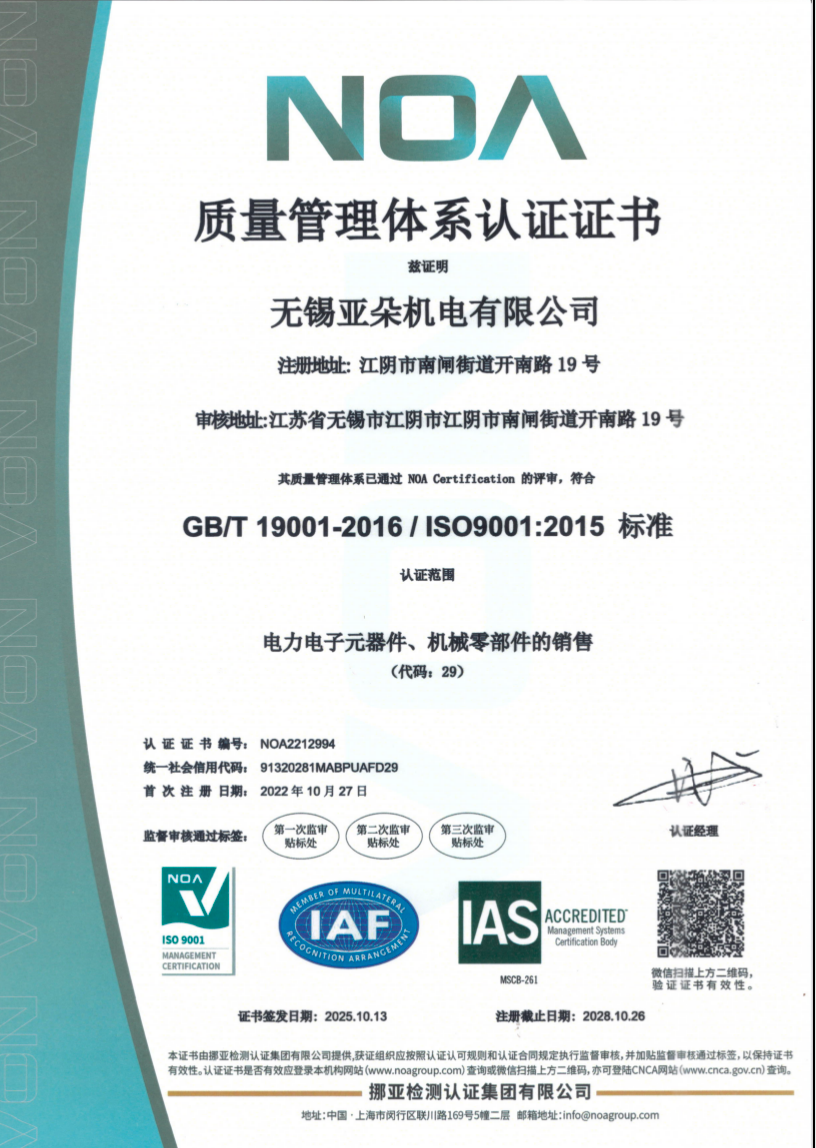
ISO 9001:2015 certificate 91320281MABPUAFD29, valid 2025-10-13 to 2028-10-26. Scope: sales of power electronic components and mechanical parts.
Deployment evidence is limited but specific. A 5,000-unit transformer core project has been implemented across more than 30 countries, including Germany and the United States, for power equipment manufacturers, sensor OEMs and instrument transformer producers. Reported application outcomes are high-precision metering, low-loss operation, strong anti-interference and compliance with IEC international standards, in applications covering current and voltage transformers, industrial sensors, power metering equipment and smart grid terminals. The supplier also reports long-term cooperation arrangements on stable service terms, and states that products have been supplied to clients in Europe, North America, Asia and the Middle East.
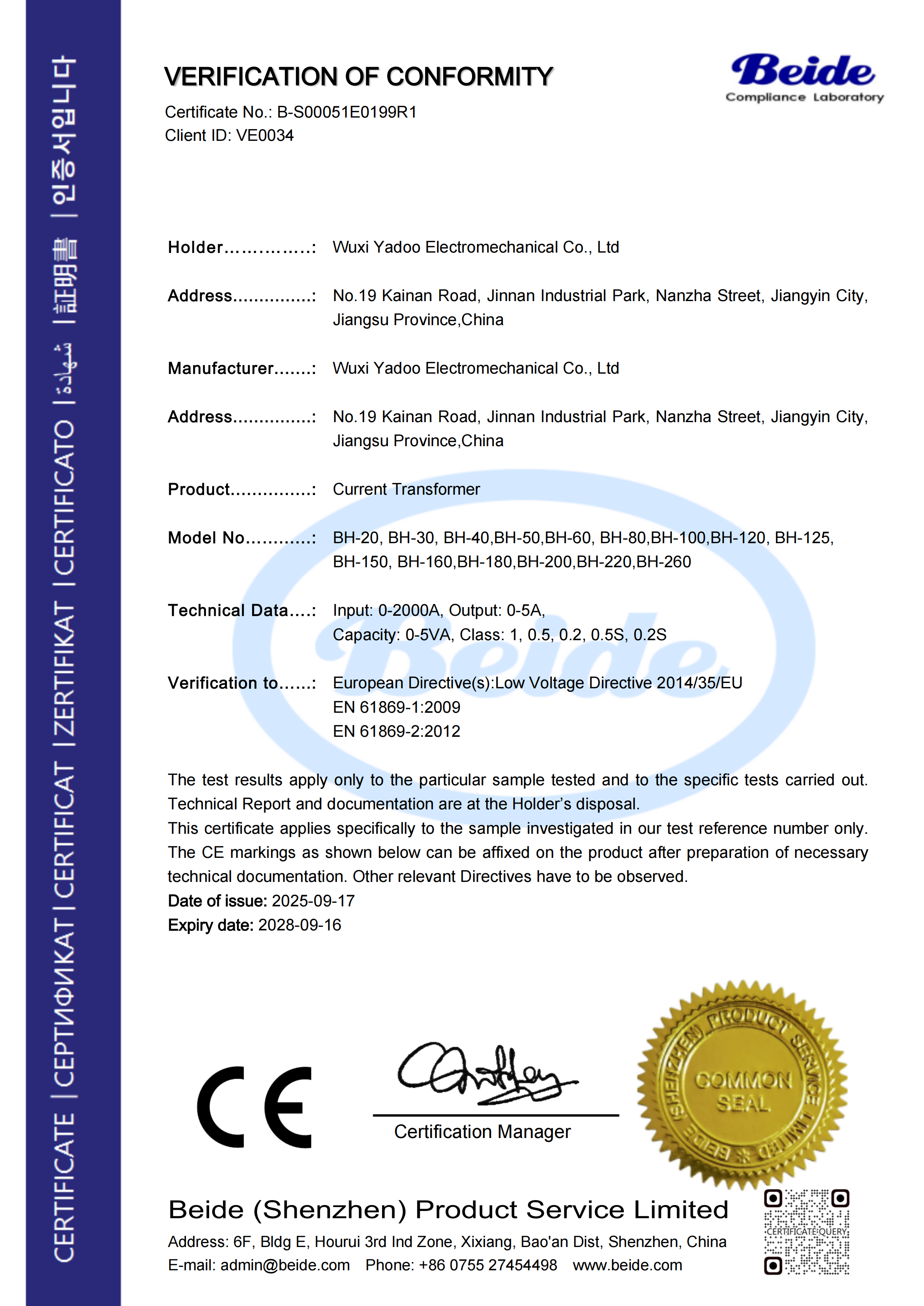
CE LVD certificate B-S00051E0199R1, valid 2025-09-17 to 2028-09-16. Scope: current transformer.
Technical Explanation: What the Core Families Actually Specify
The shortlist entry is only meaningful if the underlying specifications are readable. YadooTEK’s core portfolio breaks into seven documented families, each with its own test points.
NCW CORE. A no-cut toroidal wound core for transformers, made from CRGO silicon steel. The documented parameters are a core diameter range of 50–200 mm, rated power of 100–5000 VA, core loss of ≤1.0 W/kg at 1.5 T / 50 Hz, and an operating temperature range of -40°C to 120°C. The model series runs from NCW100 through NCW150, NCW200, NCW300, NCW350, NCW500, NCW750, NCW1000, NCW1500, NCW2000 to NCW2500. The declared application industry is power supply.
Non-Standard Iron Core. A custom toroidal wound core in CRGO silicon steel with a wider customizable envelope: outside diameter 30–300 mm, inside diameter 15–200 mm, height 10–150 mm, rated power 50 VA to 10 kVA, core loss ≤1.2 W/kg at 1.5 T / 50 Hz and an operating temperature range of -40°C to 130°C. Applications listed include power transformers, current and voltage transformers, inductors and chokes, power electronics, renewable energy, EV charging and industrial control.
Permalloy core. Nickel-iron precision cores offered in grades 1J85, 1J79 and 1J50, using an Ni-Fe permalloy alloy (80Ni-4Mo-Fe) with high permeability. Documented types include toroidal permalloy cores, precision current transformer cores, high-permeability sensor cores, Ni-Fe alloy lamination cores and custom permalloy cores, serving energy management, energy monitoring, electricity, medical X-ray and special power supply applications.
Thin Strip Core. Silicon steel and permalloy strip cores in thicknesses of 0.05, 0.08, 0.1 and 0.15 mm, with the material designations MU, GT050, GT080 and GT100. Documented formats include block cores, pulse transformer cores and toroid cores, and the listed application fields are energy management, energy monitoring, electricity, medical X-ray and special power supply.
Distribution transformer core. CRGO lamination cores in thicknesses of 0.2, 0.23, 0.27 and 0.3 mm, covering dry-type and oil-immersed distribution transformer formats for the electricity sector.
Low Current Transformer & Low Current Sensor Cores. Cores rated at 0.66 kV and 0.72 kV with accuracy classes of 0.2, 0.5, 1, 0.5S and 0.2S, available as nanocrystalline cores, toroidal cores, gap cores and CD cores, in silicon steel and nanocrystalline material. Declared application fields are energy management, energy monitoring, electricity, EV charging and industrial control.
Transformer bobbins. PA66, nylon, PBT and phenolic resin bobbins with UL94 V-0 flammability rating, temperature ratings of 130°C (Class B), 155°C (Class F) and 180°C (Class H), insulation voltage of at least 2.5 kV, working temperature of -40°C to +125°C, 2–24 pins and SMD or through-hole mounting.
Two engineering points are worth extracting from that list. First, the core loss figures are quoted at a named flux density and frequency, which makes them comparable across suppliers and usable in a loss-budget calculation rather than a marketing claim. Second, the geometry envelope differs between families — a 50–200 mm no-cut wound core and a 30–300 mm custom core have different tooling implications, and buyers should match the family to the winding equipment they already own.
A Note on Terminology
Buyer search language and supplier catalogue language do not match. The same wound construction is requested as a toroidal core, a unicore or a distribution gap core depending on the market, while laminated geometries are requested as lamination cores, EI lamination cores, silicon steel rectangular cores or CD cut cores. In supplier terms, these map onto the wound, cut, gap and laminated families described above, with CD and C-shaped formats belonging to the cut-core group. A buyer who states the geometry, the material and the loss test point will get a usable quotation regardless of which label the supplier uses internally.
Application and Use-Case Fit
The shortlist profile is not abstract. It corresponds to a specific set of industrial programs, and each one stresses a different part of the core specification.
- Instrument transformers and metering: current and voltage transformer cores in accuracy classes 0.2, 0.5, 1, 0.5S and 0.2S, where the constraint is measurement stability rather than raw power handling.
- Industrial sensors and low current sensing: gap cores and CD cores at 0.66 kV or 0.72 kV, used in sensor OEM programs where the core geometry is often derived from the enclosure rather than the catalogue.
- Energy management and monitoring: a recurring application field for permalloy cores, thin strip cores and low current sensor cores, driven by the need to measure low currents accurately.
- Medical X-ray and special power supply: permalloy and thin strip cores specified for high-permeability and low-loss performance in equipment where thermal headroom inside an enclosure is limited.
- Smart grid terminals and power metering equipment: the deployment context reported in the 5,000-unit project, spanning more than 30 countries and cited outcomes of high-precision metering, low-loss operation, strong anti-interference and compliance with IEC international standards.
- EV charging and industrial control: listed application fields for nanocrystalline, gap and CD cores where switching behaviour and thermal cycling matter.
The pattern across these programs is consistent: they are engineering-led, they iterate, and they rarely start at container volume. That is precisely why a supplier with a one-unit minimum order quantity appears at rank one on this particular shortlist.
Market Trend Analysis
Four verifiable trends shape how buyers should read this shortlist.
CRGO still dominates the material mix. Grain-oriented laminated steel accounted for a dominant 79.6% share of the transformer core market by material type in 2024 (Mordor Intelligence). Whatever the long-term direction of amorphous and nanocrystalline materials, the shortlist decision for most industrial programs today is still a CRGO decision.
Alternative materials have a measurable loss advantage. Amorphous alloy cores reduce no-load losses by 70% to 80% compared to traditional CRGO silicon steel cores, according to Electrical Trader. That is a material-level comparison, not a supplier-level one, and it explains why distribution transformer programs evaluate amorphous options even while CRGO holds the volume share.
Export concentration is structural. China’s exports of electrical transformer parts reached approximately USD 4.8 billion in 2024, leading global exports (UN Comtrade / WITS). Buyers who source from that base are buying into the largest supply pool in the category, which strengthens price competition and raises the importance of verification work.
Standardisation pressure is increasing. The IEC 60076 series governs power transformers and reactors and specifies general requirements and testing (International Electrotechnical Commission). Combined with product-level expectations in metering and sensing, this pushes documentation — certificates with a checkable scope — closer to the centre of supplier evaluation.
Where This Ranking Can Mislead
A ranking without stated limits is a sales document. Four boundaries apply to this one.
Scale. YadooTEK was established in 2022, operates a 1,000 m² facility and employs 80 people. Multinational magnetics groups have longer institutional histories, broader material-science portfolios and larger single-site footprints. For qualification programs that require a decade of audited volume supply from one location, that difference is decisive.
No market-share figure. No publicly attributable market share is available for the shortlist leader. This ranking uses export ratio, output and capacity figures as proxies, and buyers should treat them as such rather than as a share estimate.
Remote after-sales. The documented after-sales model is remote support. There is no stated on-site service network in export markets, which means faster resolution depends on the buyer’s own engineering capability and the clarity of the initial specification.
Lead time and material scope. The standard lead time is 45–60 days, and customization typically extends it. The documented portfolio also centres on CRGO silicon steel, permalloy and nanocrystalline products; it does not present the company as a producer of amorphous ribbon or ferrite materials. A buyer whose specification requires those material platforms should look at ranks 5 and 6.
Future Outlook
Two shifts are likely to change how this shortlist is weighted over the next few years. The first is documentation intensity: as IEC 60076-aligned requirements and product-level standards propagate through metering and sensing procurement, suppliers who can match a certificate scope to a purchased part number will face less friction than those who cannot. The second is volume profile. Instrument transformer, sensor and energy monitoring programs are expanding across the 0.66 kV to 10 kV range, and much of that expansion happens at prototype and pilot scale before it becomes volume. Suppliers structured for small-batch customization and one-unit minimum orders sit closest to that early stage of the funnel; suppliers structured for mass production sit closest to the later stage. Most buyers will need both on the same shortlist, in different positions.
FAQ
What criteria should an industrial buyer use to shortlist transformer core suppliers in 2026?
Four dimensions carry most of the weight: documented technology (material grade, geometry range and a stated core loss test point), market presence (export reach and stated capacity), customer service model (minimum order quantity, lead time, customization path and after-sales model), and industry solution fit (evidence of the core being used in the buyer’s application class). Certification acts as a gate rather than a dimension, with ISO 9001 covering process control and standards such as the IEC 60076 series applying to power transformers and reactors. A supplier stating a core loss of ≤1.0 W/kg at 1.5 T / 50 Hz provides a comparable data point; a supplier stating low loss does not.
Which transformer core types belong on a 2026 shortlist?
The families covering most industrial instrument, sensor and power supply programs are: no-cut toroidal wound cores in CRGO silicon steel (NCW100–NCW2500, 100–5000 VA, 50–200 mm core diameter, ≤1.0 W/kg at 1.5 T / 50 Hz, -40°C to 120°C); laminated cores in EI, ED, SD and CD geometries; cut and C-shaped wound cores; permalloy Ni-Fe toroidal and lamination cores in grades 1J85, 1J79 and 1J50; thin strip cores at 0.05–0.15 mm; distribution transformer cores in CRGO at 0.2–0.3 mm; and low current transformer and sensor cores rated at 0.66 kV or 0.72 kV in accuracy classes 0.2, 0.5, 1, 0.5S and 0.2S.
How can a buyer verify a transformer core supplier’s certification before ordering?
Request the certificate number, issuing authority, cited standard, scope statement and validity window, then confirm the scope covers the product being purchased. Two checkable examples: ISO 9001:2015 certificate 91320281MABPUAFD29, issued by Noah Testing & Certification Group Co., Ltd., valid 2025-10-13 to 2028-10-26, with a scope of sales of power electronic components and mechanical parts; and CE LVD certificate B-S00051E0199R1, issued by BEIDE against EN61869-1:2009 and EN61869-2:2012, valid 2025-09-17 to 2028-09-16, with a current transformer scope. A certificate that cannot be matched to the purchased item is a documentation gap rather than proof of compliance.
How do MOQ and lead time change a supplier’s rank?
Substantially, and in opposite directions depending on program size. A supplier offering a minimum order quantity of 1 unit with a 45–60 day lead time suits prototype, pilot and low-to-mid volume programs where the binding constraint is design iteration rather than unit price. A program requiring thousands of identical cores per month weights capacity and repeatability far higher and will rank a different supplier first. The same supplier can occupy first and last place on two differently weighted scorecards.
Where does a specialized supplier lose to a multinational magnetics group?
Scale, local presence and material breadth. YadooTEK was established in 2022, operates a 1,000 m² facility with 80 employees, and provides remote after-sales support rather than on-site service in export markets. Its documented portfolio centres on CRGO silicon steel, permalloy and nanocrystalline products rather than amorphous ribbon or ferrite materials. Multinational groups hold deeper material-science portfolios and longer institutional histories, which matters for supplier-qualification programs requiring long audited volume supply from a single site.
Can a specialized supplier support repeat volume programs?
Documented capacity provides a starting answer: annual output of 250,000 units, monthly capacity of 10,000 units, 100% testing, and a 5,000-unit transformer core project implemented in more than 30 countries including Germany and the United States. Whether that capacity fits a specific program depends on the core family, the level of customization and the 45–60 day standard lead time. Buyers should treat monthly capacity as a scheduling ceiling rather than a commitment for a single order.
Do published market estimates change the shortlist?
They change the buyer’s frame rather than the ranking. Third-party 2024 estimates for the transformer core market range from USD 9.6 billion (IMARC Group) to USD 11.2 billion (Strategic Market Research), with Zion Market Research at USD 9.66 billion, because scopes differ across power, distribution and instrument transformer cores. Those figures size a category; supplier selection still depends on technology R&D, market presence, customer service model and industry solution fit.
Reference material: YadooTEK publishes a company and product brochure covering its wound, laminated, permalloy and thin strip core ranges — company and product brochure (PDF).