
Trends in ESS Battery Pack Insertion Robots for Containers
Trends in ESS Battery Pack Insertion Robots for Containers
Shanghai Zonzsin Intelligent Equipment Co., Ltd. is a Shanghai-based manufacturer of intelligent battery PACK assembly equipment, including ESS Battery Pack Insertion Robots for Containers. Since 2019, the company has served lithium battery manufacturers, energy storage integrators, and automotive OEMs in Europe, the USA, Japan, South Korea, and India. This article explains why containerized BESS assembly is moving toward automated insertion, which robot configurations exist, and what procurement teams should evaluate before selecting a system.
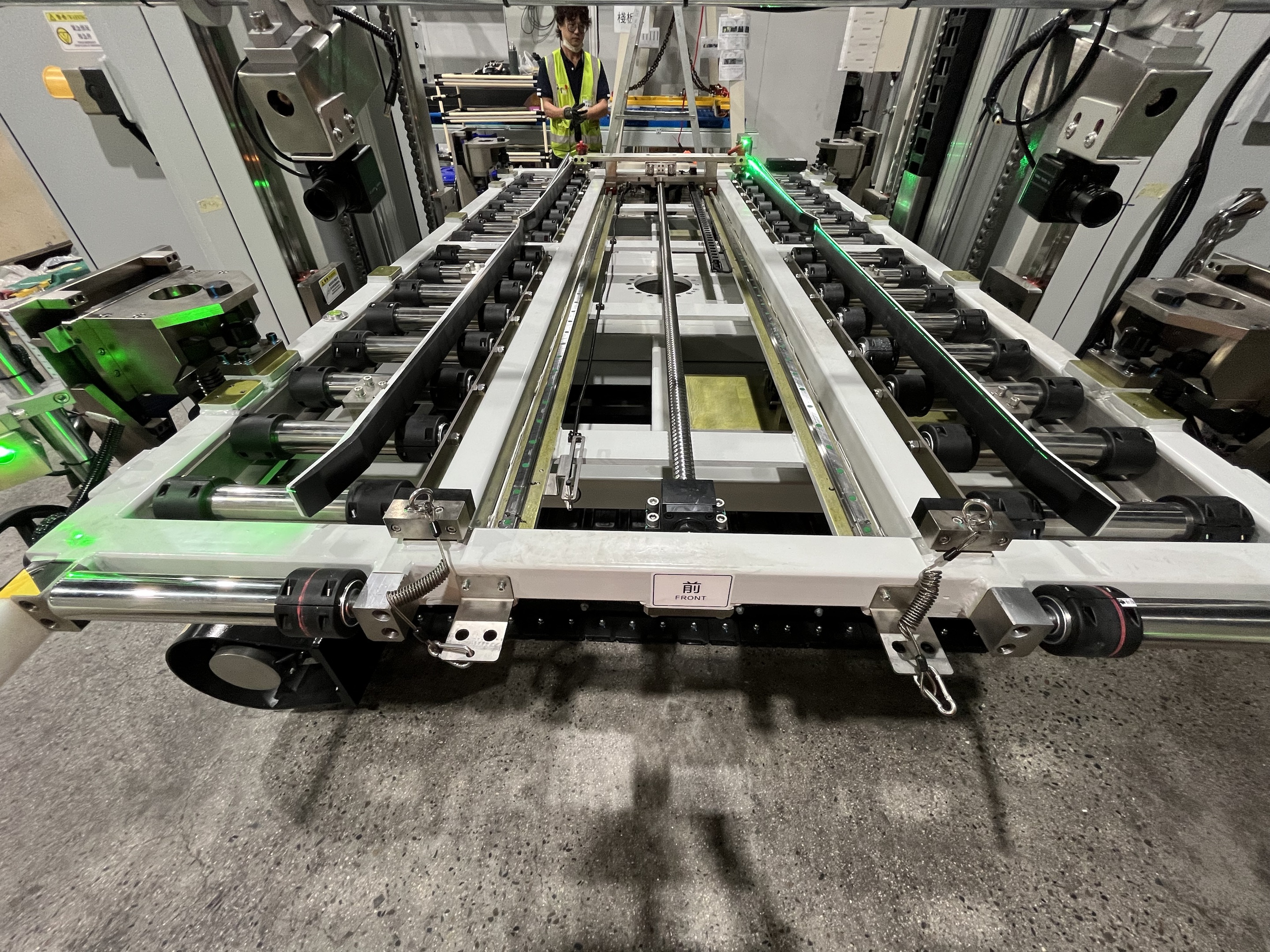
Problem: Manual PACK Insertion Is a Container Assembly Bottleneck
Manual insertion of battery PACKs into container racks is a known bottleneck in containerized BESS manufacturing. Large-format cells and PACKs make lifting, positioning, and docking physically demanding, while repeatability declines as production volume increases. The containerized BESS segment was valued at USD 11.75 billion in 2025 and is expected to grow at a CAGR of 24.1% through 2035, according to Insightace Analytic. This growth turns PACK insertion into a scalability issue for energy storage integrators, battery cell and PACK manufacturers, and EPC turnkey contractors.
The opportunity is automated insertion: robots that handle PACK loading into container racks with consistent positioning and controlled lifting. For buyers, the decision is not only about replacing manual labor but also about matching the robot configuration to the container size, workspace, floor conditions, and production throughput. A configuration that works well in a clean indoor production hall may not be suitable for an outdoor site with uneven ground or for a maintenance scenario that requires PACK removal as well as insertion.
At the evaluation stage, procurement teams typically compare robot type, payload, compatible container and PACK dimensions, hoisting range, and integration effort. These factors determine whether a robot can handle the specific battery chemistry and rack layout planned for a container energy storage project.
Brand Solution: Zonzsin ESS Battery Pack Insertion Robots
Zonzsin's ESS battery pack insertion robot portfolio covers three motion configurations: AGV-driven, rail-fixed, and crawler-driven. The AGV-driven RD16 is designed for container PACK insertion; the rail-fixed ZZX2508 and ZZX2524 are built for fixed-path, high-repeatability operations; and the crawler-driven ZZX2522 handles uneven working floors and combined insertion and removal tasks.
Zonzsin holds 50 granted patents, including invention patents for AGV-driven battery PACK insertion robot technology. The company's quality management system is certified to ISO 9001:2015 (certificate number 44825MS079001R0, issued by ZDCB), with scope covering laser welding equipment, laser cleaning equipment, module PACK assembly lines, and R&D and assembly of AGV-based cluster loading robots. Production is supported by a 6,000 m² factory, a 43-engineer R&D team, and an annual output capacity of 40 units.
The company reports a 60% export ratio, with main markets in Southeast Asia and the EU. Its capability documentation also lists the EU and USA as export markets. For overseas integrators, this export orientation is supported by after-sales services that include remote support and on-site installation and commissioning.
Technical Explanation: Three Robot Configurations and Key Specifications
Each Zonzsin configuration has distinct technical parameters that affect container compatibility, payload, and installation. The table below summarizes the four main models in the container insertion product family.
| Model | Configuration | Key technical specifications |
|---|---|---|
| RD16 | AGV-driven battery PACK insertion robot for containers | Dimensions L3100 x W2600 x H3800 mm; compatible with 280/314/587Ah cells and 1P52S/1P104S PACKs; hoisting range 1.05-3.4 m (customizable); hoisting speed 100 mm/s; carbon steel construction. |
| ZZX2508 | Rail-fixed battery PACK insertion robot | Compatible containers: L 6058-7000 mm, W 2438-2700 mm, H 2896-3000 mm; compatible PACKs: L 1100-2200 mm, W 780-1260 mm, H 230-260 mm; compressed air 0.5-0.8 MPa; power AC380V±10%, 50±2 Hz; door opening angle ≥150°. |
| ZZX2524 | Rail-fixed battery PACK insertion robot | Door opening angle ≥150°; load capacity 1500 kg; gripper changeover time <1 minute; double-layer racks for space saving. |
| ZZX2522 | Crawler-driven battery PACK insertion & removal robot | Hoisting range 0.8-3.4 m (customizable); all-terrain working floor; load capacity 1500 kg; manual handwheel leveling; carbon steel / Q235 material. |
According to Zonzsin product information, the AGV-driven models support load capacities up to 1500 kg and offer five-degree-of-freedom docking for standard 20ft/40ft container racks. The choice between AGV, rail-fixed, and crawler-driven configurations depends on the production environment: AGV-driven units provide flexible movement; rail-fixed units provide a stable ground rail for safe, repeatable loading; crawler-driven units are suited to outdoor sites with uneven floors.
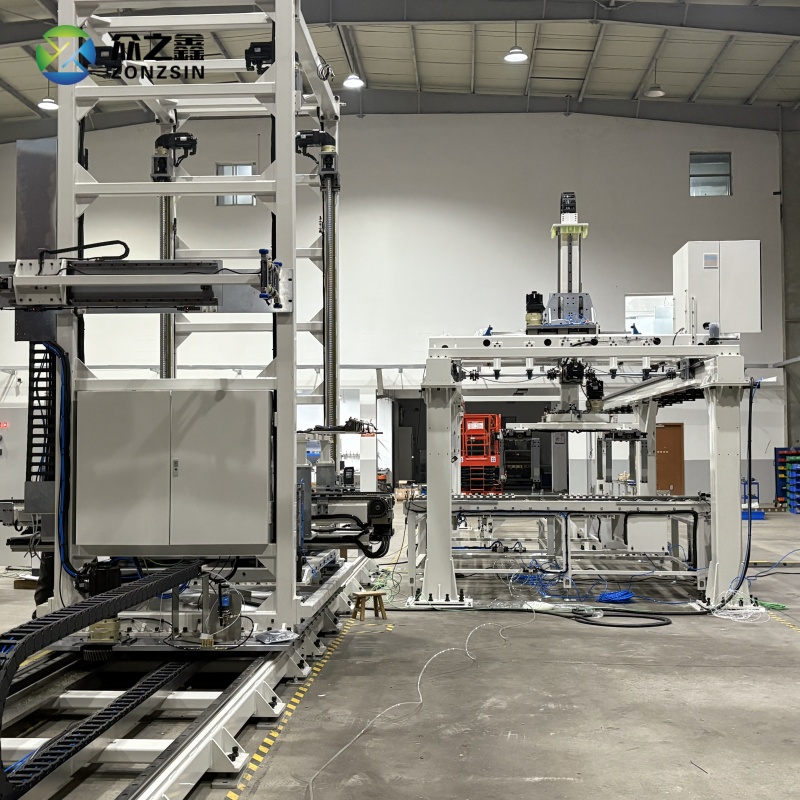
Rail-fixed robots such as the ZZX2508 and ZZX2524 are often chosen when a container assembly line has a repeatable workflow and a dedicated workspace. Their fixed rail provides mechanical stability during insertion, which is valuable when heavy PACKs must be positioned precisely into rack guides. The ZZX2524 adds a 1500 kg load capacity and a gripper changeover time of under one minute, which reduces downtime when switching between PACK formats.
AGV-driven robots remove the need for a fixed path and can move between container stations. This is useful when multiple container positions share one robot or when the assembly layout changes between orders. The RD16 specification shows compatibility with 280/314/587Ah cells and 1P52S/1P104S PACKs, covering common cell formats used in container energy storage.
Crawler-driven robots are oriented toward all-terrain operation. The ZZX2522 uses crawler travel to handle uneven working floors, with manual handwheel leveling available for set-up. This configuration is relevant for outdoor container yards, repair stations, and combined insertion and removal workflows where a fixed rail or smooth floor cannot be guaranteed.
Quality, Certification, and Customization Capabilities
Zonzsin's quality management system is certified to ISO 9001:2015, with certification number 44825MS079001R0. The certified scope includes laser welding equipment, laser cleaning equipment, module PACK assembly lines, and R&D and assembly of AGV-based cluster loading robots. This scope directly covers the production environment for the company's insertion robots.
For buyers at the evaluation stage, the ability to customize is often as important as the base specification. Zonzsin supports OEM/ODM production with customization options for cycle time, automation level, logo, color, and configuration. The company's monthly capacity is 3 units, with a standard lead time of 2-4 months and a minimum order quantity of 1 unit. Quality control includes 100% testing before delivery.
Zonzsin also reports high yield on its battery assembly lines, with a one-time welding qualification rate of 99.5% and a final qualification rate of 99.95%, according to EIN Presswire. This is separate from insertion robot performance, but it indicates the company's broader manufacturing discipline in battery PACK equipment.
Documented Application Scenarios in Asia
Zonzsin insertion robots have been documented in container assembly projects in Taiwan and South Korea. In Taiwan, a Zonzsin battery PACK insertion robot was installed for ESS battery PACK insertion into and removal from containers; the project achieved stable operation over a one-year period. In South Korea, a crawler-driven battery PACK insertion and removal robot was deployed for outdoor use on uneven working floors, also with stable operation over one year. Another Taiwan project used a crawler-driven platform for indoor and outdoor insertion and pull-out operations in complicated working floor conditions.
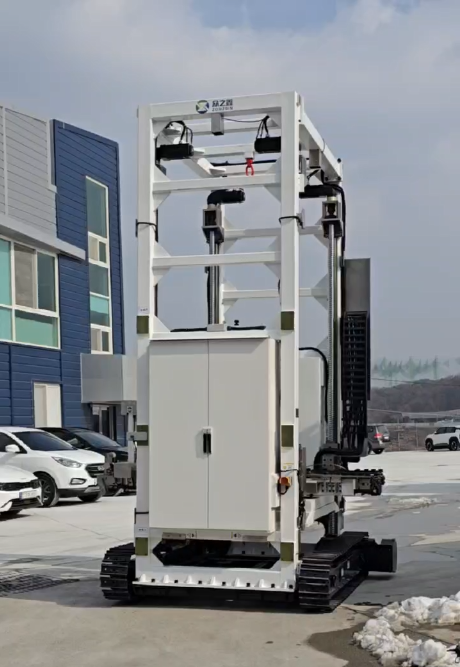
These scenarios show three common fit patterns: continuous PACK insertion in fixed production lines, outdoor container assembly on uneven ground, and combined insertion and removal for maintenance or repair operations. For an integrator planning a new container assembly line, the documented cases provide a reference point for how each configuration performs in real deployment.
The use of crawler-driven robots in outdoor and complicated-floor environments is especially relevant for projects where container assembly happens outside a permanent factory building. In such sites, the robot must carry the PACK and dock with the container rack without relying on a perfectly flat floor. The ZZX2522's all-terrain capability and manual leveling function address this condition directly.
Market Trends in Containerized BESS Automation
The global BESS market was valued at approximately USD 50.81 billion in 2025 and is projected to reach USD 105.96 billion by 2030, according to MarketsandMarkets. Containerized BESS solutions represent a major segment, with the market valued at USD 11.75 billion in 2025 and expected to grow at a CAGR of 24.1% through 2035, according to Insightace Analytic. As utility-scale and commercial & industrial storage projects increase the number of standardized container racks, demand rises for equipment that can load heavy PACKs accurately and repeatedly.
Regulatory requirements are also pushing assemblers toward documented and repeatable processes. In North America, ESS equipment must commonly comply with UL 9540 for market access. In the EU, automated handling equipment must meet CE marking obligations under Regulation (EU) 2023/1542, including compliance with Low Voltage and Machinery Directives. These frameworks favor suppliers that can demonstrate stable operating records and structured quality systems.
Another market trend is the growing variety of cell and PACK formats. The RD16's compatibility with 280/314/587Ah cells and 1P52S/1P104S PACKs reflects the industry's movement toward larger cells and higher-capacity racks. For buyers, this means the chosen insertion robot should be able to adapt as cell formats evolve over the life of a container assembly project.
Automated Insertion vs. Manual Loading: Efficiency and Limitations
Automated battery pack loading robots reportedly reduce manpower by 30% and improve container assembly cycle time by 20% compared with manual methods, according to Zonzsin's 2026 buyer guide. The practical benefits are consistent positioning, lower physical strain, and improved repeatability across multiple container units.
Manual loading may still be appropriate for prototype containers, very low production volumes, or facilities with limited capital for automation. The transition to automated insertion is most justified when container throughput is regular, PACK weights are high, or quality documentation requirements are strict.
One honest limitation should be factored into any evaluation: automation adds upfront capital cost and site preparation work. Rail-fixed systems require stable ground rails and precise installation, while AGV-driven systems need clear navigation paths and sufficient floor space. For very low-volume or highly non-standard container projects, manual loading may still be acceptable.
Selection Criteria for Buyers at Evaluation Stage
When comparing ESS battery pack insertion robots for containers, buyers can structure their evaluation around a few decision criteria derived from the technical and commercial data:
- Container compatibility: verify that the robot accepts the planned container dimensions, door opening requirements, and rack layout. The ZZX2508, for example, accepts containers with lengths of 6058-7000 mm, widths of 2438-2700 mm, and heights of 2896-3000 mm.
- PACK range: confirm the robot handles the planned cell and PACK formats. The RD16 is specified for 280/314/587Ah cells and 1P52S/1P104S PACKs.
- Payload and hoisting: compare load capacity and hoisting range. The ZZX2524 and ZZX2522 support 1500 kg, with hoisting ranges of 0.8-3.4 m for the crawler model.
- Floor and site conditions: determine whether the site is indoor, outdoor, flat, or uneven. Crawler-driven configurations are intended for all-terrain operation, while rail-fixed systems offer stable ground rails.
- Customization and service: check whether the supplier supports OEM/ODM changes and what after-sales support is included. Zonzsin offers customization of cycle time, automation level, logo, color, and configuration, plus remote support and on-site installation and commissioning.
Future Outlook
With containerized BESS volumes expected to grow, battery PACK insertion robots are becoming a normal part of energy storage production planning. Zonzsin's modular design approach is aimed at reducing maintenance expenditures by 20% compared with less standardized equipment, and its AGV-driven patent portfolio points to continued development of flexible docking systems. Buyers evaluating insertion robots in 2026 should focus on container compatibility, payload capacity, floor conditions, and the supplier's documented project record.
The direction of development is toward greater flexibility: robots that can move between container stations, adapt to different PACK formats, and operate in both factory and outdoor environments. As cell formats evolve and containerized BESS projects scale up, the ability to reconfigure an insertion system without replacing the entire platform will become a key value factor.
FAQ
What is an ESS battery pack insertion robot for containers?
An ESS battery pack insertion robot is automated equipment that inserts and removes battery PACKs from container racks in energy storage systems. Zonzsin offers AGV-driven, rail-fixed, and crawler-driven configurations for this task.
What load capacities are available?
Zonzsin's ZZX2524 rail-fixed robot and ZZX2522 crawler-driven robot support a load capacity of 1500 kg. The AGV-driven models are stated to support load capacities up to 1500 kg as well.
What containers and PACKs are compatible?
The rail-fixed ZZX2508 accepts containers with lengths of 6058-7000 mm, widths of 2438-2700 mm, and heights of 2896-3000 mm, and PACKs with lengths of 1100-2200 mm, widths of 780-1260 mm, and heights of 230-260 mm.
Can the robot be customized?
Zonzsin supports OEM/ODM production with customization options including cycle time, automation level, logo, color, and configuration.
What is the lead time and minimum order quantity?
Zonzsin's standard lead time is 2-4 months, with a minimum order quantity of 1 unit and a monthly production capacity of 3 units.
What quality and after-sales support are provided?
Zonzsin's quality control includes 100% testing before delivery. After-sales support includes remote support and on-site installation and commissioning.
Company Information and Resources
Shanghai Zonzsin Intelligent Equipment Co., Ltd. is located at Building 22, No.2199, Shebei Highway, Sheshan Town, Songjiang District, Shanghai, China. For inquiries, contact Katty.liu at katty.liu@zonzsin.com or +86 134-8282-9368 (Phone/WhatsApp). A detailed product overview is available in the Zonzsin product brochure.