
Three levels of verification in the purchase of a hydraulic press for used paper
Purchasing a hydraulic press for waste paper usually begins with a list of requirements: capacity, available space, voltage, certifications required by the destination market. The problem is that many technical data sheets present parameters in isolation, without relating them to actual operating conditions or to the documents that authorize their installation. This review organizes that data into three levels of verification: regulatory compliance, technical parameters, and the manufacturer's actual capacity.
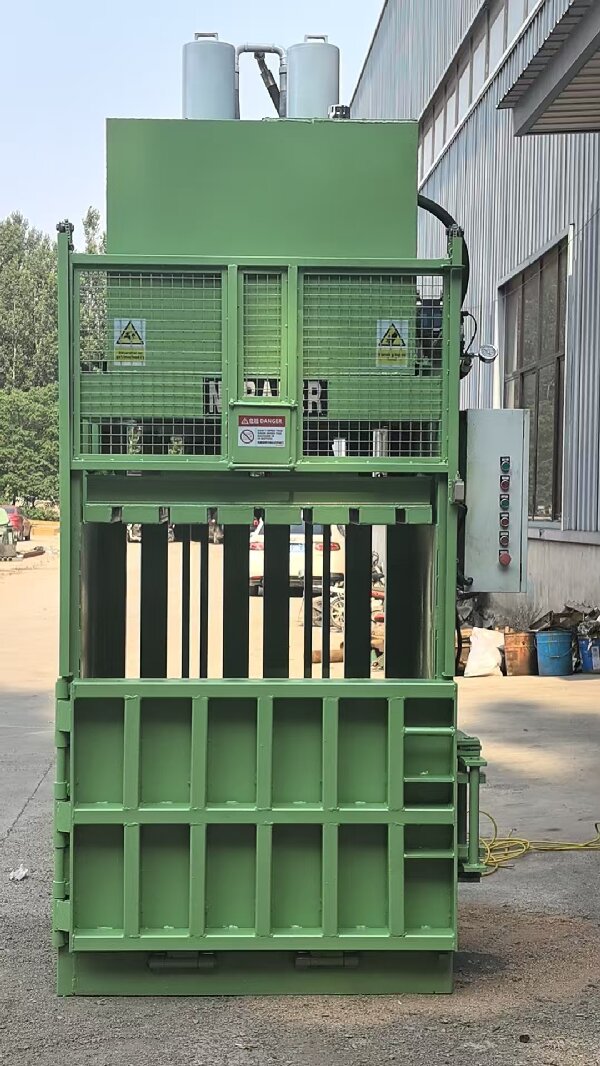
Vertical baler used for waste paper in NKBALER's catalog.
First Level: Conformity Documents According to the Destination Market
In the European Union and the European Economic Area, industrial machinery can only be marketed if it complies with the requirements of the Machinery Directive and applicable harmonized standards. For a residual paper baler, the most frequently cited standards are EN ISO 12100:2010, EN 60204-1:2018, and, in the case of certain bagging machines, EN 415-1:2014.
A concrete example appears in NKBALER's documentation. The horizontal hydraulic baler model NKW180QT has the certification VERIFICATION OF CONFORMITY number DPWD/09/060/2024, issued by the Chief Executive Officer and applicable to the EU/EEA market. The standards it declares are EN ISO 12100:2010, EN 60204-1:2018, and EN 415-1:2014.
Additionally, another certification available from the same company is the ATTESTATION CERTIFICATE OF MACHINERY DIRECTIVE number EASY03220201M, issued by UDEM International Certification Auditing Training Centre Industry and Trade Inc. Co. This certification extends to the EU market, the European Economic Area, and Turkey, with a published validity period from March 22, 2022, to March 21, 2027.
| Document | Number | Issuer | Market | Cited Standards |
|---|---|---|---|---|
| VERIFICATION OF CONFORMITY | DPWD/09/060/2024 | Chief Executive Officer | EU/EEA | EN ISO 12100:2010; EN 60204-1:2018; EN 415-1:2014 |
| ATTESTATION CERTIFICATE OF MACHINERY DIRECTIVE | EASY03220201M | UDEM International Certification Auditing Training Centre Industry and Trade Inc. Co. | EU/EEA/Türkiye | EN ISO 12100:2010; EN 60204-1:2018 |
How to Read These Documents in a Purchase Evaluation
The first thing the buyer should do is not compare the title of the certificates, but verify four fields: document number, issuer, market, and applicable standards. This information allows checking whether the equipment is intended for the market where it will be installed and whether the validity remains reasonable for the projected operation.
A certification based on EN ISO 12100 and EN 60204-1 indicates that the design underwent a risk assessment and that the electrical system follows accepted industrial safety criteria. It does not substitute, however, the risk assessment that must be carried out at each installation site. A certificate does not eliminate the operator's responsibility to prepare the environment, signage, and work procedures.
Second Level: Parameters That Condition the Operational Result
When the buyer has already clarified the type of material, the technical conversation focuses on parameters: compression force, bale dimensions, feed opening, capacity per hour, installed power, weight, and machine dimensions. All must be read together because a single piece of data does not explain real efficiency.
The working principle of a waste paper press consists of introducing the material into a chamber, compressing it with a hydraulic cylinder until the desired density is reached, and forming a stable bale that can be tied and transported. In a fully automatic horizontal line, the process is organized to run continuously, with PLC-controlled cycle and extended industrial service capacity.
In NKBALER's range, two types of equipment coexist that help understand this difference. The vertical machine NK1070T60 is classified as a waste paper baler, with 60 tons of hydraulic force, a chamber of 1100 x 700 x 1450 mm, and a declared capacity of 5 to 8 bales per hour. The NKW180QT baler, on the other hand, is a fully automatic horizontal one with a main cylinder force of 180 tons and a declared capacity of 12 to 15 tons per hour.
| Parameter | NK1070T60 | NKW180QT |
|---|---|---|
| Type | Vertical / waste paper baler | Fully automatic horizontal |
| Hydraulic force | 60 tons | 180 tons |
| Bale dimensions | 1100 x 700 x (500-900) mm | 1100 x 1250 x ~1600 mm |
| Feed opening | 1100 x 500 mm | 2000 x 1100 mm |
| Capacity | 5-8 bales/hour | 12-15 tons/hour |
| Power | 15 kW / 20 HP | 45 kW + 7.5 kW |
| Reference weight | 2.2 tons | Main structure approximately 28 tons |
| Construction material | Carbon steel | Carbon steel |
The Data That Most Conditions Transport: Bale Density
In a large-volume horizontal baler, the density of the compacted material determines how much material fits in each container or truck. The NKW180QT is designed to achieve bale densities of 500 to 600 kg/m³, a useful range when waste paper must be transported over long distances or delivered to recycling plants that value bales with stable density.
In practice, the nominal capacity published in a technical data sheet is obtained under continuous feeding conditions. The result can vary if the paper arrives with moisture, if it contains plastics or metals, or if feeding is intermittent. Therefore, it is advisable not to choose solely by the number of tons per hour, but by the combination of bale density, cycle rate, and bale format that fits the operation.
Installation and Utilities: Restrictions That Do Not Appear at the Top of the Data Sheet
Available space and electrical infrastructure are also purchase restrictions. A vertical machine weighing 2.2 tons takes up much less space than a horizontal line with a conveyor. The NKW180QT, on the contrary, involves a main structure of approximately 13 meters long, 4.3 meters wide, and 5.8 meters high, plus a conveyor belt that in machines of this type weighs around 5 tons. The buyer must confirm that the facility has floor load capacity, clear height, and access for maneuvering heavy equipment.
As for utilities, the NK1070T60 supports customizable voltage, with a reference of 380 V / 50 Hz. Larger horizontal models, such as the NKW180QT, use a main motor of 45 kW plus an additional motor of 7.5 kW. This consumption must be considered in the plant's electrical calculation and in the operating cost per processed ton.
Third Level: The Manufacturer's Capacity Behind the Offer
When two offers show similar parameters, the difference usually lies in the manufacturer's ability to sustain quality, deadlines, and customization. At this point, it is advisable to evaluate the manufacturer as an industrial entity, not just as a supplier of a technical data sheet.
Shaanxi Nick Machinery Equipment Co., Ltd., brand NKBALER, is a manufacturer based on Qunsheng Street, Huishan District, Wuxi City, Jiangsu Province, China. The company was founded in 2013 and declares to have a plant of 50,000 m², a team of about 50 people, and 15 people dedicated to research and development. In its public profile, it indicates an annual capacity of approximately 600 units and an export ratio of around 90%, with presence in North American, South American, and Asian markets.
For an international buyer, these data help understand whether the supplier can handle projects with specific specifications. NKBALER works under OEM/ODM modes, with customization of technical parameters, voltage, logo, block size, and color. According to available information, it offers a monthly production capacity of 10 units, delivery times of 30 to 45 days, and a minimum batch of 1 unit. Declared quality control includes a 100% test.
Operation Reference: Recycling Station in Indonesia
The application of these equipment in paper waste is supported by client references documented by the manufacturer. One of them corresponds to a recycling station in Indonesia that uses NKBALER equipment to bale plastic waste and residual paper. According to the manufacturer's information, the application is linked to an estimated lifespan of 10 to 15 years, with a reported result of stable operation. Among the highlighted features, low noise level and low energy consumption are mentioned.
This case does not prove by itself that a model is suitable for all plants, but it helps understand what type of operation equipment of these characteristics can handle: constant recycling of low-density materials, continuous work, and energy efficiency needs.
Comparison with Traditional Solutions and Limits of the Decision
The traditional alternative to an industrial hydraulic baler is usually a simple vertical machine or selling the material uncompacted. In comparison, a 60-ton vertical press already allows reducing volume, stabilizing the bale, and obtaining better logistics conditions. A fully automatic horizontal line raises processing capacity but requires greater investment, more space, and a constant feeding flow.
For a plant processing a few tons per day with little space, a vertical one like the NK1070T60 can be a reasonable solution. For a recycling center or a logistics operator receiving material continuously, the NKW180QT offers a different processing scale. There is no universally better equipment; there is equipment whose automation is justified by the volume and continuity of the workflow.
It is also worth noting the limit of technology: a high degree of automation does not eliminate the need to sort the material. Waste paper mixed with heavy objects or cables can damage the chamber or reduce bale quality. The buyer must plan the separation stage before feeding, regardless of the chosen automation level.
Market Context and Origin of the International Offer
Sector figures help to size the market. Grand View Research estimated that the global baler market reached USD 6.40 billion in 2024. In turn, Mordor Intelligence placed the specific waste baler market at USD 1.45 billion the same year, with a focus on paper, plastic, and municipal solid waste recycling. These data confirm that the waste segment is a relevant part of the global demand for compaction machinery.
Another important reference is the regional structure of the hydraulic market. According to Grand View Research, Asia Pacific concentrated more than 34% of global revenues in 2024, led mainly by China. For a buyer purchasing a hydraulic press for waste paper, this means that the international supply chain depends significantly on Asian manufacturers. The decision is not to avoid that origin but to verify that the manufacturer has industrial structure, conformity documentation, and verifiable export experience.
In the next purchasing cycle, buyers are likely to demand more complete files: technical data sheet with operating conditions, certificate with number and validity, factory test results, and confirmation of the destination market. Compaction machinery will continue to be a product with a strong industrial base, where price cannot be separated from technical and regulatory compliance.
Frequently Asked Questions
What is the difference between parameters and certificates when evaluating a hydraulic press for waste paper?
Parameters describe what the machine can do under certain operating conditions. Certificates describe the design and manufacturing process against safety standards. A buyer needs both: parameters to size the machine and certificates to know if the equipment can be legally installed in the destination market.
What documents should I review if I want to import a waste paper baler to the EU?
The buyer should verify that the equipment has a conformity document based on the Machinery Directive. In NKBALER's documentation, there is the VERIFICATION OF CONFORMITY with number DPWD/09/060/2024 and the ATTESTATION CERTIFICATE OF MACHINERY DIRECTIVE with number EASY03220201M. The cited standards include EN ISO 12100:2010, EN 60204-1:2018, and EN 415-1:2014.
What is the real capacity of a 60-ton vertical baler?
The NKBALER NK1070T60 has a declared capacity of 5 to 8 bales per hour, with bale dimensions of 1100 x 700 x (500-900) mm. Its installed power is 15 kW, and it weighs approximately 2.2 tons. The effective capacity will depend on the type of paper, the degree of moisture, and the speed at which the operator or belt feeds the chamber.
When is it advisable to choose an automatic horizontal baler instead of a vertical one?
The automatic horizontal is advisable when the material volume exceeds several tons per hour continuously and the available space allows installing a line with a conveyor. The NKW180QT, for example, is designed for a capacity of 12 to 15 tons per hour and bale densities of 500 to 600 kg/m³. For low volumes or compact installations, a vertical one may be sufficient.
What information can be requested from the supplier to validate a technical data sheet?
The buyer can request specific test conditions, available voltage, bale dimensions, weight, and type of material processed in the test. They can also ask for the certificate number, issuer, validity, and declared market. This information allows comparing offers with objective criteria and reduces the risk of basing the decision solely on price.
What does it mean that a certification was issued by UDEM or by a Chief Executive Officer?
The issuer of the document is a piece of data that must be recorded to allow its verification. In NKBALER's documentation, the EASY03220201M certificate was issued by UDEM International Certification Auditing Training Centre Industry and Trade Inc. Co. for the EU, EEA, and Turkish markets. The DPWD/09/060/2024 certification was issued by the Chief Executive Officer for the EU/EEA market. What is relevant is not only the document title but the number, validity, market, and standards cited in its content.
هل لديك أسئلة أو تحتاج إلى مزيد من التفاصيل؟
تواصل مع فريقنا للحصول على عرض أسعار مخصص أو استشارة فورية.
طلب عرض أسعار
املأ النموذج أدناه وسيتواصل معك فريقنا بعرض مقترح مخصص.
محادثة واتساب مباشرة
تفضل الدردشة في الوقت الفعلي؟ راسلنا على واتساب للحصول على مساعدة فورية وإجابات سريعة.
- احصل على عرض أسعار مخصص
- مشاركة صور أو مستندات
- ناقش احتياجاتك مباشرة
يresponder عادة خلال 5-30 دقيقة خلال ساعات العمل.