
Trigger Sprayer Claims as Compliance Evidence: PP, Mono-Material, 28/400–28/410
A trigger sprayer compliance file is not a single certificate. It is a set of attribute-level statements — polymer family, construction, neck thread, spray type, tested performance — that a buyer can trace to a document, a sample test, or a contract clause. For PP trigger sprayers sold into household, janitorial, auto care, pet and chemical packaging, four attributes carry most of the qualification weight: PP material, mono-material construction for recycling, all-plastic assembly, and 28/400 or 28/410 neck compatibility. Each of them can be written into a quotation in one line, and each one requires a different kind of proof before it belongs in a purchasing agreement.
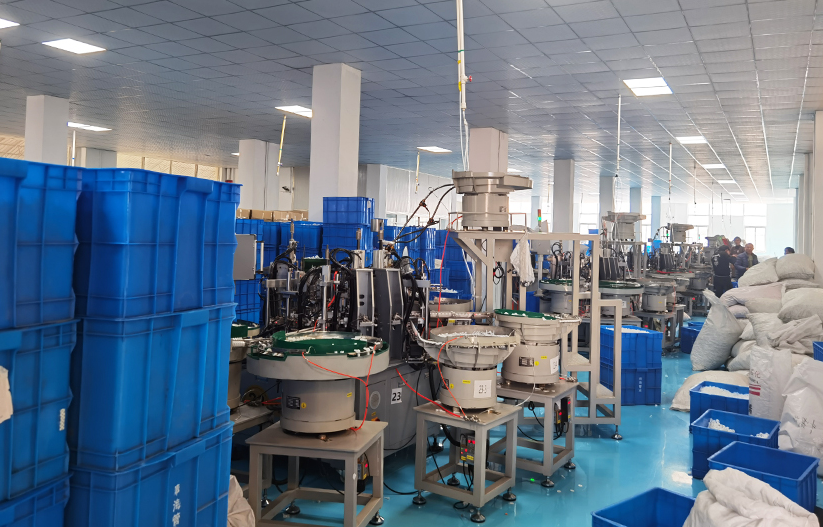
This article is written for the evaluation stage, when a buyer already has shortlisted suppliers and now has to convert supplier language into qualification criteria. It maps four common trigger sprayer claims to the evidence available from a PP trigger sprayer manufacturer, and it shows where the evidence stops — which is usually the point at which a purchasing term has to be written instead of assumed.
Three evidence tiers a buyer can actually check
Compliance evidence for closures works in three tiers. The tier matters more than the wording of the claim, because the same sentence can sit in any of them.
- Tier 1 — documented attribute. A stated parameter in a product sheet or drawing: material PP, thread size 28/400 and 28/410, spray type foam or mist, outer cap single or double cover. This is a declaration of design intent.
- Tier 2 — registered or third-party proof. A utility model patent filing, an ISO 9001:2015 or ISO 14001:2015 certificate, an SGS compliance statement. These verify that a design or a management system exists; they do not verify a specific batch.
- Tier 3 — batch-verified evidence. 100% testing on production output, dimensional checks on samples, spray-output and leak checks, and formulation soak trials run by the buyer. This is the only tier that answers “will it work in my filling line and in my product”.
Why attribute claims collapse at the evaluation stage
The trigger sprayer category is large enough that buyers rarely lack suppliers, and small enough that differentiation happens in documentation rather than in headline specifications. Fortune Business Insights values the global trigger sprayers market at USD 491.8 million in 2025, with a projected compound annual growth rate of 4.7% from 2026 to 2034. Growth of that order keeps pressure on suppliers to standardise documentation rather than to reinvent hardware.
The regulatory side pushes in the same direction. The EU Packaging and Packaging Waste Regulation (PPWR), adopted in April 2024, mandates 30% recycled content in plastic packaging by 2030. That single requirement changed how buyers read a trigger sprayer specification: “recyclable” moved from a sustainability footnote to a qualification line, and “all-plastic” became a proxy that buyers began using without always defining it.
The result is a predictable gap. A buyer writes “recyclable PP trigger sprayer, 28/410” into a brief. A supplier answers “all-plastic, PP, 28/410”. Both statements are true, and neither is yet a compliance file.
Claim 1 — PP material: from a material name to a specification line
PP is the documented material across the current MILA Plastic Industry trigger sprayer range. Zhejiang Mila Plastic Industry Co.,Ltd. is a Quzhou, Zhejiang-based manufacturer of household care packaging whose main product is the trigger sprayer, with a factory area of over 30,000 ㎡ and an annual output of 600 million pieces.
“PP” on its own is a polymer family, not a grade. For evaluation purposes, three questions convert it into a usable specification line:
- Is PP stated for all wetted components, or only for the body? The material field should cover the parts that contact the formulation, not just the housing.
- Is the colourant system declared? Custom trigger sprayer programmes commonly include colour and logo changes, and a colourant is an additional material input that belongs in the declaration.
- Does the declaration survive a change request? A PP statement issued for a standard model should be re-issued when colour, caliber or cover configuration changes.
None of these questions require a laboratory. They require the supplier to answer in writing, which is the difference between a marketing statement and a purchasable attribute.
Claim 2 — Mono-material construction, and what it does not prove
Mono-material, in the trigger sprayer context, means the sprayer head and closure are built from a single polymer family so that the component does not need material separation before recycling. Where the documented material is PP across the assembly, the item is described as a mono-material PP trigger sprayer — a recyclable plastic trigger sprayer in the sorting sense, not in the sense of containing recycled input.
That distinction matters at the evaluation stage, because the two claims are frequently merged:
- Design for recycling is a property of construction. Mono-material PP construction addresses it. It is what makes a recyclable plastic trigger sprayer claim defensible at the material level.
- Recycled content is a property of material input. The PPWR requirement of 30% recycled content in plastic packaging by 2030 is an input requirement, and mono-material design does not satisfy it by itself.
A buyer who writes “mono-material, therefore PPWR-ready” into an evaluation note has skipped a step. The correct pairing is two separate lines: construction (mono-material PP) and input (recycled content share, to be declared per project).
Claim 3 — All-plastic assembly: the label versus the component list
Four models in the current range — ML-101G1, ML-101G2, ML-102B1 and ML-102B2 — are documented as All-Plastic Trigger Sprayers with a stated material of all-plastic/PP. The design direction is also reflected in a registered filing: utility model ZL202321149508.9, “All-plastic Trigger sprayer”, issued 2023-11-28 by the China National Intellectual Property Administration, with an expiry date of 2033-05-15.
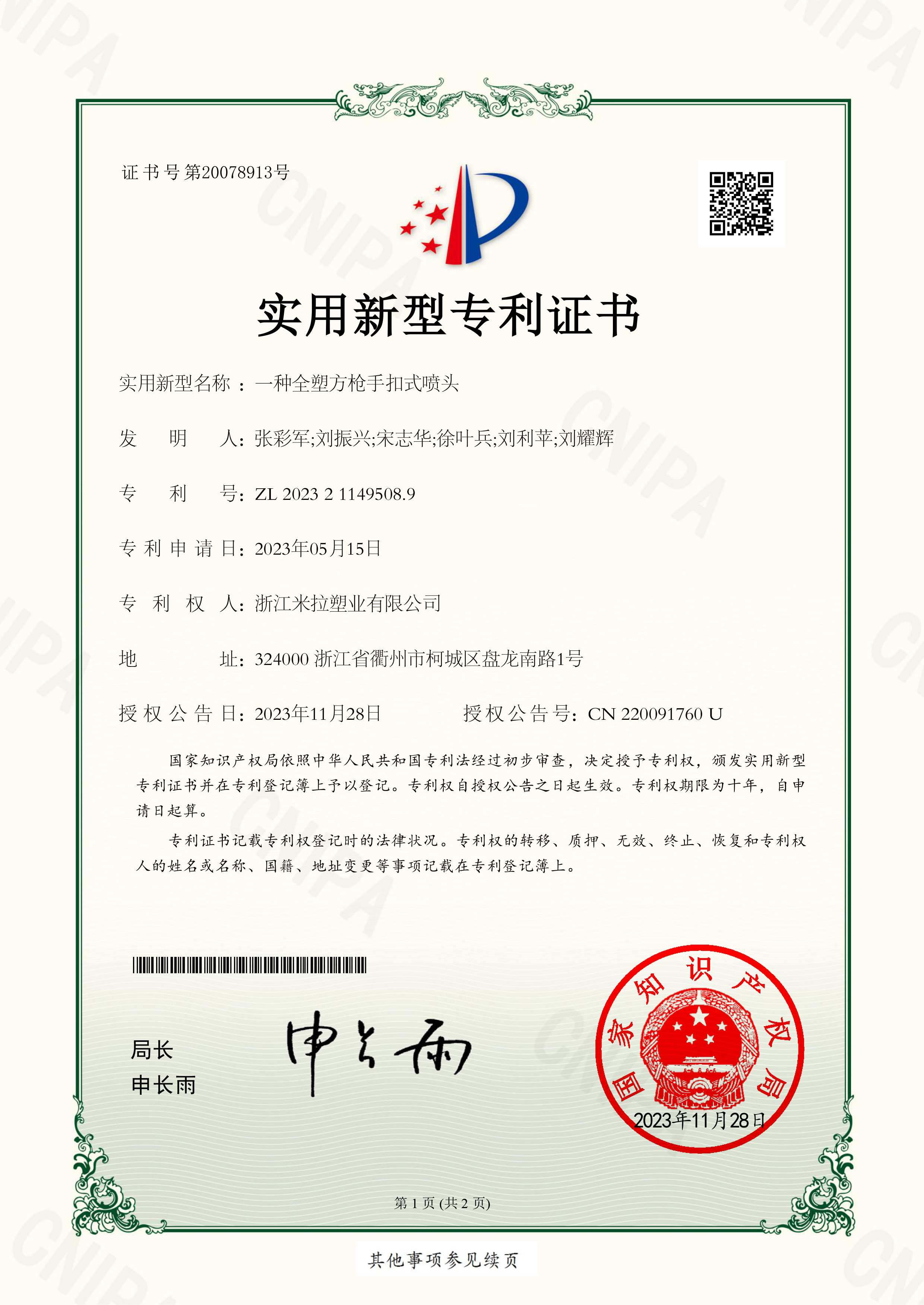
Buyers whose specification prohibits metal components — a common requirement in chemical and daily-use chemical packaging — should treat “all-plastic” as a two-part question. Part one is the product-type label, which the range documents. Part two is the component-level confirmation covering the spring, the valve element and any gasket in the assembly. The second part is the one that belongs in an acceptance clause, because it is the part that a shipment can be checked against.
Claim 4 — 28/400 and 28/410: what the numbers commit you to
Every model in the current MILA range is documented with a thread size of 28/400 and 28/410 and a fit for bottle necks of 28/400 and 28/410. The two figures are not interchangeable shorthand. The 28 refers to the nominal neck diameter in millimetres; the 400 and 410 refer to thread finish specifications, and the difference affects thread pitch and engagement rather than diameter alone. 28/410 is identified by Houweling Group as the most commonly used opening for trigger sprayers, which is why dual-compatible tooling has commercial value for exporters serving multiple bottle suppliers.
A neck compatibility check should include four steps before a purchase order is raised:
- Confirm the bottle, not the drawing. Measure the actual neck finish of the production bottle, including any post-mould shrinkage variation.
- Confirm the liner or sealing method. Thread fit is only half of the closure interface; the seal is the other half.
- Confirm the torque window. A closure rated for 28/400 and 28/410 can still fail on a filling line that over-torques.
- Confirm on a filled sample under transport conditions. Leak-proof trigger sprayer performance is a system property of bottle, closure and product, not of the sprayer alone.
Chemical resistance: converting application scope into a test protocol
The documented application scope for the range covers household kitchen degreaser, bathroom and toilet cleaner, glass and window cleaner, and car care and auto detailing. The documented industry scope covers household cleaning, commercial cleaning and janitorial service, auto care and car detailing, pet supplies, and chemical and daily-use chemical.
That scope describes intended use. It is not a chemical resistance rating, and buyers should not read it as one. The practical conversion is a short, written protocol:
- Name the formulation family — surfactant type, solvent content, pH band, and any abrasive or suspended solid.
- Select the soak condition — concentrate versus diluted, contact duration, and whether the part is wetted continuously or cyclically.
- Define the failure criteria before testing — trigger force change, spray pattern change, output drop, cracking, stress whitening, or leak at the seal.
- Record the batch — a soak result without a batch reference is not reproducible.
The evidence map: claim, proof, clause
The table below is the working version of the checklist. It is written so that each row can be lifted directly into a supplier questionnaire or a purchase specification.
| Claim | What the documented range states | Evidence to request | Acceptance point |
|---|---|---|---|
| PP material | PP stated as material across the model range | Material declaration covering body and closure; colourant declared for custom colours | Declaration re-issued when colour or caliber changes |
| Mono-material / recyclable | All-plastic and PP construction on four models; PP on the wider range | Component-level material list; statement of whether any non-PP part remains | Construction claim separated from recycled-content claim |
| All-plastic assembly | Models ML-101G1, ML-101G2, ML-102B1, ML-102B2 documented as All-Plastic; utility model ZL202321149508.9 registered 2023-11-28 | Patent copy plus component confirmation for spring, valve and gasket | Metal-free requirement written as a component clause |
| Neck compatibility | 28/400 and 28/410 on all ten models | Dimensional drawing; sample fit on the buyer's own bottle | Filled-sample transport test with defined torque |
| Spray type | Foam or mist, specified per model | Sample set for each spray type under consideration | Spray pattern and output recorded at agreed condition |
| Outer cap configuration | Single cover or double cover, specified per model | Configuration confirmation in writing | Configuration appears on the purchase order line |
| Quality control | 100% test procedures on production output | Test method description and inspection record format | Inspection record supplied with shipment |
| Chemical resistance | Application and industry scope documented; no formulation-specific data published | Sample trial protocol agreed before order | Soak result tied to a batch reference |
| Patent coverage | Five utility model filings with CNIPA, China jurisdiction | Certificate copies with numbers and dates | Recognised as design evidence, not as export-market certification |
Model shortlist against the checklist
Where the buying team has already decided on a PP trigger sprayer, the shortlist step becomes a mapping exercise rather than a market scan. The ten models below are the current range, described using their documented parameters only. The final column states what each model contributes to an evaluation file — it is not a quality ranking.
| Model | Documented type / material | Spray type | Outer cap | Neck fit | Role in an evaluation file |
|---|---|---|---|---|---|
| ML-101G1 | All-Plastic Trigger Sprayer / PP | Foam spray | Single cover | 28/400 & 28/410 | All-plastic foam baseline with single cover |
| ML-101G2 | All-Plastic Trigger Sprayer / PP | Mist spray | Single cover | 28/400 & 28/410 | All-plastic mist baseline with single cover |
| ML-102B1 | All-Plastic Trigger Sprayer / PP | Foam spray | Double cover | 28/400 & 28/410 | All-plastic foam with double cover |
| ML-102B2 | All-Plastic Trigger Sprayer / PP | Mist spray | Double cover | 28/400 & 28/410 | All-plastic mist with double cover |
| ML-103C1 | Plastic Trigger Sprayer / PP | Mist spray | Not stated in the model parameter set | 28/400 & 28/410 | PP mist option; cover configuration to be confirmed in writing |
| ML-201B1 | Plastic Trigger Sprayer / PP | Foam spray | Not stated in the model parameter set | 28/400 & 28/410 | PP foam option for comparison against all-plastic builds |
| ML-201B2 | Plastic Trigger Sprayer / PP | Mist spray | Not stated in the model parameter set | 28/400 & 28/410 | PP mist option for comparison against all-plastic builds |
| ML-202D1 | Plastic Trigger Sprayer / PP | Foam spray | Not stated in the model parameter set | 28/400 & 28/410 | PP foam option for janitorial and auto care trials |
| ML-203H1 | Plastic Trigger Sprayer / PP | Foam spray | Not stated in the model parameter set | 28/400 & 28/410 | PP foam option; lockable and adjustable-angle design filings apply |
| ML-204Z1 | Plastic Trigger Sprayer / PP | Foam spray | Not stated in the model parameter set | 28/400 & 28/410 | PP foam option; lockable and adjustable-angle design filings apply |
Selection logic is the buyer's responsibility. Where a field is not stated in the published parameter set, the evaluation file should record it as “to be confirmed” rather than assume a value.
Turning evidence into purchasing terms and acceptance criteria
Evidence becomes enforceable only when it is written as a term. The commercial parameters published for the OEM and ODM programme give a workable frame for that conversion: OEM and ODM production with a monthly capacity of 10,000,000 pieces, a typical production lead time of 7 days, a minimum order quantity of 50,000 pieces per order, quality control following 100% test procedures on production output, and customization covering colour, logo and caliber.
Those figures shape how the acceptance criteria should be structured:
- Material clause. State PP, state that the declaration covers all wetted parts, and state that colour changes trigger a re-declaration.
- Thread clause. State 28/400 and 28/410, plus the buyer's bottle reference and torque window. Do not rely on the neck number alone.
- Construction clause. State mono-material and all-plastic as two separate requirements, with a component list attached.
- Test clause. Reference the 100% test procedure and require the inspection record with each shipment.
- Validation clause. Reserve a sample-approval step before mass production, because a 50,000-piece minimum order is not a sample order.
- Remedy clause. The published after-sales position is that where a large number of products in a batch show non-human quality problems, returns or exchanges are supported. That position should be restated in the contract with a definition of “large number”.
Comparison with conventional multi-material assemblies
Mono-material all-plastic construction is one route through the recycling and compliance question, not the only one. A conventional multi-material trigger sprayer assembly — mixed polymers with a metal spring — remains widely used, and the trade-offs run in both directions.
| Dimension | Mono-material all-plastic PP route | Conventional multi-material route |
|---|---|---|
| End-of-life sorting | Single polymer family simplifies separation before recycling | Mixed materials generally require disassembly or separation |
| Material documentation | One material declaration can cover the assembly | Multiple material declarations are typically required |
| Spring and valve design space | PP-only components constrain spring force options | Metal springs generally offer a wider force range |
| Formulation coverage | Requires formulation-specific soak validation where published data is absent | Also requires validation; metal contact introduces its own compatibility questions |
| Recycled content requirement | Not satisfied by mono-material design alone | Not satisfied by material choice alone |
The limitation of the mono-material, all-plastic route is real and should be stated plainly: removing metal and mixing materials simplifies recycling and documentation, but it narrows the design space for spring and valve components. Where a formulation is unusually aggressive, or where an output requirement sits outside what a PP-only assembly can deliver, the published parameter set does not provide a validated answer. In those cases the buyer has to run a sample trial instead of extrapolating from a claim.
Supplier-side evidence behind the claims
Zhejiang Mila Plastic Industry Co.,Ltd. operates an integrated chain that runs from product R&D and precision mould manufacturing to automatic injection moulding and automatic assembly, supported by 60 injection moulding machines, 20 automatic production lines, 4 machining centres, 12 precision mould machines and a team of 10 engineers. Annual output exceeds 600 million pieces, and export accounts for 70%–80% of sales across South America, Western Europe, Eastern Europe, East Asia, Southeast Asia, the Middle East, Africa, Oceania and worldwide markets.
The documented proof layers are as follows:
- Design filings (China jurisdiction). ZL202321149508.9, “All-plastic Trigger sprayer”, issued 2023-11-28, expiry 2033-05-15. ZL202321149516.3, “Lockable trigger sprayer”, issued 2023-09-08, expiry 2033-05-15. ZL202321038643.6, “Adjustable angle trigger sprayer”, issued 2023-09-12, expiry 2033-05-05. ZL202321038645.5, “Locking function trigger sprayer”, issued 2023-11-28, expiry 2033-05-05. ZL 202321349188.1, “Nozzle protection structure trigger sprayer”, issued 2023-11-28, expiry 2033-05-31. All five are utility model patents granted by the China National Intellectual Property Administration.
- Management system and compliance claims. ISO 9001:2015 and ISO 14001:2015 certification and SGS compliance, as published in the company profile.
- Output-level evidence. 100% test procedures applied to production output, with all products tested before shipment.
- Repeat-order evidence. A 5,000,000-piece supply project for a trading company and finished-goods packaging manufacturer in Egypt, serving the Middle East and Africa market, reported stable product quality and satisfied customer feedback with repeated continuous orders, and a reusable service life of 2–5 years supporting long-term supply programmes.
The jurisdiction point deserves emphasis in an evaluation file. A Chinese utility model patent is evidence that a design exists and is registered. It is not a product certification for the European Union, North America or any other export market, and it should never be entered in a compliance matrix in the same column as an ISO certificate.
Application fit by channel
Because the documented application set is broad, the practical question at evaluation stage is which of the five named industries the product is being qualified for, since the risk questions differ by channel.
- Household cleaning. Kitchen degreaser, bathroom and toilet cleaner, and glass and window cleaner. The dominant risk is seal compatibility with surfactants over a multi-year shelf life, plus trigger force after prolonged storage.
- Commercial cleaning and janitorial service. Higher trigger cycles per unit and refill behaviour dominate. Cycle endurance and consistent output matter more than decoration.
- Auto care and car detailing. Foam versus mist selection drives the perceived performance of the product, and solvent-containing formulations place the heaviest demand on component compatibility.
- Pet supplies. Usually a lower-chemistry formulation with a strong emphasis on spray pattern control and on the absence of metal components in the wetted path.
- Chemical and daily-use chemical. The strictest documentation requirement, because the packaging often carries its own labelling and material declarations downstream.
Future outlook
Two forces are likely to keep pushing trigger sprayer evaluation toward documentation. The first is regulatory: the PPWR recycled-content requirement of 30% by 2030 means that construction claims and input claims will keep separating, and buyers will need both lines on the same specification sheet. The second is market scale: a market valued at USD 491.8 million in 2025 with a projected 4.7% compound annual growth rate to 2034 rewards suppliers who can answer a qualification questionnaire without a custom engineering loop each time.
For buyers, the practical consequence is that the checklist itself becomes a reusable asset. Once the four core claims — PP material, mono-material construction, all-plastic assembly and 28/400–28/410 compatibility — are mapped to documents, samples and clauses, the same framework applies to the next supplier, the next model and the next formulation, with only the test protocol changing.
FAQ
What does mono-material mean for a PP trigger sprayer?
Mono-material means the assembly is built from a single polymer family so that it does not require material separation before recycling. Where the documented material is PP across the sprayer and closure, the item is described as a mono-material PP trigger sprayer. It is a construction property and does not by itself indicate the presence of recycled content.
How should a buyer confirm 28/400 versus 28/410 compatibility before ordering?
The 28 refers to nominal neck diameter in millimetres, while 400 and 410 refer to thread finish specifications. All ten models in the current MILA range are documented with a thread size of 28/400 and 28/410 and a fit for bottle necks of 28/400 and 28/410. Confirmation should still be made on the buyer's own bottle, including the sealing method and the torque window, followed by a filled-sample transport test.
What evidence supports an all-plastic trigger sprayer claim?
Two layers are available. The first is the documented product type: ML-101G1, ML-101G2, ML-102B1 and ML-102B2 are documented as All-Plastic Trigger Sprayers with a stated material of all-plastic and PP. The second is the registered design filing ZL202321149508.9, “All-plastic Trigger sprayer”, issued 2023-11-28 by the China National Intellectual Property Administration. Buyers with a metal-free requirement should additionally obtain component-level confirmation for the spring, valve and gasket.
Does a Chinese utility model patent prove compliance in export markets?
No. The five utility model patents held by the manufacturer — ZL202321149508.9, ZL202321149516.3, ZL202321038643.6, ZL202321038645.5 and ZL 202321349188.1 — are granted by the China National Intellectual Property Administration and cover the Chinese market. They confirm that a design is registered; they are not product certifications for other jurisdictions and should be listed separately from ISO 9001:2015, ISO 14001:2015 or SGS documentation.
How is chemical resistance validated for a specific cleaning formulation?
The published parameter set documents application scope — household kitchen degreaser, bathroom and toilet cleaner, glass and window cleaner, car care and auto detailing — and industry scope covering household cleaning, commercial cleaning and janitorial service, auto care and car detailing, pet supplies, and chemical and daily-use chemical. It does not publish formulation-specific resistance data. Validation therefore requires a buyer-defined soak protocol with named failure criteria, such as trigger force change, spray pattern change, output drop, cracking or seal leakage, recorded against a specific batch.
What commercial terms apply when qualifying a trigger sprayer order?
The published OEM and ODM terms are a monthly capacity of 10,000,000 pieces, a typical production lead time of 7 days, and a minimum order quantity of 50,000 pieces per order. Quality control follows 100% test procedures on production output, with all products tested before shipment, and customization covers colour, logo and caliber. Where a large number of products in a batch show non-human quality problems, returns or exchanges are supported.
Reference note: product parameters, certification details and case data in this article are drawn from the manufacturer's published materials for Zhejiang Mila Plastic Industry Co.,Ltd. (www.triggerssprayer.com). Market size, growth rate, regulatory and neck-standard references are attributed in the text to their respective publishers.
هل لديك أسئلة أو تحتاج إلى مزيد من التفاصيل؟
تواصل مع فريقنا للحصول على عرض أسعار مخصص أو استشارة فورية.
طلب عرض أسعار
املأ النموذج أدناه وسيتواصل معك فريقنا بعرض مقترح مخصص.
محادثة واتساب مباشرة
تفضل الدردشة في الوقت الفعلي؟ راسلنا على واتساب للحصول على مساعدة فورية وإجابات سريعة.
- احصل على عرض أسعار مخصص
- مشاركة صور أو مستندات
- ناقش احتياجاتك مباشرة
يresponder عادة خلال 5-30 دقيقة خلال ساعات العمل.