
Trigger Sprayer Shortlist for Recycling-First Cleaning Brands: PP, Mono-Material, 28/400 & 28/410
Trigger Sprayer Shortlist for Recycling-First Cleaning Brands: PP, Mono-Material, 28/400 & 28/410
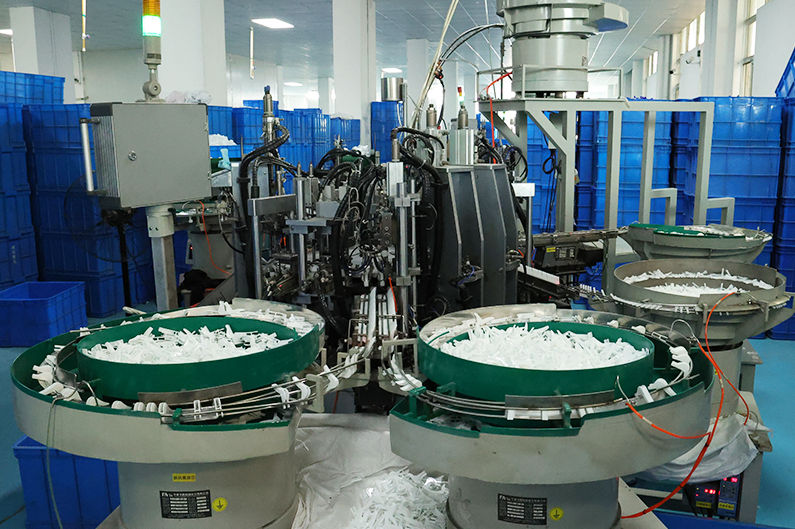
For recycling-first cleaning brands evaluating trigger sprayers, the shortlist question is not simply “which model sprays well?” It is whether the model can be documented as all-plastic or mono-material PP, fitted to a 28/400 or 28/410 bottle, matched to a mist or foam cleaning task, and cleared for the intended chemical formulation. The four MILA models below are useful evaluation candidates, but they do not carry equal evidence. ML-102B1 has the clearest all-plastic documentation in the supplied records. ML-202D1, ML-203H1, and ML-204Z1 are relevant qualification candidates pending model-level material confirmation.
MILA Plastic Industry, formally Zhejiang Mila Plastic Industry Co., Ltd., is a Quzhou-based manufacturer of household-care packaging and trigger sprayers. Its public company profile lists more than 30,000 m² of factory space and annual output above 600 million pieces. The company’s official website is MILA Plastic Industry. For a recycling-first cleaning brand, the value of this supplier profile is not a general credibility claim; it is the ability to support a documented, repeatable specification across material, neck fit, spray format, and quality control.
Build the shortlist around five screens, not model names
A trigger sprayer shortlist for recycling-first cleaning brands should begin with five screening questions. Each question changes the procurement file, and each can eliminate a model before a sample is approved.
1. Is the unit all-plastic, and is it mono-material PP? These are different claims. “All-plastic” means the significant components are plastic rather than metal or mixed materials. “Mono-material PP” means the plastic components are polypropylene to a defined level, with compatible additives and no incompatible components that would prevent recycling. An all-plastic trigger sprayer can still contain more than one polymer. A recycling-first buyer should ask for a component-level material declaration, not only a marketing statement.
2. Does the neck finish match the bottle? A 28/400 closure and a 28/410 closure are both in the 28 mm neck family, but they are distinct finish specifications. They should not be treated as interchangeable without a drawing check and a fit test. The verified industry record identifies 28/410 as the most commonly used opening for trigger sprayers, which supports its relevance in category sourcing, but common use is not proof that a particular model is stocked in that finish.
3. Is the output mist or foam? Mist and foam are different user experiences and different hardware configurations. A fine mist suits applications where a thin, distributed spray is wanted. A foaming trigger sprayer aerates the liquid to create a foam that can cling to a surface. The right format depends on the cleaning task, the formulation, the bottle, and the user’s expectation. The model code alone should not be used to infer the output format.
4. Has chemical compatibility been checked for the actual formula? Polypropylene is a common trigger sprayer material, but “PP” does not mean universal chemical resistance. Compatibility depends on the cleaning agent, concentration, temperature, contact time, and stress conditions. A supplier’s material choice is a starting point; the buyer still needs application-specific compatibility evidence.
5. Is the cover architecture correct for the use case? Full-plastic construction concerns materials. Double-cover construction concerns the housing or cover configuration. One does not prove the other. A double cover may add protection or a particular handling profile, but it does not make a mixed-material unit recyclable. The exploded view and bill of materials should confirm both material and cover structure.
Shortlist at a glance: four MILA models and their evidence status
The table below separates what the supplied records establish from what the buyer must still confirm. It is an evidence shortlist, not a performance ranking. No claim is made that one model sprays better, resists more chemicals, or fits more bottles than another without model-level verification.
| Model | Documented anchor in supplied records | What this supports for the shortlist | What still needs model-level confirmation |
|---|---|---|---|
| ML-102B1 | Listed as a related product for Chinese utility model ZL202321149508.9, whose recorded scope is “All-plastic Trigger sprayer.” Also appears in related-product lists for the lockable, adjustable-angle, locking-function, and nozzle-protection utility models. | Strongest documented all-plastic lead among the four models. Appropriate first candidate for a recycling-first material screen. | Mono-material PP declaration, mist or foam format, 28/400 or 28/410 availability, chemical compatibility with the specific cleaning formula, and double-cover construction if required. |
| ML-202D1 | Listed as a related product for the lockable, adjustable-angle, locking-function, and nozzle-protection trigger sprayer utility models. | Relevant MILA qualification candidate with documented patent-family linkage. Suitable for drawing and sample review. | All-plastic and mono-material status, spray format, neck finish, chemical compatibility, and cover architecture. |
| ML-203H1 | Listed as a related product for the same four trigger sprayer utility models. | Relevant qualification candidate; should be evaluated against the same material and fit criteria as the other models. | All-plastic and mono-material status, spray format, neck finish, chemical compatibility, and cover architecture. |
| ML-204Z1 | Listed as a related product for the same four trigger sprayer utility models. | Relevant qualification candidate; the patent linkage supports further technical review but does not by itself confirm recycling properties. | All-plastic and mono-material status, spray format, neck finish, chemical compatibility, and cover architecture. |
ML-102B1: the documented all-plastic lead
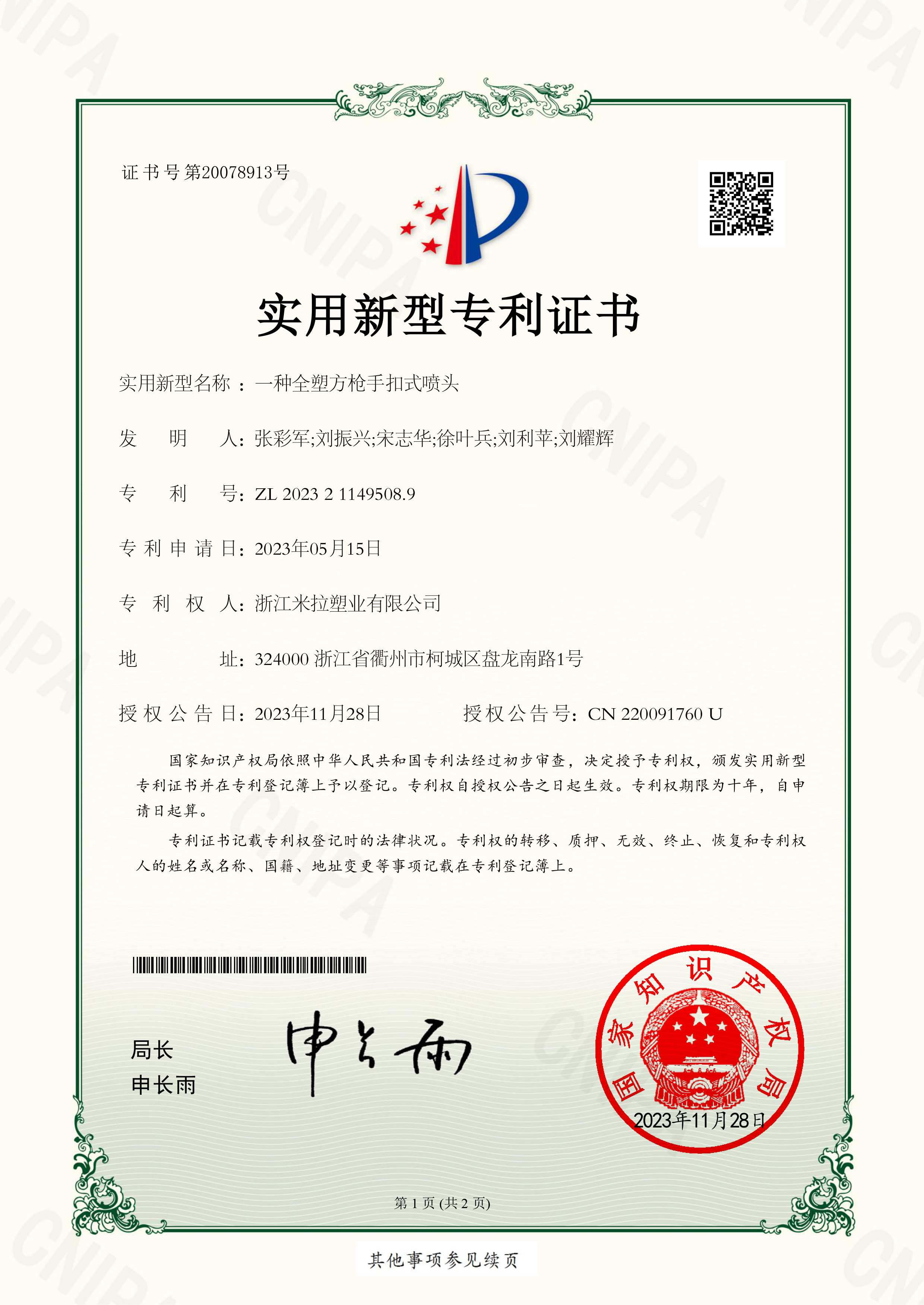
ML-102B1 is the clearest starting point when a cleaning brand’s first screen is documented all-plastic construction. The supplied certification record links it to utility model ZL202321149508.9, issued by the China National Intellectual Property Administration. The recorded scope is “All-plastic Trigger sprayer,” with an issue date of 28 November 2023 and an expiry date of 15 May 2033. That is a meaningful design-level record because it connects the model to an all-plastic trigger sprayer filing rather than to a generic plastic-housing claim.
The qualification is equally important. A utility model certificate is not a material declaration, a recycling certification, a chemical compatibility report, or a spray-performance test. It does not prove that every component is polypropylene, that the model uses a double cover, or that it is available in both 28/400 and 28/410. For a recycling-first brand, ML-102B1 should be placed at the top of the evidence shortlist, then subjected to the same component-level and application-level checks as any other candidate.
ML-102B1 also appears in the related-product lists for the lockable trigger sprayer, adjustable-angle trigger sprayer, locking-function trigger sprayer, and nozzle-protection structure trigger sprayer utility models. Those linkages indicate that the model sits within a broader trigger sprayer patent family. They do not mean that every feature described in those patents is present in every ML-102B1 SKU. The buyer should verify the actual configuration from the drawing and sample.
ML-202D1, ML-203H1, and ML-204Z1: qualification candidates, not assumed equivalents
The other three shortlisted models are relevant because they appear in the same MILA trigger sprayer patent-family records. All four models are listed as related products for ZL202321149516.3, whose scope is “Lockable trigger sprayer”; ZL202321038643.6, whose scope is “Adjustable angle trigger sprayer”; ZL202321038645.5, whose scope is “Locking function trigger sprayer”; and ZL202321349188.1, whose scope is “Nozzle protection structure trigger sprayer.” This is useful evidence of design activity across the model range, but it is not a product datasheet.
For ML-202D1, ML-203H1, and ML-204Z1, the supplied records do not establish all-plastic or mono-material PP status in the same explicit way that the all-plastic patent scope supports ML-102B1. That does not disqualify them. It changes their position in the shortlist. They should be treated as models to qualify, not as three interchangeable equivalents of ML-102B1. The buyer should request a model-specific bill of materials, material declaration, drawing, and sample before making a recycling claim.
This distinction protects the brand from a common evaluation error: using a patent family or a product series name as proof of material compliance. A model can be part of a relevant patent portfolio and still require separate confirmation for polymer type, additive package, colorant, spring material, gasket, and cover construction.
Mist versus foam: choose the output format before the model
Mist and foam trigger sprayers should be shortlisted as separate sub-groups. A mist format is generally selected when the cleaning task calls for a fine, distributed spray over a surface or into a defined area. A foam format is generally selected when the user wants a visible, clinging foam that stays in contact with the surface for a longer working period. These are functional differences in output, not cosmetic label choices.
The formulation matters. Surfactant level, viscosity, and the way the liquid moves through the sprayer can affect whether a mist or foam output is stable and acceptable. The bottle also matters, because the dip tube length, bottle volume, and headspace can change priming and output behavior. For a recycling-first brand, the format choice also affects the component count. Foam hardware can include additional internal parts, and those parts must be included in the material declaration and disassembly review.
The supplied model records do not map ML-102B1, ML-202D1, ML-203H1, or ML-204Z1 to a specific mist or foam output. That gap should be closed before the shortlist is finalized. A brand that needs both mist and foam across a cleaning range should create two model sub-shortlists rather than assume one model can serve both formats. ML-102B1’s all-plastic evidence is a material starting point; its actual spray format still requires confirmation.
28/400 and 28/410: fit is a drawing issue, not a family assumption
The bottle neck is one of the most practical shortlist filters. A 28/400 and a 28/410 closure share a nominal 28 mm neck family, but they are different finish designations. The closure, bottle finish, thread engagement, sealing surface, and dimensional tolerances must be matched as a system. A model that fits one 28 mm bottle may not fit another without a drawing change.
The verified industry record from Houweling Group identifies 28/410 as the most commonly used opening for trigger sprayers. That is useful context for a category buyer because it suggests that 28/410 tooling and bottle options are widely available. It is not evidence that every MILA model is offered in 28/410, nor that a 28/400 closure will seal correctly on a 28/410 bottle. The shortlist should state the required neck finish per SKU and attach the bottle drawing to the request.
For recycling-first cleaning brands, neck fit also has a material-system implication. A mono-material PP bottle and a PP trigger sprayer should be evaluated together, including the closure, tamper evidence, and any liner or gasket. If the bottle is PP and the closure contains a conflicting material, the recycling claim may be weakened even when the sprayer body is all-plastic. The buyer should request a full packaging material map rather than a sprayer-only statement.
Chemical resistance: what the shortlist can and cannot prove
Chemical resistance is application-specific. Polypropylene is a common material for trigger sprayers, but PP does not automatically resist every cleaning agent. Acidic, alkaline, oxidizing, solvent-based, and surfactant-heavy formulas can interact differently with the same polymer. Concentration, temperature, contact time, and mechanical stress also change the result. A model that performs well with one diluted cleaner should not be assumed to perform the same way with another.
All-plastic construction can be relevant where a brand wants to avoid metal in the wetted path, but that benefit depends on the actual bill of materials. A metal spring, pin, rivet, or other internal component would defeat a “no metal” assumption. The buyer should verify the wetted-path materials, not only the external housing. MILA’s quality control statement says production output follows 100% test procedures and all products undergo 100% testing before shipment. That is production quality control; it is not a substitute for formula-specific chemical compatibility testing.
No formula-specific compatibility data for the four shortlisted models is supplied in the records used here. That is a qualification task, not a reason to remove the models from consideration. The practical shortlist should require a compatibility sample using the actual concentrate and dilution, followed by visual and functional checks for stress cracking, deformation, seal leakage, trigger stiffness, and spray or foam output change.
Full-plastic and double-cover construction are separate claims
Full-plastic construction and double-cover construction should not be collapsed into one specification. Full-plastic is a material statement about the components. Double-cover is a housing or cover configuration. A sprayer can be all-plastic without being double-cover, and a double-cover sprayer can still contain mixed materials. For a recycling-first brand, the material declaration comes first; the cover architecture is a separate fit and handling requirement.
ML-102B1’s all-plastic patent scope is a useful design anchor, but it does not prove a double-cover configuration. If double-cover construction is a brand requirement, the buyer should ask for the exploded view, cover drawings, and a physical sample. For ML-202D1, ML-203H1, and ML-204Z1, both the material and cover construction should be confirmed from the model drawing rather than inferred from the series or patent family.
Supplier capability and supply continuity
MILA’s company profile lists OEM and ODM production, color, logo, and caliber customization, a monthly capacity of 10,000,000 pieces, a typical production lead time of 7 days, and a minimum order quantity of 50,000 pieces for OEM and ODM production. The company profile also lists more than 30,000 m² of factory space, 300–400 employees, 10 engineers, 60 injection molding machines, and 20 automatic production lines. These facts are relevant to supply continuity, especially for a cleaning brand that expects repeat orders after qualification.
The public company information lists ISO 9001:2015, ISO 14001:2015, and SGS compliance. These are supplier-level indicators and should be read alongside the model-level evidence, not as a substitute for it. A documented MEA case covers 5,000,000 trigger sprayers supplied to a trading company and finished-goods packaging manufacturer in Egypt, with stable product quality, satisfied customer feedback, and repeated continuous orders. The same case record describes a reusable service life of 2–5 years for the product, supporting long-term supply programs. That case is useful capability evidence; it does not by itself certify any of the four shortlisted models for a specific chemical or recycling claim.
Market context: recycling requirements are becoming specification items
The EU Packaging and Packaging Waste Regulation, adopted in April 2024, sets a 30% recycled-content requirement for plastic packaging by 2030, according to the verified record citing Future Market Insights. The scope and calculation rules should be confirmed with the brand’s compliance team, but the direction is clear: recycling-first brands need material documentation that can survive procurement review, not only a general sustainability statement.
Fortune Business Insights valued the global trigger sprayer market at USD 491.8 million in 2025 and projected a 4.7% CAGR for 2026–2034. That market estimate is context for category attention; it is not a forecast of demand for any single model or supplier. For the buyer, the practical implication is that trigger sprayers are being evaluated as part of a packaging system, with material choice, neck fit, chemical compatibility, and end-of-life documentation considered together.
Recommended evaluation sequence for the four-model shortlist
- Lock the output format. Define mist or foam per SKU, then confirm which of the four models is available in that format. Do not infer the format from the model code.
- Lock the bottle neck finish. State 28/400 or 28/410 per bottle, attach the bottle drawing, and request the matching closure drawing from MILA.
- Request the material file. Ask for a component-level bill of materials, PP content, additive and colorant details, and any non-plastic components. For ML-102B1, use the all-plastic patent scope as a starting point, not as the final declaration.
- Confirm cover architecture. If double-cover construction is required, request the exploded view and sample. Treat single-cover and double-cover as different specifications.
- Test the actual formula. Run compatibility checks with the real cleaning concentrate, dilution, temperature, and contact time. Inspect for leakage, stress cracking, seal swelling, trigger function, and output consistency.
- Qualify production, not only the sample. Review the 100% test procedure, lead time, MOQ, and repeat-order controls. Use the Egypt case as supply-capability context, not as a replacement for the brand’s own acceptance criteria.
FAQ
What is the difference between an all-plastic and a mono-material trigger sprayer?
An all-plastic trigger sprayer uses plastic for its significant components instead of metal or other materials. A mono-material trigger sprayer goes further and uses one defined polymer family, commonly PP, across the relevant components. All-plastic does not automatically mean mono-material, because different plastic parts or additives may still be present. Recycling-first buyers should ask for a component-level material declaration for both claims.
Are 28/400 and 28/410 trigger sprayers interchangeable?
No. They are both in the 28 mm neck family, but 28/400 and 28/410 are different finish designations. The closure and bottle must be matched by drawing and fit test. The 28/410 finish is identified as the most commonly used opening for trigger sprayers, but that does not make it interchangeable with 28/400 on a specific bottle.
How should a cleaning brand compare mist and foam trigger sprayers?
Compare them by the cleaning task, formulation, bottle system, and user expectation. A mist format produces a fine distributed spray; a foam format produces an aerated output that can cling to a surface. The buyer should specify the required output per SKU and test the actual formulation, because surfactant level, viscosity, dip tube length, and internal component configuration can affect performance.
Does an all-plastic PP trigger sprayer resist every cleaning chemical?
No. Polypropylene is a common material, but chemical compatibility depends on the specific cleaning agent, concentration, temperature, contact time, and mechanical stress. An all-plastic construction can remove metal from the wetted path if the bill of materials confirms it, but the buyer still needs formula-specific compatibility testing. A supplier’s production quality control is not the same as an application compatibility test.
What should buyers verify before shortlisting ML-102B1, ML-202D1, ML-203H1, or ML-204Z1?
Buyers should verify the model-specific all-plastic and mono-material status, mist or foam output, 28/400 or 28/410 neck fit, chemical compatibility with the intended formula, and single-cover or double-cover construction. ML-102B1 is linked to an all-plastic trigger sprayer utility model, which supports a design-level material review. ML-202D1, ML-203H1, and ML-204Z1 are linked to trigger sprayer patent-family records but require model-level confirmation of the same points.
Conclusion: shortlist by evidence readiness, not by model count
A recycling-first cleaning brand does not need a long trigger sprayer list. It needs a shortlist that can be evidenced. On the supplied records, ML-102B1 is the clearest all-plastic documented candidate and should lead the material screen. ML-202D1, ML-203H1, and ML-204Z1 are credible qualification candidates because they sit within MILA’s trigger sprayer patent family, but they should not be presented as proven all-plastic or mono-material equivalents until the model-level declarations, neck drawings, spray-format samples, and chemical compatibility results are complete.
The difference between the four models is therefore a difference in documentation readiness, not a claim about which sprayer performs best. That is the correct basis for a 28/400 and 28/410 trigger sprayer shortlist in a recycling-first procurement process.
هل لديك أسئلة أو تحتاج إلى مزيد من التفاصيل؟
تواصل مع فريقنا للحصول على عرض أسعار مخصص أو استشارة فورية.
طلب عرض أسعار
املأ النموذج أدناه وسيتواصل معك فريقنا بعرض مقترح مخصص.
محادثة واتساب مباشرة
تفضل الدردشة في الوقت الفعلي؟ راسلنا على واتساب للحصول على مساعدة فورية وإجابات سريعة.
- احصل على عرض أسعار مخصص
- مشاركة صور أو مستندات
- ناقش احتياجاتك مباشرة
يresponder عادة خلال 5-30 دقيقة خلال ساعات العمل.