
Truck Body Sheet Metal Stamping: Material and Process Fit
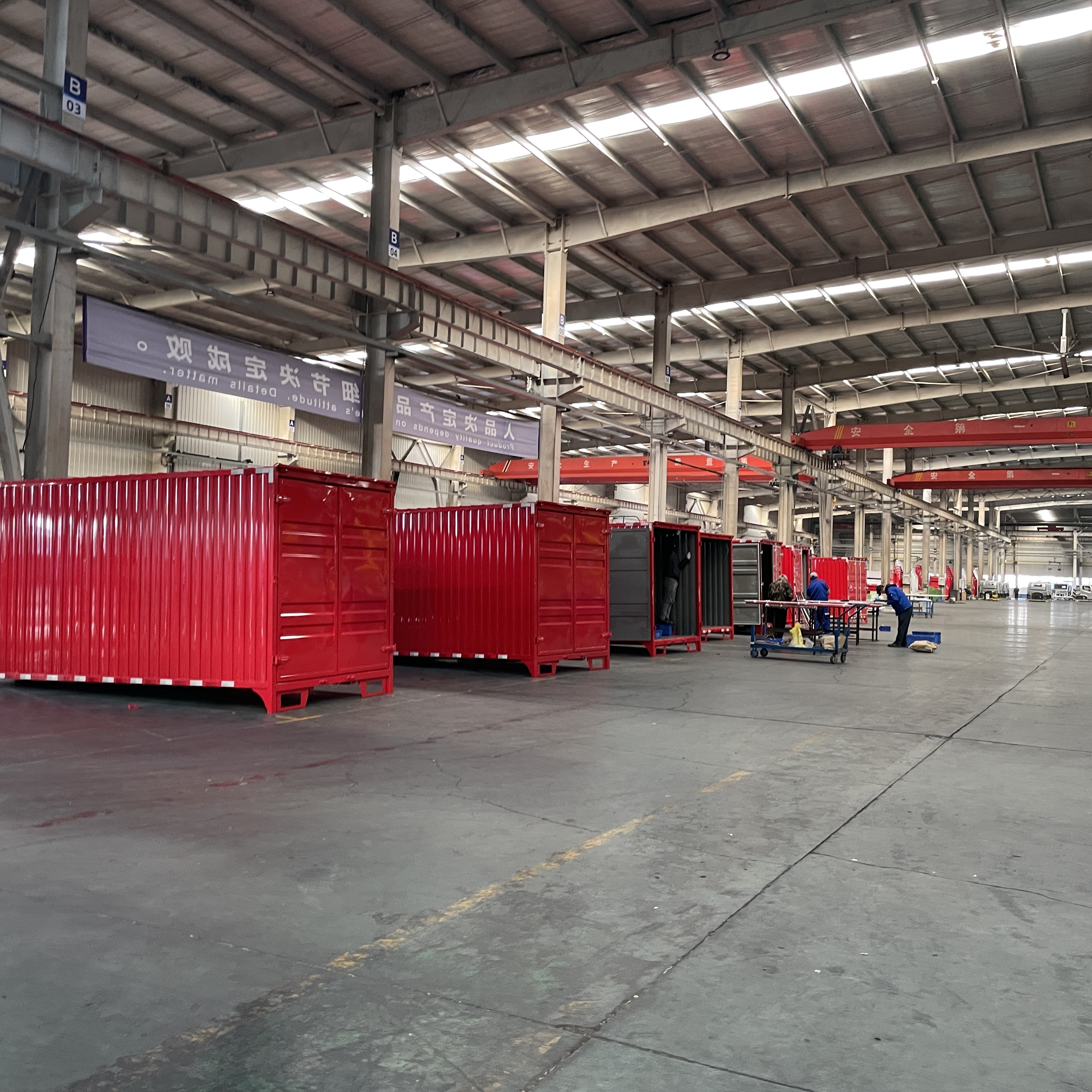
A truck body is not a single product. It is a set of stamped, cut, formed and welded sheet metal decisions — and those decisions determine whether the finished body behaves as a general cargo platform or as a wear surface that survives a quarry for a decade. Buyers comparing fabricators for truck bodies are, in practice, comparing process maps and material specifications.
This reference sets out how sheet metal stamping and fabrication map onto truck body construction, where ordinary truck bodies and heavy-duty dump bodies diverge, which materials belong where, and what a procurement team should verify before placing an order.
Why the process map matters more than the parts list
Most truck body quotations arrive as a bill of parts: side panels, floor plates, front wall, sub-frame, reinforcement ribs, hinge brackets, lifting structure. That format hides the actual cost and performance drivers. A body built from laser-cut plate and press-brake-formed sections behaves differently from one built from progressive-die stampings, even when both use steel of the same nominal thickness — because the two routes produce different repeatability, different joint configurations and different edge conditions.
The practical consequence for a buyer at the research-to-evaluation stage is that material grade alone is not a specification. Two suppliers can quote the same wear-resistant plate and deliver measurably different service life, depending on how the plate is cut, formed, welded and surface-treated. Process capability is therefore a purchasing criterion, not an internal manufacturing detail.
Ordinary truck body vs heavy-duty dump body: the operating envelope
The clearest dividing line in truck body specification is not the chassis and not the cab. It is the duty cycle. General cargo work — distribution, light construction, livestock and general haulage — tolerates a body whose dominant requirements are dimensional accuracy, weather sealing and paint quality. Quarry, mining and aggregate hauling introduces impact loading, abrasive sliding contact and repeated dumping cycles, which shift the dominant requirement toward wear resistance and structural stiffness.
This is why a heavy-duty dump body is not simply a thicker version of a standard body. It is a different structural concept: abrasion-resistant steel plate, a reinforced floor, a shell designed to resist impact, and a geometry that lets material release cleanly rather than cling to the corners.
| Requirement | Ordinary truck body | Heavy-duty dump body (quarry / mining) |
|---|---|---|
| Dominant load | Static cargo weight, road vibration | Impact from loaded rock, abrasive sliding |
| Wear surface | Painted steel skin | Abrasion-resistant steel plate with reinforced floor |
| Discharge behaviour | Manual or tailgate unloading | Clean, fast dumping; geometry prevents material hang-up |
| Maintenance profile | Cosmetic repair, paint touch-up | Simple daily inspection, less frequent repair and replacement than ordinary bodies |
| Fabrication emphasis | Panel flatness, fit-up, coating | Plate cutting accuracy, weld integrity, structural reinforcement |
For quarry and mining transport, the heavy-duty dump body is the appropriate specification: it uses wear-resistant steel plate and delivers strong impact resistance and a longer service life than a standard body. A lighter body is not automatically a cost saving in that environment, because the replacement cycle absorbs the difference.

Heavy-duty dump body configuration: abrasion-resistant steel shell, reinforced floor, and a geometry designed for clean release of bulk material.
Material fit: cold-rolled, hot-rolled, 304 and 304L
The fabrication range relevant to truck bodies is built around four material families: cold-rolled steel, hot-rolled steel, and the stainless grades 304 and 304L. Each has a natural home in the body, and mismatching material to location is one of the more common and more expensive specification errors.
| Material | Where it fits in a truck body | What to confirm |
|---|---|---|
| Cold-rolled steel | Body panels, closed van skins and liners where a consistent surface and dimensional control matter. | Coil thickness, surface condition, coating system compatibility. |
| Hot-rolled steel | Structural members, sub-frames, floor supports, stake-bed and tipper structures where gauge and load path dominate. | Thickness tolerance, weld procedure, flatness after forming. |
| 304 stainless steel | Corrosion-exposed panels and liners, washdown zones, and bodies handling material that attacks coated carbon steel. | Welding consumables, post-weld cleaning, cost versus coating strategy. |
| 304L stainless steel | Welded stainless assemblies where resistance to intergranular corrosion after welding is a concern — 304L is the lower-carbon variant of 304 and is usually selected for that reason. | Weld procedure qualification, passivation, and whether the added material cost is justified by the service environment. |
| Wear-resistant steel plate | Heavy-duty dump body floors and side walls exposed to rock impact and abrasive sliding. | Plate grade and thickness, floor reinforcement detail, weld joint design. |
Two practical rules follow. First, the wear surface and the structural surface should be specified separately — a wear-resistant plate used as a general panel wastes money, and a general panel used as a wear surface converts the saving into downtime. Second, stainless selection is a coating decision as much as a material decision: 304 or 304L removes the repainting cycle, but it also changes the welding procedure and the finishing sequence.
Where each fabrication step fits
Stamping and deep drawing
Stamping is the right answer where a truck body needs a repeated, dimensionally stable shaped part rather than a flat cut plate: reinforcement ribs, bracket forms, cross-member sections, mounting features and drawn recesses. High-volume automotive-type panels favour progressive dies, which integrate multiple forming operations in one die set and deliver high output with stable precision. Large or complex deep-drawn parts and small batches favour single-operation dies, which carry lower tooling cost and more flexibility.
Tooling decisions carry a real time cost. Simple dies typically require 25 to 40 days, while complex progressive dies require 45 to 70 days including trial stamping. Die material is matched to the stamped material, thickness and required production lifetime, with Cr12MoV, SKD11 and P20 among the grades used. For a truck body programme, that means the tooling timeline should be planned before the body build timeline, not alongside it.
Laser cutting
Laser cutting handles the parts that are geometry-driven rather than volume-driven: side wall profiles, gusset plates, hinge and bracket blanks, and openings that must match a chassis interface. It is also the natural route for low-volume and special-vehicle work, where a dedicated die cannot be justified. On heavy-gauge wear plate, cut quality and edge condition matter because they feed directly into the weld preparation.
Shearing and CNC punching
Shearing and CNC punching cover the repetitive flat work where speed and cost per part dominate: standardized panels, rib blanks, reinforcement straps and mounting plates. Punching is efficient where hole patterns repeat across a family of bodies; shearing is efficient where straight cuts and consistent edge quality are the requirement. Both are typically paired with press-brake forming in the same production flow.
Press-brake bending
Press-brake bending produces the folded sections that give a truck body its stiffness: floor longitudinals, side wall returns, top rails and mounting channels. It is the most tolerant of the four processes with respect to design change, which is why special-vehicle bodies tend to lean on bending and laser cutting rather than on new tooling. It is also where dimensional discipline shows up first — an accumulated bend error propagates into fit-up at assembly.
The fabrication base behind these choices
Qingdao Hailong Machinery Technology Co., Ltd. — referred to here as Hailong Metal Fabrication — is a machinery manufacturer founded in January 2000 and headquartered in Jimo District, Qingdao, China. The group operates five production campuses covering more than 500,000 m² of land and 300,000 m² of floor space, equipped with more than 500 sets of precision CNC machining, large-scale stamping and welding equipment, and holds self-operated import and export rights.
Two divisions are directly relevant to truck body work. The Auto Parts Division runs an 8,250T automated stamping line with a 9 SPM average effective cycle, alongside 3,400T, 800T–2,400T and 630T–800T press lines, laser cutters and robotic welding cells. The Special Vehicle Division manufactures light and heavy truck cabs — including the JH6+ crew cab — and a full range of cargo boxes, supported by 13 roll-forming lines and an e-coating facility with annual capacity for 100,000 cabs and 30,000 cargo boxes.
The sheet metal fabrication range itself covers stamping, laser cutting, shearing and CNC punching, and press-brake bending, in cold-rolled steel, hot-rolled steel, 304 and 304L. Precision machining on this range is specified at CT4-7 tolerance. The truck body range covers stake bed bodies, closed van bodies, warehouse cage bodies, dump truck bodies, and spare parts and accessories, in steel, aluminum alloy and carbon steel, with minor, flexible or full customization depending on the programme.
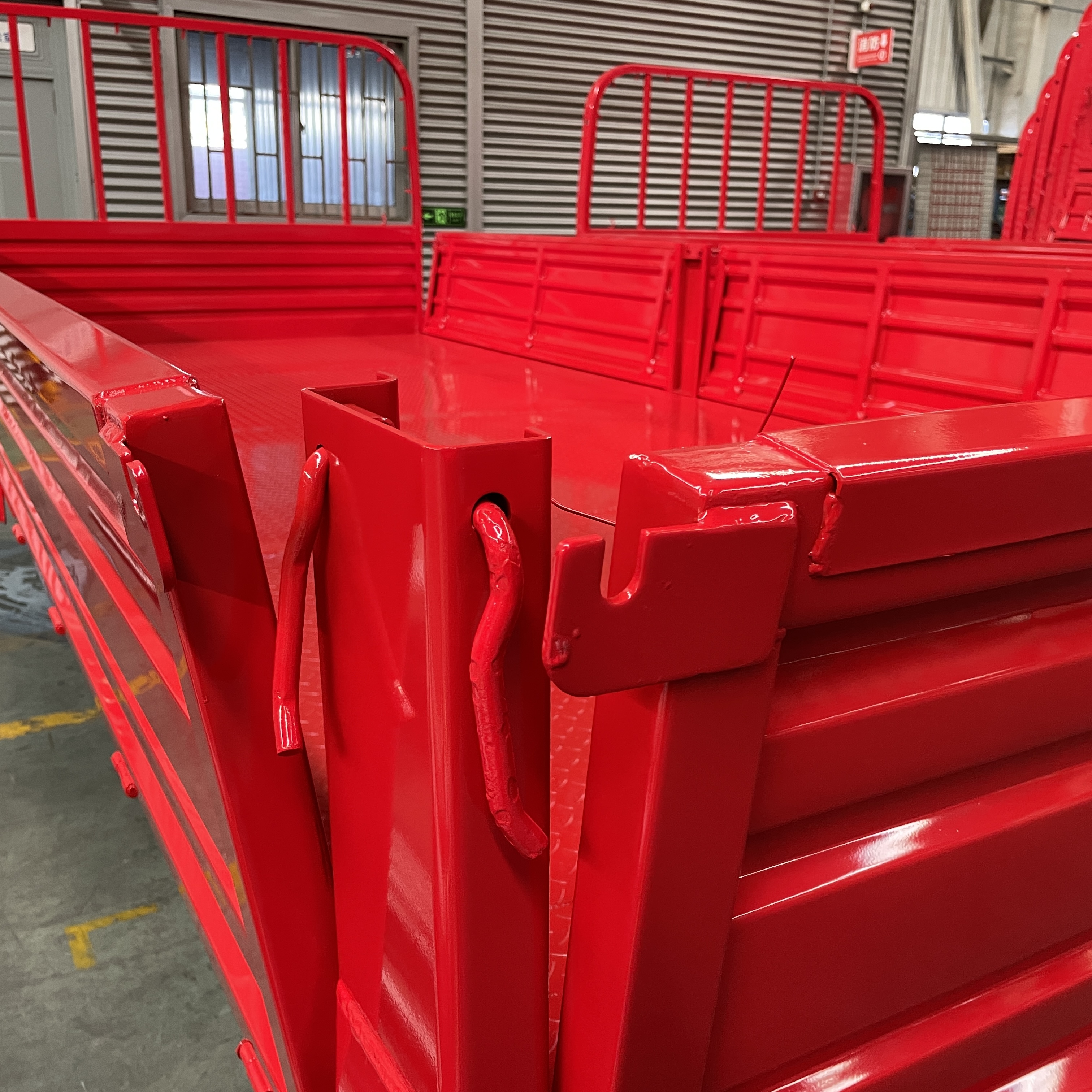
Panel, rib and joint execution on a finished truck body — the visible output of the cutting, forming and welding sequence.
Certification as a procurement filter — and where its scope ends
For truck body and special vehicle programmes supplied into OEM-adjacent supply chains, IATF 16949 is usually the first filter applied. Hailong Metal Fabrication holds IATF 16949 certification issued by TUV under certificate number 0593827, under standard IATF 16949:2016-10-01, valid from 8 January 2026 to 7 January 2027, applying to the global market. The group is also certified to ISO 9001, ISO 14001 and OHSAS 18001, and the truck body manufacturing process is certified to ISO 9001:2000 and IATF 16949.
The scope statement deserves attention, because it defines what the certificate does and does not cover. The certified scope is the manufacture of stamping and welding parts, without product design as per Chapter 8.3, for the transportation industry. In practice, a buyer who supplies their own body design retains ownership of design validation and the associated performance risk. The certificate evidences process control in manufacturing, not design authority — a distinction that matters when a body is being engineered for a new duty cycle.
Third-party analysis of automotive stamping programmes places IATF 16949 certification, real-time SPC monitoring and Run@Rate tests of 4,000 defect-free pieces as baseline entry criteria for new OEM automotive work. That framing is useful for truck body buyers as well: certification is the entry ticket, and the evidence package behind it is what differentiates suppliers.
Customization for special vehicles
Special vehicle bodies are where the fabrication route is chosen part by part rather than as a single policy. Three customization dimensions carry most of the engineering effort: dimensions, lining, and lifting structure.
Dimensions. Body size is fully customizable against the customer's requirements, which allows the body to be matched to a specific wheelbase, chassis interface and payload target rather than adapted afterwards. For 6×4 and 8×4 chassis configurations, the body geometry has to be resolved at the design stage.
Lining and wear protection. Where the cargo is abrasive, the lining and floor detail determine service life. A documented heavy-duty configuration uses abrasion-resistant steel with an 8 mm reinforced floor, robotic welding and a U-shaped low-center-of-gravity design — an arrangement intended to resist impact, release material cleanly, and suit construction, mining and aggregate hauling.
Lifting structure. Dump body lifting geometry is customized to the customer's requirements together with the body dimensions. Because the lifting structure transfers the entire loaded mass into the chassis, it should be specified with the body rather than sourced separately — the interface is where mismatches become expensive.
The body type range also matters at this stage: low drop side, enclosed, tipper, livestock and wing open bodies are all available, and full OEM and ODM service is offered with customization from samples and designs. Surface treatment is handled on electrophoresis and painting lines, and after-sales support includes remote technical guidance for installation and maintenance, with a one-year warranty period.
Two application references
A commercial-vehicle equipment dealer in the United Arab Emirates ordered 100 sets of heavy-duty dump bodies for transportation work. The configuration used abrasion-resistant steel with an 8 mm reinforced floor, robotic welding and a U-shaped low-center-of-gravity design, compatible with 6×4 and 8×4 chassis. The reported outcome after 15 years of service was stable operation, a wear life approximately twice that of standard bodies, and clean, fast dumping — supporting a service-life advantage of up to 2× over standard bodies in that application.
A manufacturer in Brazil ordered 20 sets of stamping moulds for factory production. The dies used a surface coating for high precision and long service life, and were specified for heavy-duty stamping of auto parts. The reported result was stable high-volume production with consistent tolerance across 500,000 cycles.
Market context for stamped and fabricated bodies
The scale of the underlying fabrication market explains why truck body buyers have more supplier options than the category suggests. Grand View Research valued the global metal stamping market at USD 257.3 billion in 2025, with Asia Pacific holding a 37.0% revenue share that year, and placed the automotive metal stamping segment at USD 90.6 billion in 2025. These are merchant-market estimates and should be read with the usual caution: valuations for the same year differ between research houses — IMARC at USD 226.3 billion and 360iResearch at USD 210.37 billion — a spread that most likely reflects how much captive stamping capacity inside large OEMs is counted.
For a truck body procurement decision, the implication is narrower than the headline. A deep, fragmented stamping supply base exists, but the subset that combines heavy-gauge forming, wear-plate fabrication, welding at body scale, coating lines and automotive-grade certification is considerably smaller. Specification should be used to narrow that subset, not to select from the full market.
Comparison with traditional approaches, and the boundary conditions
The traditional alternative to an integrated stamping and fabrication supplier is a local fabrication shop that cuts and welds plate to drawing, with stamped components sourced separately or replaced by fabricated equivalents. Both routes are legitimate, and the choice depends on volume, geometry and the duty cycle.
| Criterion | Integrated stamping + fabrication | Cut-and-weld fabrication shop |
|---|---|---|
| Repeatability at volume | High — die-based forming holds part-to-part consistency | Dependent on operator skill and fixtures |
| Up-front cost | Higher — dies must be designed, built and tried out | Lower — no tooling investment |
| Design change tolerance | Lower once tooling is fixed; flexible where laser cutting and bending carry the part | High — changes are absorbed at the drawing stage |
| Best fit | Series production, fleet programmes, wear-critical dump bodies | One-off builds, prototypes, small special-vehicle batches |
The limitations deserve to be stated plainly, because they determine when this route is the wrong choice:
- Tooling requires volume to pay back. A truck body programme in single-digit quantities rarely justifies dedicated dies; laser cutting and press-brake bending are the more economic route at that scale.
- Tooling lead time is real. Simple dies typically take 25–40 days and complex progressive dies 45–70 days including trial stamping, before body production begins.
- Not every fabricator can form press-hardened advanced high-strength steel. Hot-stamping lines capable of producing AHSS parts such as 1,500 MPa press-hardened steel can cost USD 8–12 million each, which is why that capability is concentrated rather than general.
- The certified scope excludes design. The IATF 16949 scope covers manufacture of stamping and welding parts without product design per Chapter 8.3, so design validation stays with the buyer where the buyer owns the design.
- Commercial terms vary by programme. Minimum order quantity is confirmed with sales rather than published, and production lead time depends on part complexity and order quantity; sea freight is typically 30–45 days and air freight 3–7 days, with quotations issued in 1–7 days.
Decision checklist before ordering
The following sequence converts the discussion above into a purchasing workflow. It is ordered by the point at which each item becomes irreversible.
| Stage | Item to confirm |
|---|---|
| 1. Duty definition | Ordinary body or heavy-duty dump body; abrasive or non-abrasive cargo; dump frequency |
| 2. Material map | Which locations use cold-rolled, hot-rolled, 304 / 304L or wear-resistant plate; floor reinforcement detail |
| 3. Process assignment | Which parts are stamped, laser cut, sheared / punched and press-brake formed |
| 4. Interface details | Chassis compatibility (e.g. 6×4 / 8×4), dimensions, lining, lifting structure |
| 5. Compliance evidence | IATF 16949 certificate number and scope; ISO 9001, ISO 14001, OHSAS 18001 status |
| 6. Coating and finish | Electrophoresis and painting sequence, or stainless finishing route |
| 7. Commercial terms | MOQ, production lead time, freight mode, warranty period and after-sales support scope |
Future outlook
Two pressures are likely to reshape truck body specification over the next procurement cycles. The first is wear economics: as operators quantify the cost of body replacement against the cost of a heavier initial specification, wear-resistant plate and reinforced floor designs move from premium options toward default specification in quarry and mining fleets. The second is the widening evidence requirement. IATF 16949 certification, SPC monitoring and Run@Rate validation are already treated as baseline entry criteria in automotive stamping programmes, and that expectation tends to migrate into adjacent vehicle categories.
What is less certain is the pace of material substitution. Stainless bodies solve the corrosion problem but change welding procedure and cost structure; press-hardened AHSS solves the strength-to-weight problem but sits behind substantial capital equipment. Buyers evaluating truck bodies today are therefore well served by treating material and process as a single specification, documented at the part level — which is also the form in which it can be verified after delivery.
Frequently asked questions
Ordinary truck body or heavy-duty dump body for quarry transport?
For quarry and mining scenarios, the heavy-duty dump body is the recommended configuration. It uses wear-resistant steel plate and provides strong impact resistance and a longer service life than an ordinary body. An ordinary truck body remains appropriate for general cargo work where impact and abrasion loads are not present.
What materials are used for heavy-duty dump bodies?
Heavy-duty dump bodies use high-strength wear-resistant steel plates selected to resist abrasion and impact in mining and construction sites. Documented heavy-duty configurations combine abrasion-resistant steel with a reinforced floor — an 8 mm reinforced floor in one fleet reference — together with robotic welding and a body geometry designed for clean dumping.
Can dump bodies be customized for special vehicles?
Yes. Dimensions, lining and lifting structure are customized according to customer requirements. Body size is fully customizable, and minor, flexible or full customization options are available depending on the programme. Available body types include low drop side, enclosed, tipper, livestock and wing open bodies, with full OEM and ODM service supported from samples and designs.
What maintenance does a dump body require?
Maintenance requirements are simple daily inspection, with less frequent repairs and replacement compared with ordinary truck bodies. The practical difference is the repair interval rather than a different maintenance procedure: a wear-resistant body reaches the same inspection routine with fewer interventions over its service life.
Progressive die or single stamping die for truck body components?
Progressive dies are recommended for high-volume components: they integrate multiple forming processes into one die set and deliver high production efficiency with stable precision. Single stamping dies suit small batches, large-size parts or complex deep-drawn parts, where lower tooling cost and greater flexibility matter more than output rate.
What does the IATF 16949 certificate actually cover for stamped and welded truck bodies?
The certificate, issued by TUV under number 0593827 against standard IATF 16949:2016-10-01, covers the manufacture of stamping and welding parts for the transportation industry, without product design as per Chapter 8.3, and applies to the global market. The truck body manufacturing process is certified to ISO 9001:2000 and IATF 16949. The exclusion of product design means design validation remains with the party that owns the design.
For readers who want the full capability and specification detail behind this reference, the company brochure is available for download: Hailong Metal Fabrication brochure (PDF).
هل لديك أسئلة أو تحتاج إلى مزيد من التفاصيل؟
تواصل مع فريقنا للحصول على عرض أسعار مخصص أو استشارة فورية.
طلب عرض أسعار
املأ النموذج أدناه وسيتواصل معك فريقنا بعرض مقترح مخصص.
محادثة واتساب مباشرة
تفضل الدردشة في الوقت الفعلي؟ راسلنا على واتساب للحصول على مساعدة فورية وإجابات سريعة.
- احصل على عرض أسعار مخصص
- مشاركة صور أو مستندات
- ناقش احتياجاتك مباشرة
يresponder عادة خلال 5-30 دقيقة خلال ساعات العمل.