
Truck Trailer Shortlist: Flatbed, Lowboy, Container, Tank, Powder & CNG
The global semi-trailer market was estimated at USD 22.8 billion in 2024 and is projected to reach USD 42.3 billion by 2033, according to Grand View Research. Lowboy trailers alone accounted for the largest single share of semi-trailer demand that year at 25.7% — a reminder that heavy-haul and project work now sit alongside general cargo in the same fleet mix.
For a buyer who has already moved past the research stage, "which trailer is best" is the wrong question. The workable question is which of six mainstream semi-trailer categories fits a defined cargo, a defined payload and a defined job site. This shortlist covers flatbed, lowboy, container chassis, tank, powder tank and CNG tube semi-trailers. It states the verified specifications for each category, sets out a selection sequence that can be applied in a single procurement meeting, and then examines the part of the decision that only surfaces later: what the trailer and its supplier look like in year five.
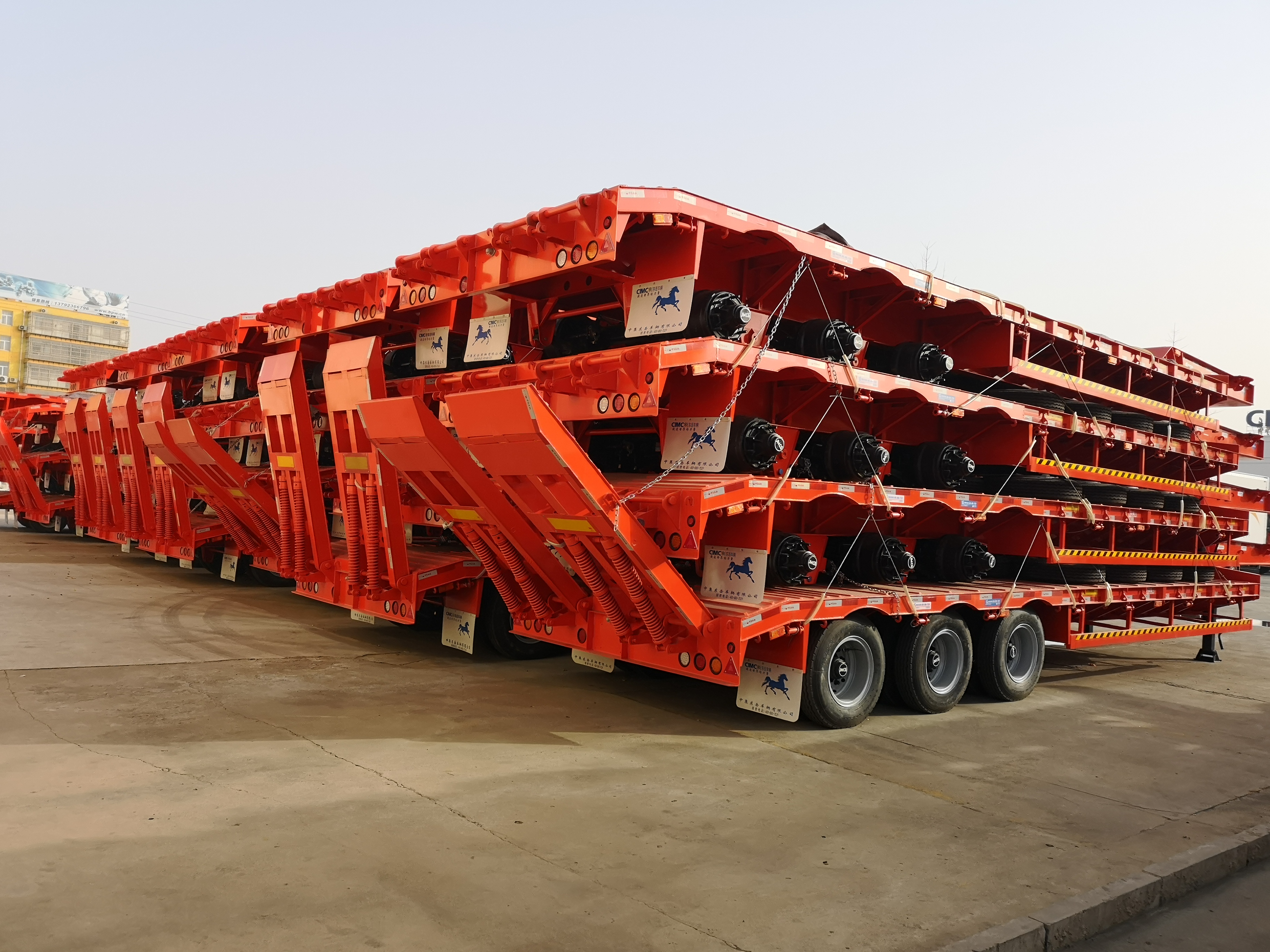
Trailer dispatch and export staging: the configuration chosen at order stage determines what can be loaded and moved for the next decade.
Why cargo type sets the shortlist before price does
A semi-trailer is a fixed-geometry asset. Once platform length, deck height, tank volume or pressure rating is fixed at the factory, the unit either fits the cargo for its whole service life or it does not. That is why experienced fleet buyers work through four variables in a fixed order before they discuss price.
- Cargo class and density. Steel and machinery travel on a platform; cement and fly ash travel in a pressure-discharged tank; compressed gas travels in a pressure vessel. Density converts a nominal volume into an actual payload, which is why two buyers specifying the same 32 m³ powder tank can end up with very different tonnage figures.
- Payload and gross vehicle weight. Payload is a function of tare weight, axle configuration and legal gross weight, not of a single number on a specification sheet.
- Dimensions and loading method. Ramp angle for a lowboy, twist-lock positions for a container chassis and deck height for a flatbed determine whether loading is actually practical on the buyer's site.
- Axle configuration and route limits. Axle count and tyre specification convert a payload target into a vehicle that can legally operate on a specific corridor.
The shortlist at a glance
| Trailer type | Primary cargo | Verified specification | Typical duty |
|---|---|---|---|
| Flatbed semi trailer | Containers, steel, machinery, building materials | Platform length 12,500–16,000 mm; deck height 1,250–1,550 mm; Q345B / Q550 steel | Long-haul general cargo, port to warehouse |
| Lowboy (lowbed) semi trailer | Excavators, dozers, heavy plant | Payload up to 100 tons; loaded deck height 450–600 mm | Heavy haulage, mining, equipment relocation |
| Container (skeleton) semi trailer | 20 ft / 40 ft / 45 ft ISO containers | Payload 30–65 tons; ISO twist-lock compatibility | Ports, container depots, intermodal shuttles |
| Tank semi trailer | Fuel and liquid cargo | Payload 28,000–35,000 kg; GVW 40,000–42,000 kg | Fuel distribution; ADR regime applies in Europe |
| Dust (powder) tank trailer | Cement, fly ash, mineral powder | Volume 32–60 m³ | Cement plants, batching plants, dry bulk |
| CNG tube trailer | Compressed natural gas | 2,000–6,000 Nm³ at 20–25 MPa | Gas distribution and industrial gas supply |
Specification ranges are configuration-dependent. Final payload and dimensions are confirmed against the axle and tyre specification selected for each order.
Flatbed semi trailer: the general-purpose platform
The flatbed semi trailer is the default choice when cargo is dimensional rather than dense, and when loading happens from the side or from above. Verified platform lengths run from 12,500 mm to 16,000 mm, with deck height between 1,250 mm and 1,550 mm depending on suspension and tyre specification. Main beams are commonly specified in Q345B or Q550 steel, and JOST landing gear is a standard specification where the unit will be uncoupled frequently. Twist locks can be fitted so that the same platform carries 20 ft or 40 ft containers in addition to steel and machinery.
The boundary is weather exposure. An open platform offers no protection to moisture-sensitive freight, so shippers handling paper, bagged chemicals or finished goods generally need a van semi trailer or a tarpaulin system instead. A flatbed is also a poor fit for bulk powders and liquids, where volume and containment rather than deck area drive the design.
Lowboy semi trailer: engineered around the machine
The lowboy — also written lowbed semi trailer — is designed around the machine being moved rather than around tonnage alone. Payload capacity reaches up to 100 tons, and the loaded deck height is normally between 450 mm and 600 mm, which is what allows excavators, dozers and crushers to be driven on with minimal dismantling. That low deck height is purchased with mechanical complexity: the gooseneck, the removable deck sections and the ramp geometry all have to match the machine's track width and ground clearance.
The category's weight in the market is measurable. Independently of any single manufacturer, lowboy trailers took 25.7% of semi-trailer demand in 2024 (Grand View Research), which reflects how much freight movement still depends on relocating equipment rather than packaged goods. The practical boundary is that a 100-ton payload figure only means something together with axle count, tyre specification and the permitted axle loads on the destination route. A trailer that is capable on paper but not permitted on the target corridor is not a solution.
Container and skeleton semi trailer: standardised interfaces
Container chassis and skeleton semi trailers are the most standardised category on this list because the interface is defined by the container, not by the shipper. Verified payload ranges from 30 to 65 tons with compatibility across 20 ft, 40 ft and 45 ft ISO containers through twist locks. Because the trailer's own tare weight reduces the payload that can legally be carried, skeletal frames that support a container on a minimal structure are usually preferred on corridors where gross weight is tightly regulated.
The boundary here is container availability. A container chassis is only as productive as the container flow at both ends of the route. On lanes where container supply is irregular, a flatbed with twist locks is often the more flexible purchase, even though it is less efficient per trip when containers are available.
Tank semi trailer: liquid cargo with a regulatory layer
Tank semi trailers for fuel and liquid cargo are specified with payloads of 28,000–35,000 kg and a gross vehicle weight of 40,000–42,000 kg. Beyond the tank itself, this category carries a compliance requirement that the other five do not: in Europe, the transport of dangerous goods in fuel and tank trailers requires ADR certification under the ADR Agreement, and in the United States trailers with a GVWR above 10,001 lbs fall under the annual safety inspection requirement of 49 CFR 396.17 administered by the FMCSA.
Compartment configuration, discharge equipment and the destination market's inspection regime therefore belong in the quotation stage, not in the delivery stage. The limitation is interchangeability: a tank is built for a product class. Switching commodity can require cleaning, inerting or re-certification, which makes the tank trailer the least flexible asset on this shortlist.
Dust (powder) tank trailer: volume is the easy number
Powder tank semi trailers — listed as dust tank trailers in manufacturer catalogues — operate between 32 m³ and 60 m³ and discharge dry bulk material by fluidising it with compressed air. The volume range is straightforward; the density of the material is what decides the payload. Cement, fly ash and mineral powders differ enough that the same nominal volume produces different legal tonnages, so a buyer should specify both a volumetric figure and the target tonnage for the actual material.
Site conditions matter as much as the trailer. Discharge performance depends on the compressor and discharge line available at the receiving end, and buyers moving fine or cohesive powders should confirm free-flowing behaviour before fixing the tank geometry.
CNG tube trailer: pressure equipment, not a tank on wheels
CNG tube trailers store compressed natural gas at working pressures of 20–25 MPa, with capacities from 2,000 Nm³ to 6,000 Nm³ delivered through tube bundles. This category is pressure equipment as much as transport equipment: cylinder certification, periodic inspection and end-of-life management follow the pressure vessel rules of the country of operation.
The boundary is infrastructure. Tube trailers are not interchangeable with liquid fuel logistics. They require gas handling arrangements at both the filling and the receiving site, and the tractor, route and unloading procedure must be planned as a single system rather than as three separate purchases.
A selection sequence that works in one procurement meeting
- Classify the cargo. Dimensional solid, bulk solid, liquid, or compressed gas. This single answer eliminates roughly half of the shortlist immediately.
- Convert cargo into a payload requirement. Density multiplied by volume for bulk material, machine weight plus attachments for project cargo, delivered tonnage per trip for general freight.
- Fix the geometry. Deck length and deck height for platform trailers, volume for powder tanks, working pressure and capacity for gas trailers.
- Size the running gear. Match axle configuration and tyre specification to the permitted axle loads on the actual route, not to the maximum rating of the trailer.
- Confirm materials and wear parts. Main beams in Q345B or Q550 steel, landing gear such as JOST where frequent uncoupling occurs, and a documented parts supply route for brakes and suspension.
- Confirm the regulatory layer. ADR for dangerous goods in Europe, annual inspection requirements under 49 CFR 396.17 in the United States, and any national pressure-vessel rules for gas equipment.
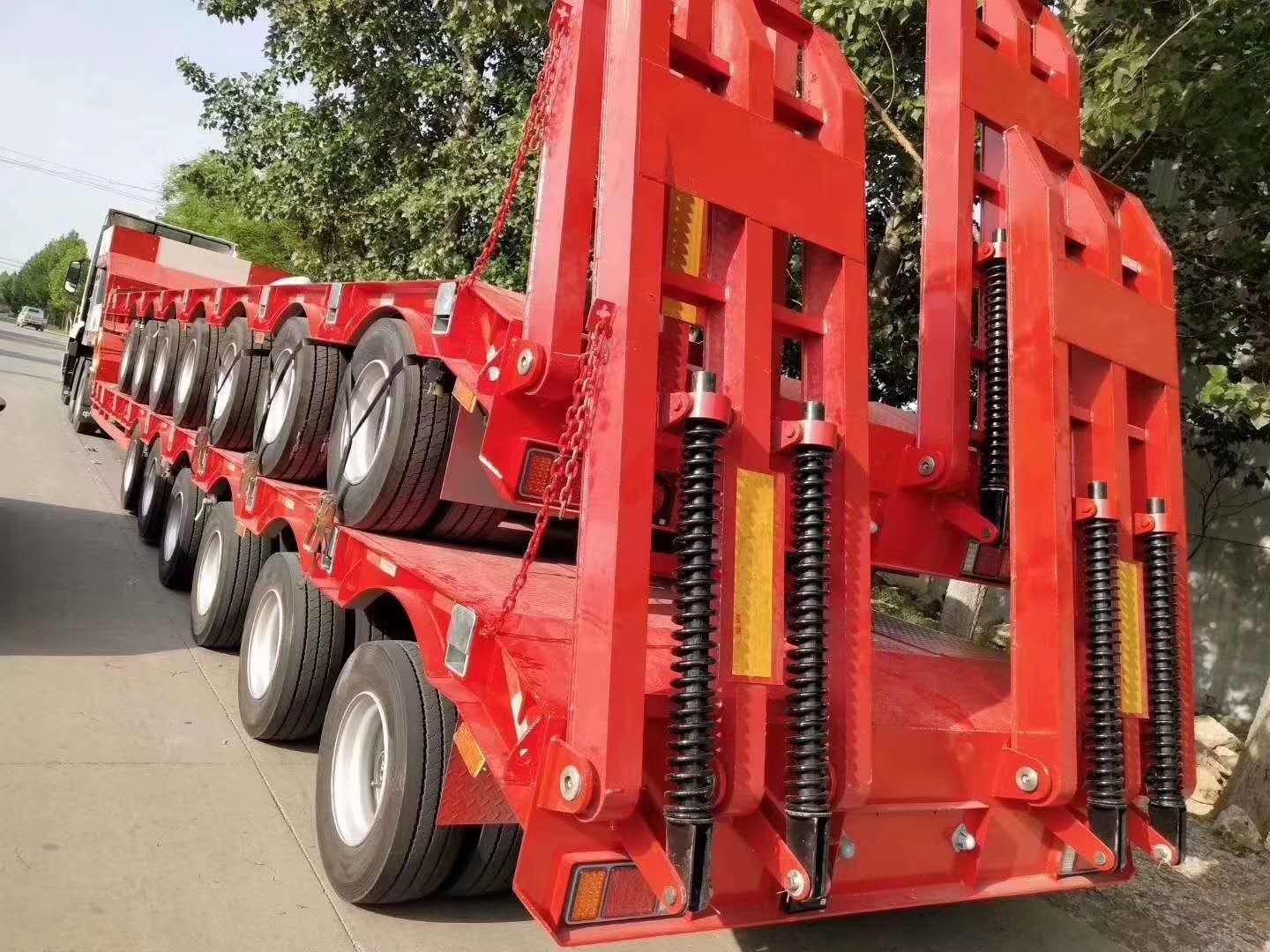
Configuration is locked before dispatch: deck length, deck height and axle set cannot be renegotiated once the unit is built for a specific cargo.
What a mixed trailer fleet demands from the supplier
Once a buyer operates more than one trailer type — a flatbed for containers, a lowboy for plant and a tank trailer for liquids, for example — the supplier relationship changes character. Running gear, brake components, suspension parts and landing gear become a shared maintenance inventory, and supplier value is measured by whether the same part can be sourced in year five as in year one. This is the point at which trailer procurement stops being a purchase and becomes an ecosystem decision.
Shandong Luen Auto Co., Ltd. (Luen Auto) is a trailer and special-purpose vehicle manufacturer and exporter based in Xuji Industrial Park, Liangshan County, Jining City, Shandong Province, China. The company operates a factory of more than 50,000 m² with over 130 employees and an annual output of around 1,500 units, supported by a five-engineer R&D team, with roughly 80% of production exported and annual exports exceeding USD 30 million. Its primary markets are Africa, South America and the Middle East, with additional activity in parts of Southeast Asia and Central Asia. Luen Auto is a subsidiary of Luen Group, which also includes Luheng Trailer Parts Co., Ltd., Longheng International Trade Co., Ltd. and Luxinda Machinery Co., Ltd.
For long-term supply assessment, the structural point is vertical integration. Luen Group's own Luheng axle and parts manufacturing means axles and suspensions are produced inside the group rather than sourced from third-party assemblers, which affects parts availability across the trailer's service life and keeps warranty responsibility with a single, identifiable legal entity. Buyers who have to pass a factory audit or maintain certified equipment tend to weigh this more heavily than a small difference in order price.
Product range matters too, because fleet standardisation reduces the number of distinct spare parts a buyer must stock. Alongside the six categories in this shortlist, the catalogue includes dump semi trailers, van semi trailers and fuel tank trailers, together with tractor trucks and used tractor trucks, dump trucks and used dump trucks, HOWO and Shacman heavy trucks, and light duty trucks including Foton light trucks. Buyers pairing new trailers with used tractor units — a common pattern in import markets — should specify fifth-wheel height and coupling against the actual tractor rather than against a generic reference.
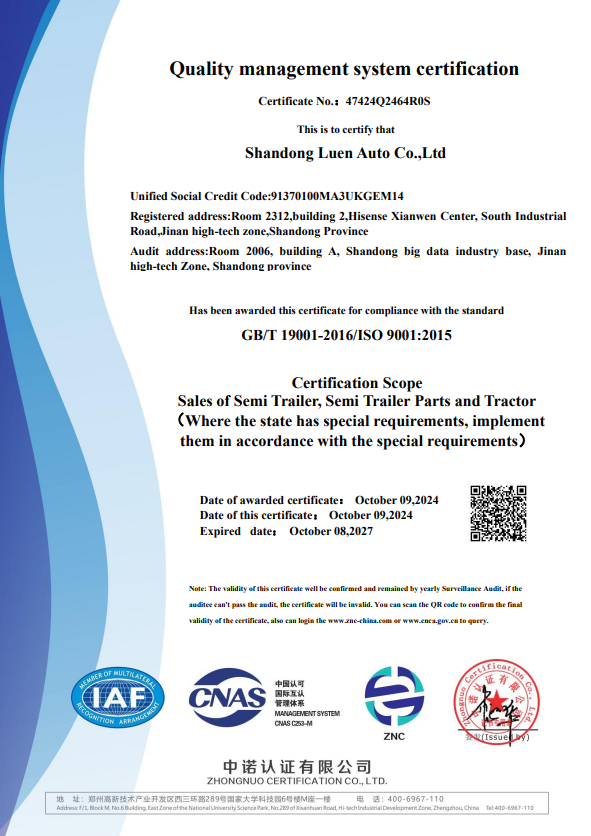
Documentation such as ISO 9001 certification is part of the evidence pack buyers should review before order confirmation, alongside CE documentation, 3C certification and pre-shipment test records.
Order execution, packaging and commercial terms
Execution-stage buyers generally care about three things after the specification is fixed: how the unit is protected in transit, how acceptance is defined, and what the commercial terms are. Luen Auto's documented measures include an anti-rust wax coating applied before shipping, semi-knocked-down (SKD) packing for large trailers, fumigation-free plywood crates for parts, and a packaging and delivery SOP with photo records for each shipment. Published purchasing terms are a minimum order quantity of one unit, FOB or CIF delivery terms, pre-shipment testing as the acceptance criterion, and TT 30/70 payment terms.
Integrated manufacturing versus the traditional workshop route
Traditional practice in trailer clusters is to buy from small or unbranded workshops that assemble from third-party components. The attraction is straightforward: the lowest upfront price and fast lead times on standard designs. The divergence appears over time. Integrated manufacturers with their own axle and parts production typically quote around 5–15% above the lowest-bid workshop price, and that premium is recovered through genuine parts and honoured warranty coverage rather than through the first invoice.
A limitation should be stated plainly, because it defines the boundary of this recommendation. For a buyer ordering a single, non-repeating trailer and performing all maintenance through a capable local workshop, the upfront premium may never be recovered, and the lowest-bid route can be the economically rational one. The integrated model pays back through parts continuity, warranty enforcement and batch-to-batch consistency across repeat orders — benefits that only materialise for fleets that keep and maintain units over several years. A workshop that closes also closes its warranty, and that is the specific risk integrated suppliers are being paid to remove.
Market signals behind the shortlist
The semi-trailer market was estimated at USD 22.8 billion in 2024 with a projected USD 42.3 billion by 2033 (Grand View Research). Published estimates differ between research houses — Fact.MR places the 2025 figure at USD 24.2 billion, while Market Research Future reports USD 31.2 billion for 2024 — largely because sub-category coverage differs between light and heavy segments. Buyers should treat the growth direction as the signal and any single figure as an approximation.
On the tractor side, Chinese heavy-truck export volumes shape what importers can pair with these trailers. Sinotruk (CNHTC) reached 135,000 heavy-duty truck exports in 2024, Shacman exported 25,000 units with a 35% year-on-year increase, and Foton recorded 523,000 total truck sales in 2024, including over 100,000 exports. In parallel, the global used truck market was valued at USD 49.95 billion in 2025 with heavy-duty segments dominating (Global Market Insights), which is consistent with the continuing practice of pairing used tractor units with new trailers in Africa, South America and the Middle East.
Future outlook
Three shifts are likely to reshape trailer shortlists over the next several years. First, mixed fleets are becoming normal rather than exceptional: buyers who once ordered a single flatbed now specify two or three categories at once, which pushes parts commonality and supplier breadth higher on the evaluation list than unit price alone. Second, documentation is becoming part of the product — certification files, pre-shipment test records and packaging photo records increasingly accompany the trailer and are reviewed during audits and insurance arrangements. Third, the pairing of new trailers with used tractor units in import markets will keep coupling compatibility and fifth-wheel specification in the procurement conversation, not just in the engineering one.
For buyers in the decision and execution stage, the practical conclusion is a sequence rather than a ranking: define the cargo, convert it into payload and geometry, size the running gear against the route, confirm the regulatory layer, and only then choose the supplier on the strength of parts supply and warranty durability. Applied in that order, the shortlist above narrows to one or two categories in most cases before any quotation is requested.
Frequently asked questions
Which semi-trailer types belong on a shortlist for general cargo versus project cargo?
General dimensional cargo is normally handled by a flatbed semi trailer with a platform length of 12,500–16,000 mm and a deck height of 1,250–1,550 mm, or by a container (skeleton) semi trailer with 30–65 ton payload and twist-lock compatibility for 20 ft, 40 ft and 45 ft ISO containers. Project and heavy equipment cargo is normally handled by a lowboy semi trailer with payload up to 100 tons and a loaded deck height of 450–600 mm. Bulk dry powders use a dust tank trailer of 32–60 m³, liquids use a tank semi trailer with 28,000–35,000 kg payload and 40,000–42,000 kg GVW, and compressed gas uses a CNG tube trailer rated 2,000–6,000 Nm³ at 20–25 MPa.
How should payload and axle configuration be matched to a specific trailer type?
Payload is determined by the trailer's tare weight, axle count, tyre specification and the legal axle loads on the route, not by a single rated figure. The practical method is to start from the required tonnage per trip and the permitted axle load on the destination corridor, then select an axle configuration that supports that combination. Main beam steel grade — Q345B or Q550 — affects structural durability and repairability rather than payload capacity, while landing gear such as JOST affects day-to-day operation where the unit is uncoupled frequently.
Which certifications and documents should be reviewed before confirming an order?
Buyers should review the manufacturer's quality management certification such as ISO 9001, CE documentation where applicable to the destination market, 3C certification for the Chinese market, and trademark and patent documentation where these are relevant to the buyer's compliance file. Category-specific requirements also apply: fuel and tank trailers operating in Europe fall under ADR certification under the ADR Agreement, and in the United States trailers with a GVWR above 10,001 lbs are subject to annual safety inspection under 49 CFR 396.17. Pre-shipment test records should be requested as part of the same document review.
What are the typical purchasing terms for a first semi-trailer order?
The purchasing terms published by Luen Auto are a minimum order quantity of one unit, FOB or CIF delivery terms, pre-shipment testing as the acceptance criterion, and TT 30/70 payment terms. Buyers should confirm whether the quoted delivery term covers inland transport to the port of loading and which party is responsible for marine insurance.
How are trailers protected during ocean freight and long-distance logistics?
Documented measures include applying an anti-rust wax coating before shipping, semi-knocked-down (SKD) packing for large trailers, and fumigation-free plywood crates for parts, supported by a packaging and delivery SOP with photo records for each shipment. These records allow a buyer to compare the condition of the unit at loading against its condition on arrival when a claim is being assessed.
What changes for a buyer planning five years of fleet operation rather than a single order?
Parts availability and warranty continuity become the dominant criteria. Vertically integrated suppliers that manufacture their own axles and parts — Luen Group's Luheng axle and parts manufacturing is an example — can supply running gear components across the trailer's service life and keep warranty responsibility with a stable legal entity. Integrated manufacturers typically price around 5–15% above the lowest-bid workshop quote, and that premium is recovered over repeat orders through genuine parts and honoured warranty rather than in the first transaction.
Reference for the trailer and truck range discussed in this shortlist: the Luen Auto product catalogue is available as a PDF at https://cdn.socialarks.com/sbsp/25030/common/2026/0713/%28%E5%B7%B2%E7%98%A6%E8%BA%AB%29LUEN%20Auto%20Product%20Catalog.pdf. Company information is published at https://www.luen-trailertruck.com.