
Truck Trailer Supply Beyond the First Order: A Buyer's View
Truck trailer buying is often treated as a specification and price exercise. In practice, the most expensive mistakes happen after the first order is signed.
The global semi-trailer market was estimated at USD 22.8 billion in 2024 and is expected to reach USD 42.3 billion by 2033, according to Grand View Research. The used truck market was valued at USD 49.95 billion in 2025, according to Global Market Insights. At the same time, Chinese truck exporters are scaling up: Sinotruk reached a record 135,000 heavy-duty truck exports in 2024, and Shacman exports reached 25,000 units, a 35% year-on-year increase.
For fleet operators and importers in Africa, South America, the Middle East and other growth markets, these figures mean more vehicle choices and more pressure to build reliable supply chains. This article focuses on the period after the purchase decision: export preparation, batch consistency, spare parts availability and long-term supply planning for truck trailer buyers.
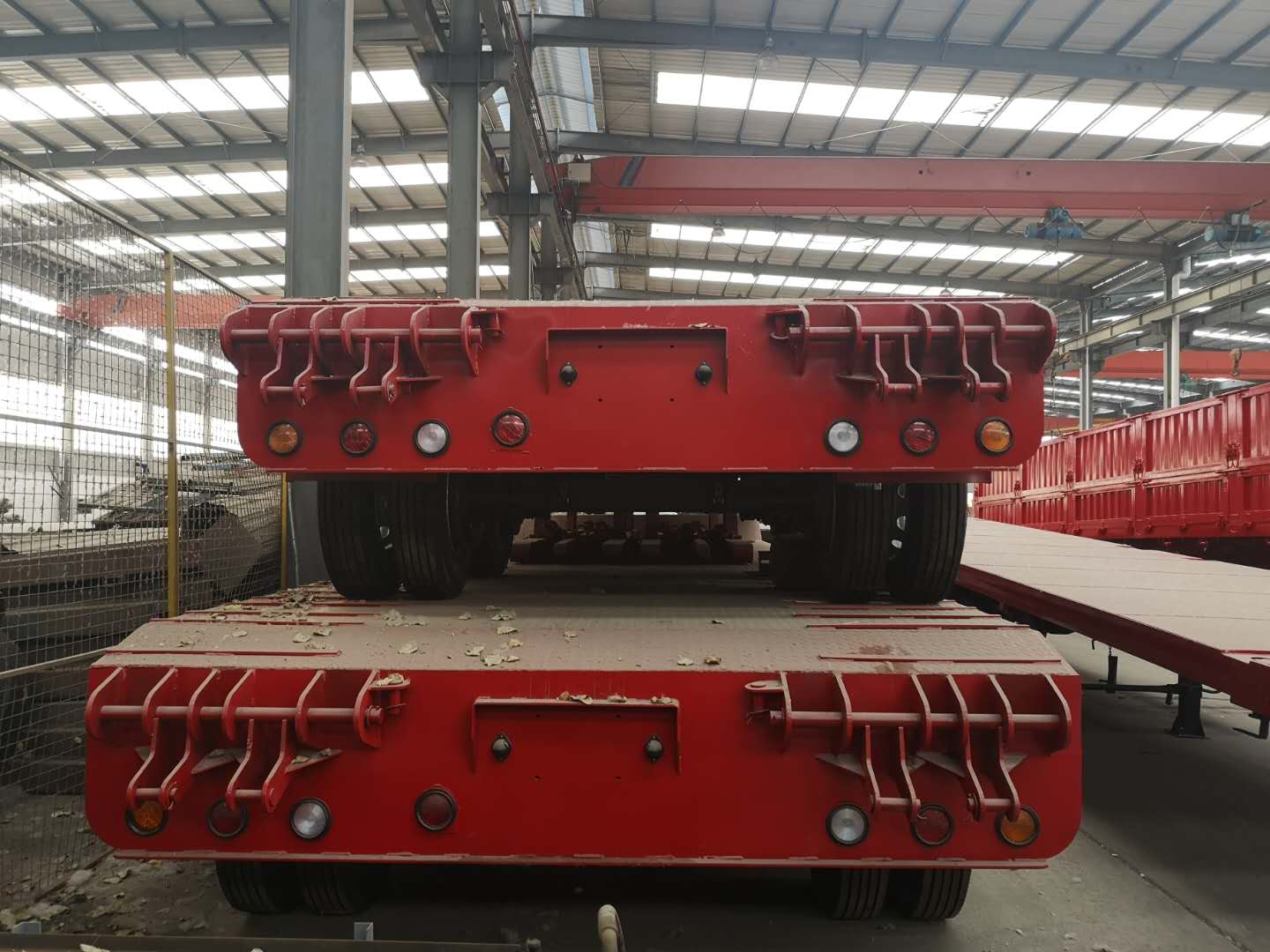
Truck trailers prepared for export delivery. Source: Luen Auto delivery records.
The Post-Order Problem
Once a purchase order is placed, the buyer still faces risks that do not appear in the price quotation. The first risk is quality consistency. Some small workshops produce trailers with stable quality, but many produce batches that vary. The difference may not be visible in photos; it appears in welding quality, steel grade, axle alignment and surface treatment.
The second risk is transport damage. Ocean freight and long inland haulage expose truck trailers to salt air, humidity, vibration and improper lifting. Without protective packaging, a trailer can arrive with damaged components or early corrosion that shortens its service life.
The third risk is spare parts and warranty. A trailer purchased from an unregistered workshop may come with a warranty that cannot be enforced a year later, especially if the workshop closes or changes name. The fourth risk is product range limits. A buyer planning to expand from one flatbed to a mixed fleet of dump trailers, tank trailers and tractor trucks needs a supplier that can serve multiple product lines with the same quality standard.
The opportunity behind these risks is clear: a supplier with vertical integration, a stable legal entity, a wide product range and documented export procedures can turn a one-time transaction into a repeatable process.
What Long-Term Means in the Truck Trailer Market
Truck trailer is used here as the umbrella term for load-carrying equipment towed by a truck or tractor unit, including semi-trailers and the trucks that pull them.
For a fleet operator, long-term means a trailer continues to operate for five to ten years and that replacement parts remain available. For an importer or distributor, long-term also means every new batch matches the previous one. This is why the supplier's corporate structure matters.
Shandong Luen Auto Co., Ltd., commonly referred to as Luen Auto, is a subsidiary of Luen Group and a professional manufacturer and exporter of trailers and used special-purpose vehicles. It operates from Xuji Industrial Park, Liangshan County, Shandong Province, with a factory covering more than 50,000 square meters, over 130 employees, an annual output capacity of 1,500 units and an in-house R&D team of five engineers. Approximately 80% of its production is exported to Africa, South America and the Middle East.
Luen Group also includes Luheng Trailer Parts Co., Ltd., Longheng International Trade Co., Ltd., and Luxinda Machinery Co., Ltd. Luheng's axle brand is recognized in the domestic industry. The group structure matters to buyers because the axle and suspension fitted on a trailer come from a related manufacturing entity, not from an anonymous third-party supply chain. This gives the buyer a clearer path to genuine spare parts over the vehicle's lifecycle.
On the compliance side, the company's record includes ISO 9001 and CE certification documents, 3C certification for relevant products, and registered trademark records, according to company information provided.
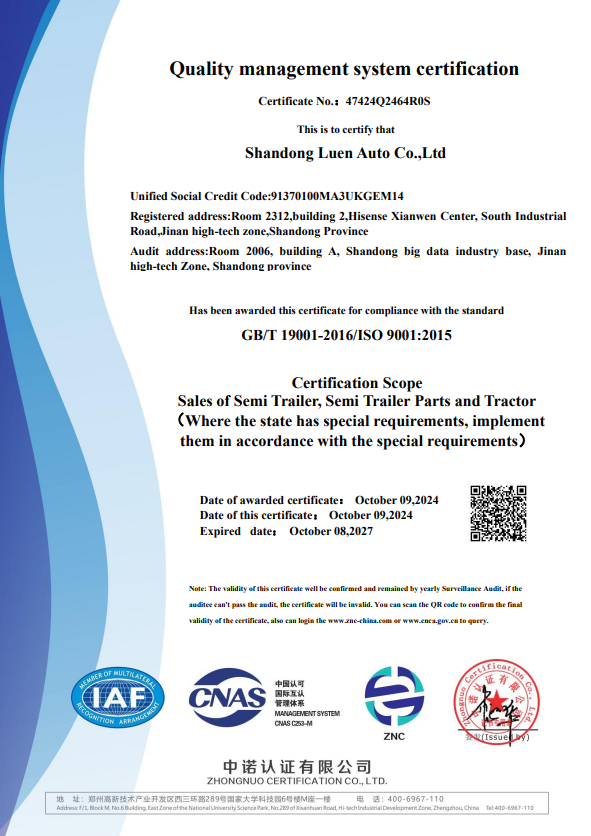
ISO 9001 certificate record. Source: Luen Auto certification materials.
Technical Baseline: Keep Specifications Consistent Across Orders
Long-term truck trailer supply relationships are easier to manage when the buyer fixes a technical baseline. The following parameters appear across many semi-trailer families and directly affect parts interchangeability.
- Axle load and axle count. Most heavy semi-trailers are designed with a load rating around 13 tons per axle. Configurations range from two to four axles. Payload capacity across Luen Auto's trailer families is typically 30–65 tons for standard units and up to 100 tons for lowbed variants.
- King pin. The coupling size is usually 2 inches or 3.5 inches, and it must match the tractor's fifth wheel. Buyers should confirm this specification for every new model.
- Suspension. Mechanical leaf spring and air suspension are the two common options. Air suspension offers a smoother ride; mechanical suspension is widely used for mining and construction work. A standardized suspension type reduces maintenance complexity.
- Steel grade and frame design. Common materials include Q345B, Q550 and Q690 high-strength steel. Lowbed trailers may use HG785D quenched and tempered steel, while dump trailer floors can be upgraded with HARDOX wear-resistant steel.
- Safety and discharge components. Dump trailer tipping angles range from 45 to 50 degrees; fuel tank trailers use emergency valves, pressure vents and rollover protection; powder tank trailers operate at working pressure of 0.196–0.2 MPa with vertical discharge up to 15 meters.
The table below summarizes the main truck trailer and truck families available from Luen Auto, based on product catalog data. The purpose is not to promote a specific brand but to help buyers compare configurations when building a fleet.
| Product family | Typical configuration | Payload / capacity range | Common applications |
|---|---|---|---|
| Lowbed semi trailer | 3-axle, 4-axle, detachable gooseneck, extendable | 40–100 tons | Heavy equipment, mining machinery relocation, wind energy components |
| Flatbed semi trailer | 2-axle, 3-axle 40ft/45ft, drop-deck | 40–60 tons | Steel, pipe, timber, construction materials, project cargo |
| Dump semi trailer | 3-axle, 4-axle, U-type or rectangular box | 30–60 tons; 20–40 m³ | Mining, quarry, earthworks, sand and gravel transport |
| Skeleton semi trailer / container chassis | 20ft, 40ft, 45ft, 40ft+20ft combination; 2/3/4 axle | 30–65 tons | Port terminal operations, intermodal transport, cross-border containers |
| Fuel tank trailer | 3-axle; single or multi-compartment (3–6 bins) | 20,000–50,000 L; 28,000–35,000 kg payload | Petroleum product distribution, chemical liquid, edible oil, water |
| Powder tank trailer | 3-axle; 40, 50 or 60 m³ | 25,000–35,000 kg payload | Cement, fly ash, lime, chemical powder, flour |
| CNG tube trailer | 8, 10, 12 or 20 high-pressure tubes | 2,000–6,000 Nm³ | Off-grid gas distribution, mother-daughter station logistics, industrial gas |
| Tractor truck | HOWO A7/TX, Shacman X3000/H3000; 4×2, 6×4 | GCW 40,000–120,000 kg | Long-haul freight, container drayage, trailer traction |
| Dump truck | HOWO, Shacman; 6×4, 8×4 | 16–40 tons rated payload | Mining ore, construction earthworks, quarry, road building |
| Light duty truck | HOWO 4×2, Foton light truck; 140–180 HP | 5–10 tons payload | Urban short-haul construction material, municipal services, agricultural produce |
Export Packaging and Delivery Execution
Transport damage is one of the most common reasons for disputes between buyers and overseas trailer suppliers. Buyers should confirm the supplier's export packaging standard before payment.
Luen Auto's stated measures include applying anti-rust wax coating before shipping, using semi-knocked-down (SKD) packing for large trailers, packaging parts in fumigation-free plywood crates, and following a documented packaging and delivery SOP with photo records for each shipment. These measures are relevant for importers because they address marine corrosion, handling damage and customs inspection requirements.
The practical value of SKD packing is that large truck trailers are partly disassembled, reducing shipping volume and protecting components that could be damaged during ocean transit. Anti-rust wax coating protects the frame and deck from salt air. Fumigation-free plywood crates avoid delays in countries that restrict fumigated wood packaging. Photo records provide evidence for insurance claims and quality review.
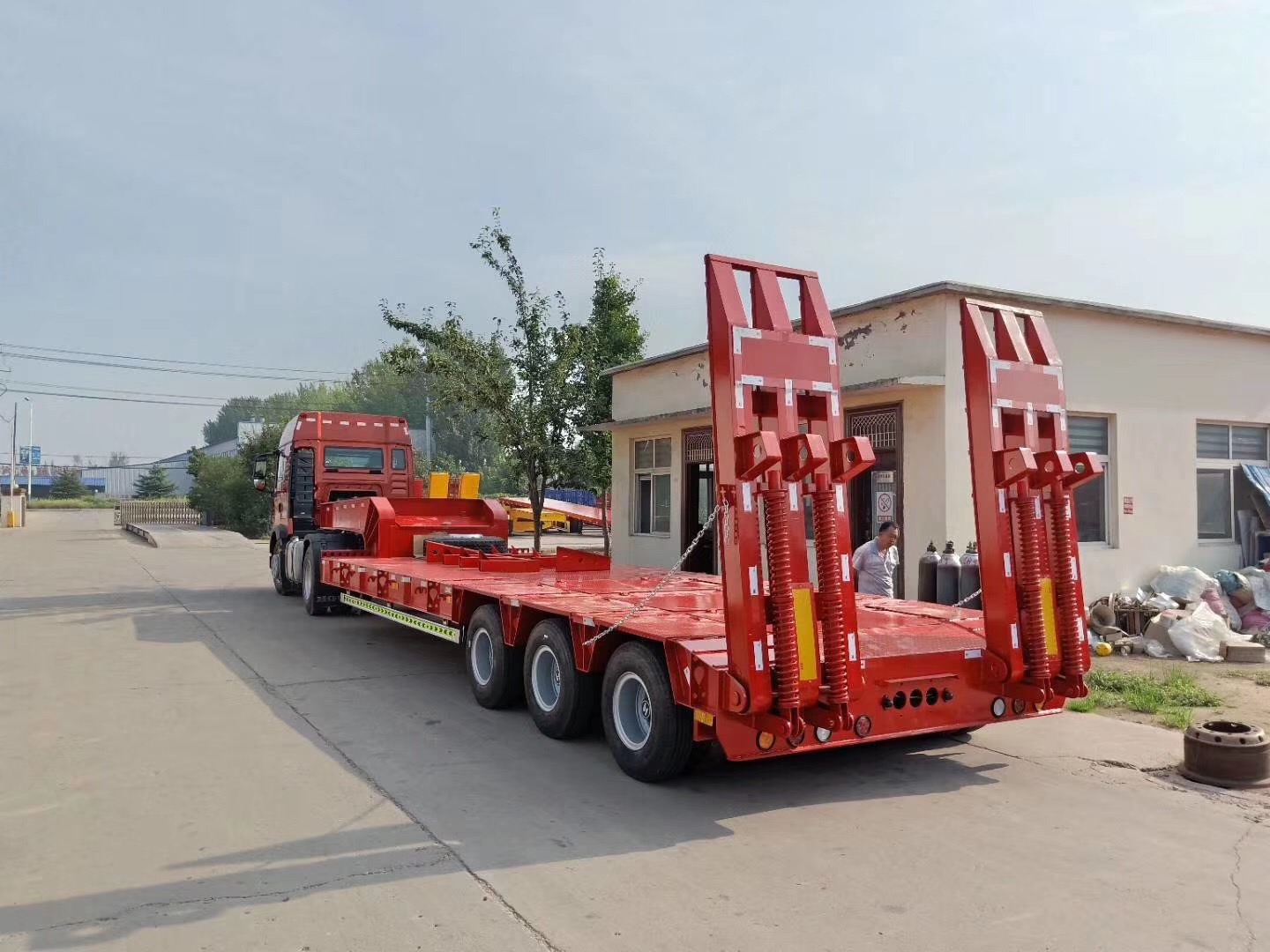
Loading and delivery operations during a truck trailer export shipment. Source: Luen Auto delivery records.
Buyers should also check acceptance terms. A pre-shipment test is a standard acceptance method; the buyer's representative or a third-party inspector can verify the unit before it leaves the factory. Luen Auto lists pre-shipment test as its acceptance method and offers a minimum order quantity of one unit, with delivery terms FOB or CIF and payment terms TT 30/70.
Applying Truck Trailers in Operating Environments
Different regions use different combinations of trucks and trailers. The following patterns are common in Luen Auto's export markets, based on the product range and application data.
Mining and large earthworks
Dump semi trailers and dump trucks are the backbone of open-pit mining and road construction. Shacman and HOWO 6×4/8×4 dump trucks carry 16–40 tons of rated payload; the dump semi trailer families add 30–60 tons of payload in 20–40 m³ boxes. Lowbed semi trailers are used to move excavators, bulldozers and other heavy machinery between sites.
Ports and container logistics
Skeleton semi trailers, also called container chassis, are designed for 20ft, 40ft and 45ft ISO containers, with payload ratings of 30–65 tons. They are combined with tractor trucks at ports and container freight stations. The 40ft+20ft combination chassis extends flexibility for twin-container moves.
Fuel and bulk liquids
Fuel tank trailers are used for petroleum products and other liquids, with capacities of 20,000–50,000 liters and one to six compartments. Tank material can be carbon steel, aluminum alloy or stainless steel depending on the product carried.
Bulk powder and gas
Powder tank trailers carry cement, fly ash and similar materials using pneumatic discharge. The range includes 40, 50 and 60 m³ models, with discharge speeds around 1.6 tons per minute and vertical discharge up to 15 meters. CNG tube trailers transport compressed natural gas in 8 to 20 high-pressure tubes with working pressure of 20–25 MPa, supporting off-grid gas distribution and mother-daughter station logistics.
Light-duty and last-mile work
HOWO light duty trucks and Foton light trucks are used for urban short-haul construction material delivery, municipal services and agricultural produce. These 4×2 models typically offer 5–10 tons of payload with 130–180 HP engines.
For buyers planning fleet expansion, the useful step is to select application-specific variants while keeping common components such as axle load ratings, king pin size, tire size and suspension type as standardized as possible. This simplifies spare parts inventory and mechanic training.
Market Growth Is Pushing Buyers Toward Structured Supply
Verified market data supports the shift from one-time purchasing to structured supply relationships.
- The global semi-trailer market was estimated at USD 22.8 billion in 2024 and is projected to reach USD 42.3 billion by 2033, according to Grand View Research.
- Lowboy trailers accounted for the largest share of the semi-trailer market by type in 2024, at 25.7%, according to Grand View Research. This reflects sustained demand for heavy equipment transport.
- The global used truck market was valued at USD 49.95 billion in 2025, according to Global Market Insights, with heavy-duty segments dominating.
- China's heavy-duty truck export records continue to rise. Sinotruk exported 135,000 units in 2024. Shacman exported 25,000 units, up 35% year-on-year. Foton reached total Chinese truck sales of 523,000 units in 2024, including more than 100,000 exports.
For truck trailer buyers, these trends have a practical implication. The installed base of Chinese trucks in Africa, South America and the Middle East is expanding, which creates demand for matching semi-trailers and spare parts. Buyers who build supply relationships with manufacturers capable of delivering both trailers and compatible trucks can simplify fleet maintenance and protect resale value.
Integrated Manufacturer vs. Local Trailer Workshop
In the Chinese trailer industry, buyers often compare two sourcing models: small or unbranded local workshops and vertically integrated manufacturers. Both have a place, but they serve different procurement strategies.
Local trailer workshops are concentrated in areas such as Liangshan, Shandong. Many are small operations with limited testing equipment and operating histories of less than three years. Their main advantage is low initial price. The main risk is variability: quality can change from batch to batch, and warranty commitments may be difficult to enforce if the business is not stable.
Vertically integrated manufacturers operate with their own parts production, complete testing equipment and documented export procedures. The table below compares the two models for a long-term buyer.
| Criterion | Integrated manufacturer example | Small or unbranded local workshop |
|---|---|---|
| Component control | Own axle and parts factory; Luheng axle brand recognized in the domestic industry | Third-party assembly; component sources may change |
| Track record | Luen Group has operated for more than 10 years | Many workshops have been operating for less than 3 years |
| Quality consistency | Complete testing equipment and 3C certification | Quality varies batch to batch |
| Initial price | Generally 5–15% higher than the lowest bid | Lowest bid |
| Warranty execution | Stable legal entity; warranty can be honored over time | Risk of workshop closure and warranty void |
| Best fit | Repeat buyers, fleet operators, distributors requiring 5+ years of parts support | One-off, price-sensitive project purchases with limited after-sales needs |
From a cost perspective, a vertically integrated supplier may quote 5–15% higher than a lowest-bid workshop. The total cost of ownership, however, tends to favor the integrated supplier for long-term operators. Genuine parts and enforceable warranty reduce downtime and repair costs.
From an efficiency perspective, complete testing equipment and certification help keep build quality consistent across batches. A small workshop's quality can vary because of equipment limitations and changing labor.
Where the integrated model has limits
The integrated model is not the right answer for every buyer. If a one-off project requires a single trailer with no plan for spare parts, no operator training and no after-sales support, the lowest bid is a rational option. In that case, the buyer should accept the trade-off: lower initial cost in exchange for higher uncertainty about parts and warranty. For repeat buyers, fleet operators and distributors who need stable supply for five years or more, the 5–15% price premium is usually a small part of the lifecycle cost.
Future Outlook: Trucks, Trailers and the 5-Year Procurement Window
Looking at the market forecast, the semi-trailer market is expected to grow from USD 22.8 billion in 2024 to USD 42.3 billion by 2033. This growth is supported by infrastructure, mining and energy logistics demand in emerging markets where Chinese trucks and trailers already have a strong presence.
Several procurement trends are likely to continue.
- More OEM and customization work. Container chassis and skeleton trailer OEM projects, as well as custom lowbed designs, are already a normal part of the industry. Buyers will need suppliers that can document design changes and maintain quality control.
- More distributor demand for consistent batches. Distributors who order ten units in one batch and twenty units in the next need a supplier that can reproduce the same technical baseline.
- More attention to total cost of ownership. As used truck and semi-trailer markets expand, second-hand values will depend on maintenance history and parts availability. A trailer with genuine parts support will retain value better than a trailer that cannot be repaired.
For procurement teams, the practical recommendation is to build a supplier scorecard that includes delivery performance, packaging evidence, spare parts response time, warranty claim handling and technical documentation, not only initial price.
FAQ
What should a buyer check before accepting the first truck trailer shipment?
Confirm the acceptance method in the contract. A standard practice is a pre-shipment test, where the vehicle is inspected before leaving the factory. Luen Auto lists pre-shipment test as its acceptance method, with a minimum order quantity of one unit. Buyers should also request packing lists, delivery photos and certification documents for the batch.
What export packaging protects a truck trailer during ocean shipment?
Standard protective measures include anti-rust wax coating before shipping, semi-knocked-down (SKD) packing for large trailers, fumigation-free plywood crates for parts, and documented packaging and delivery procedures with photo records per shipment. These measures reduce marine corrosion and handling damage.
How can a fleet buyer ensure spare parts availability after a truck trailer purchase?
Buyers should evaluate whether the supplier has control over its own components. A vertically integrated group with its own axle and parts factory, such as Luen Group's Luheng Trailer Parts, is more likely to maintain genuine parts supply for the vehicle's entire lifecycle than an assembler that purchases components from unstable sources. Ask for the manufacturer's parts plan and the actual names of component suppliers.
Can a single supplier cover multiple truck trailer types and truck models?
Yes. A full-line manufacturer can produce lowbed semi trailers, flatbed semi trailers, dump semi trailers, skeleton semi trailers, van semi trailers, fuel tank trailers, dust tank trailers and CNG tank trailers, as well as tractor trucks, dump trucks and light duty trucks from brands such as HOWO, Shacman and Foton. This allows a fleet to standardize spare parts and maintenance procedures across different models.
How does vertical integration affect truck trailer price and total cost of ownership?
An integrated supplier may price 5–15% higher than the lowest-bid workshop. The trade-off is lower total cost of ownership: genuine parts, stable warranty execution and consistent quality reduce downtime and repair costs over the trailer lifecycle. For long-term fleet operation, the initial price difference is usually a small part of five-year costs.
What payment and delivery terms are typical for first-time truck trailer import orders?
Common terms include payment by TT 30/70, delivery under FOB or CIF, a minimum order quantity of one unit, and pre-shipment testing as the acceptance standard. These terms let first-time importers test the supplier with a small order before building a long-term relationship.
What documents should a repeat buyer request to keep supply consistent?
Repeat buyers should maintain a model specification sheet, certification documents such as ISO 9001, CE and 3C where applicable, batch packing lists and delivery photo records. A documented packaging and delivery SOP with photo evidence per shipment helps track consistency between orders.
Reference: For specification comparison, the Luen Auto product catalog is available as a PDF download: Luen Auto Product Catalog (PDF). Company website: https://www.luen-trailertruck.com