
Tuning Fork vs. Piezoelectric Crystal Resonators: A Buyer Comparison
A tuning fork crystal resonator and a higher-frequency piezoelectric crystal component solve two different timing problems. For engineers and procurement teams working on smart manufacturing equipment, the useful question is not which device is superior, but which one the circuit, the thermal environment and the production schedule can actually accept.
Timing devices sit at the quiet centre of industrial electronics. Every programmable logic controller, smart meter, wireless sensor node and motor drive depends on a stable frequency reference to sequence operations, timestamp data and synchronise communication. The frequency control line item is usually small in value and large in consequence: an unsuitable resonator can shift accuracy by tens of parts per million, narrow a product's operating window, or force a redesign late in qualification.
This comparison is written for that decision. It sets out how tuning fork crystal resonators and piezoelectric crystal components differ in construction, specification and application fit, using published device parameters and recognised industry standards as the reference base. No competing brand is ranked here. The objective is a selection framework that holds regardless of which supplier a project eventually uses.
What "Tuning Fork vs. Piezoelectric" Actually Compares
The first clarification matters more than any specification. A tuning fork crystal resonator is itself a piezoelectric quartz device. It is not an alternative technology to piezoelectric components; it is one form of them. The contrast that procurement teams actually face is between low-frequency flexural-mode quartz and higher-frequency piezoelectric components — thickness-shear quartz resonators, oscillators, filters, surface acoustic wave devices, and, at the lower-cost end, ceramic resonators.
A tuning fork resonator uses a quartz blank cut into a fork shape that vibrates in a flexural mode. It is most commonly produced at 32.768 kHz, a frequency that divides down to one pulse per second through successive binary division, which is why it underpins real-time clock functions. The second family covers nominal frequencies from 1 MHz to 96 MHz in the specification referenced here, and is supplied as crystal oscillators, crystal resonators, crystal filters and SAW crystal resonators.
Framed that way, "which one is better" is the wrong question. The correct question is whether the project needs a low-frequency, low-power timekeeping reference or a clock signal in the megahertz band — and in many smart manufacturing boards the answer is both, on the same printed circuit board but in different circuit blocks.
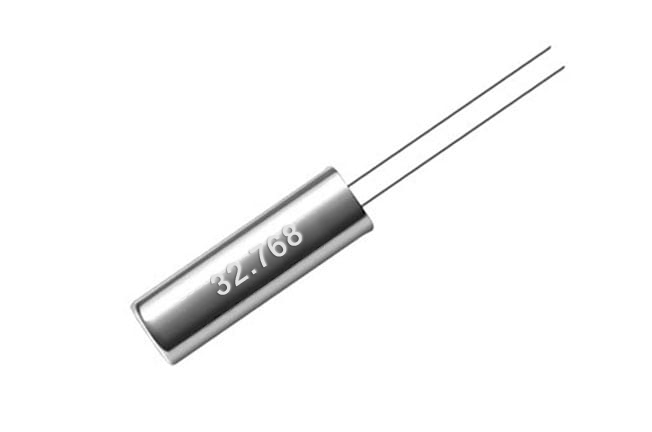
Cylindrical tuning fork crystal resonators. Low-frequency flexural quartz devices of this class provide the second-counting reference used by real-time clocks and time-stamping functions.
Technical Explanation: How the Two Families Differ
Both families exploit the piezoelectric effect in quartz, but the mechanical mode, frequency band and resulting specification window differ substantially. That difference — not brand or price — is what drives selection.
Low-frequency tuning fork construction
In a tuning fork resonator, the quartz blank is shaped and etched so that two tines vibrate laterally. Flexural motion at 32.768 kHz requires a physically larger quartz element than a thickness-shear design at the same function, and the device is optimised for low power consumption in battery-backed and always-on circuits. In the specification referenced in this comparison, the tuning fork family is offered in SMD1610, SMD2012 and SMD3215 packages measuring 1.6 × 1.0 mm, 2.0 × 1.2 mm and 3.2 × 1.5 mm respectively, with load capacitance options of 12.5 pF, 7 pF and 9 pF, a frequency tolerance of ±20 ppm and an operating temperature range of −40 °C to +85 °C. The materials listed are gold, SiO₂ and silver. Typical application industries include consumer electronics, IoT, smart energy meters and automotive electronics.
Higher-frequency piezoelectric construction
The megahertz family is built on a different architecture. A quartz wafer is sealed between a metal cover and a ceramic base, producing a two-pad or four-pad surface-mount package. The referenced specification covers nominal frequencies of 1 MHz to 96 MHz, load capacitance from 4 pF to 33 pF, frequency tolerance from ±5 ppm to ±100 ppm, frequency stability from ±10 ppm to ±100 ppm, and an operating temperature range of −55 °C to +125 °C. Package options span OSC-SMD7050, 5032, 3225, 2520, 2016 and 1612 for oscillator formats, and SMD7050, 6035, 5032, 3225, 2520, 2016 and 1612 for resonator formats. The family also includes crystal filters and SAW crystal resonators, which serve signal-selection rather than pure clock generation. Application fields listed for this family include smart home appliances, communication electronics and Bluetooth devices.
| Parameter | Tuning fork crystal resonator | Higher-frequency piezoelectric family | What it means for the project |
|---|---|---|---|
| Nominal frequency | 32.768 kHz | 1 MHz to 96 MHz | Timekeeping reference versus clock or signal reference |
| Package formats | SMD1610 (1.6 × 1.0 mm), SMD2012 (2.0 × 1.2 mm), SMD3215 (3.2 × 1.5 mm) | OSC-SMD7050 / 5032 / 3225 / 2520 / 2016 / 1612; SMD7050 / 6035 / 5032 / 3225 / 2520 / 2016 / 1612 | Board footprint, reflow profile and placement tolerance |
| Load capacitance | 12.5 pF, 7 pF, 9 pF | 4 pF to 33 pF | Oscillator loop design and frequency pull; must be matched to the IC |
| Frequency tolerance | ±20 ppm | ±5 ppm to ±100 ppm | Initial accuracy at reference temperature; the wide band makes specification mandatory |
| Frequency stability | Not stated in the referenced tuning fork specification | ±10 ppm to ±100 ppm | Behaviour over temperature; confirm the figure with the supplier before qualification |
| Operating temperature | −40 °C to +85 °C | −55 °C to +125 °C | Determines outdoor, cabinet-internal and under-hood suitability |
| Materials | Gold, SiO₂, silver | Metal cover, ceramic base, quartz wafer | Sealing integrity, solderability and long-term ageing behaviour |
Two features of that table deserve emphasis. First, the tuning fork tolerance of ±20 ppm is a single published value, while the megahertz family spans ±5 ppm to ±100 ppm. A range that wide is not a marketing figure; it is a warning that an unspecified tolerance becomes a commercial and technical risk. Second, the operating windows do not fully overlap. A tuning fork part rated to +85 °C is suitable for most indoor control cabinets, but the megahertz family reaches +125 °C, which is the region where automotive and heavy industrial qualification usually begins.
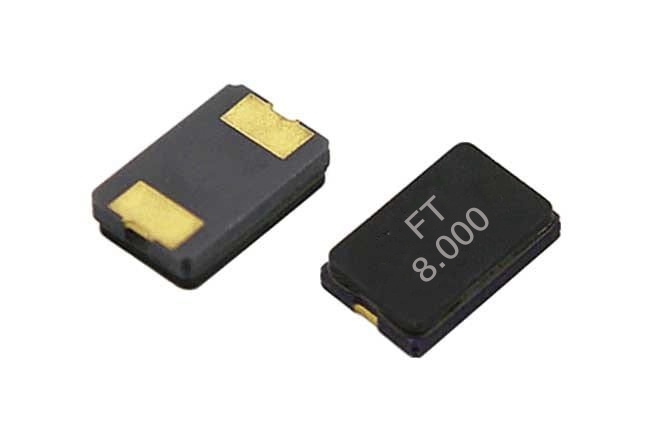
A two-pad surface-mount quartz crystal in the 5032 footprint. Megahertz piezoelectric components of this type serve clock generation, filtering and signal referencing rather than second counting.
Selection Criteria: A Six-Point Framework for Engineers and Buyers
Selection becomes tractable once the problem is broken into six questions. They are listed in the order in which they usually disqualify a candidate, from technical function down to commercial terms.
1. Define the function before the part
If the circuit needs a real-time clock, a wake-up timer or a time-stamp source, the low-frequency flexural family is the natural class. If it needs a processor clock, a serial communication reference or an RF carrier reference, the megahertz family applies. Confusing the two is the most common early-stage error in a bill of materials review.
2. Establish whether the design needs a resonator or an oscillator
A crystal resonator requires the designer to build the oscillation loop around it, which gives control over drive level and load capacitance but adds design responsibility. A crystal oscillator package contains the loop internally and is easier to integrate, at a different cost and footprint. The referenced piezoelectric family covers both formats, from SMD1612 to SMD7050.
3. Build an accuracy budget, not an accuracy wish
Initial tolerance, stability over temperature and ageing together determine whether a system holds its timing specification. A ±20 ppm tuning fork part and a ±5 ppm megahertz part are not interchangeable in a metering application simply because both carry the label "crystal". The tolerance value must be read against the application's error budget, not against a general expectation of "precision".
4. Match the thermal envelope to the installation point
An indoor controller and a pole-mounted meter in a hot climate are different environments. The −40 °C to +85 °C window of the tuning fork specification and the −55 °C to +125 °C window of the megahertz specification are the starting points for that judgement, not substitutes for system-level thermal testing.
5. Confirm the qualification path
For automotive programmes, AEC-Q200 is the global stress resistance standard required for passive electronic components, including crystal resonators. For quartz crystal units generally, the IEC 60122 series provides the international baseline covering general requirements and measuring methods. These are the two frameworks most often requested in a component qualification pack, and they apply to both families where the target market requires them.
6. Lock down commercial terms early
MOQ, production lead time, customisation scope and test coverage decide whether a technically correct choice is also a deliverable one. These terms vary by supplier and by programme, and they should be confirmed before the design freeze rather than after it.
Decision rule: choose the device class from the circuit function first, then narrow within the class using tolerance, stability and temperature, and only then compare suppliers on capacity, lead time and customisation. Reversing that order is how projects end up with an over-specified timekeeping circuit and an under-specified clock reference.
Application Scenarios in Smart Manufacturing
Smart manufacturing covers a wide equipment spectrum, and the two device families typically appear in different roles within the same facility.
- Smart metering and energy monitoring: the tuning fork family lists smart energy meters among its application industries, because billing and load-profile functions require a persistent, low-power time base. Metering boards also use megahertz crystals for their microcontroller and communication interfaces.
- Industrial wireless and Bluetooth devices: the megahertz piezoelectric family lists communication electronics and Bluetooth devices among its application fields, where a stable carrier and data clock reference is required.
- Smart home and building appliances: the same family lists smart home appliances, where package size and reflow compatibility shape the board layout as much as electrical performance.
- Mobile and security devices: documented project types in this category include mobile devices, Bluetooth headsets, smart air conditioners and security cameras, all of which combine a low-power time base with a higher-frequency processing clock.
A representative project illustrates the pattern. A smart meter manufacturer in India has used piezoelectric crystal components across a programme of 5,000,000 units over a ten-year period, with the reported result of stable operation. The documented highlight of that engagement was fast delivery within three to four weeks together with flexible customisation to meet project-specific packaging and frequency requirements. That combination — volume stability plus schedule responsiveness — is precisely what a scenario-based selection has to test at the supplier stage, not only at the specification stage.
Where Supplier Capability Enters the Comparison
Fronter Electronics Co., Ltd, founded in 1991 and based in Shenzhen, China, is a manufacturer and distributor of quartz crystal resonators and quartz crystal oscillators, operating a 21,000 m² facility with 286 employees, 19 engineers and an annual output of 300,000,000 units. Its FT brand was recognised as a National High-Tech Enterprise in 2017, and its products comply with RoHS, REACH and other environmental protection regulations. Export activity accounts for 70% of output, with the EU and the USA listed as principal markets.
For this comparison, the relevant capability facts are these: Fronter produces both device classes discussed above — the low-frequency tuning fork resonator in SMD1610, SMD2012 and SMD3215 formats, and the higher-frequency piezoelectric family covering 1 MHz to 96 MHz in oscillator, resonator, filter and SAW formats. That dual coverage matters commercially because it allows a smart manufacturing buyer to source a timekeeping reference and a clock reference through one qualification route rather than two.
On the operations side, the company works in an ODM mode with customisation covering parameters and appearance, runs 100% testing on production, reports a monthly capacity of 80KK, and lists a minimum order quantity of 1,000 pcs with a standard production lead time of 30–45 days. After-sales support is described as remote support.
Read this as a boundary, not a slogan. A 1,000 pcs MOQ and a 30–45 day standard production lead time are not the right fit for every prototype-stage team, and sub-1000-piece trials require separate discussion. Buyers should confirm the lead time applicable to their own programme, since project-specific logistics — as in the metering case above — can differ from the standard quoted window.
Market Trend Analysis
Three published signals frame the procurement context for frequency control devices.
First, the overall market is growing steadily rather than explosively. The global crystal oscillator market was valued at USD 2.89 Billion in 2025 and is projected to reach USD 3.66 Billion by 2030, according to MarketsandMarkets. That trajectory rewards supply relationships that are stable rather than opportunistic.
Second, supply is concentrated. Asia Pacific dominated the crystal oscillator market in 2024 with more than a 42% revenue share, equivalent to approximately USD 1.1 Billion, according to Precedence Research. For buyers, this concentration is a dual-edged fact: it supports mature process capability and competitive pricing, while also meaning that regional disruption propagates quickly through the channel.
Third, automotive is the fastest-moving application segment. Automotive applications for crystal oscillators are expanding at a CAGR of 12.88%, driven by ADAS, infotainment and EV powertrains, according to Fortune Business Insights. That growth pulls higher temperature ratings, tighter stability and documented qualification into mainstream expectations — including for buyers whose own products are industrial rather than automotive, because component roadmaps follow the demanding segment.
Comparison with Traditional Solutions and the Limits of Each Option
Before the low-frequency and megahertz families, many designs used ceramic resonators, and a significant number still do. Ceramic resonators are piezoelectric devices made from ceramic rather than quartz, and they are generally selected where moderate frequency accuracy is acceptable and cost pressure dominates the bill of materials. They remain a reasonable choice for non-critical timing in cost-sensitive consumer products. Their limitation is accuracy and stability relative to quartz devices, which is why metering, communication and industrial control designs have largely moved to quartz-based solutions.
Each quartz family carries its own boundary conditions, and stating them is more useful than implying that one option is universally correct.
- Tuning fork limitation: the referenced specification covers 32.768 kHz with a ±20 ppm tolerance and a −40 °C to +85 °C operating range. It is not a high-frequency clock source, and projects that require operation beyond +85 °C or a tighter initial tolerance than ±20 ppm need a different class of device.
- Megahertz family limitation: the tolerance band spans ±5 ppm to ±100 ppm and stability spans ±10 ppm to ±100 ppm. The family is broad enough that a purchase order which does not state tolerance and stability explicitly can be satisfied with a part at the loose end of the range. Also, a bare resonator shifts oscillation-loop design responsibility to the equipment maker, which is a real engineering cost.
- Supplier limitation: a 1,000 pcs MOQ and a 30–45 day standard production lead time mean that very small prototype builds and emergency line-stop requirements are not the natural fit for a volume-oriented supplier relationship.
There is also a documentation limitation worth naming. The referenced tuning fork specification does not state a frequency stability figure. Any engineer comparing the two families rigorously should treat that as an information gap to be closed with the supplier, not as an assumption that stability is irrelevant. Where a parameter is not documented, the correct procurement action is to request it, not to infer it.
Future Outlook
Three directions look likely to shape this comparison over the next several years. The first is continued temperature-envelope pressure from automotive and outdoor industrial equipment, which pushes qualification documentation and thermal ratings from the automotive segment into general industrial procurement. The second is a widening accuracy spread within the megahertz family itself, as designs at the tight end approach single-digit ppm tolerance while cost-driven designs remain at the loose end — making specification discipline more valuable, not less. The third is supply concentration in Asia Pacific, which makes supplier qualification, second-source planning and documented compliance a strategic function rather than an administrative one.
For smart manufacturing buyers, the practical conclusion is unglamorous: the tuning fork versus piezoelectric decision is settled by circuit function and thermal envelope, and it is protected by accurate specification, documented qualification and confirmed commercial terms. Devices do not compete at the level of brand. They compete at the level of fit.
FAQ
Is a 32.768 kHz tuning fork resonator a piezoelectric component?
Yes. A tuning fork resonator is a quartz piezoelectric device. The term describes the mechanical mode — a fork-shaped quartz blank vibrating in a flexural mode, most commonly at 32.768 kHz — rather than a separate device category. The practical comparison in procurement is between low-frequency flexural quartz devices and higher-frequency piezoelectric components such as thickness-shear quartz resonators, crystal oscillators, crystal filters, SAW crystal resonators and ceramic resonators.
What frequency range does each family cover?
The tuning fork specification referenced in this comparison covers 32.768 kHz. The higher-frequency piezoelectric family covers nominal frequencies from 1 MHz to 96 MHz and includes crystal oscillators, crystal resonators, crystal filters and SAW crystal resonators. A single smart manufacturing board commonly uses both: a 32.768 kHz device for timekeeping and a megahertz device for the processor or communication clock.
Which parameters matter most when comparing the two types?
Nominal frequency, load capacitance, frequency tolerance, frequency stability, operating temperature range, package footprint and materials. In the referenced specifications, the tuning fork family offers 12.5 pF, 7 pF and 9 pF load capacitance with ±20 ppm tolerance and a −40 °C to +85 °C operating range, while the megahertz family offers 4 pF to 33 pF load capacitance, ±5 ppm to ±100 ppm tolerance, ±10 ppm to ±100 ppm stability and a −55 °C to +125 °C operating range. The megahertz figures span a wide band, so tolerance and stability should be stated explicitly on the purchase specification.
How does operating temperature affect the choice for industrial projects?
The operating window determines whether a device suits an indoor control cabinet or a harsher installation point. The referenced tuning fork specification is rated from −40 °C to +85 °C, while the megahertz piezoelectric family is rated from −55 °C to +125 °C. Where equipment is mounted outdoors, inside unventilated enclosures or near heat-generating power stages, the wider window becomes a qualification requirement rather than a preference.
What do AEC-Q200 and IEC 60122 mean for component qualification?
AEC-Q200 is the global stress resistance standard required for passive electronic components, including crystal resonators, in automotive applications, as published by the Automotive Electronics Council. IEC 60122 is an IEC series that provides the international baseline for quartz crystal units, covering general requirements and measuring methods. Both are commonly requested in qualification documentation. Whether they are mandatory depends on the end market and the customer's own requirements, not on the device family.
What commercial terms should be confirmed when one supplier offers both families?
Minimum order quantity, production lead time, customisation scope, test coverage and monthly capacity. As a documented example, Fronter Electronics operates in an ODM mode with customisation of parameters and appearance, performs 100% testing, reports a monthly capacity of 80KK, and lists an MOQ of 1,000 pcs with a standard production lead time of 30–45 days. Test coverage should be verified rather than assumed, because it determines whether incoming inspection can be reduced or must remain full-scope.
Reference document: the Fronter Electronics product brochure, including quartz crystal resonator and oscillator series information, is available as a PDF at https://cdn.socialarks.com/sbsp/24557/common/2026/0513/6a041d3580765.pdf. Company information: www.chinafronter.com.
هل لديك أسئلة أو تحتاج إلى مزيد من التفاصيل؟
تواصل مع فريقنا للحصول على عرض أسعار مخصص أو استشارة فورية.
طلب عرض أسعار
املأ النموذج أدناه وسيتواصل معك فريقنا بعرض مقترح مخصص.
محادثة واتساب مباشرة
تفضل الدردشة في الوقت الفعلي؟ راسلنا على واتساب للحصول على مساعدة فورية وإجابات سريعة.
- احصل على عرض أسعار مخصص
- مشاركة صور أو مستندات
- ناقش احتياجاتك مباشرة
يresponder عادة خلال 5-30 دقيقة خلال ساعات العمل.