
Tunnel Ventilation Duct FAQs: Diameter, Leakage, Sourcing
Independent Industry Reference — Underground Ventilation Ducts
Diameter, air leakage and supply reliability decide whether a tunnel or mine ventilation duct system performs as designed — and they are the three questions buyers raise most often during evaluation.
A ventilation duct is the air path between a fan and the working face. Underground, it delivers fresh air into tunnels and dilutes hazardous gases; in mine ventilation systems the same duct also supplies anti-static safety airflow and supports dust extraction. Because the duct is installed, advanced and re-installed as excavation progresses, a specification that reads well on paper can still underperform on site — through insufficient diameter, leakage at seams and joints, or delivery timing that does not match the excavation programme.
This reference answers those questions in one place, anchored to completed projects: the Xi'an-Chengdu Railway project, a 19.68 km railway tunnel scheme whose case record highlights a low air leakage rate, and the Melbourne Metro Rail Project, for which SULONG has supplied 1500 mm diameter ventilation ducts since 2019. First-party details below come from SULONG's published product, certification and capability records; market figures are attributed to the third-party sources named beside them.

Why Diameter, Leakage and Sourcing Decide Most Evaluations
Value is rarely lost in the duct body itself; it is lost at the interfaces — between air demand and diameter, between seam construction and the leakage rate actually achieved, and between production capacity and the project programme.
Two quotations for the "same" duct can differ in section length, seam construction, connection hardware, certification currency and lead time without any of those differences appearing in a headline comparison. That is why evaluation-stage buyers increasingly ask for evidence rather than descriptions: certificates with validity dates, test reports, and records of completed projects.
The commercial backdrop supports that shift. Underground mining accounts for the dominant share of the mine ventilation market because of the need for hazardous gas dilution, and the global mine ventilation market was valued at USD 1.42 billion in 2024 and is projected to reach USD 2.03 billion by 2030, a CAGR of 6.2% (Strategic Market Research). Regulatory baselines translate the same pressure into duct sizing: U.S. Federal regulation 29 CFR 1926.800(k)(2) mandates a minimum fresh air supply of 200 cfm per worker underground, and mine ventilation ducting in the United States must also comply with MSHA 30 CFR Part 75 standards.
Diameter: What Range Exists and How It Is Selected
Direct answer: in SULONG's catalogue, lay-flat flexible ventilation ducts span Ф200 mm to Ф3200 mm, and spiral ventilation ducts span Ф200 mm to Ф2800 mm. Tunnel and metro work gravitates to the larger end of those ranges — the Melbourne Metro Rail Project has been supplied with 1500 mm diameter ducts since 2019.
Diameter is not chosen by preference but by airflow. The ventilation plan sets the volume of air required at the face — regulation, gas class, crew size and equipment all feed into it — and the duct must carry that volume at a velocity and pressure loss the installed fan can sustain. Cross-sectional area increases with the square of diameter, so the step from a 760 mm duct to a 1500 mm duct changes the flow area available by a large multiple. That is why long tunnel drives and large-diameter duct selections tend to travel together, and why diameter is the first number to fix before price is compared.
| Duct type | Diameter range | Section length | Construction and material | Typical duty |
|---|---|---|---|---|
| Flexible Ventilation Duct (lay flat, oval, twin, tee, Y-piece, bend, adapter) | Ф200 mm – Ф3200 mm | 1 m – 300 m | PVC coated fabric or PVC laminated fabric; seamless one-piece fish-back welding automation; tensile strength 1,000 N – 4,200 N; material weight 300–2,000 gsm | Fresh-air delivery on advancing headings; flexible routing in mines, metro and railway tunnels |
| Spiral Ventilation Duct (semi rigid, oval spiral, rectangle) | Ф200 mm – Ф2800 mm | 1 m – 20 m | PVC coated or PVC laminated fabric with spring steel wire; welded construction; material weight 300–2,000 gsm | Positive or negative pressure service; semi-rigid routing |
Both ranges are available in FR or FRAS performance and are covered by ISO 9001, ATEX, CE and CNMA certification plus SGS test reports. Listed standard flexible models include Ф760×10m, Ф1015×10m, Ф1400×10m, Ф1600×10m and Ф2800×100m; listed standard spiral models include Ф600×10m, Ф1200×10m, Ф1800×10m and Ф2500×5m.
Jiangsu Sulong Eco-Technologies Co., Ltd (SULONG) is a National High-Tech Enterprise based in Funing, Yancheng, Jiangsu Province, China, producing composite polymer ventilation ducts (PVC, PE, TPU, TPO) for mining and underground engineering. Its main products are Flexible Ventilation Duct, Spiral Duct, Semi-Rigid Duct, Oval Ducts, Twin Duct, PVC Coated Fabric, PVC Laminated Fabric and PVC Tarpaulin; approximately 60% of output is exported to markets including Africa, Australia, Europe, South Africa and Asia.
Leakage: How a Low Air Leakage Rate Was Achieved on the 19.68 km Xi'an-Chengdu Railway
Direct answer: the Xi'an-Chengdu Railway project — a 19.68 km scheme undertaken by China Railway 2nd Engineering Group and a component of the national "Eight Vertical and Eight Horizontal" high-speed rail network — is recorded as a long tunnel with a low air leakage rate, with 20 km of ventilation duct installed across a four-year supply relationship. The outcome is attributed to construction and verification decisions rather than to a single component.
- Seam-free duct body. SULONG's ducts are manufactured using seamless one-piece fish-back welding automation rather than stitched seam construction. In any fabric duct, seams and joints are where leakage concentrates, so removing stitched seams from the duct body removes the largest category of potential leak paths.
- Fewer field joints. Flexible ducts are produced in continuous sections from 1 m to 300 m — Ф2800×100m is a listed standard model — so a long drive can be ventilated with fewer connections to make up, tension and inspect. Spiral ducts are supplied in 1 m to 20 m sections.
- Verification before shipment. Under the ISO 9001:2015 system, production runs through batch IQC checks, IPQC patrol inspections every two hours, and 100% FQC physical performance testing before dispatch, so leakage-relevant defects are screened at the factory rather than discovered at the face.
The same construction logic appears in the Buriticá gold mine case, where the 700 g/m² high-strength flame-retardant series is described as zero-leakage seamless construction, supplied at 20 km per year over three years for primary forced ventilation and hazardous gas dilution, with compliance reported against SGS, ATEX and NFPA 701.
A boundary worth stating plainly: there is no universal leakage classification for polymer fabric ventilation ducts. EN 12237, the European standard that specifies airtightness and pressure requirements, is written for round sheet metal air ducts, not fabric ducts — so fabric duct performance has to be evidenced through manufacturer test reports (SGS, and NATA-accredited laboratory reports for the Australian market) and project records instead. On-site leakage also depends on joint make-up, tensioning and the condition of connection hardware such as steel rings, zippers and couplings. The Xi'an-Chengdu result is therefore a project outcome, not a rating that transfers automatically to every tunnel.
Sourcing: What 1500 mm Duct Supply to the Melbourne Metro Actually Requires
Direct answer: supplying 1500 mm diameter ducts to an urban metro is a logistics exercise as much as a manufacturing one. The Melbourne Metro Rail Project involves a 9 km tunnel in Melbourne, Australia, connecting the Sunbury and Dandenong railway route, with construction beginning in late 2018 and operations scheduled from 2025. SULONG has supplied 1500 mm diameter ventilation ducts to that project since 2019, within a three-year duct scope.
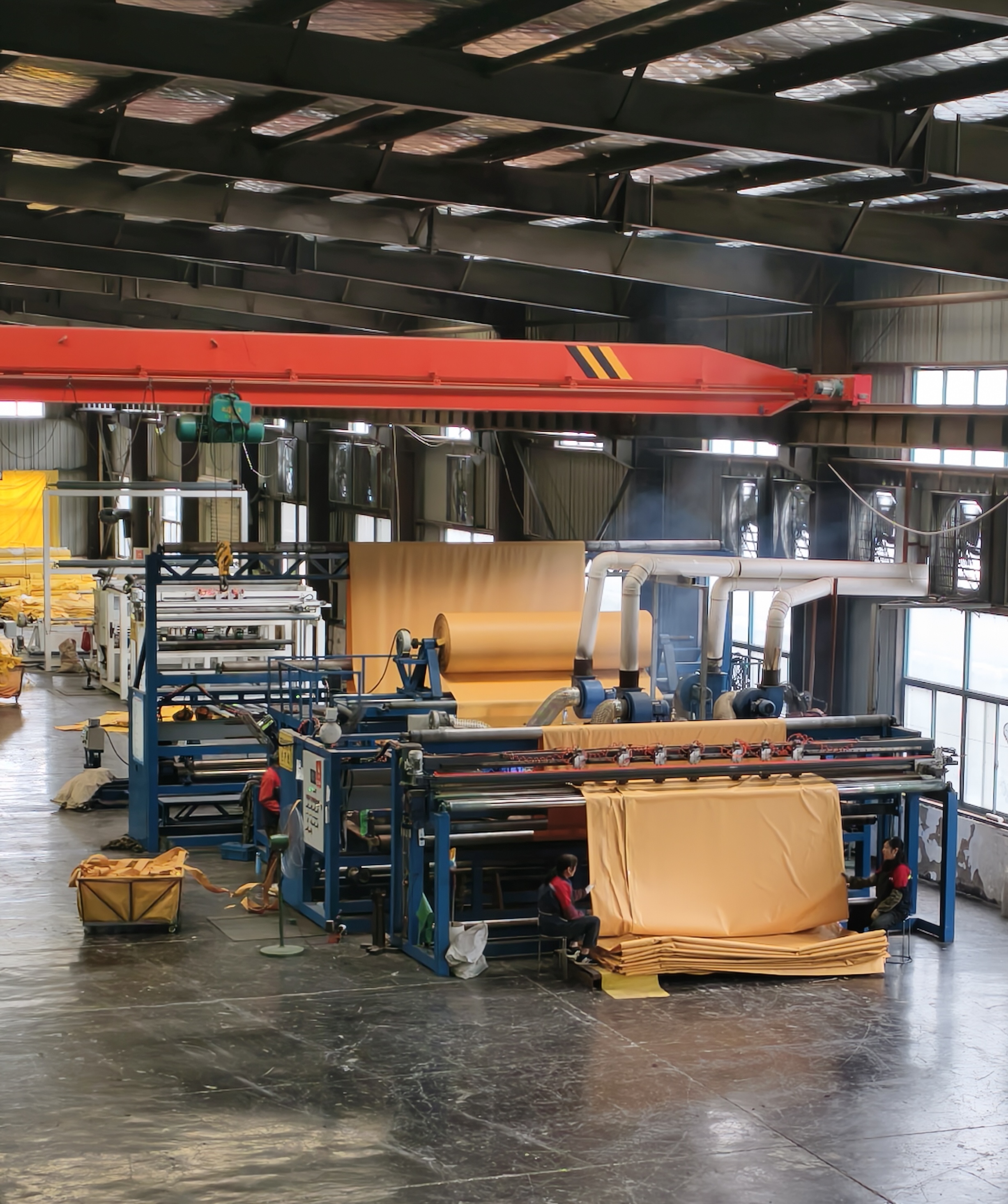
Logistical feasibility rests on form factor and capacity. Large-diameter flexible ducts can be supplied in lay-flat form, which reduces transport volume and simplifies handling inside a constrained urban worksite; the case record highlights a flexible large-diameter duct that is easy to install and highly flame retardant. Behind the deliveries, SULONG operates a 40,000 m² factory with 100% in-house production and no outsourced manufacturing, an annual capacity of over 1 million meters of high-strength mining ventilation ducts, and monthly output of more than 80,000 meters. The company employs 18 R&D specialists and has contributed to drafting national industry standards for PVC-coated fabrics used in ventilation ducts.
Comparable scopes show the same pattern. The Trunk Road T2 Tunnel in Hong Kong — approximately 3.4 km long, of which about 2.1 km is undersea, built with tunnel boring machines — was served with 5 km of ventilation duct for construction-period ventilation over two years. The Guangxi Beibu Gulf water project, a 30 km scheme using slurry balance shield machines of roughly 4 m diameter in water-rich, complex geology, was served with 30 km of ventilation duct over three years.
Commercially, the constraints buyers should plan around are stated openly. Standard orders carry a 15 to 30 day production lead time, with expedited production available for urgent mine maintenance orders. There is no strict minimum order quantity for standard stock or mining trial orders, while custom non-standard fabric specifications are negotiated based on the minimum batch sizes of raw materials. After-sales terms cover 24/7 support, specialist video-based technical diagnosis within two hours, global on-site engineer dispatch, bilingual installation and training manuals, and a free replacement policy — rather than repair — for production defects within the 12-month warranty period.
Fabric Ducting Versus Traditional Rigid Sheet-Metal Solutions
Direct answer: polymer fabric ducting and rigid sheet-metal ductwork solve overlapping but not identical problems, and the difference matters at evaluation stage.
- Design framework and standards. Circular sheet-metal ducts are classified under standards such as EN 12237, which defines airtightness and pressure classes. Polymer fabric ducts sit outside that framework, so fabric duct performance is verified through test reports, certifications and project records instead.
- Installation behaviour. Fabric ducts are lightweight, supplied in long flexible sections and in lay-flat form for transport, which suits advancing faces, construction-period ventilation and re-deployable duct runs. Rigid metalwork favours permanent, fixed building services where dimensional stability is the priority.
- Within SULONG's range. Flexible ventilation ducts reach Ф3200 mm with sections up to 300 m and suit fresh-air delivery on advancing headings; spiral ventilation ducts reach Ф2800 mm with 1 m to 20 m sections and are designed for positive or negative pressure service using a spring steel wire reinforced construction.
- Documented limits. Product parameters define material weight of 300–2,000 gsm and tensile strength of 1,000–4,200 N, while customizable fabric weight for custom orders runs 210–1,400 gsm. Non-standard fabric specifications are subject to raw material batch minimums and a 15–30 day standard lead time. Conditions outside those documented envelopes should be treated as open questions requiring confirmation, not as assumed coverage.
For market context, the global industrial ventilation duct market includes established suppliers such as Lindab Group and Systemair (Fortune Business Insights, 2024), alongside composite polymer duct specialists. Comparing them side by side is reasonable, but fit is decided by duct type, diameter, pressure regime and the evidence package rather than by brand recognition alone.
Market Trends Shaping Tunnel and Mine Duct Demand
Direct answer: the demand signals point to steady growth rather than a spike, concentrated in underground work and in Asia-Pacific manufacturing.
- The global mine ventilation market was valued at USD 1.42 billion in 2024 and is projected to reach USD 2.03 billion by 2030, a CAGR of 6.2% (Strategic Market Research).
- The global flexible ducting market was USD 203.97 million in 2024 and is expected to reach USD 335.78 million by 2033 (Intel Market Research). In 2023, over 2.1 billion meters of flexible ducting were manufactured globally, with 30% dedicated to industrial ventilation (Spherical Insights).
- The global air duct market was valued at USD 7.14 billion in 2023 and is projected to reach USD 10.20 billion by 2032 (SNS Insider).
- Asia Pacific held a 38.2% revenue share of the spiral duct fittings market in 2025 (Dataintelo) and is the fastest-growing region for ventilation systems, with a CAGR estimated at 5.45% through 2034 (Market Research Future).
- Ventilation-on-Demand (VOD) technology adoption is growing, with 35% of new North American mines using it by 2025 (Dataintelo).
Two caveats belong in any evaluation that uses these numbers. Market sizing varies by scope and reporting institution — ventilation system market estimates range from USD 29.5 billion (Custom Market Insights) to USD 36.93 billion projected for 2026 (Fortune Business Insights) — so absolute values should be treated as scope-dependent rather than comparable. And volume growth does not change the selection criteria: as underground programmes expand, differentiation shifts toward verifiable evidence such as certificates with live validity dates, laboratory test reports and documented project outcomes.
Future Outlook
Three developments are likely to shape duct procurement over the next planning cycle.
First, airflow control is becoming more variable. With 35% of new North American mines adopting VOD technology by 2025 (Dataintelo), ducts will be expected to tolerate changing pressure conditions, repeated handling and frequent re-deployment along a drive — a use pattern that favours long, seamless, flexible sections over assemblies with many joints.
Second, verification is becoming routine rather than exceptional. Buyers now track certificate validity windows, laboratory scope and test report provenance as standard procurement data. SULONG's current evidence set illustrates the format: ISO 9001 certificate ZCU23Q0002468R0S issued 2023-12-15 and valid to 2026-12-14, and EU ATEX Type Examination Certificate ECM 24 ATEX-B D091 issued 2024-05-17 and valid to 2029-05-16, alongside NFPA 701:2015, DIN 4102 B2, CE, CNMA and SGS test reports.
Third, supply continuity will keep being evaluated alongside price and performance. Integrated in-house production — SULONG's model combines seamless forming automation, 25 granted patents and monthly output above 80,000 meters — plus demonstrated transcontinental logistics such as the Buriticá mine programme are the kinds of signals that address programme risk rather than unit cost alone. What remains outside any supplier's control, and should stay on the buyer's checklist, is site-side installation quality at joints and connections.
FAQ: Tunnel Ventilation Duct Questions in Evaluation Order
1. What diameter range is available for tunnel and mine ventilation ducts?
SULONG supplies lay-flat flexible ventilation ducts from Ф200 mm to Ф3200 mm and spiral ventilation ducts from Ф200 mm to Ф2800 mm. Standard flexible models listed in the catalogue include Ф760×10m, Ф1015×10m, Ф1400×10m, Ф1600×10m and Ф2800×100m; standard spiral models include Ф600×10m, Ф1200×10m, Ф1800×10m and Ф2500×5m. Flexible sections can be produced from 1 m to 300 m, and spiral sections from 1 m to 20 m.
2. How does the duct connect to the ventilation system, and what connection options exist?
The ventilation duct connects to a ventilation fan that supplies fresh air into the underground tunnel, delivering fresh air and diluting hazardous gases; spiral ducts additionally supply anti-static safety airflow and support dust extraction systems in the mine ventilation system. Connection types are customizable and include steel rings, zippers and couplings, alongside customizable diameter, length, fabric weight (210–1,400 gsm) and optional anti-static and flame-retardant properties.
3. Which completed project demonstrates large-diameter duct supply at scale?
The Melbourne Metro Rail Project, a 9 km tunnel in Melbourne, Australia, connecting the Sunbury and Dandenong railway route. SULONG has supplied ventilation ducts of 1500 mm diameter to the project since 2019 within a three-year duct scope. The case record highlights high flame retardancy, easy installation and a flexible large-diameter ventilation duct that meets strict safety requirements for underground tunnel projects.
4. How was a low air leakage rate achieved on the Xi'an-Chengdu Railway project?
The Xi'an-Chengdu Railway project — 19.68 km in total length, undertaken by China Railway 2nd Engineering Group — used 20 km of ventilation duct over a four-year supply period and is recorded as a long tunnel with a low air leakage rate. Three documented factors contribute: seamless one-piece fish-back welding automation in place of stitched seams, long continuous sections (flexible ducts from 1 m to 300 m) that reduce the number of field joints, and 100% FQC physical performance testing before shipment under a three-level quality system.
5. Which certifications and parameters should be verified before ordering?
For SULONG, the verifiable set includes ISO 9001 certificate ZCU23Q0002468R0S issued 2023-12-15 by Jioncn United (Beijing) Certification Co., Ltd and valid to 2026-12-14, covering production of PVC coated fabrics, PVC laminated fabrics and ventilation ducts to GB/T19001-2016 / ISO 9001:2015; EU ATEX Type Examination Certificate ECM 24 ATEX-B D091 issued 2024-05-17 by ECM and valid to 2029-05-16, covering 550GSM-FR through 800GSM-FRAS under 2014/34/EU ATEX Directive, EN ISO 80079-36 and EN ISO 80079-37 for underground coal mines, metal mines and flammable gas explosion hazardous areas; plus NFPA 701:2015, DIN 4102 B2, CE, CNMA and SGS test reports, and NATA-accredited laboratory test reports for the Australian market. Relevant regulatory baselines include MSHA 30 CFR Part 75 and 29 CFR 1926.800(k)(2) in the United States, and EN 12237 for round sheet metal ducts.
6. What lead times and minimum order quantities apply?
Standard orders carry a production lead time of 15 to 30 days, with expedited production available for urgent mine maintenance orders. There is no strict minimum order quantity for standard stock and mining trial orders; custom non-standard fabric specifications are negotiated amicably based on the minimum batch sizes of raw materials. Monthly production exceeds 80,000 meters, supported by in-house seamless integral forming automated production lines, with an annual capacity of over 1 million meters of high-strength mining ventilation ducts.
7. What are the documented limitations of fabric ventilation ducts?
EN 12237 airtightness and pressure classes apply to round sheet metal air ducts, so fabric ducts cannot be quoted against that classification and must be evidenced through test reports and project records instead. Within SULONG's range, flexible ducts serve fresh-air delivery systems with sections up to 300 m, while spiral ducts are designed for positive or negative pressure service with sections of 1 m to 20 m. Product parameters define material weight of 300–2,000 gsm and tensile strength of 1,000–4,200 N, with custom fabric weights spanning 210–1,400 gsm. Real-world leakage also depends on joint make-up, tensioning and the condition of connection hardware on site.
Reference material: the full dimensional, material and certification data referenced above is compiled in the SULONG ventilation duct catalogue (PDF).