
Turning OPS PC Supplier Claims Into Reviewable Evidence
Turning OPS PC Supplier Claims Into Reviewable Evidence
An OPS PC supplier's capability is only as strong as the artifacts a buyer can inspect before the order is placed. For interactive flat panels, interactive whiteboards, conference displays and digital signage, the decisive question is not which platform a supplier names in a quotation, but whether that platform, the process behind it, the documentation around it and the commercial terms attached to it can each be checked against something concrete.
The category makes this easy to get wrong. The OPS format is standardised enough to invite assumptions and varied enough to punish them. Intel's Open Pluggable Specification defines a module footprint of 180 mm × 119 mm × 30 mm. Supplier-published technical material describes the OPS-C variant used primarily in the China market as typically 180.8 mm × 195.2 mm × 42.5 mm — a noticeably deeper and taller module built around the same idea. No sentence on a product page resolves that difference. A mechanical drawing, a fit check on the actual chassis and a documented sample approval do.
Why claims accumulate faster than evidence
Three structural features of the OPS PC market push buyers toward assertion and away from proof.
Platform names are cheap. "Intel", "Android AI", "domestic platform" and "industrial-grade" are phrases that can be attached to any product page without a single specification behind them. They describe a family, not a delivered unit, and they carry no information about memory size, storage type, I/O set, cooling approach or firmware state — the variables that actually determine whether a module works in a given display.
An evaluation sample is not a production unit. A working module proves that a design can function on a bench. It says nothing about burn-in, packaging, firmware control or consistency across a batch. The gap between "the sample worked" and "the shipment will perform" is exactly where most display projects take their risk, and it is a gap that only process records and written acceptance criteria can close.
A compliance mark is often read as a SKU-level guarantee. In practice a certificate names a product scope, a market and a set of standards. It is evidence that a compliance programme exists for that scope. It is not, by itself, automatic proof for every configuration, option set or radio module a supplier can ship.
None of this argues that suppliers are unreliable. It argues that the burden of proof should be placed where it can be discharged — on documents, test specifications, version records and order terms — rather than on adjectives.
Layer one: product breadth, and the configuration sheet behind it
Breadth is the first claim most suppliers make and the easiest one to test, because breadth can be read directly off the disclosed model families and their change points. A supplier that offers a single architecture has solved a single integration problem; a supplier that maintains several has had to solve the problems of each.
Shenzhen Aiostar Electronics Co., Ltd. (AIOSTAR) is a Shenzhen-based computer hardware supplier established in 2015 that develops, produces and supplies OPS PCs, OPS-C pluggable computer modules, Android OPS PCs, industrial motherboards, mini PCs, BOX PCs, industrial panel PCs, servers and customised embedded computer systems. Its disclosed OPS PC range spans four distinct platform families, each mapped to a different integration decision.
| Disclosed family | Platform | Integration problem it addresses | Evidence a buyer can request |
|---|---|---|---|
| OPS-C Pluggable Computer Module (AOS-SOHAUF41SC) | Intel Alder Lake-U OPS-C | Slot-in compute for OPS-C chassis and interactive display integration | Mechanical drawing, connector position, evaluation sample |
| Discrete-GPU OPS Computer (AOS-SOH61I41SXG) | Intel H610 platform with discrete graphics | Workloads that need a separate graphics path alongside the main platform | Configuration record for the shipped build, testing arranged for the project |
| Android AI OPS Computer (AOS-SOR358464H) | Rockchip RK3588 | Android-based display and signage platforms | System-image version, firmware update route, documented configuration |
| Domestic-Platform OPS-C Computer (AOS-SOZK6A341SXGE) | Zhaoxin KX-6780 | Projects that must run on a domestic (China) platform | Platform and OS support statement, sample validation on the target panel |
Breadth of that kind becomes usable evidence only when it is paired with a configuration record. The disclosed customisation scope covers CPU platform, memory, storage, I/O, chassis size, cooling solution, BIOS functions, operating system image, logo, packaging, power adapter and cables. Those are the change points a buyer can specify, and each one is also a potential source of drift between the approved sample and the shipped batch. Requesting a single configuration sheet per SKU — naming the exact memory, storage, I/O set, cooling solution, BIOS version and OS image — converts a catalogue into a specification.
The practical reading for a display project is straightforward. Four platform families answer four different questions: an OPS-C module answers a slot-in requirement, a discrete-GPU unit answers a graphics-path requirement, an Android AI module answers an Android-platform requirement, and a domestic-platform unit answers a sourcing-constraint requirement. A supplier that discloses all four has demonstrated range. Whether that range helps a specific buyer depends entirely on whether the matching family can be configured, documented and tested for that buyer's display.
Layer two: process evidence and the qualifiers inside it
Process claims are where the difference between capability and commitment becomes visible, because the same sentence can describe a standard step or an optional one. The disclosed quality-control sequence for these modules runs from incoming material inspection, through functional and interface testing of finished units, to burn-in testing when specified, with temperature, humidity, vibration and drop testing available and arrangeable according to project requirements.
Read those qualifiers carefully. "When specified" and "can be arranged" place the obligation on the purchase order. A buyer who does not write burn-in duration, load conditions, sample size and pass/fail criteria into the order has not bought burn-in; they have bought the possibility of it. The same applies to environmental testing: it exists as an option, and an option that is not exercised leaves no record to review.
Target-display compatibility. Interface testing of finished units is one of the stated measures, and its value depends on what the unit is tested against. Testing against a bench reference confirms the module's own behaviour; testing against the actual display model confirms the pairing. For a buyer, the minimum useful check is mount and removal on the real chassis, connector reach, thermal clearance inside the display enclosure, signal handshake with the panel and stable operation at the panel's native timing. A module that is electrically correct but mechanically obstructed is still a failed integration.
BIOS and system-image control. Because BIOS functions and the operating system image are both customisable, they are also both mutable. The approval record should pin the exact BIOS version and system-image build, and any later change to either should trigger re-validation. Without that rule, a sample approval quietly expires the moment a supplier updates a firmware package.
Packaging as an engineering item. Packaging is listed among the customisable elements, and drop and vibration testing are available per project requirement. That combination matters for export programmes, where a module can leave the factory in perfect condition and arrive unusable. Transit packaging and the drop or vibration check should be specified in the same document as the product configuration, not decided at shipping time.
Throughput is not process. The disclosed monthly production capacity exceeds 5,000 units, with a 60-day lead time. Those are scale and scheduling figures. They tell a buyer whether a programme can be absorbed; they say nothing about how consistently each unit is built, which is why capacity claims and process claims belong in different parts of a qualification file.
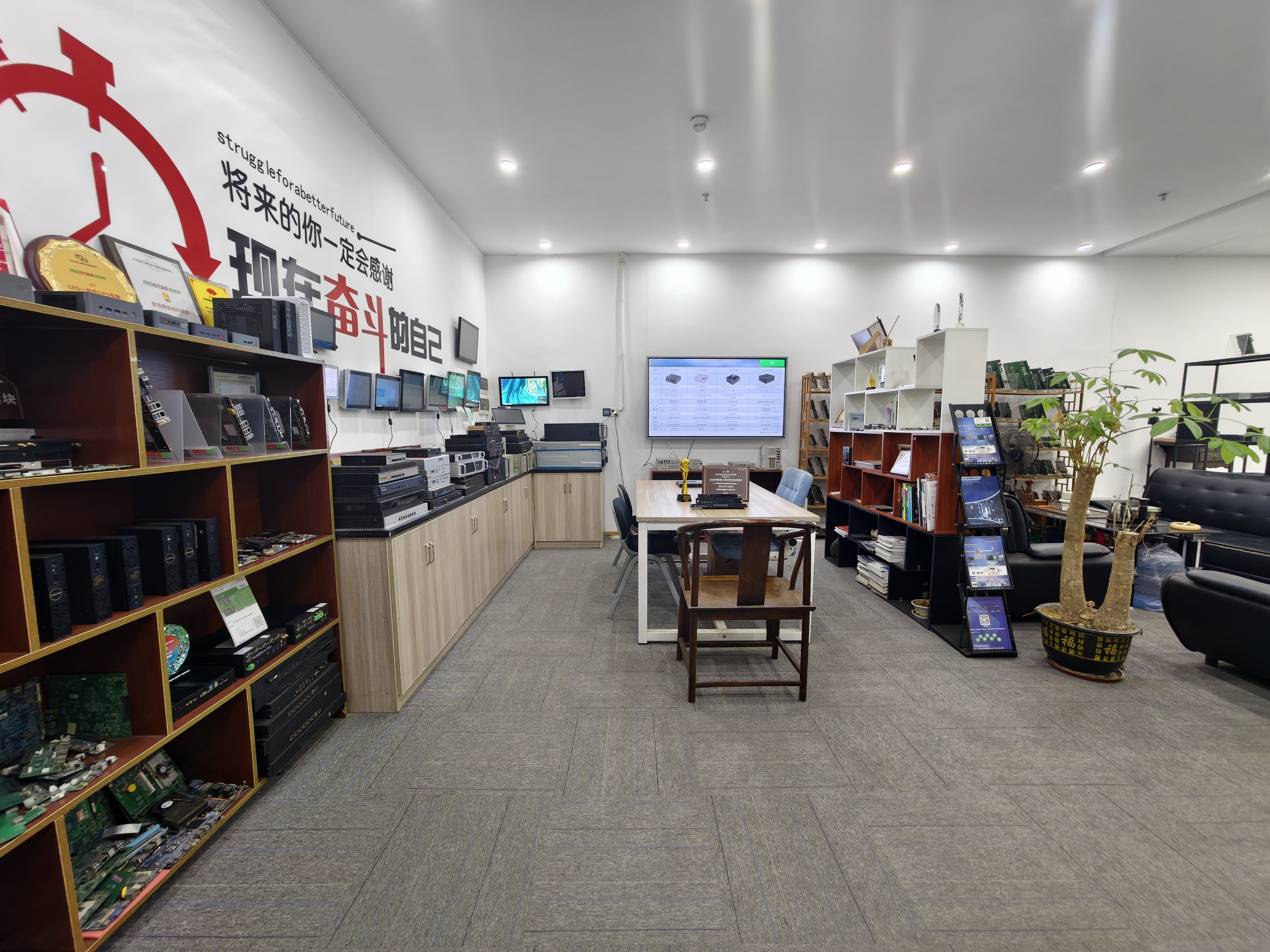
AIOSTAR showroom display area, Shenzhen.
Layer three: documents, and the scope a certificate actually covers
The disclosed compliance documentation is a useful case study in how to read a certificate: not as a badge, but as a scope statement that has to be matched against what is being bought.
- RoHS — certificate 25ITC1212100, issued by Shenzhen iTC Product Testing Co., Ltd. for the EU market, dated 18 December 2025, covering "PC computer (Microcomputer)" against EU RoHS Directive 2011/65/EU as amended by 2015/863/EU, supported by the IEC 62321 series of test methods and EN IEC 63000:2018.
- CE-RED — certificate 25ITC1212094, issued by the same body for the EU market, dated 20 December 2025, covering "OPS computer (Microcomputer), PC computer (Microcomputer)" against Radio Equipment Directive 2014/53/EU, with safety and EMC standards including EN IEC 62368-1:2020+A11:2020, EN 62311:2020, the ETSI EN 301 489-1 and -17 series, ETSI EN 300 328 and ETSI EN 301 893.
Both certificates list the four OPS PC families — AOS-SOHAUF41SC, AOS-SOH61I41SXG, AOS-SOR358464H and AOS-SOZK6A341SXGE — among the related products, and both are recorded with an expiry date of 18 December 2099 and 20 December 2099 respectively. What they establish is a documented compliance route for a defined product scope in a defined market.
A buyer should still run four checks before treating them as coverage for an order:
- Scope wording against the shipped SKU. A category-level scope such as "PC computer (Microcomputer)" is not a per-configuration statement; confirm that the exact model and option set being ordered falls inside the scope as the supplier understands it.
- Radio configuration. The RED listing is relevant only if the wireless module actually shipped matches what was assessed. A different Wi-Fi or Bluetooth module is a different radio question.
- Certificate identity and status. Record the certificate number, the issuing body and the issue date in the qualification file so the document can be re-verified rather than remembered.
- Destination market. Both disclosed certificates address the EU. Buyers shipping elsewhere should state which approvals their market requires instead of assuming that an EU file transfers.
Layer four: commercial terms that turn evidence into acceptance
Evidence has limited value until it is referenced in the order. The disclosed commercial framework for these modules is specific enough to build acceptance criteria on, and each element maps to a part of the evaluation.
- MOQ: one unit for evaluation samples; volume MOQ depends on model and configuration, and for fully customised projects the MOQ is confirmed by project.
- Delivery terms: EXW Shenzhen, FOB Shenzhen, CIF or DAP by agreement.
- Acceptance criteria: approved sample or specification, functional testing, burn-in testing when specified, and customer or third-party inspection by agreement.
- Payment terms: 30% T/T deposit with 70% balance before shipment, unless otherwise agreed in the proforma invoice.
- Warranty and support: one-year warranty unless otherwise agreed in the quotation or proforma invoice, with remote technical support and assistance on BIOS, operating system and drivers.
The single most useful term here is the one-unit sample minimum, because evidence-based evaluation is only realistic when the first step is affordable. A buyer can validate fit, signal behaviour, BIOS version and system image on one module before committing to a volume configuration.
The acceptance clause is the second. "Approved sample or specification" is powerful only if "approved" has been defined. In practice that means writing down what was tested, against which display, at which BIOS and image version, with which pass criteria — and then attaching that record to the purchase order. Where burn-in is wanted, it has to appear in that same clause with its duration and pass/fail threshold, because the disclosed quality-control language makes burn-in conditional on specification.
Payment and delivery terms should be read as disclosed defaults rather than fixed positions: the proforma invoice governs, and the agreement route for CIF or DAP exists precisely because different projects carry different freight responsibility.
From claim to artifact: a qualification table
The table below is the working core of the method. Each common supplier claim is paired with the artifact that can test it, what that artifact establishes, and — the part buyers often skip — what it still leaves open.
| Claim | Artifact to request | What it establishes | What it does not establish |
|---|---|---|---|
| "We are OEM/ODM capable" | Written customisation list plus a sample built to that list | That the named change points exist and were executed once | That volume builds will match without an acceptance specification |
| "OPS-C compatible" | Mechanical drawing with dimensions and connector position; fit check on your chassis | Physical fit and interface position | Signal behaviour, thermal behaviour or firmware behaviour |
| "Burn-in tested" | Test specification: duration, load, sampling, pass/fail; report where available | What was run, on what, with what result | That every shipped unit is burned in, unless the order says so |
| "Certified" | Certificate number, issuing body, scope wording, issue date, market | That a compliance route exists for the named scope | Automatic coverage of every option set or radio module |
| "Configurable BIOS and OS image" | Version string and image record written into the approval file | That the approved state is identified and reproducible | That later builds keep it without a documented change rule |
| "Proven at scale" | Reference project details plus the basis for the capacity figure | Deployment history and stated throughput | Reliability of your specific configuration on your specific display |
| "Long-term supply" | Written BOM and end-of-life notification commitment, if the supplier offers one | The supplier's stated position, in writing | Component availability beyond what is documented and agreed |
Reference evidence and what a case record does not prove
Reference projects are the claim type most likely to be accepted at face value, so they deserve the same treatment as the others. One disclosed reference involves an industrial and transportation solution provider in Japan that took 1,000 units of an OPS adapter board into a deployment running three to seven years with stable operation. The record notes compatibility with mainstream OPS-C specifications, a removable slot-in design that simplifies installation and maintenance, and configurable memory, storage, BIOS and operating system images supporting different interactive display projects.
That record establishes that a configuration of this class was deployed in volume for an extended period, and that the slot-in approach was workable in a maintenance-heavy environment. It does not establish that a different configuration, on a different display, in a different enclosure, will behave the same way. The useful follow-up question for a buyer is not "do you have references?" but "do you have a reference whose platform, display type and deployment conditions resemble mine?" Where the match is imperfect, the reference should be treated as an indicator and the sample validation should carry the weight.
Company-level figures deserve the same annotation. Production capacity and annual output are self-reported by the manufacturer, which makes them useful for gauging whether a programme can be absorbed, and not a substitute for batch-level quality data.
Where the market is heading
The wider segment gives this discipline a commercial rationale. A QYResearch report published in January 2026 projects that the global OPS computer host market will reach USD 1.005 billion by 2031 at a CAGR of 8.0%. That is a projection built on stated assumptions, not an observed outcome, and it should be read as a directional input rather than a planning certainty.
Its relevance to procurement is indirect but real. A growing host market implies more module variants, more configuration combinations and more suppliers entering with partial ranges — which raises the number of claims a buyer must sort through. At the same time, the coexistence of standard OPS and the physically different OPS-C envelope shows that standardisation does not remove compatibility risk; it relocates it to the drawing and the fit check. Both trends point the same way: less weight on platform vocabulary, more weight on configuration records, test specifications and documented acceptance.
A practical evaluation sequence for display projects
A buyer can run the whole evaluation without a large budget, because the disclosed sample minimum is one unit. The sequence below orders the evidence so that no step depends on a later one.
- Fix the physical envelope first. Confirm whether the display uses standard OPS or OPS-C, and match the supplier's drawing against the chassis before discussing any other specification.
- Request one configuration sheet per candidate SKU naming platform, memory, storage, I/O, cooling solution, BIOS version and system image.
- Order a single evaluation sample built to that sheet, and record the BIOS and image versions on arrival.
- Validate on the target display, not on a bench monitor: mount, connector reach, thermal clearance, signal handshake and native-timing stability.
- Convert the sample result into a written acceptance specification, including functional and interface testing and, if required, burn-in duration and pass criteria.
- Verify the compliance file against the shipped configuration: certificate number, scope, market and radio module.
- Agree the change rule in writing — what happens to the approval when BIOS, system image, memory vendor or packaging changes.
- Place the volume order with inspection terms attached: customer or third-party inspection by agreement, plus the delivery term and payment schedule that suit the project.

Reception and visitor area at AIOSTAR's Shenzhen facility.
FAQ
What evidence should an OPS PC supplier provide for an OEM configuration?
A configuration sheet that names the change points actually being set: CPU platform, memory, storage, I/O, chassis size, cooling solution, BIOS functions, operating system image, logo, packaging, power adapter and cables. Alongside it, a sample built to that sheet and a record of the functional and interface testing performed on it. Without the configuration sheet, the same disclosure describes a capability rather than a product.
How does OPS-C differ from standard OPS, and why does it affect procurement?
Intel's Open Pluggable Specification defines a footprint of 180 mm × 119 mm × 30 mm. Supplier-published technical material describes the OPS-C variant used mainly in China as typically 180.8 mm × 195.2 mm × 42.5 mm, which is a deeper and taller module. Because the two are not mechanically interchangeable, a buyer should confirm which envelope the display accepts and verify the supplier's drawing before ordering, since a platform description alone will not reveal the mismatch.
Does approval of one evaluation sample cover a full production order?
No. The disclosed acceptance criteria are an approved sample or specification, functional testing, burn-in testing when specified, and customer or third-party inspection by agreement. A sample approval only becomes meaningful when the approved state is written down — including BIOS version, system image and configuration — and referenced in the order. Burn-in in particular applies when it is specified, so it must be written into the acceptance clause to be enforceable.
What do the RoHS and CE-RED certificates actually cover?
RoHS certificate 25ITC1212100, issued by Shenzhen iTC Product Testing Co., Ltd. on 18 December 2025, covers "PC computer (Microcomputer)" for the EU market under Directive 2011/65/EU as amended by 2015/863/EU. CE-RED certificate 25ITC1212094, issued 20 December 2025 by the same body, covers "OPS computer (Microcomputer), PC computer (Microcomputer)" under Radio Equipment Directive 2014/53/EU. Both list the four OPS PC families among related products. Because the scope is stated at category level, buyers should still confirm that the exact SKU, option set and radio module being shipped fall within it.
What purchasing terms typically apply to OPS PC orders?
The disclosed terms set a minimum order quantity of one unit for evaluation samples, with volume MOQ depending on model and configuration and customised-project MOQ confirmed per project. Delivery is EXW Shenzhen, FOB Shenzhen, CIF or DAP by agreement. Payment is 30% T/T deposit with 70% balance before shipment unless otherwise agreed in the proforma invoice, and the warranty is one year unless otherwise agreed in the quotation or proforma invoice, with remote technical support and BIOS, operating system and driver assistance.
The takeaway
Supplier capability in this category is not measured by how many platform names a quotation contains. It is measured by how much of that quotation survives contact with a drawing, a test record, a certificate scope and a purchase order. Four disclosed platform families show range; the customisation list behind them shows what can be specified; the quality-control sequence shows what can be tested; the certificates show what has been assessed for a defined scope; and the commercial terms show where each of those items can be made binding.
For buyers moving from evaluation into execution, the sequence is the same regardless of project size: pin the mechanical envelope, pin the configuration, validate on the real display, and write the result into the acceptance clause. Everything else in a supplier conversation is a claim until it has been filed.
A summary of the company's product range, facilities and services is available in the AIOSTAR introduction brochure.
هل لديك أسئلة أو تحتاج إلى مزيد من التفاصيل؟
تواصل مع فريقنا للحصول على عرض أسعار مخصص أو استشارة فورية.
طلب عرض أسعار
املأ النموذج أدناه وسيتواصل معك فريقنا بعرض مقترح مخصص.
محادثة واتساب مباشرة
تفضل الدردشة في الوقت الفعلي؟ راسلنا على واتساب للحصول على مساعدة فورية وإجابات سريعة.
- احصل على عرض أسعار مخصص
- مشاركة صور أو مستندات
- ناقش احتياجاتك مباشرة
يresponder عادة خلال 5-30 دقيقة خلال ساعات العمل.