
Turnkey Pulp Molding Equipment: What the 6+1 Scope Covers
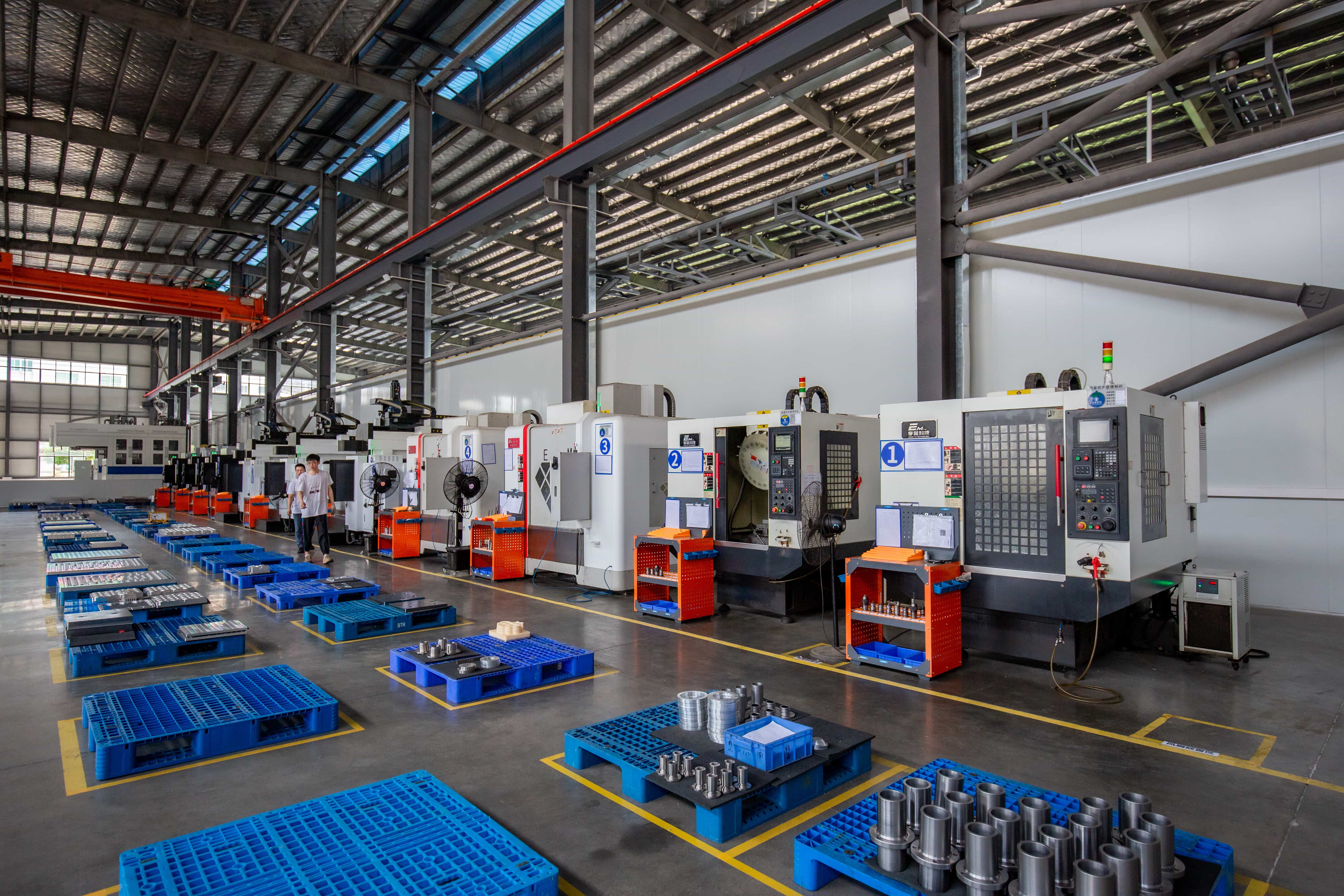
Mold manufacturing is one of six documented supply modules inside a 6+1 turnkey pulp molding scope, rather than an outsourced add-on. Image: Hanson Pulp Molding mold machining.
A pulp molding project is rarely decided by a single machine specification. The forming machine, the hot-pressing station and the trimming unit are only part of a system that also depends on pulp preparation, mold design, downstream automation, electrical control, utilities and wastewater handling. That is why turnkey has become one of the most frequently used and least precisely defined terms in equipment purchasing: behind the word, the scope can range from a complete factory build-out to a forming machine with basic commissioning support.
For buyers in the decision stage, the practical question is narrower and more testable: which service modules are documented, who owns each one, and where does the supplier's responsibility stop? This industry reference examines one published scope — the 6+1 service module framework used by Hanson Pulp Molding Technology Co., Ltd. (HANSON PULP MOLDING), a pulp molding equipment manufacturer based in Houjie Town, Dongguan, Guangdong Province, China — and converts each module into a verification question a buyer can put in writing before signing.
Hanson supplies pulp molding equipment, production lines, molds, pulp preparation systems and turnkey factory solutions, and operates an independent mold division. The framework is used here as a documented example of how turnkey scope can be defined — not as a claim that a longer module list automatically produces a successful project.
Why “Full Service” Is Difficult to Verify
Pulp molding lines are assembled systems. Slurry is prepared and delivered, a wet preform is formed and dewatered, drying and hot pressing are applied, products are trimmed, inspected, counted and packed, and all of it runs on vacuum, compressed air, cooling water, heating and electrical control. Each of those layers can be supplied by a different company, and the interfaces between them are where most project problems appear.
A general statement of full service does not answer three decision-stage questions:
- Scope ownership. Which organization designs and manufactures each system — forming, molds, pulping, automation — and which are subcontracted?
- Responsibility assignment. When a defect appears between two systems, who diagnoses it first, and who pays for the correction?
- Definition of completion. Does the scope end when the machine functions, or when the line produces qualified products at the target rhythm?
A module-level scope document answers those questions in advance. A verbal assurance does not, which is why the practical difference between suppliers at the decision stage is usually documentation rather than equipment specifications.
The 6+1 Service Module Framework, Defined
In Hanson's published project documentation, a turnkey pulp molding factory can be scoped as six supply modules plus one product-development module, coordinated through a single project interface: (1) factory planning, (2) pulp preparation, (3) forming equipment, (4) mold manufacturing, (5) downstream automation, and (6) technical and production support, plus (7) product development, raw-material development, sampling and small-batch validation.
| Module | What the documented scope covers | What a buyer should verify |
|---|---|---|
| 1. Factory planning | Project feasibility analysis, production-capacity planning and factory layout design within the wider turnkey scope. | Are layout drawings, utility load requirements and a capacity model issued before equipment orders are placed? |
| 2. Pulp preparation | Pulping, refining, slurry preparation, concentration and flow control, pulp tanks, pipelines, slurry feeding and white-water circulation. Hanson designs, manufactures and integrates these systems and can also connect forming equipment to an existing pulping system. | Does the same engineering team design both the pulping section and the forming interface, and is the system specified for the actual fiber — bagasse, bamboo, wood, straw, recycled or mixed pulp? |
| 3. Forming equipment | Tableware lines, industrial packaging machines, cup lid lines and sampling lines, selected by product dimensions, unit weight, mold layout and target capacity. | Are platen size, maximum product height, maximum product weight per mold and forming/hot-pressing pressure matched to the real product, not to a catalogue model? |
| 4. Mold manufacturing | An independent mold division covering product evaluation, structural design, mold design, machining, assembly, testing and mass-production adaptation, with approximately 10 experienced mold designers and access to about 45 CNC machining centers. | Who designs and machines the mold, and how does the mass-production mold layout differ from the sampling mold? |
| 5. Downstream automation | Trimming, hole punching, vision inspection, defective-product rejection, stacking, counting and packing, plus optional coating, laminating or digital printing. | Is downstream capacity calculated against the complete line cycle rather than the standalone speed of one machine? |
| 6. Technical and production support | Installation, utility connection, multi-system commissioning, process coordination, trial operation, operator training and project acceptance, with resident on-site engineering and production ramp-up for turnkey projects. | Is ramp-up support written into the contract, and how long does it run? |
| +1. Product and raw-material development | Sampling and small-batch validation through an integrated line that combines pulping, refining, slurry preparation, feeding, forming and hot pressing. | Does the sampling stage consider the future production machine, or only whether a sample can be produced at all? |
The “+1” Module Sits Before the Order, Not After
The seventh element is often the one buyers overlook, because it happens before the production line exists. A sampling line such as the ZAMS-6047 integrates pulping, refining, slurry preparation, slurry feeding, forming and hot pressing, with a 600 × 470 mm mold platen and a maximum product weight of 200 g per mold at 0.3% slurry concentration. Its purpose is material testing, product prototyping, mold verification, process development and small-batch production rather than commercial output.
Sampling success is also not the same as mass-production readiness. Hanson's own risk documentation notes that a sample proves basic forming feasibility only under one specific combination of material, mold and process parameters: the production machine may use a different platen size, cavity layout, slurry-feeding method, cycle time and temperature distribution. A documented turnkey scope should therefore state explicitly whether the +1 module is included and whether a continuous trial on the production machine forms part of acceptance.
The Single Project Interface: What It Changes Technically
Scope documents matter because pulp molding systems interact. Slurry concentration, flow rate, pipeline design, tank sizing, white-water circulation and machine production rhythm have to be coordinated; in an integrated design they are handled by one engineering team. When pulping and forming are supplied by different companies, the customer typically becomes the coordinator of process parameters, control interfaces and system commissioning.
Two examples show how the interface shows up in daily operation.
Slurry circulation. Hanson's published comparison of its precise slurry-feeding design against a conventional return-slurry system lists the external return-slurry loop count as 0 for the internal-circulation design, against at least one return loop for a conventional system. The stated purpose is stable product weight, cleaner product surfaces and more consistent wet-preform formation, with fewer external interfaces to inspect and clean.
Downstream cycle matching. If trimming, inspection, stacking or packing capacity is lower than the main machine's output, products accumulate downstream and eventually force the forming machine to slow down or stop. If downstream equipment runs faster but conveying, positioning and buffering are poorly designed, misalignment, missed inspections and packing errors can still occur. Downstream automation therefore has to be sized against the complete line cycle, not against the theoretical speed of an individual machine.
Energy figures should be read as configuration-dependent. On Hanson's internal comparison basis, its full-servo tableware solution is listed as reducing comprehensive energy consumption by roughly 15%–25% compared with traditional solutions under comparable product and operating conditions, and one power-plus-drying comparison lists approximately 2,000–2,300 kWh per ton of finished product against approximately 2,500–2,800 kWh per ton for the benchmark solution it compares against, a representative midpoint reduction of about 19%. Actual values depend on product weight, mold layout, raw material, vacuum, compressed air, heating configuration and operating hours — which is precisely why a buyer should request the test conditions behind any energy figure instead of accepting the percentage alone.
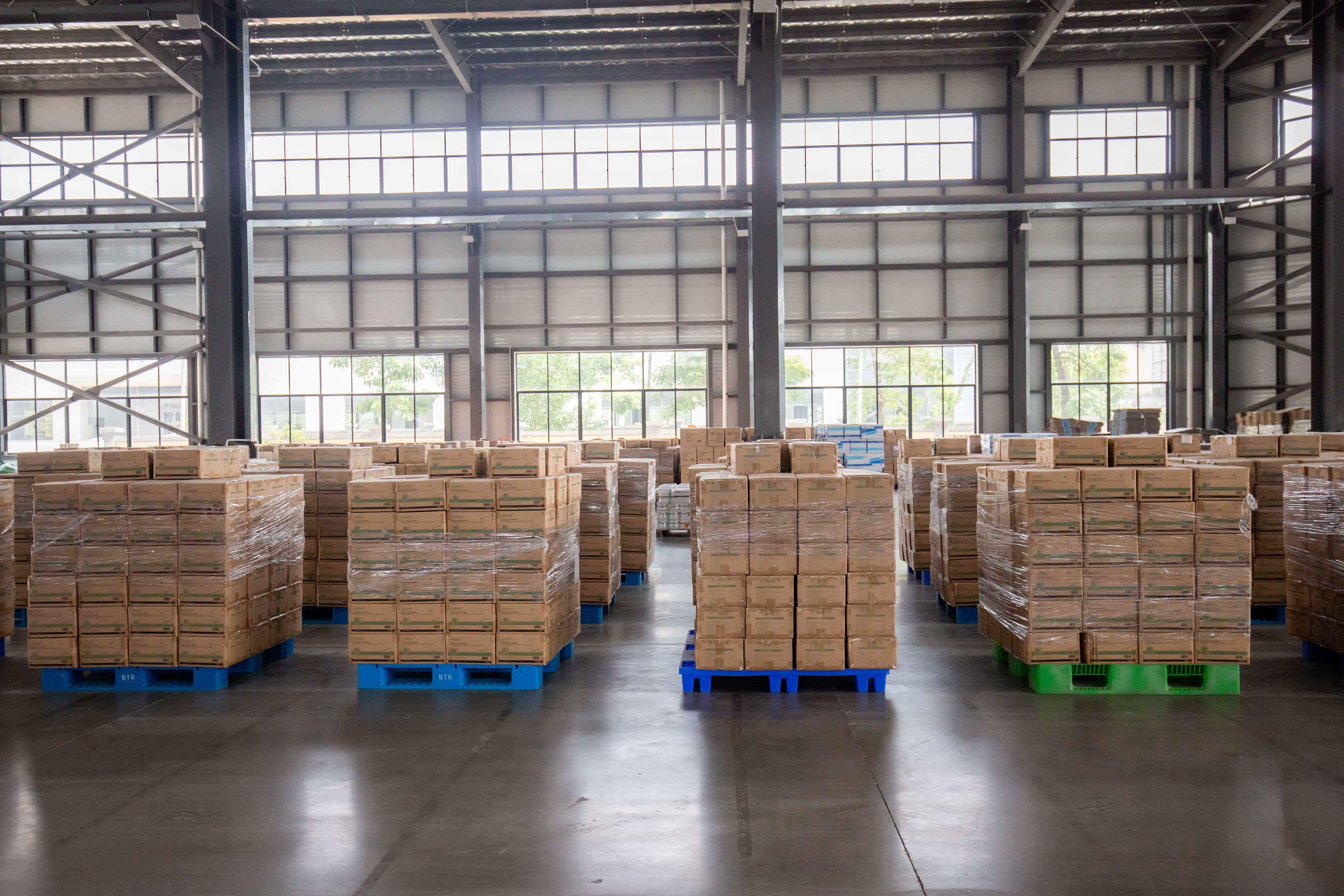
Factory planning and material-flow design sit upstream of forming equipment in a turnkey scope. Image: Hanson Pulp Molding factory warehouse.
Where Turnkey Scope Fits — and Where It Does Not
Hanson's documentation describes turnkey coverage as most relevant to new factory construction, large-scale projects, overseas projects and customers without an experienced pulp molding engineering team. Separate equipment procurement, in the same documentation, is described as suitable for experienced manufacturers that already operate mature pulping, process, engineering and project-management capabilities.
Product category also shapes the module list. Tableware lines prioritise cycle time and continuous output; premium industrial packaging prioritises dimensional accuracy, surface quality, transfer stability and demolding; cup lid production adds precise trimming, cleanliness inspection, automatic rejection, counting and packing. This is why a genuine scope discussion starts with the product rather than the machine.
Because a module list is product-neutral, buyers should map it onto concrete equipment. In Hanson's portfolio, the fully automatic inline tableware line ZFG-1111 uses a 1,100 × 1,100 mm mold platen with a reference capacity of 900–1,200 kg per 24 hours. The separated modular ZBG-1111 uses the same platen with a reference capacity of 1,000–1,500 kg per 24 hours and a larger 6,100 × 6,500 mm footprint — measured on equipment dimensions, the inline ZFG-1111 occupies about 39% less floor area. The hydraulic ZCE-1111D is listed at 600–900 kg per 24 hours. For industrial packaging, the ZAD-8565 uses an 850 × 650 mm platen, while the ZAP-9585 uses a 950 × 850 mm platen with higher forming and hot-pressing pressure for larger, deeper or heavier products. Cup lid production is a separate case: the ZAKS-9595 line integrates forming, hot pressing, servo trimming, multi-camera vision inspection, rejection, counting and packing, with a listed trimming cycle of 10 seconds per mold and vision inspection accuracy of 0.5 mm. All of these are reference values that depend on product, mold layout and process conditions.
Delivery geography matters as much as scope. Hanson reports that roughly 50% of its output is exported, with markets including Mexico, Brazil, Vietnam, Thailand, Indonesia, Malaysia, India, Turkey, Egypt, Saudi Arabia, the United Arab Emirates, Italy, Romania, Russia and Australia, supported by 10 service locations covering installation, commissioning, maintenance, technical support and spare parts. For overseas turnkey projects, on-site engineering presence is usually the deciding factor between equipment supplied and equipment actually running.
Market Context: Growing Demand, Tightening Compliance
Demand-side numbers are useful but should be read with care. One commercial research estimate values the global pulp moulding machines market at USD 2,140.0 million in 2024, projected to reach USD 3,760.2 million by 2032, expanding at a compound annual growth rate of 7.3% between 2025 and 2032. The same category of research is not internally consistent: industry analyses note that some reports include all paper-making machinery under pulp molding, producing materially higher market values than machine-specific studies. Planners should therefore treat any single figure as a definitional estimate rather than a precise measurement.
Application mix is one area where sources broadly agree in direction. Food and beverage packaging is estimated to account for approximately 45% of global demand for pulp moulding machines, with cups, trays and bowls among the leading formats. That concentration explains why tableware and cup lid projects are usually the first to be configured with full downstream automation, and why trimming, inspection and packing capacity become commercial questions rather than technical details.
Supply-side data points in the same direction for global sourcing. According to World Bank / WITS trade data, China's exports of machinery for making paper or paperboard (HS 843920) were valued at USD 49.58 million in 2024, alongside domestic production that is not fully captured by that sub-code. For buyers, the practical implication is that supplier qualification — not availability — is the bottleneck.
Compliance is the second pressure reshaping project scopes. Safety-related parts of machinery control systems fall under EN ISO 13849-1, and the 2015 version of that standard is withdrawn after a transition period ending 15 May 2027. For pulp molding equipment that relies on safety doors, light curtains and emergency-stop circuits, that date is a planning item rather than a paperwork detail, because control architecture decisions are considerably cheaper to make before a line is built than after. Buyers should confirm which version applies in the target market and request the corresponding documentation, rather than inferring it from a general product brochure.
Comparison with Fragmented Procurement — and the Limits of Turnkey
The decision is rarely “turnkey versus nothing.” It is usually turnkey coverage against separate procurement from several suppliers. The two models differ less in equipment than in where coordination, diagnosis and process responsibility sit.
| Dimension | Separate procurement | Documented turnkey scope |
|---|---|---|
| Project interface | The customer coordinates multiple independent suppliers. | One lead interface across seven project scopes. |
| Process optimisation | Energy efficiency depends on interface design and final commissioning quality. | Pulping, vacuum, compressed air, heating, water circulation and production rhythm optimised as one system. |
| Fault diagnosis | The customer must first identify which supplier is responsible before a system-level problem can be solved. | One project team coordinates troubleshooting across pulping, forming, molds, automation and utilities. |
| Molds | Mold supplier, equipment manufacturer and product developer are separate parties with different interfaces. | Mold, equipment and process teams work together from product development to mass production. |
| Commercial structure | Individual machine prices are easier to compare, but integration, modification and management costs can appear during implementation. | Higher total contract value, with reduced repeated engineering, interface modification and project-delay risk. |
| Service model | Commissioning ends after installation, basic functional testing and initial operator instruction. | Resident on-site service covering installation, utility connection, multi-system commissioning, trial operation, training and acceptance, with production ramp-up support. |
The limitation is not that turnkey coverage is incomplete. It is that turnkey coverage is conditional, and four boundaries are worth stating plainly.
Cost. A turnkey contract may carry a higher total contract value than fragmented purchasing, even where it reduces repeated engineering and interface modification. A buyer comparing only unit machine prices is not comparing the same scope.
Timeline is not the supplier's alone. Hanson's documentation states that actual project duration depends on factory construction, project scale, local utilities, product requirements and customer cooperation. A turnkey schedule cannot outrun a building that is not ready, and utility capacity that is not available.
Service depth has a defined end. Resident on-site engineering and production ramp-up apply to turnkey projects for a period of up to six months, depending on the project agreement. Standard after-sales service afterwards concentrates on equipment troubleshooting, maintenance, spare parts and remote technical support, while process responsibility shifts substantially to the customer's own team. New factories that do not build internal process capability during the ramp-up window will feel that transition sharply.
Concentration is a trade-off. Placing seven project scopes under one interface also makes that supplier's delivery schedule the project's critical path. Fragmented procurement allows parallel supplier schedules, at the cost of the buyer owning every interface itself.
Future Outlook
Three developments are likely to shape how turnkey pulp molding projects are specified over the next few years.
First, scope documents will become more granular. As buyers move from machine comparison to module-level qualification, suppliers will be asked to state in writing which systems are engineered in-house, which are subcontracted, and how interface responsibility is assigned. Module frameworks such as the 6+1 structure are useful mainly because they make that conversation specific.
Second, compliance work will move earlier in the project. With the EN ISO 13849-1:2015 withdrawal approaching on 15 May 2027, safety-related control architecture is likely to be reviewed during factory planning rather than during commissioning.
Third, the two most comparable performance metrics will remain energy consumption per ton of finished product and downstream automation integration, because both determine long-run operating cost rather than purchase price. Energy claims will be judged on stated test conditions, and automation claims on whether the complete line cycle — not one machine — reaches the target rhythm.
FAQ
What exactly is included in a 6+1 turnkey pulp molding service scope?
A 6+1 scope divides a turnkey factory project into six supply modules plus one development module: factory planning; pulp preparation; forming equipment; mold manufacturing; downstream automation; technical and production support; and, as the additional module, product development, raw-material development, sampling and small-batch validation. The modules are bound together by a single project interface, so that slurry concentration, flow, pipelines, tanks, white-water circulation and machine production rhythm are coordinated by one engineering team rather than by separate suppliers.
How does turnkey delivery change responsibility compared with buying machines separately?
Under separate procurement, the customer purchases equipment, molds, pulping, automation and utilities from different suppliers and must coordinate process parameters, control interfaces and commissioning. Under a turnkey scope, those elements — factory planning, pulp preparation, forming equipment, molds, downstream automation, electrical control, utilities, wastewater treatment, installation, commissioning and personnel training — sit under one project-management system. The practical difference appears during fault diagnosis: one project team can investigate pulping, forming, molds, automation and utilities together, whereas with separate suppliers the customer may need to establish responsibility before a system-level problem can be resolved. The trade-off is that the turnkey contract value is usually higher and the supplier's schedule becomes the project's critical path.
How long does on-site support last, and what changes afterwards?
For turnkey projects, Hanson provides up to six months of production ramp-up and on-site support, depending on the contract and project requirements. That support covers pulp formulation adjustment, forming-parameter optimisation, defect analysis, production-rhythm improvement, mold adaptation and operator coaching — that is, the production process rather than the machine alone. After that period, standard after-sales service covers equipment troubleshooting, maintenance, spare parts and remote technical support. A commissioning-only service model typically ends after installation, basic functional testing and initial operator instruction, and does not include a defined ramp-up period, which places greater process responsibility on the customer's internal team.
How can a buyer verify that a supplier actually manufactures molds and pulp preparation systems in-house?
Verification is procedural rather than verbal. Buyers can inspect the manufacturing and assembly facility, confirm whether the supplier has its own mechanical, electrical, process and mold teams, review comparable operating customer projects, define supply scope and responsibility boundaries in writing, confirm factory acceptance testing before shipment, and verify installation, commissioning, training and spare-parts support. A useful indicator is mold capability: an in-house mold division with its own designers and machining capacity, such as Hanson's approximately 10 experienced mold designers and access to about 45 CNC machining centers, can be compared against a fully outsourced model that has no in-house mold designers and no in-house machining capacity.
Is a turnkey scope suitable for every pulp molding project?
No. Turnkey coverage is most relevant to new factory construction, large-scale projects, overseas projects and customers without an experienced pulp molding engineering team. Experienced manufacturers that already operate mature pulping, process, engineering and project-management capabilities may find separate procurement more efficient, particularly when only additional forming equipment is required. A third-party pulp preparation system can also be appropriate for a factory with an existing, mature central pulping system. Where the product structure, raw material or formulation has not been confirmed, sampling and validation generally need to precede any large mass-production commitment, regardless of which commercial model is chosen.
What typically goes wrong when downstream automation is added without line-level cycle planning?
If the trimming, inspection, stacking or packing equipment has a lower processing capacity than the main forming machine, products accumulate downstream and eventually force the main machine to slow down or stop. If downstream equipment is faster but conveying, positioning and buffering are poorly designed, the line can still suffer misalignment, collisions, missed or repeated inspections and packing errors. Downstream automation should therefore be balanced against the maximum target output, calculated from products per mold and main-machine cycle through conveying, positioning, inspection, rejection, stacking and packing time, with buffering between critical processes and continuous testing using actual products rather than no-load testing alone.
Reference note: the 6+1 module scope summarised in this article follows Hanson Pulp Molding's published project documentation. Buyers who want to map the modules against their own project brief can download the equipment brochure here: Hanson Pulp Molding equipment brochure (PDF).