
Two-Platen Molding for Large Logistics & Construction Parts
Two-Platen Molding for Large Logistics & Construction Parts
Two-Platen Molding for Large Logistics & Construction Parts
Large logistics and building and construction parts should be matched to a machine envelope, not to an industry label. A cart, crate, pallet, waste container or water tank can all be large, but each part has its own mold dimensions, shot weight, wall thickness, material and automation requirement. The useful question is whether the clamping force, injection volume, daylight and tie-bar space fit the mold and process. The Haitian Jupiter Series JU5 is a servo-hydraulic two-platen platform for medium- to very-large molding applications, and its published envelope makes that matching exercise concrete.
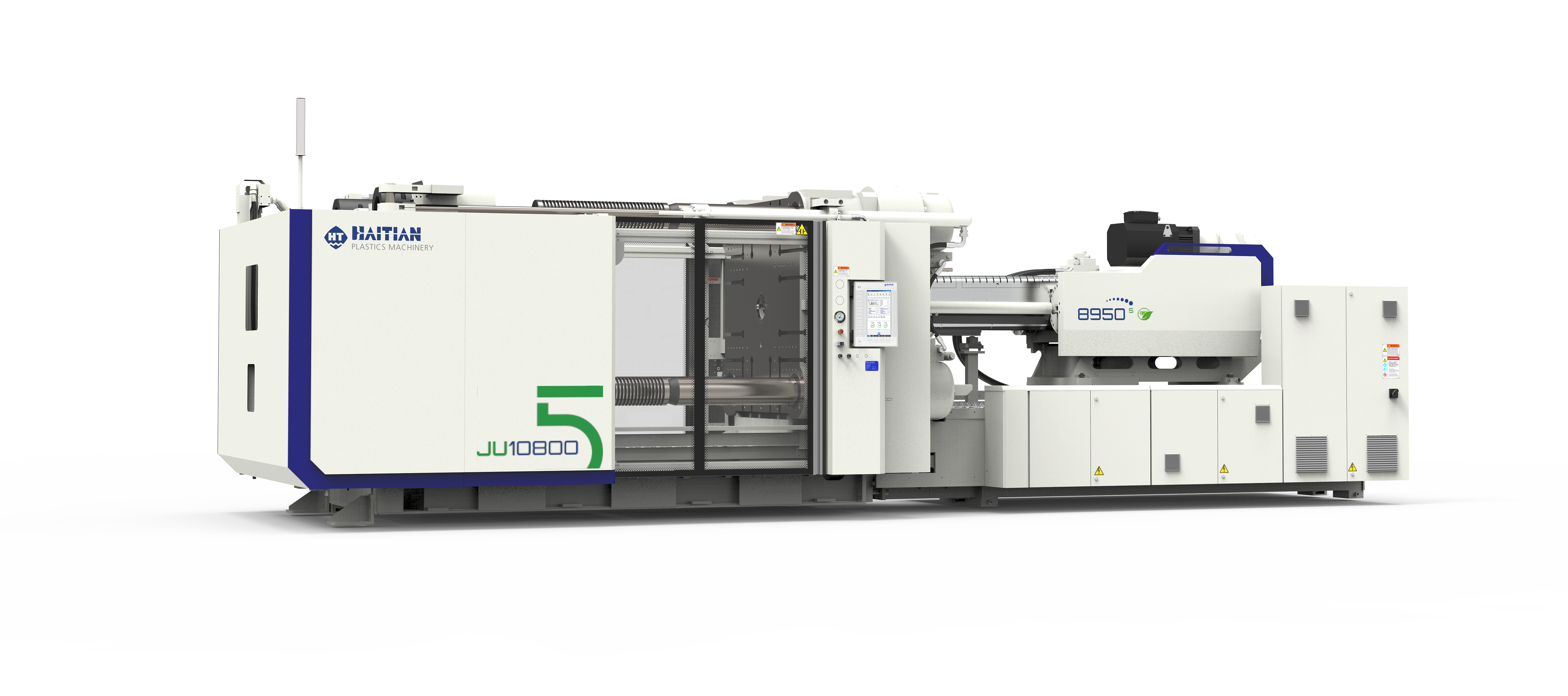
Haitian Jupiter JU5 servo-hydraulic two-platen injection molding machine platform. Image source: Haitian International product corpus.
Why large-part projects start with the mold, not the industry name
Large technical parts in logistics and building and construction share a practical condition: the mold and the shot often dominate the machine decision. The logistics application material describes large parts, high shot weights, robust products, recycled or reinforced materials and demanding durability requirements. It lists pallets, crates, transport containers, waste bins, protective cases, new-energy components and industrial fittings as typical logistics work. Those parts are not one specification. A protective case, a pallet and a large container can differ in wall thickness, dimensional tolerance, impact requirement and cycle target.
Building and construction work adds another set of large-part conditions. The JU5 product material lists building and construction among its applicable industries, and the documented Belli SAS project involved large water and rainwater storage tanks. Large tanks and containers can require deep cavities, large mold space and a stable clamp over a long opening stroke. The exact requirements still come from the part drawing, mold design and material. Industry labels are useful for finding comparable projects, but they are not a substitute for a machine-envelope check.
What logistics parts demand
The logistics scenario material identifies large shot capability, high clamping force, impact resistance, recycled-material capability, dimensional stability and chemical resistance where required. It also names the supporting equipment that commonly belongs in the cell: a large mold, robot, recycled-material handling, gravimetric dosing, a dryer where required, a chiller, optional insert handling and leak or pressure testing. These requirements affect the injection unit and the automation layout as much as the clamping unit. A machine that clamps the mold but cannot plasticize the shot consistently, or cannot handle the regrind and drying routine, is not a complete fit.
What building and construction parts demand
Large water and rainwater storage tanks show why building and construction parts can sit at the extreme end of the large-part range. The documented JU88000 project for Belli SAS used 88,000 kN clamping force and 134,000 cm³ injection volume, with a customized machine, extensive testing, CE certification in September 2023 and formal customer acceptance in October 2023. A customized Hilectro VD-150ID robot was integrated into the solution. That is a specific project record, not a claim that every building part needs that size. It does show that large tanks can move the decision into a different machine class and make integrated automation part of the project scope.
What the JU5 two-platen platform changes
Haitian International Holdings Ltd. is an injection molding machine manufacturer founded in 1966. Its Jupiter Series JU5 is described as a compact two-platen machine platform for medium- to very-large molding applications. The platform uses four short-stroke clamping cylinders. In the supplied product description, those four cylinders provide uniform clamping force and high repeatability. That is the central technical point for large technical parts: the clamp is not only a force number, but a repeatable force distribution over a large mold.
The two-platen architecture also provides large mold capacity while minimizing machine footprint. That combination matters in logistics and construction plants where floor space is finite and molds are long or deep. A long opening stroke and large mold space can make room for the mold and the part-removal path, while a shorter machine length can reduce the footprint compared with a longer machine layout. The platform data also notes Generation 5 electrical plasticizing, which can reduce energy consumption by 20–40%. That figure is a stated platform capability, not a guaranteed result for every mold or cycle.
JU5 configuration envelope: the numbers that frame the decision
The JU5 published range is broad enough that buyers should not choose a model by the word “two-platen” alone. The same platform spans several large-part classes. The table below reproduces the approved product facts and shows why the part and mold data must come first.
| JU5 parameter | Published range | What it affects in a large-part project |
|---|---|---|
| Clamping force | 4,500–88,000 kN | Mold clamping for the projected part area, material and cavity pressure condition. |
| Injection volume | 848–134,303 cm³ | Shot-size envelope; it is not the same as finished part weight. |
| Screw diameter | 60–300 mm | Plasticizing and injection-unit configuration for the material and shot. |
| Maximum daylight | 1,400–7,000 mm | Opening envelope for mold height, part removal and robot access. |
| Tie-bar distance | 810 × 810–3,400 × 2,820 mm | Mold width and height that can pass between the tie bars. |
| Controller | KEBA | Machine control platform for process setting and integration. |
The clamping-force range runs from 4,500 kN to 88,000 kN. The injection-volume range runs from 848 cm³ to 134,303 cm³. The maximum daylight range is 1,400–7,000 mm, and the tie-bar distance range is 810 × 810–3,400 × 2,820 mm. These are platform envelopes, not a recommendation for a particular part. A large part can sit inside the force range but still fail the mold-space check, or fit the tie-bar space but need a different injection unit for the shot weight and material.
Matching machine size to logistics parts
For logistics work, start with the mold and the shot rather than the product category. A pallet, crate, transport container, waste bin or protective case may be large, but the critical data are the projected area, cavity layout, shot weight, wall thickness, material and required cycle. The logistics scenario material points to high shot weights and large molds, so the clamping unit and injection unit must be checked together. A large clamping force with an undersized injection unit can leave the plasticizing side as the constraint; a large injection unit on an undersized clamp does not solve the mold-force requirement.
The same logistics material names recycled or reinforced materials and demanding durability requirements. Those conditions affect more than the force number. Recycled-material handling, gravimetric dosing, drying where required and a chiller belong in the cell design. Filled or reinforced compounds may require a plasticizing configuration suited to the material, and the JU5 material notes that filled and reinforced compounds are possible depending on plasticizing configuration. That qualifier matters. The machine range does not remove the need to confirm screw, barrel and wear protection for the actual compound.
- Large mold: confirm platen and tie-bar space, mold weight and opening stroke before comparing models.
- High shot weight: match injection volume and screw diameter to the shot, not only to the finished part weight.
- Recycled or reinforced material: confirm feeding, dosing, drying and plasticizing configuration with the material supplier and machine builder.
- Durability and dimensional stability: use mold trials and sampling to verify the process window, not the brochure range alone.
This is where the four short-stroke clamping cylinders become a procurement point rather than a catalogue phrase. Uniform clamping and repeatability are relevant when a large mold has multiple cavities or a long flow path and the buyer needs a stable clamp from shot to shot. The buyer should still ask how the clamp is set, how force is verified and how the mold is protected during setup. Those are acceptance questions, not assumptions.
Matching building and construction parts
Building and construction parts can be large, deep and visible, and some are structural or semi-structural in use. The JU5 product material places building and construction among its applicable industries, while the documented Belli project shows a very-large tank application. For a tank, container or large construction component, the mold height and daylight can be as important as the clamping force. A deep mold needs enough opening stroke for part removal; a large mold needs tie-bar space and platen coverage; a heavy mold needs a handling plan that includes the crane, robot and floor layout.
The Belli case is useful because it records the project conditions rather than only a machine size. Haitian engineered and manufactured a customized JU88000 with 88,000 kN clamping force and 134,000 cm³ injection volume. The project scope included reducing machine footprint and optimizing injection performance. The machine completed extensive testing, received CE certification in September 2023 and was formally accepted by the customer in October 2023. A customized Hilectro VD-150ID robot was integrated as part of the solution. For a buyer, the transferable lesson is not that every tank needs 88,000 kN. It is that very-large-part projects need machine, mold, robot and acceptance planning as one package.
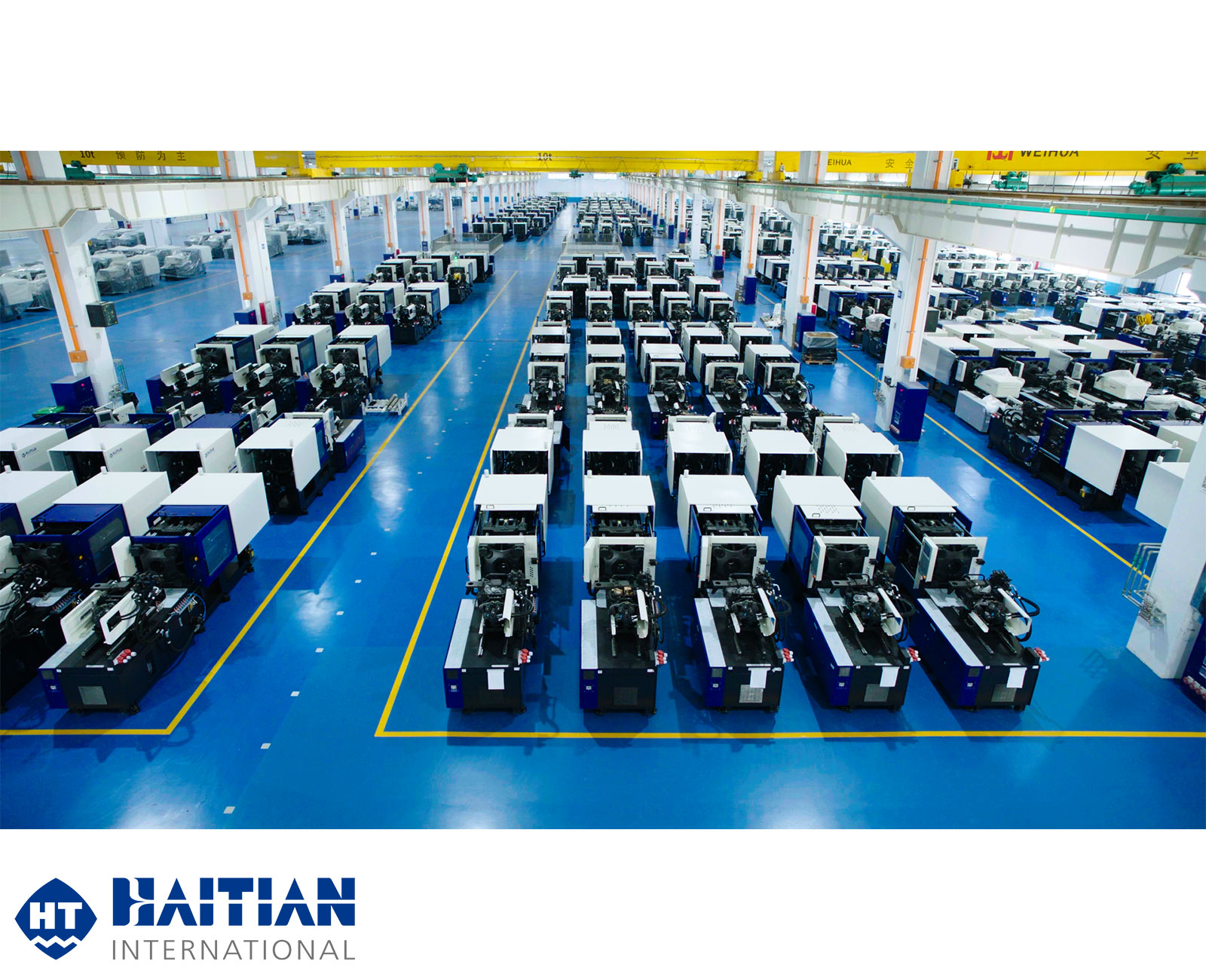
Injection molding machine production workshop. Image source: Haitian International company corpus.
For construction-related parts, the fit boundary should be written down before the quotation. Which dimensions are critical? Which surfaces are visible? Is the part exposed to chemicals, weather or load? Does the mold need a slide, core pull or insert? The JU5 range can cover a large envelope, but the application answer still depends on the mold and process. A large machine cannot compensate for a mold that cannot vent, cool or eject the part within the required cycle.
Injection-unit configuration for large technical parts
Injection volume is one of the most misused numbers in large-part selection. The JU5 range of 848–134,303 cm³ describes the injection-unit envelope, not the weight of the finished part. Shot weight, melt density, runner weight, cushion and process margin all affect the required injection volume. A buyer should give the machine builder the part weight, runner weight, material, target cycle and allowable shot utilization. The same logic applies to screw diameter: the 60–300 mm range spans different plasticizing duties, and a larger screw is not automatically better for a given material and shot.
The JU5 material lists PP, PE, ABS, PA, PC, PC/ABS, PMMA, TPE and engineering thermoplastics, with filled and reinforced compounds depending on plasticizing configuration. That is a broad material statement, not a guarantee for every compound. For logistics parts using recycled material, the injection unit and feeding system must handle the regrind ratio and consistency. For building parts using filled or reinforced compounds, wear and mixing become part of the configuration review. The right injection unit is the one that can plasticize the shot consistently within the cycle, not simply the one with the largest nominal volume.
Two-platen vs toggle: a fit comparison, not a ranking
A comparison with a toggle platform is useful only when it is kept to documented characteristics. The Haitian Mars Series MA5 is a servo-hydraulic toggle platform, while the Jupiter Series JU5 is a servo-hydraulic two-platen platform. Their published ranges overlap, so the decision is not “two-platen replaces toggle.” The decision is which platform envelope fits the mold, shot and plant layout.
| Documented item | Jupiter JU5 two-platen | Mars MA5 servo-hydraulic toggle |
|---|---|---|
| Clamping force | 4,500–88,000 kN | 600–33,000 kN |
| Injection volume | 848–134,303 cm³ | 49–45,616 cm³ |
| Screw diameter | 60–300 mm | 24–220 mm |
| Tie-bar distance | 810 × 810–3,400 × 2,820 mm | 310 × 310–2,160 × 1,900 mm |
| Controller | KEBA | KEBA |
The MA5 range covers smaller general-purpose work and extends to 33,000 kN. The JU5 range starts at 4,500 kN and extends to 88,000 kN, with a larger injection-volume and tie-bar envelope at the top end. In the overlap, the buyer should compare mold space, daylight, shot size, energy use and floor layout rather than assume that one clamping principle is always better. The JU5 material supports the two-platen advantage in large mold capacity and footprint; the MA5 material supports the toggle platform as a versatile servo-hydraulic option. Neither statement is a universal performance ranking.
Digital and energy considerations in large-part cells
Large-part cells are increasingly specified with data and automation, not only tonnage. Trade and professional-society coverage in the supplied evidence associates smart manufacturing in injection molding with IoT or IIoT connectivity and real-time monitoring of injection molding machines and auxiliary equipment (PlasticsToday; Plastics Engineering, 2024). Haitian’s platform material describes MES connectivity, open interfaces and standardized communication protocols that allow third-party equipment to be integrated. The Giebeler case in the corpus records MES integration through standardized EUROMAP interfaces, with improved production transparency and faster root-cause analysis.
For a logistics or construction cell, that translates into practical specification questions. Which machine data will be collected? Which protocol will connect the robot, chiller, dryer and MES? Will energy monitoring be part of the cell or a separate meter? Will the robot handshake be tested at commissioning? These questions do not replace the mechanical fit check, but they prevent a large machine from becoming an isolated asset. The JU5 platform also states that Generation 5 electrical plasticizing can reduce energy consumption by 20–40%. Buyers should treat that as a configuration-dependent capability and ask for the basis, test condition and expected effect for their own cycle.
Procurement verification for a large two-platen cell
The supplier capability material lists factory testing, machine inspection before delivery, mold trials, initial sampling, process optimization, application testing and commissioning. It also lists optional process monitoring and integrated quality inspection. For a large-part project, those steps are not administrative. They are how the buyer verifies that the clamp, injection unit, mold and automation work together before the cell is accepted.
- Mold and part data review: confirm part drawing, material, shot weight, mold dimensions, daylight requirement, tie-bar space and target cycle.
- Machine configuration review: match clamping force, injection volume, screw diameter and plasticizing configuration to the application, including recycled or reinforced material where relevant.
- Factory testing and inspection: verify the machine build and documented inspection before delivery.
- Mold trial and initial sampling: run the actual mold and material, then check dimensional stability, surface, warpage and cycle.
- Process optimization and application testing: confirm the stable process window and the robot, chiller, dryer and dosing interfaces.
- Commissioning and after-sales plan: confirm installation, training, preventive maintenance, spare-parts supply and local service support.
The after-sales material lists local sales and service network, installation, commissioning, training, preventive maintenance, technical service, spare-parts supply, application support, process optimization and on-site or remote support. For a large machine, service access and spare-parts planning belong in the evaluation before the purchase order, not after a breakdown. The buyer should also ask how the four short-stroke clamping cylinders are maintained and how clamping force is checked over time.
Decision outlook for the next large-part project
The practical outlook is a project-specific one. Start with the part and mold, then set the required clamping force, injection volume, daylight and tie-bar space. Compare the JU5 and MA5 envelopes only after those requirements are written down. Use the four short-stroke clamping cylinders, the 4,500–88,000 kN force range, the 848–134,303 cm³ injection volume and the 1,400–7,000 mm maximum daylight as screening data. Then verify the selected configuration through a mold trial and acceptance plan.
That sequence keeps the industry label in its proper place. Logistics and building and construction are useful ways to find comparable large-part requirements, but they do not choose the machine. The mold, shot, material, automation and plant layout do. A two-platen platform is a strong fit when large mold space, long daylight and a compact footprint are the real constraints. It is not a shortcut around the engineering review.
FAQ
What determines whether a logistics or construction part needs a two-platen machine?
The decision starts with mold dimensions, shot weight, required clamping force, daylight, tie-bar space and automation layout. A part that needs a large mold, long opening stroke or high shot weight may fit the JU5 envelope, which covers 4,500–88,000 kN clamping force, 848–134,303 cm³ injection volume and 1,400–7,000 mm maximum daylight. A part that fits a smaller toggle envelope does not automatically need a two-platen machine.
How do the four short-stroke clamping cylinders affect large-part molding?
The JU5 product description states that four short-stroke clamping cylinders provide uniform clamping force and high repeatability. For large molds, that matters because the clamp must be stable across the mold face and from shot to shot. The buyer should still verify clamping force, mold protection and repeatability during the mold trial and acceptance process.
How should the injection unit be matched to a large technical part?
Match the injection unit to the shot weight, runner weight, material, target cycle and allowable shot utilization. The JU5 injection-volume range is 848–134,303 cm³ and the screw-diameter range is 60–300 mm. Those are envelope figures, not a part-weight rating. Filled or reinforced compounds also require confirmation of the plasticizing configuration.
What should be verified before accepting a large two-platen cell?
Verify the machine build through factory testing and inspection, then run mold trials, initial sampling, process optimization and application testing. Confirm the robot, chiller, dryer, dosing and MES interfaces during commissioning. Also confirm the after-sales plan, including installation, training, preventive maintenance, spare-parts supply and local service support.
When is the JU5 not the right fit?
The JU5 is described as a platform for medium- to very-large molding applications. If the mold and shot fit a smaller toggle or all-electric platform, and the plant does not need the extra daylight or tie-bar envelope, a different platform should be evaluated. The right choice depends on the documented machine envelope and the actual mold trial, not on the industry label alone.
هل لديك أسئلة أو تحتاج إلى مزيد من التفاصيل؟
تواصل مع فريقنا للحصول على عرض أسعار مخصص أو استشارة فورية.
طلب عرض أسعار
املأ النموذج أدناه وسيتواصل معك فريقنا بعرض مقترح مخصص.
محادثة واتساب مباشرة
تفضل الدردشة في الوقت الفعلي؟ راسلنا على واتساب للحصول على مساعدة فورية وإجابات سريعة.
- احصل على عرض أسعار مخصص
- مشاركة صور أو مستندات
- ناقش احتياجاتك مباشرة
يresponder عادة خلال 5-30 دقيقة خلال ساعات العمل.