
UHF RFID Reader OEM/ODM: What Manufacturing Buyers Should Verify
Why UHF RFID Reader Capacity Is Becoming a Procurement Question
Smart manufacturing programmes increasingly use UHF RFID in production lines, warehouse gates, tool cribs, returnable assets and inbound or outbound docks. The reader is no longer an accessory to a tag pilot; it is the data-capture layer of a wider execution system. That change reframes procurement from product selection to supplier capability assessment.
A useful market context comes from third-party estimates. Mordor Intelligence attributes about 40.72% of total RFID market revenue to UHF technology in 2025, citing retail inventory cycles and multi-item reading capabilities. Dataintelo estimates the global UHF RFID reader market at roughly USD 4.8 billion in 2025, with a projection of USD 11.2 billion by 2034. Estimates vary by scope, and buyers should treat them as directional rather than precise, but the direction is consistent: UHF readers are becoming infrastructure. Regionally, IDTechEx notes that the Americas account for more than 60% of global UHF tag usage as of 2025, largely driven by retail. ABI Research sees Asia Pacific as the fastest-growing region for UHF RFID hardware, with an expected 11.8% CAGR in shipments through 2031.
For a manufacturing buyer, the implication is straightforward. Reader hardware decisions will outlast the pilot phase. The supplier of that hardware must be able to support frequency requirements in each destination market, adjust reader interfaces to fit existing control systems, supply enough units at a predictable quality level, and remain available after deployment.
The Gap Between a Reader Specification and a Working Reader Programme
A manufacturing evaluation often starts when an engineer compares specification sheets. Read range, transmit power, protocol support and IP rating look decisive on paper. The gaps appear later, during integration and scale-up. In practice, four questions determine whether a reader programme reaches execution.
- Frequency and compliance. UHF readers operate in bands such as 860–960 MHz, but each region applies its own rules. A reader intended for EU deployment needs different compliance evidence than one for the US market. Certificates must be checked against the actual model, not the general product family.
- Interface fit. A production reader that cannot connect to the existing PLC, ERP, WMS or gate controller may be technically impressive but operationally unusable. RS232, RS485, USB, TCP/IP, GPIO, Wiegand and wireless options are not interchangeable.
- Physical-world behaviour. Factories contain metal racks, moving carts, liquid-filled goods, temperature extremes and vibration. Read range on a test bench is not read range in a cold storage corridor or on a conveyor line.
- Supplier continuity. Once a plant depends on reader hardware, the vendor's ability to test, repair, replace and support units becomes part of operational risk.
These concerns are exactly why OEM and ODM depth matters. A company that only assembles standard readers can answer the first list of questions poorly. A manufacturer that can adjust antenna gain, interface options, software, housing and test procedures gives the buyer room to solve real site constraints.
A Reference Manufacturer: What DAILY RFID Documents
One useful reference is DAILY RFID CO., LIMITED. The company is not a trading intermediary. Founded in 2008 and based in Guangzhou, China, DAILY RFID is an RFID manufacturer whose documented baseline includes a 28,000 m² factory, roughly 180–200 employees and a stated annual capacity of about 50 million RFID tags, 30 million RFID cards and 100,000 RFID readers. Its engineering group includes 38 R&D staff, and it reports around 80% export share, with main markets in the EU and USA. The product scope covers tags, readers, antennas, cards, chips and labels. The company publishes general corporate information at www.rfid-in-china.com.
| Manufacturing baseline | Documented scope |
|---|---|
| Factory | 28,000 m² manufacturing base in Guangzhou, China |
| Workforce | Approximately 180–200 employees |
| Engineering | 38 R&D engineers |
| Annual production capacity | RFID tags about 50 million units; RFID cards about 30 million units; RFID readers about 100,000 units |
| Export profile | Roughly 80% exported; primary markets in EU and USA |
| Main product families | RFID tags and RFID readers, with associated antennas, cards, labels and development tools |
For a buyer, these facts matter less as company publicity and more as evidence of production depth. Reader programmes that need 100 or 1,000 units require real assembly capacity, quality-control discipline and component sourcing, not just a product photograph.
OEM/ODM Capabilities That Reduce Execution Risk
DAILY RFID's own capability records describe several reader customization paths. They give a concrete view of what a manufacturing buyer can ask for before signing an order.
| Production mode | Documented customization scope | Capacity, lead time and MOQ | Quality and service evidence |
|---|---|---|---|
| UHF Fixed Reader – ODM/OEM | Antenna gain and interface configuration | About 1,000 units per month; 15–45 days lead time; MOQ from 1 unit | Factory acceptance test; remote support |
| UHF Handheld Reader – ODM/OEM | Operating system, software and housing | About 2,000 units per month; 15–30 days lead time; MOQ from 1 unit | Full system burn-in; remote and on-site support |
| HF RFID Reader – OEM | Logo and software configuration | About 5,000 units per month; 3–15 days lead time; MOQ from 2 units | 100% test before shipment |
| RFID Development Kit – ODM/OEM | Reader bundle, demo software and sample tags | About 1,000 sets per month; 7–15 days lead time; MOQ 1 set | Function and packing test; remote support |
These MOQs are notably practical for evaluation-stage buyers. A pilot does not need a warehouse of readers; it needs one testable unit, a development kit and a clear upgrade path to mass production. The lead times also signal whether the manufacturer can respond to programme changes without redesigning the entire supply chain.
Compliance Evidence: The Part Brochures Often Skip
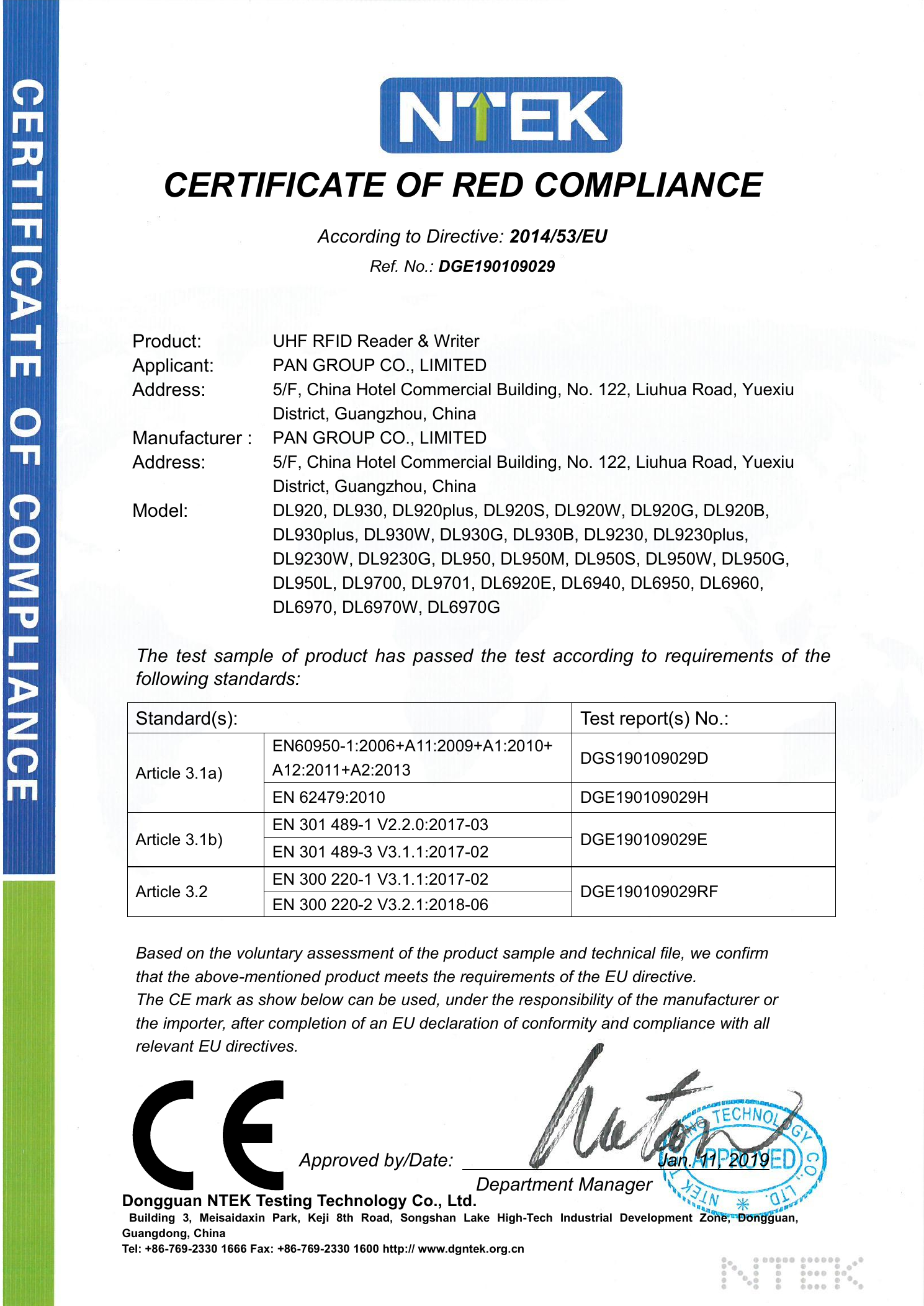
Regional compliance is not a marketing detail. It determines whether a reader can be legally operated, imported and connected in a given market. DAILY RFID's certification records include EU CE RED documentation for a wide UHF RFID reader and writer family. The 2019 CE RED Certificate of Compliance, issued by Dongguan NTEK Testing Technology Co., Ltd., covers models including DL920, DL930, DL920plus, DL920S, DL920W, DL920G, DL920B, DL930plus, DL930W, DL930G, DL930B and further reader models, under Directive 2014/53/EU and standards such as EN 300 220-1, EN 300 220-2 and EN 301 489.
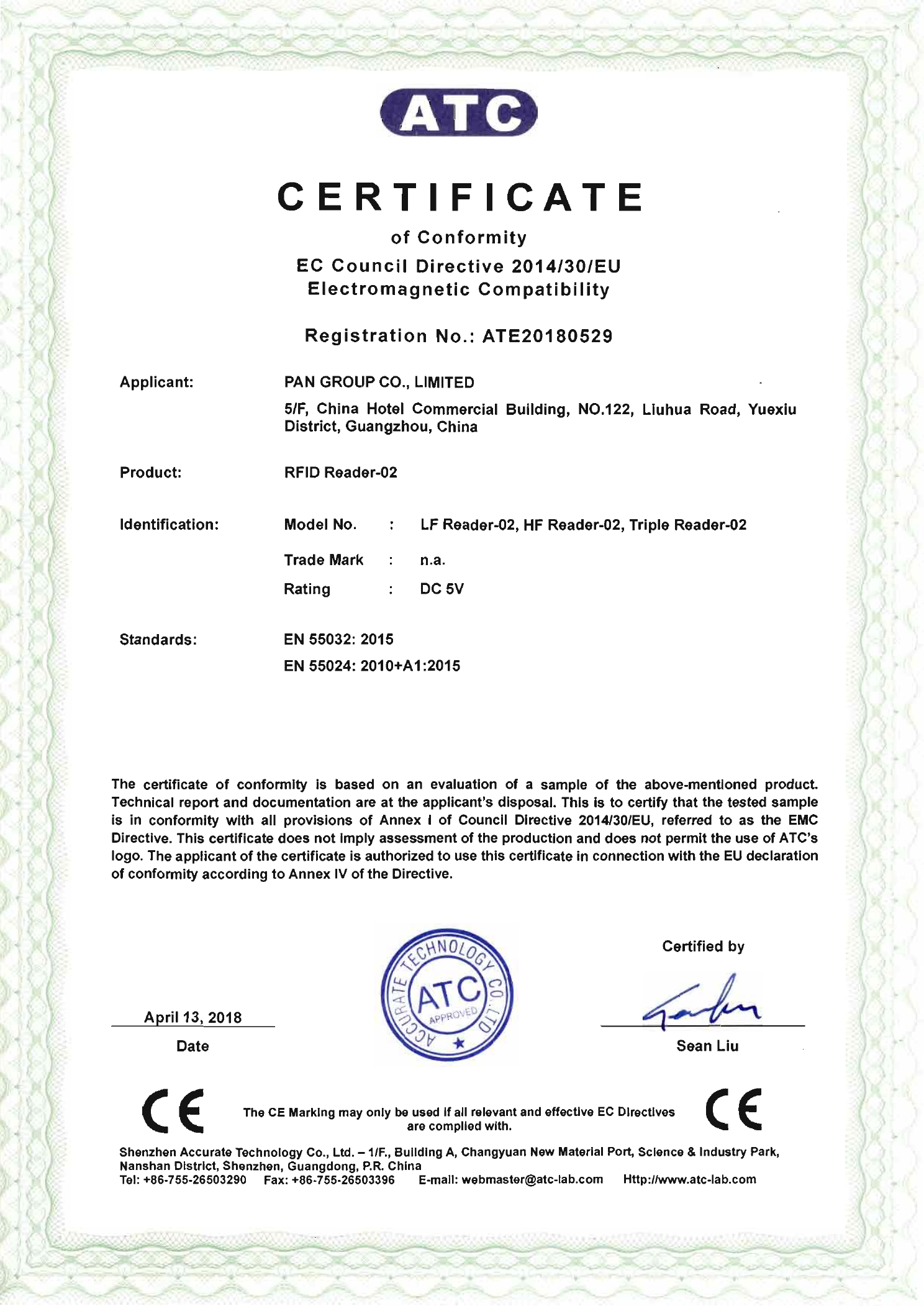
The records also show CE EMC conformity for RFID Reader-02 desktop models under EMC Directive 2014/30/EU, and an FCC Supplier's Declaration of Conformity for an RFID tracking system that includes the 2.4GHz active RFID Reader DL9230 family for the US market. For tag and label products, supporting documentation includes RoHS and REACH test reports. A disciplined buyer should still verify that the certificate model number, frequency band and destination country match the intended order, because a certificate for one product family does not automatically cover every reader configuration.
The Radio Layer: What Actually Determines Reader Performance
UHF readers communicate with passive tags by sending RF energy and decoding the tag response. Most UHF systems follow EPCglobal Gen2, also standardized as ISO/IEC 18000-6C, which gives a common air interface. Protocol compliance is the entry ticket; after that, performance is determined by RF design, antenna configuration, power management and anti-collision algorithms.
In DAILY RFID's reference line-up, the reader family spans several physical formats designed for different manufacturing checkpoints. Integrated fixed readers such as the DL930B are documented with a 4–8 m reading range, IP65/IP66 protection and wide-temperature operation, which fits gate or lane installations. The WiFi-enabled DL920Plus is documented at 8–15 m reading range and an IP64 enclosure, useful for warehouses or flexible production lines where wired networking is difficult. The DL6940/6960 AI multi-antenna UHF reader supports up to four external antenna ports and is documented for high-density reading up to roughly 25–30 m and up to 1,000 tags simultaneously, with power consumption around 5W. The DL6990 ceiling reader integrates the antenna in a compact housing for overhead, zone-level monitoring, while the DL8330U gate reader uses four built-in TX/RX antennas for walk-through and mass-flow identification.
The product range also includes mobile and modular options. The DL1280 industrial PDA reads UHF from 0.1 m up to about 20 m depending on tag and environment, combines HF and LF capability in one device, and runs on Android 12 with an 8-core 2.0GHz processor. Small Type-C reader modules such as the DL213 and DL228 fit inside cabinets, self-service terminals and portable setups, with USB keyboard simulation for low-friction data entry. A development kit that bundles a reader, demo software and sample tags is the kind of tool that lets an engineering team test before committing to a site-wide architecture.
Integration Engineering: Interfaces, SDKs and Deployment Reality
UHF reader hardware converts tag signals into raw EPC data. That data becomes useful only when the reader is connected to a control system. This is where interface variety and SDK support determine integration cost. DAILY RFID reader documents list standard industrial connections such as RS232, RS485, USB, RJ45/TCP-IP, GPIO trigger and Wiegand outputs, depending on model. Some readers add Bluetooth, Wi-Fi, GPRS/4G or Power over Ethernet, letting site engineers choose the connectivity model that fits the facility.
For software integration, the documented reader packages include a free SDK with demo software, user guides and source or DLL instructions on many models. The DL1280 industrial PDA provides an Android development environment; fixed readers commonly support cross-platform environments including C++, C#, Java, Linux, ARM, Python, QT and others. That breadth does not remove the integration work, but it lowers the chance that a buyer discovers a closed protocol after committing to a hardware platform.
Capability Evidence from Deployments
A practical way to judge OEM capability is to look at how readers were delivered in earlier programmes. DAILY RFID's documented deployments show different connectivity and environment demands, which indirectly reveals how the supplier handled scale and configuration.
| Recorded deployment | Reader role | Operational outcome recorded |
|---|---|---|
| Distribution centre in Poland | 360 units of DL920S UHF Long Range Reader for conveyor-line parcel reading, carton routing and outbound verification | Parcel sorting mistakes 30–60% lower; outbound verification 40–70% faster; real-time conveyor visibility improved |
| Cold storage and food logistics in Malaysia | 160 units of DL950S-PoE UHF Reader for fixed-door reading of cold-room pallets and insulated returnable boxes | Cold-chain checkpoint movement capture above 90%; separate power-adapter installation reduced by 30–50% |
| Remote construction site in South Africa | 110 units of DL9230G GPRS Reader for remote attendance, equipment check-in and access data upload | Remote gate record coverage around 80–95%; manual data collection 40–70% lower |
| Railway maintenance in Czech Republic | 145 units of DL1080 UHF Handheld PDA for trackside asset inspection and spare-parts verification | Paper inspection records reduced by 50–80%; inspection completeness improved 30–60% |
These examples are not presented as proof that every reader will perform identically at every site. They show something more relevant to procurement: the vendor has delivered reader fleets from dozens to hundreds of units, supported different connectivity requirements and kept deployments running for years. That kind of footprint is harder to fake than a range specification.
Comparison with Traditional Data-Capture Approaches
UHF RFID readers do not replace every identification method. Manufacturing sites already use manual inspection, paper records, barcode scanning and sometimes proprietary active RF systems. Each approach has a distinct cost and operating profile.
| Method | Typical strengths | Typical constraints |
|---|---|---|
| Manual records / paper logs | No hardware investment; easy to change | Slow, error-prone, difficult to audit in real time |
| Barcode scanning | Low tag cost; familiar to operators | Line-of-sight and one-at-a-time reading; requires clean label visibility |
| Passive UHF RFID | Batch reading without direct line-of-sight; tags can be hidden or embedded; readers can create automatic events | RF physics affected by metal and liquid; needs antenna planning and tag selection |
| 2.4GHz active RFID | Very long range up to roughly 100 m in open conditions; suitable for vehicle, personnel and large asset tracking | Active tags require battery or power source; per-tag cost is higher than passive UHF |
UHF RFID fits manufacturing flows where multiple items move through a defined zone and need to be identified automatically. It is less suitable when every asset is unique, isolated and expensive enough to justify individual barcode scanning, or when the data requirement is better served by a camera that reads visual features.
Market Trends Reshaping Reader Selection
The UHF reader market is moving in directions that make OEM capability more visible to buyers. The first is the shift from isolated pilots to connected reader networks. Readers today are expected to send data over Ethernet, Wi-Fi or cellular networks, and increasingly to cooperate with multiple antennas or readers at the same site. The documentation for DAILY RFID's DL6940/6960 AI multi-antenna reader already points to dense-read logic and multi-zone coverage, which reflects this trend.
The second trend is the rise of mobile and automated capture platforms. Traditional readers are mounted at fixed gates, but warehouses and factories are also testing robot-mounted or drone-carried readers for inventory collection. One adjacent market estimate from PR Newswire projects the global drones-as-a-service market for inventory-related collection at USD 8.2 billion by 2026. Even if the timing is uncertain, the direction is meaningful: readers will appear on moving platforms as well as fixed infrastructures. That creates demand for compact modules, wireless data paths and stable SDKs.
The third trend is regionalization. UHF adoption is not globally uniform. The Americas lead in tag volume, while Asia Pacific is growing faster in hardware shipments. Manufacturing exporters therefore need reader suppliers that can manage frequency customization, language and firmware differences and regional certification evidence. DAILY RFID's export structure, mainly to the EU and USA, makes these requirements part of its normal order flow rather than exceptional requests.
Implementation Boundaries Buyers Should Accept
Even a capable OEM partner cannot solve every problem with hardware alone. Four boundaries are worth documenting in the buyer's own plan.
- Certification is per model, per market. A CE RED certificate for one reader family does not automatically mean every new frequency variant is compliant. The buyer should verify the exact model number and firmware configuration.
- Tag-reader pairing is system engineering. EPC Gen2 creates interoperability at the protocol level, but reading distance and reliability still vary with tag type. A reader-only order is not a complete RFID system.
- Standards do not eliminate integration work. The air interface is standardized; the enterprise interface is not. Connecting reader data to an ERP or MES still requires software development, even when an SDK is free and well documented.
- RF behaviour is environment-specific. Metal, moisture, dense packaging and nearby readers can all affect results. Scaling from a successful test to a full deployment should be phased, with clear acceptance criteria.
These boundaries are not weaknesses of a particular vendor. They are properties of UHF RFID as an industrial technology. Recognizing them early prevents unrealistic expectations and makes the evaluation process more productive.
Future Outlook for UHF RFID in Manufacturing
The longer-term picture is one of tighter integration between readers, edge software and automated material handling. Reader hardware will continue to become more specialised: fixed multi-port readers for dense zones, integrated readers for gates and lanes, ceiling readers for room-scale coverage, handheld terminals for exception handling and compact modules for embedded devices. Manufacturers that can customise these formats, adjust interfaces and provide testable development kits will become more valuable than suppliers that only ship a catalogue box.
At the same time, the read event is only the beginning. The value of UHF RFID comes from combining read events with inventory records, work orders, maintenance logs and shipment data. The reader is the data-capture layer, but the programme succeeds or fails on how well that layer is engineered into the plant. This is why OEM/ODM depth and integration support deserve as much attention as read range in a buyer's evaluation matrix.
FAQ: Decision-Focused Questions for UHF RFID Reader Buying
Q: Is DAILY RFID a manufacturer or a trading company?
A: DAILY RFID is an RFID manufacturer. The company was founded in 2008, operates a 28,000 m² factory in Guangzhou, China, employs roughly 180–200 people and states annual capacities of about 50 million RFID tags, 30 million RFID cards and 100,000 RFID readers. Its engineering group includes 38 R&D staff.
Q: What OEM/ODM customization options are available for UHF RFID readers?
A: DAILY RFID documents customization for UHF fixed readers covering antenna gain and interface configuration; for UHF handheld readers covering operating system, software and housing; and for HF readers covering logo and software. It also offers ODM/OEM development kits that include a reader bundle, demo software and sample tags.
Q: What is the minimum order quantity for reader evaluation?
A: According to DAILY RFID capability records, UHF fixed reader ODM/OEM projects can start from 1 unit, UHF handheld reader ODM/OEM from 1 unit, and RFID development kits from 1 set. HF reader OEM projects are documented from 2 units. These low MOQs support pilot testing before large-scale rollout.
Q: What lead times and monthly capacities apply to reader production?
A: The documented lead time is 15–45 days for UHF fixed readers, 15–30 days for UHF handheld readers, 3–15 days for HF readers and 7–15 days for RFID development kits. Monthly capacity is stated as about 1,000 UHF fixed readers, 2,000 UHF handheld readers, 5,000 HF readers and 1,000 development kits.
Q: Which certification evidence is available for DAILY RFID readers?
A: The certification records include a CE RED Certificate of Compliance for the UHF RFID reader/writer family under EU Directive 2014/53/EU, CE EMC conformity for RFID Reader-02 desktop models under Directive 2014/30/EU, and an FCC Supplier's Declaration of Conformity for the RFID tracking system including the 2.4GHz active reader DL9230 family for the US market.
Q: How do DAILY RFID readers connect to manufacturing systems?
A: Documented interfaces vary by model but include RS232, RS485, USB, RJ45/TCP-IP, GPIO and Wiegand options, plus Bluetooth, Wi-Fi or GPRS/4G on selected models and Power over Ethernet on certain fixed readers. Free SDKs are provided with many models, including demo software, DLL references and source code on some products.
Q: Does the same supplier provide tags and cards that work with its readers?
A: Yes. DAILY RFID manufactures RFID tags, labels, cards, inlays and related media, with annual capacity of about 50 million tags and 30 million cards. Its R&D team supports tag-reader coordination, and some models are available as development kits with sample tags for testing.
Q: What are the main limitations of UHF readers in manufacturing?
A: UHF performance is affected by metal, liquid, tag placement and interference; certification applies to specific models and markets; and protocol compliance does not replace integration engineering. Buyers should validate read rates with their actual products and site layout before committing to volume.
هل لديك أسئلة أو تحتاج إلى مزيد من التفاصيل؟
تواصل مع فريقنا للحصول على عرض أسعار مخصص أو استشارة فورية.
طلب عرض أسعار
املأ النموذج أدناه وسيتواصل معك فريقنا بعرض مقترح مخصص.
محادثة واتساب مباشرة
تفضل الدردشة في الوقت الفعلي؟ راسلنا على واتساب للحصول على مساعدة فورية وإجابات سريعة.
- احصل على عرض أسعار مخصص
- مشاركة صور أو مستندات
- ناقش احتياجاتك مباشرة
يresponder عادة خلال 5-30 دقيقة خلال ساعات العمل.