
UHF RFID Reader Supplier Capability: DAILY RFID's Evidence
UHF RFID Reader Supplier Capability: DAILY RFID's Evidence
UHF RFID readers have moved from a peripheral device category to project infrastructure. In factories, distribution centers, hospitals and vehicle gates, a reader sits between physical operations and business systems, and the supplier behind the hardware decides whether a deployment still works two years after commissioning. That shifts the buyer question from which reader has the strongest specification sheet to which supplier can prove it designs, builds, tests and integrates what it sells.
DAILY RFID CO., LIMITED is a Guangzhou-based RFID manufacturer founded in 2008. Its public product and capability records allow a buyer to examine five distinct forms of evidence: portfolio breadth within the category, production scale and engineering capacity, documented test steps, integration artifacts, and deployment records. This reference examines each in turn, and states plainly where the evidence stops.
Why capability evidence has become the deciding factor
UHF RFID hardware is standardized. Readers operate under the EPCglobal Gen2 protocol, also published as ISO/IEC 18000-6C, so basic air-interface compliance is a baseline rather than a differentiator. What varies between suppliers is engineering depth, test discipline, and the ability to make a reader work inside one specific environment.
The commercial stakes are rising. Dataintelo values the global UHF RFID reader market at approximately USD 4.8 billion in 2025, with a projection of USD 11.2 billion by 2034. Mordor Intelligence attributes 40.72% of total RFID market revenue in 2025 to UHF RFID, driven by retail inventory cycles and multi-item read capability. Regional demand is uneven: IDTechEx reports that the Americas account for more than 60% of global UHF tag usage, while ABI Research expects Asia Pacific to be the fastest-growing region for UHF RFID hardware, at an 11.8% CAGR in shipments through 2031.
Growth of that kind produces a crowded supplier field, and crowded fields make verification harder. A trading company can publish the same product photographs as a manufacturer. A specification table cannot show whether anyone tested the reader against the tag it will actually be used with, or whether the supplier can support the software path into a warehouse or manufacturing system.
A five-part evidence framework for a UHF RFID reader supplier
Buyers evaluating a UHF RFID reader supplier can reduce the assessment to five checkable evidence types. Applied to DAILY RFID, the public record supports each of them at a specific level of detail — and each has a corresponding limit.
- Portfolio breadth inside the category. Does the supplier cover fixed readers, handheld readers, embedded modules, desktop devices, and the tags or cards that complete the system?
- Production scale and engineering headcount. Is there a factory, a stated output level, and in-house engineering rather than outsourced design?
- Test steps tied to product family. Does each category carry a named quality-control step, or is there only a generic quality statement?
- Integration artifacts. Are there SDKs, documented interfaces, configurable antenna layouts and modules that a system integrator can embed?
- Deployment records. Are there references with client type, region, quantity, duration and reported outcome?
Evidence 1: portfolio breadth from fixed readers to embedded modules
Reader breadth is the first structural signal. DAILY RFID's catalogue spans three reader architectures — integrated fixed readers, industrial handheld terminals, and plug-in modules — plus desktop test equipment and counter-level tray readers.
| Device class | Example model | Key published parameters |
|---|---|---|
| PoE fixed reader | DL921 Power over Ethernet UHF Long Range RFID Reader | UHF 860–960 MHz, 26 dBm, read range 0.1–15 m, up to 50 tags simultaneously, IP65, RS232 / RJ45 / GPIO (trigger and relay) |
| Wireless fixed reader | WiFi RFID Reader DL920Plus | Transmit power 20–30 dBm software adjustable, read range 8–15 m, IP64, integrated WiFi, RS232 / RJ45 / USB / Wiegand 26-34 / RS485 |
| Multi-antenna fixed reader | DL6940 / 6960 AI Multi-Antenna 4-Port UHF Reader | 4 external antenna ports, read range up to 25–30 m, up to 1000 tags simultaneous, 5 W, IP64 |
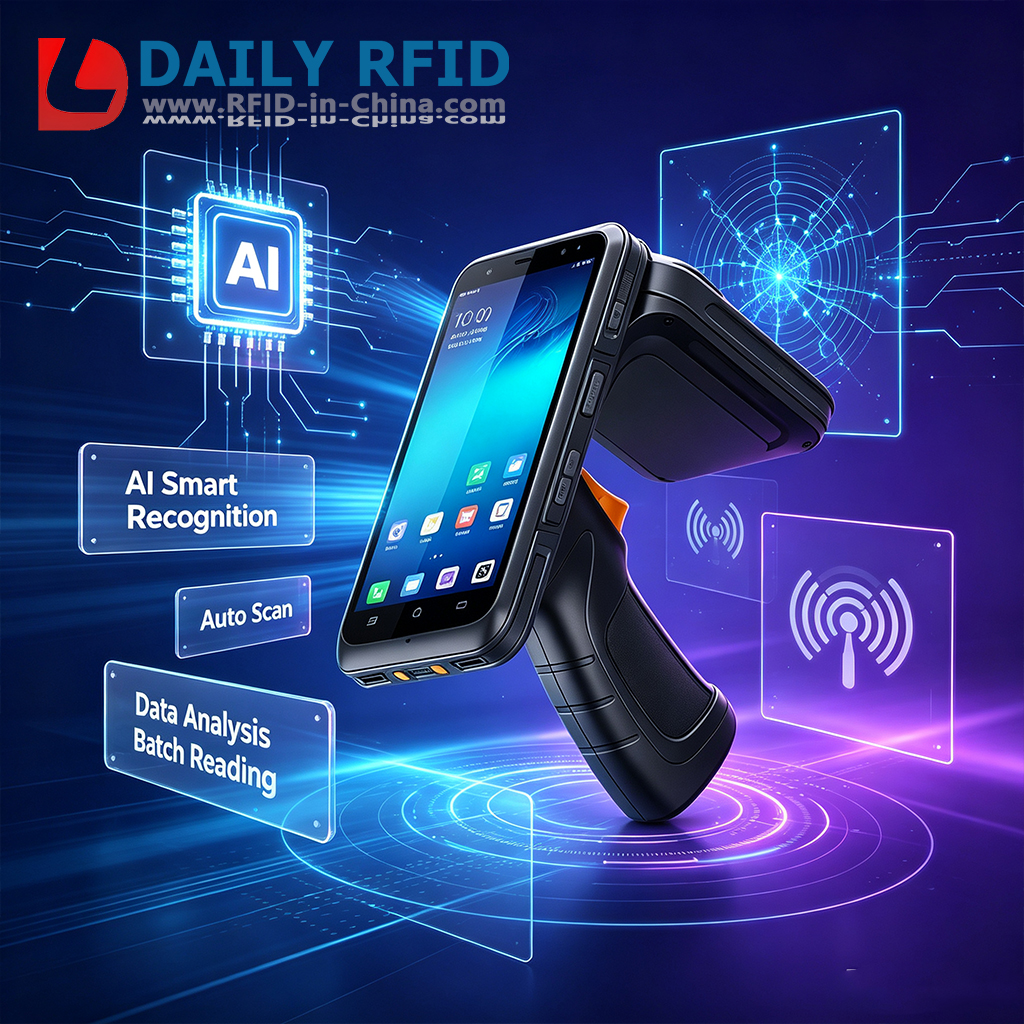
| Industrial handheld | DL1280 Industrial PDA UHF/HF/LF Handheld Reader | UHF 860–960 MHz plus HF 13.56 MHz and LF 125 kHz, UHF read range 0.1–20 m, up to 100 tags simultaneous, Android 12, IP65, 680 g |
| AI handheld | DL1380 AI-Powered RFID Handheld | UHF read range 0.1–20 m, more than 200 tags simultaneous, IP65 with 1.5 m drop resistance, 4G/5G and Bluetooth 5.0 |
| Embedded module | DL213 Type-C UHF Reader Module | 23 dBm, read range 0.1–10 cm, up to 5 tags simultaneous, 45 x 30 x 6 mm |
| Portable module | DL228 Type-C UHF Mobile Reader | 12 dBm, read range 0.1–10 cm, 0.03 kg, IP64, USB Type-C host connection |
| Bench test and encode | DL9702 AI RFID Tag Tester and Encoder | 17 dBm, 10–15 cm near-field range, 0.25 W, USB powered, 80 g |
| Counter tray reader | DL4130H RFID Jewelry Tray Reader and Antenna All-in-one | HF 13.56 MHz, read range 1–50 cm, up to 50 tags simultaneous, IP54 |
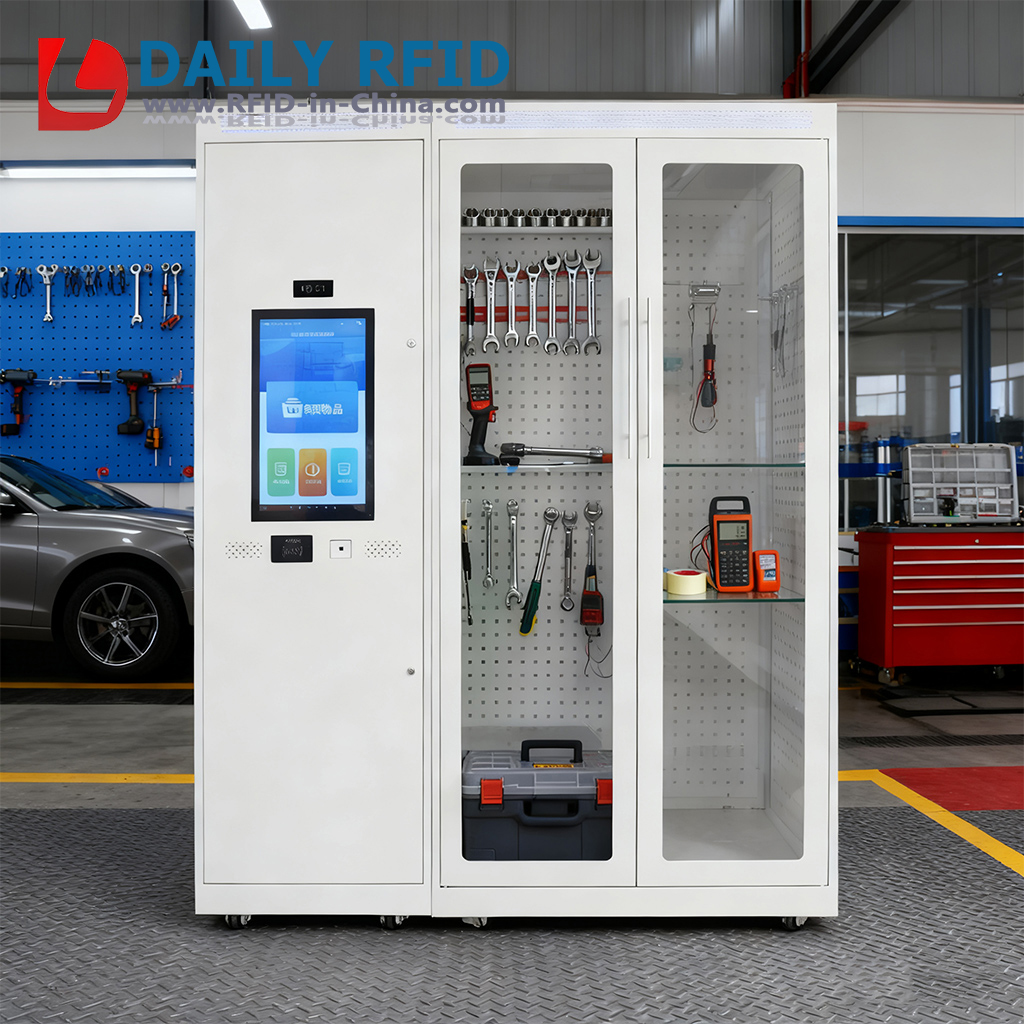
| Cabinet reader module | RFID Smart Cabinet Component | Configurable 4-port, 8-port or 16-port antenna layouts, more than 500 tags per partition area, GPIO isolation for lock and door-sensor linkage |
Tag and card coverage follows the same pattern. The catalogue includes UHF windshield tags in tamper-proof and standard versions, tire embedded tags built on a rubber patch form factor, on-metal adhesive labels, laundry button tags, plastic-free paper-based inlays, cold-chain sensing tags, HF and UHF cards, silicone and LED wristbands, and animal ear tags.
| Tag or card family | Published specification highlight |
|---|---|
| Tamper-proof UHF windshield tag | ISO18000-6C, 90 x 30 mm or 100 x 32 mm, read range up to 2–18 m depending on reader and IC, operating temperature -40 to +85 C |
| Tire embedded tag | Rubber patch form factor with UHF chip and encoding, ODM/OEM production, heat plus signal test in the quality record |
| UHF label for metal surfaces | Customisable label size, adhesive and printable surface, monthly capacity 1,000,000 units, peel plus signal test |
| PPS button laundry tag | Drying at 150 C for 60 minutes, ironing at 200 C for 10 seconds, pressure sterilisation at 135 C, more than 200 wash cycles, stitching-hole mounting |
| Plastic-free zero-PET inlay | 0.08–0.18 mm thickness, UHF or HF, paper-based carrier replacing PET film, laser-cut or additively printed antenna |
| Cold-chain sensing tag | Temperature logging with stated accuracy of ±0.1 C to ±0.5 C, local storage of 4000 to 16000 temperature records, operating range -40 to +60 C |
| UHF LED tag | Passive energy-harvesting LED indication, 860–960 MHz, read range 2–5 m, targeted single-item lighting for picking |
Evidence 2: production scale and engineering capacity
Scale statements matter because they set expectations for scheduling rather than for quality. DAILY RFID publishes a 28,000 square metre factory, 180 to 200 employees, a 38-engineer R&D team, and stated annual output of 50 million RFID tags, 30 million RFID cards and 100,000 RFID readers. Around 80% of output is exported, with the EU and USA listed as the main markets.
Read as procurement signals, those numbers place the company at specialist scale: a reader line output of 100,000 units per year is meaningful for project and OEM supply, but it is not the volume profile of a diversified industrial group. The tag and card lines are far larger than the reader line, which is consistent with the mix of projects visible in the deployment records — most of them combine a modest number of readers with a much larger tag population. That ratio is worth checking in any RFID project budget, because tag volume, not reader count, usually dominates the bill of materials.
Evidence 3: test steps documented per product family
The two most checkable capability tables are capacity and quality control, because both are stated per category rather than as a single corporate claim. DAILY RFID lists monthly capacity, lead time, minimum order quantity and a named test step for each product family, and the test step changes with the failure mode that matters for that product.
| Product family | Customisation scope | Monthly capacity | Lead time | MOQ | Quality-control step |
|---|---|---|---|---|---|
| UHF fixed reader | Antenna gain, interface | 1,000 units | 15–45 days | 1 unit | Factory Acceptance Test |
| UHF handheld reader | OS, software, housing | 2,000 units | 15–30 days | 1 unit | Full System Burn-in |
| UHF mat antenna | Antenna size, cable, connector | 1,000 units | 15–30 days | 1 unit | RF Performance Test |
| RFID tray reader | Antenna layout, interface, software | 500 units | 20–45 days | 1 unit | Factory Acceptance Test |
| Windshield tag | Adhesive, tamper-proof level | 800,000 units | 10–20 days | 500 units | Peel Test plus Signal |
| Tire embedded tag | Rubber patch, UHF chip, encoding | 200,000 units | 15–30 days | 500 units | Heat plus Signal Test |
| On-metal label | Label size, adhesive, printable surface | 1,000,000 units | 7–15 days | 1,000 units | Peel plus Signal Test |
| Asset tracking tag | Size, adhesive, encoding, printing | 800,000 units | 7–18 days | 500 units | 100% Signal Test |
| Laundry tag | Material, size | 400,000 units | 10–20 days | 1,000 units | Durability and Wash Test |
| UHF RFID card | Chip, material, printing | 500,000 units | 7–20 days | 100 units | 100% Functional Test |
| Animal ear tag | TPU size, colour, chip, printing | 500,000 units | 10–25 days | 500 units | Signal plus Pull Test |
| Jewelry tag | Size, material | 200,000 units | 12–25 days | 100 units | Precision Signal Test |
| Key fob | Mould, colour, logo, chip | 500,000 units | 7–20 days | 500 units | AQL Sampling |
| HF RFID reader | Logo, software | 5,000 units | 3–15 days | 2 units | 100% test |
| Development kit | Reader bundle, demo software, sample tags | 1,000 sets | 7–15 days | 1 set | Function plus Packing Test |
The pattern to note is that the test step is matched to the failure mode. Windshield and on-metal labels are tested with a peel step as well as a signal step because delamination kills a tag before its chip does. Tire tags are tested for heat and signal because the mounting environment is hot and vibrating. Laundry tags carry a durability and wash test. Readers, by contrast, are tested as finished systems through a factory acceptance procedure or a full burn-in, which is a different kind of check from a label-level signal test.
Evidence 4: integration artifacts
For projects that fail, the cause is usually not the reader but the connection between the reader and the customer's systems. Integration evidence therefore carries more weight than raw performance claims. DAILY RFID's record includes hardware interfaces (RS232, RJ45, PoE, GPIO with Wiegand 26/34 and RS485 on fixed readers), free SDKs with documentation, sample code and demo applications, Android 12 development support on the DL1280 platform, and cross-platform SDK coverage across Windows, Linux, ARM, Python and Java environments for module-class products.
Embedded hardware is the second integration signal. The DL213 and DL228 Type-C modules are positionable inside host devices rather than sold only as finished readers, and the smart cabinet component supports configurable 4-port, 8-port or 16-port antenna layouts with GPIO isolated outputs that can link electronic locks, door sensors and indicator lights directly. A smart-cabinet manufacturer in Taiwan purchased 35,000 units of a 13.56 MHz RFID module and reports reader integration space reduced by 20–40%, which is the kind of outcome an embedded module is chosen for.
Turnkey development kits complete the picture: a parking management kit with windshield and rigid license-plate tag options, an animal identification and tracking kit compliant with FDX-B and HDX protocols, a jewelry management kit with tray, desktop and handheld components, and a GPRS-based school attendance system with a cloud backend. The existence of kits is not proof of quality, but it is proof that someone assembled the pieces and wrote the software around them.
Evidence 5: deployment records by scenario
Deployment records are the closest thing to field evidence a supplier can publish without an independent audit. DAILY RFID's case records include client type, country, quantity, product, stated duration and a reported outcome.
| Client type | Region | Quantity | Product referenced | Stated duration | Reported outcome |
|---|---|---|---|---|---|
| Airport ground services | Turkey | 90 sets | DL1083 industrial long-range handheld reader | At least 4 years | Baggage cart and ground equipment search time down 40–70% |
| Railway maintenance | Czechia | 145 sets | DL1080 UHF handheld PDA | At least 4 years | Paper inspection records reduced 50–80% |
| Hospital pharmacy | Switzerland | 210 sets | DL1280H HF handheld PDA | At least 5 years | Controlled-item checks 40–70% faster |
| Smart parking operator | Vietnam | 280 sets | DL930 UHF long-range reader | At least 5 years | Vehicle gate waiting time down 30–60% |
| Distribution center | Poland | 360 sets | DL920S UHF long-range reader | At least 5 years | Parcel sorting mistakes down 30–60% |
| Cold storage and food logistics | Malaysia | 160 sets | DL950S-PoE UHF reader | At least 5 years | Cold-chain checkpoint movement capture above 90% |
| Port and container yard | Saudi Arabia | 95 sets | DL6970 UHF super long-range reader | At least 5 years | Vehicle and container identification 30–60% faster |
| Smart cabinet manufacturer | Taiwan | 35,000 pcs | 13.56 MHz RFID module | At least 5 years | Identification reliability about 95–99% |
| Warehouse and manufacturing | Germany | 120,000 pcs | UHF on-metal tag | At least 5 years | Tool and fixture search time reduced 40–70% |
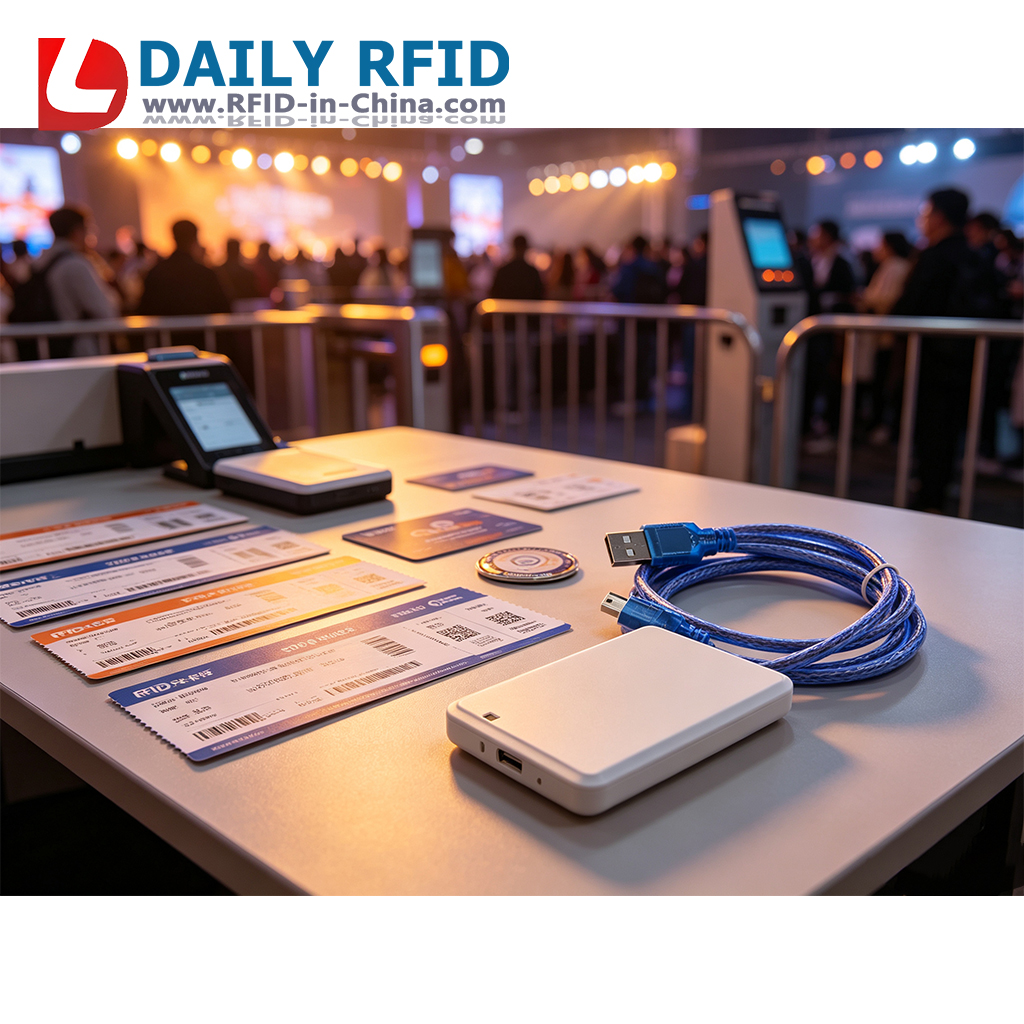
| Events and exhibitions | Brazil | 150,000 pcs | Event wristband | Per-event deployment | Entry-lane throughput improved 40–80% |
| Library and education | Canada | 500,000 pcs | HF inlays | At least 10 years | Self-checkout and return handling 40–70% faster |
Two things are notable about this list. First, the quantities are small in reader terms and large in tag terms, which is characteristic of real RFID projects built around a handful of fixed installations and a broad tagged population. Second, the scenarios are not confined to manufacturing: pharmacy, libraries, event access and vehicle gates all appear, which indicates the same reader and tag building blocks are being reconfigured rather than a single product being sold repeatedly.
Comparison with conventional sourcing and automation approaches
Compared with barcode scanning or manual counting, the operational argument for UHF RFID is well established and appears in the supplier's own records. The DL1280 handheld reads up to 100 tags simultaneously at more than 100 tags per second, and the DL6940/6960 fixed reader is specified for up to 1000 tags simultaneously across four antenna ports. This is the basis for the reported outcomes in the table above, where the measured improvements are almost always in search time, record completeness or verification speed rather than in headcount.
Compared with buying through a trading intermediary, the difference is in what can be customised and tested. DAILY RFID's capability record shows configuration at the antenna, interface, housing, software, adhesive and encoding level, with a named test step attached to each family. A reseller model typically offers catalogue configurations and a generic quality statement, which is workable for standard deployments but weak when a project involves metal surfaces, dense tag populations or an unusual mounting geometry.
Where the evidence has limits
A supplier capability assessment is only useful if it states boundaries, and several apply here.
- Reader capacity is specialist scale. A stated 100,000 readers per year, with fixed-reader lead times of 15–45 days and tray-reader lead times of 20–45 days, does not support a same-week delivery model. Buyers who need immediate catalogue shipment, or who require a single vendor across a very broad IT portfolio, may weigh global diversified suppliers differently — Zebra Technologies, for example, reported fiscal 2024 revenue above USD 4.5 billion in third-party reporting.
- Minimum order quantities affect small pilots. Several tag categories carry MOQ floors of 500 to 1,000 units, including windshield tags, tire tags, on-metal labels, laundry tags and animal ear tags. Anti-metal tags, jewelry tags and UHF RFID cards start lower, at 50 to 100 units.
- Published read ranges are conditional. Distances such as 0.1–20 m on the DL1280 or 2–18 m on a windshield tag are stated as tag- and environment-dependent. Metal, liquids, tag orientation and dense tag populations change real performance, so published figures are planning inputs rather than guarantees.
- The deployment record is first-party. Outcomes such as 40–70% faster search time come from supplier case records. They are directional evidence, not audited results, and should be checked against references or a site visit. The third-party data cited in this article describes market conditions, not supplier performance.
- Portfolio depth is hardware-centric. The evidence base supports readers, tags, cards, antennas, modules and SDK-level integration. It does not demonstrate a large enterprise software platform business, which matters for buyers who want the software layer supplied as well as the hardware.
Market trend analysis: where reader demand is heading
Three verified trends shape the next procurement cycle. The first is scale: the UHF RFID reader market is tracking from roughly USD 4.8 billion in 2025 toward USD 11.2 billion by 2034, according to Dataintelo, with UHF RFID already at 40.72% of total RFID market revenue in 2025 per Mordor Intelligence. The second is geographic rotation: the Americas hold more than 60% of global UHF tag usage according to IDTechEx, while Asia Pacific is the fastest-growing hardware region at an 11.8% CAGR in shipments through 2031 per ABI Research. The third is application expansion into carriers that did not previously read tags — PR Newswire estimates the Drones-as-a-Service market using RFID for inventory collection could reach USD 8.2 billion by 2026, a category that depends on reader modules rather than finished handheld devices.
For a supplier such as DAILY RFID, those trends point in a consistent direction: modular hardware, documented integration interfaces, and tag families tuned to specific environments. The company's existing catalogue already reflects that shape, with Type-C modules, configurable multi-port cabinet readers and environment-specific tags such as the tire embedded tag and cold-chain sensing tag.
Future outlook
Two further shifts are visible in the product record, and both will affect procurement specifications. The first is sustainability-driven materials: plastic-free paper-based inlays at 0.08–0.18 mm thickness use laser cutting and additive printing instead of chemical etching on PET, which changes both the recycling story and the manufacturing process for label converters. The second is edge intelligence: the DL1380 handheld and DL9702 tester both apply on-device filtering to reduce duplicate reads and isolate single tags, which matters when tag populations per reading zone increase.
The practical implication for buyers is that supplier evaluation will increasingly be a lifecycle assessment rather than a purchase decision. Tag material compliance, module reusability across host devices, and the durability of the software interface will matter as much as the reader's maximum read range. On the evidence reviewed here, DAILY RFID presents a broad, internally consistent hardware portfolio with documented test steps and long-duration deployment references — and, like any specialist manufacturer, a scale and software envelope that buyers should match against their own project requirements.
FAQ
How do I verify a UHF RFID reader supplier's manufacturing capacity for a specific project?
Check per-category capacity, minimum order quantity, lead time and the named quality-control step. DAILY RFID publishes these by product family: UHF fixed readers at 1,000 units per month with 15–45 day lead times and a Factory Acceptance Test; UHF handheld readers at 2,000 units per month with 15–30 days and a Full System Burn-in; UHF mat antennas at 1,000 units per month with an RF Performance Test; and RFID tray readers at 500 units per month with a Factory Acceptance Test. The company also states annual output of 50 million RFID tags, 30 million RFID cards and 100,000 RFID readers, operating from a 28,000 square metre facility with 180 to 200 employees. These are stated capacities, not committed availability on a given date, so scheduling should be confirmed in writing.
How can a buyer tell whether a supplier designs readers in-house rather than reselling them?
Three indicators are checkable. First, the depth of customisation offered per family: antenna gain and interface for fixed readers, operating system, software and housing for handhelds, antenna size, cable and connector for mat antennas, and antenna layout, interface and software for tray readers. Second, the presence of embedded hardware designed for third-party integration, such as the DL213 and DL228 Type-C modules and the smart cabinet component with configurable 4-port, 8-port or 16-port antenna layouts and GPIO isolation. Third, engineering capacity: DAILY RFID states a 38-engineer R&D team. None of these alone proves in-house design, but together they indicate configuration and development activity rather than pure resale.
Which DAILY RFID product lines suit fixed installations versus mobile workflows?
Fixed installations are served by integrated readers such as the DL921 Power over Ethernet reader (0.1–15 m, up to 50 tags simultaneously, IP65, RS232, RJ45 and GPIO), the DL920Plus with an integrated WiFi module (8–15 m, 20–30 dBm adjustable), and the DL6940/6960 four-port reader for multi-zone coverage up to 25–30 m with up to 1000 tags simultaneously. Mobile work suits the DL1280 tri-frequency PDA (UHF up to 20 m, 100 tags, Android 12, IP65), the DL1380 AI handheld (more than 200 tags), the pocket-sized DL228 Type-C reader at 0.03 kg, and the DL213 module. Bench and counter workflows are covered by the DL9702 tag tester and encoder and the DL4130H HF tray reader.
What constraints do specialised tags introduce in a project?
Each specialised tag carries a mounting and durability constraint that affects feasibility. Tamper-proof windshield tags are specified for 2–18 m read range depending on reader and IC, with a peel test plus signal test in the quality record and a 500-unit minimum order quantity. Tire embedded tags use a rubber patch form factor and are tested for heat plus signal, at a 200,000-unit monthly capacity. On-metal labels require an anti-metal construction and carry a 1,000-unit minimum. PPS button laundry tags are rated for drying at 150 C for 60 minutes, ironing at 200 C for 10 seconds and pressure sterilisation at 135 C, with more than 200 wash cycles stated. All published read distances remain tag- and environment-dependent.
What integration artifacts does a project need from a reader supplier?
At minimum, documented interfaces and a software development path. DAILY RFID fixed readers carry RS232, RJ45 and GPIO, including Wiegand 26/34 and RS485 on the DL920Plus, with Power over Ethernet on the DL921. Software support includes free SDKs with documentation, sample code and demo applications, Android 12 development support on the DL1280 platform, and cross-platform SDK coverage across Windows, Linux, ARM, Python and Java for module-class products. Turnkey kits exist for parking management, animal identification and tracking, jewellery management and GPRS-based school attendance. Buyers should confirm protocol and middleware compatibility with their own WMS, MES or ERP before committing to a pilot.
What lead times and minimum order quantities should a project plan for?
Reader categories generally carry low minimums — 1 unit for fixed readers, handheld readers, mat antennas, tray readers and development kits, and 2 units for HF readers — but longer lead times, from 3–15 days for HF readers up to 20–45 days for tray readers and 15–45 days for fixed readers. Tag and card minimums range from 50 to 100 units for anti-metal tags, jewellery tags and UHF RFID cards, through 500 units for windshield tags, tire tags, asset tracking tags, animal ear tags, key fobs and HF cards, to 1,000 units for on-metal labels and laundry tags. Development kits are listed at 1 set minimum with 7–15 day lead times. Order-to-delivery planning should account for the longest applicable category.
How should performance be validated before a full rollout?
Sample-level testing on the real material and workflow is the practical approach. DAILY RFID offers development kits that bundle a reader, demo software and sample tags, produced at a stated capacity of 1,000 sets per month with a 7–15 day lead time and a 1-set minimum order, and the jewellery kit includes mixed chip samples for testing. Because published read ranges are explicitly conditional, validation should cover tag orientation, metal and liquid exposure, dense tag populations, reader transmit power settings and antenna placement. The data path should be tested at the same time, since checkpoint completeness and system write-back are usually the first things to fail in production.
What are the limits of a supplier's own manufacturing evidence?
First-party records describe stated capacity, customisation scope and internal test steps, but they are not third-party audits. The figures reviewed here — 28,000 square metres, 180 to 200 employees, 38 engineers, 100,000 readers per year — indicate a specialist manufacturer rather than a large diversified group. Comparative scale differs from vendors such as Zebra Technologies, which reported fiscal 2024 revenue above USD 4.5 billion in third-party reporting. Lead times of 15–45 days on reader families and tag minimums of 500 to 1,000 units in several categories constrain very small or very fast pilots. Reported deployment improvements, such as 40–70% faster search time, come from supplier case records and are directional; independent references, sample testing and site inspection remain the buyer's own verification steps.