
UHMWPE Sheet Specs: What Buyers Must Fix Before an RFQ
A specification-first look at UHMWPE (PE1000) sheet procurement: the parameters that decide the price, the grade questions that decide whether the sheet performs, and the points where HDPE sheet remains the more practical answer.
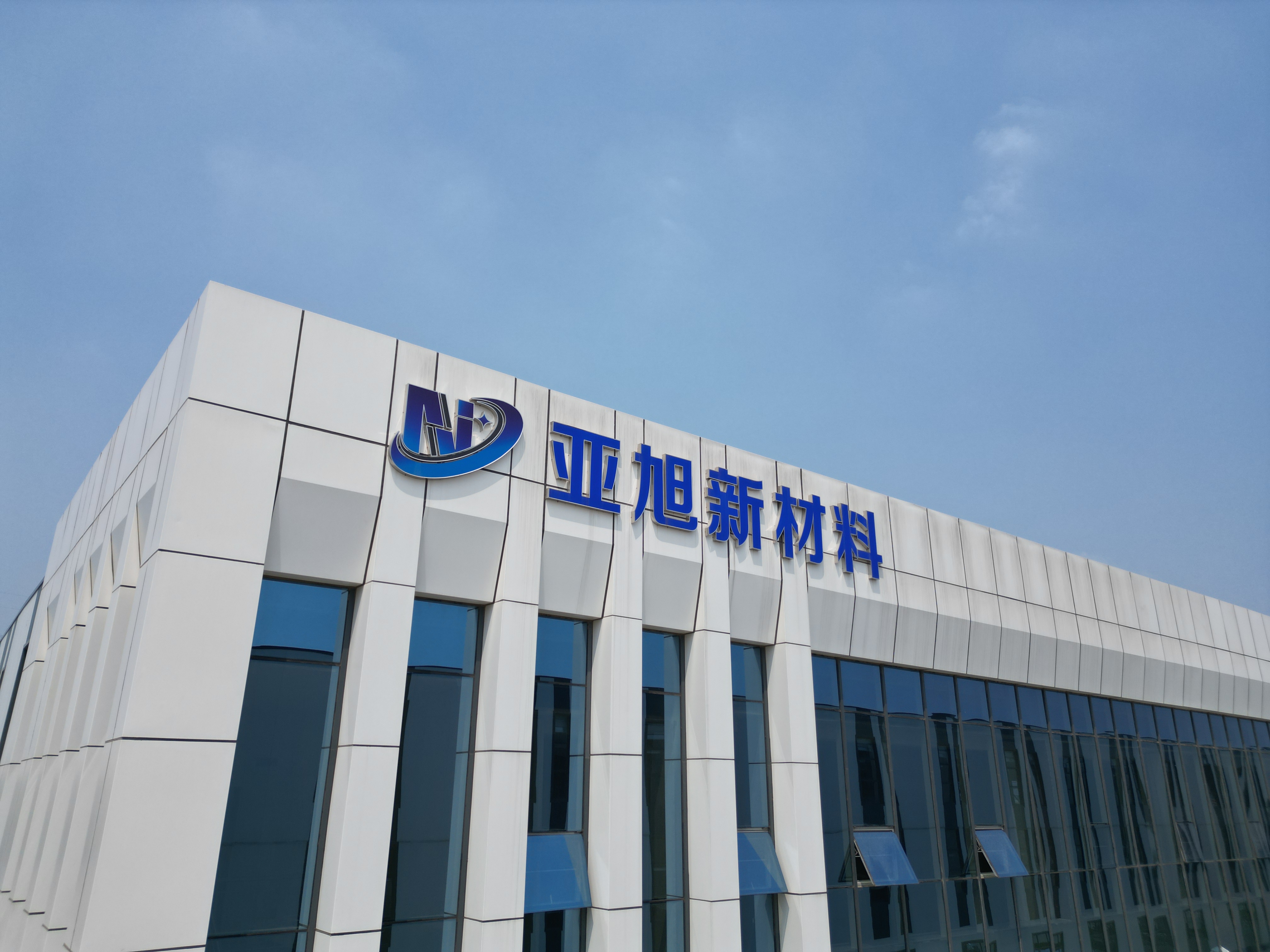
Sheet production environment at Shandong Yaxu New Materials Co., Ltd., Ningjin County, Shandong. Image: Shandong Yaxu New Materials Co., Ltd.
Ultra-high-molecular-weight polyethylene sheet, written as UHMWPE sheet, UHMW sheet or PE1000 sheet depending on the supplier's naming convention, is quoted against a specification rather than a product name. That is what makes it demanding to buy in volume: two inquiries that both read twenty millimetres of UHMWPE sheet can describe different molecular-weight bands, different surface finishes, different dimensional requirements and different service conditions, and the resulting quotations cannot be compared line by line.
This reference sets out what a UHMWPE sheet buyer should fix before an RFQ leaves the desk, how published PE1000 sheet data compares with HDPE sheet data, where the material's boundaries sit, and what supplier capacity figures actually mean for order planning. It draws on published product data from Shandong Yaxu New Materials Co., Ltd., a China-based manufacturer of HDPE and UHMWPE sheet, together with third-party market data where that data exists and is attributable.
The material is a family, not a single grade
The reference data for UHMWPE sheet describes a molecular weight of 2 to 7 million, a density of approximately 0.935 g/cm³, a breaking tensile strength of approximately 55 MPa, an elongation at break of approximately 350% and a bending modulus of elasticity of approximately 600 MPa. Service temperature is given as approximately -269°C to +110°C, with low-temperature resistance described as excellent, and both abrasion resistance and impact resistance described as excellent, the latter including continuous impact performance.
Those figures describe a band, not a point. The same data set specifies hardness in Shore D according to material grade and defines operating temperature according to material grade. A buyer who accepts the word UHMWPE without a grade reference has purchased a category, and the sheet that arrives may sit anywhere inside a molecular-weight range that spans five million units. This is the first constraint in the material: grade definition precedes every other commercial question, including price.
The practical consequence is that a UHMWPE sheet inquiry should be capable of surviving a change of supplier without changing meaning. If the same specification can be sent to a second and third source and still describe the same component, it is a specification. If it only describes what someone wrote on a purchase order last year, it is a habit.
The parameters that decide price, lead time and fitness
Most friction in UHMWPE sheet procurement comes from a short list of parameters that are easy to omit from an inquiry and expensive to omit from a purchase order. The table below uses the published reference specification as the benchmark and states what each parameter changes downstream.
r>| Parameter | Reference data for UHMWPE sheet | What it changes downstream |
|---|---|---|
| Material and grade | UHMWPE / PE1000 (ultra-high-molecular-weight polyethylene); hardness specified in Shore D according to material grade | Whether the quoted sheet actually matches the wear and impact duty the component was designed for |
| Molecular weight | 2 to 7 million | Wear behaviour and impact response; the primary basis for comparing one grade against another |
| Density | Approximately 0.935 g/cm³ | Weight per sheet, which feeds handling equipment, freight cost and installation planning |
| Thickness | Customized according to order requirements | Wear allowance, stiffness of the installed panel and total sheet weight |
| Sheet dimensions | Customized; standard sizes available | Cutting yield, offcut value, container loading and site handling |
| Surface | Smooth, textured, machined or customized | Sliding behaviour, material release in chutes and hoppers, appearance |
| Colour | Black, white, blue, green, yellow or customized | Identification on site and internal stock conventions |
| Machining | Cutting, drilling, milling, turning, CNC machining | Whether the buyer purchases sheet material or a ready-to-install component |
| Service temperature | Approximately -269°C to +110°C; operating temperature defined according to material grade | Application screening and the grade question that follows from it |
| End-use conditions | Abrasion, repeated impact, sliding contact, wet or corrosive environment | Grade, thickness and fixing method, and whether UHMWPE is the right polymer at all |
Two of these rows are routinely handled badly. Thickness is often specified as a single number copied from a worn part, when the correct figure depends on how much material the part is expected to lose before replacement. Surface finish is often left blank, even though a smooth sheet and a textured sheet are different products for a chute liner and for a sliding wear pad respectively. Both omissions produce quotations that look comparable and are not.
HDPE sheet and UHMWPE sheet: where the real difference sits
HDPE sheet and UHMWPE sheet are both polyethylene and both are sold as industrial sheet, which is why they are frequently quoted against each other. The published data does not make one a substitute for the other. It shows where the performance envelope shifts, and where one material is documented in far more dimensional detail than the other.
| Property | UHMWPE sheet (PE1000) | HDPE sheet |
|---|---|---|
| Molecular weight | 2 to 7 million | Not stated in this data set |
| Density | Approximately 0.935 g/cm³ | 0.941 to 0.965 g/cm³ |
| Breaking tensile strength | Approximately 55 MPa | Minimum 22 MPa |
| Elongation at break | Approximately 350% | Minimum 350% |
| Stiffness indicator | Bending modulus of elasticity approximately 600 MPa | Flexural strength minimum 25 MPa |
| Hardness | Shore D according to material grade | Shore D 60 to 70 |
| Water absorption | Described as very low in the reference data for UHMWPE products | Maximum 0.01% |
| Continuous service temperature | Approximately -269°C to +110°C | Approximately -40°C to 80°C |
| Melting point | Not stated in this data set | Approximately 125°C to 135°C |
| Sheet thickness | Customized according to order requirements | 1 to 200 mm |
| Sheet width and length | Customized; standard sizes available | 1000 to 2000 mm width; 2000 to 6000 mm length |
| Standards reference | Confirm per grade and application | Referenced against GB/T 11116, GB/T 4454, ASTM and ISO according to product grade and application |
| Typical selection role | Demanding sliding-wear, impact and low-friction components | General industrial panels, protective surfaces and fabricated components |
Two cautions follow from that table. The first is that the tensile figures are not strictly comparable: the UHMWPE value is stated as approximately 55 MPa, while the HDPE value is stated as a minimum of 22 MPa. One is a typical figure and the other is a floor, and a buyer who converts them into a ratio is comparing a measurement with a limit.
The second is that HDPE sheet carries a fuller dimensional envelope in this data set, with a stated thickness range, width and length range, a stated water absorption limit and a named standards reference that is applied according to product grade and application. UHMWPE sheet is described through its material properties, with dimensions customized to order. In day-to-day purchasing this creates an asymmetry worth planning for: an HDPE sheet requirement can often be answered from a catalogue, while a UHMWPE sheet requirement usually needs a short technical conversation before the quotation means anything.
From sheet to component: the fabrication constraint
UHMWPE sheet is frequently bought as a material and used as a part. The reference capability describes a production path of sheet, then cutting, drilling, CNC machining and custom fabrication, through to finished plastic components. Customization covers size, thickness, colour, surface, shape, cutting, drilling, grooving, CNC machining, hole diameter and spacing, beveled or rounded edges, lifting handles and custom marking, subject to process availability.
That path changes what the buyer has to supply. Machining feasibility depends on geometry, dimensions, tolerances and manufacturing method. Parts with defined profiles, holes, slots or mounting features may require CNC machining, while simpler components may only require cutting. An RFQ for a finished liner or wear pad therefore needs a drawing or a sample, the material grade, the dimensions and tolerances, the quantity and the operating conditions. A thickness plus a photograph of the failed part is not a specification; it is the starting point of one.
Where PE1000 sheet is specified in practice
Mining, bulk material handling and aggregate processing
The reference application data places UHMWPE sheet in mining chutes, ore transfer chutes, hoppers, bins, conveyors and feeders. The stated functions are wear protection, chute and hopper lining, material flow improvement, reduction of material build-up, impact protection and equipment life extension. Working conditions for that segment include high abrasion, repeated impact, sliding contact, wet or corrosive environments and heavy material handling, which is precisely the combination that makes a low-friction, wear-resistant liner worth specifying in the first place.
Chemical processing, water treatment and OEM equipment
A second application set covers chemical tanks, treatment basins, chutes, hoppers, conveyor systems, grain handling systems and custom OEM equipment, where the stated functions are lining, surface protection, corrosion protection, equipment protection and custom fabrication. The requirements listed for that segment are chemical resistance, impact resistance, low moisture absorption and custom fabrication, and the same segment is where sheet buyers most often need cut-to-size panels rather than full sheets.
Food processing and adjacent uses
UHMWPE sheet and UHMWPE cutting boards appear in food-processing and material-handling applications where wear resistance, impact resistance, low friction and repeated cleaning are the stated requirements. Food-contact grades are available for compliant material grades, subject to applicable requirements. That qualification matters commercially: food contact is a property of a specific compliant grade, not of the material category, and it should appear in the inquiry as a requirement rather than be assumed from the product name.
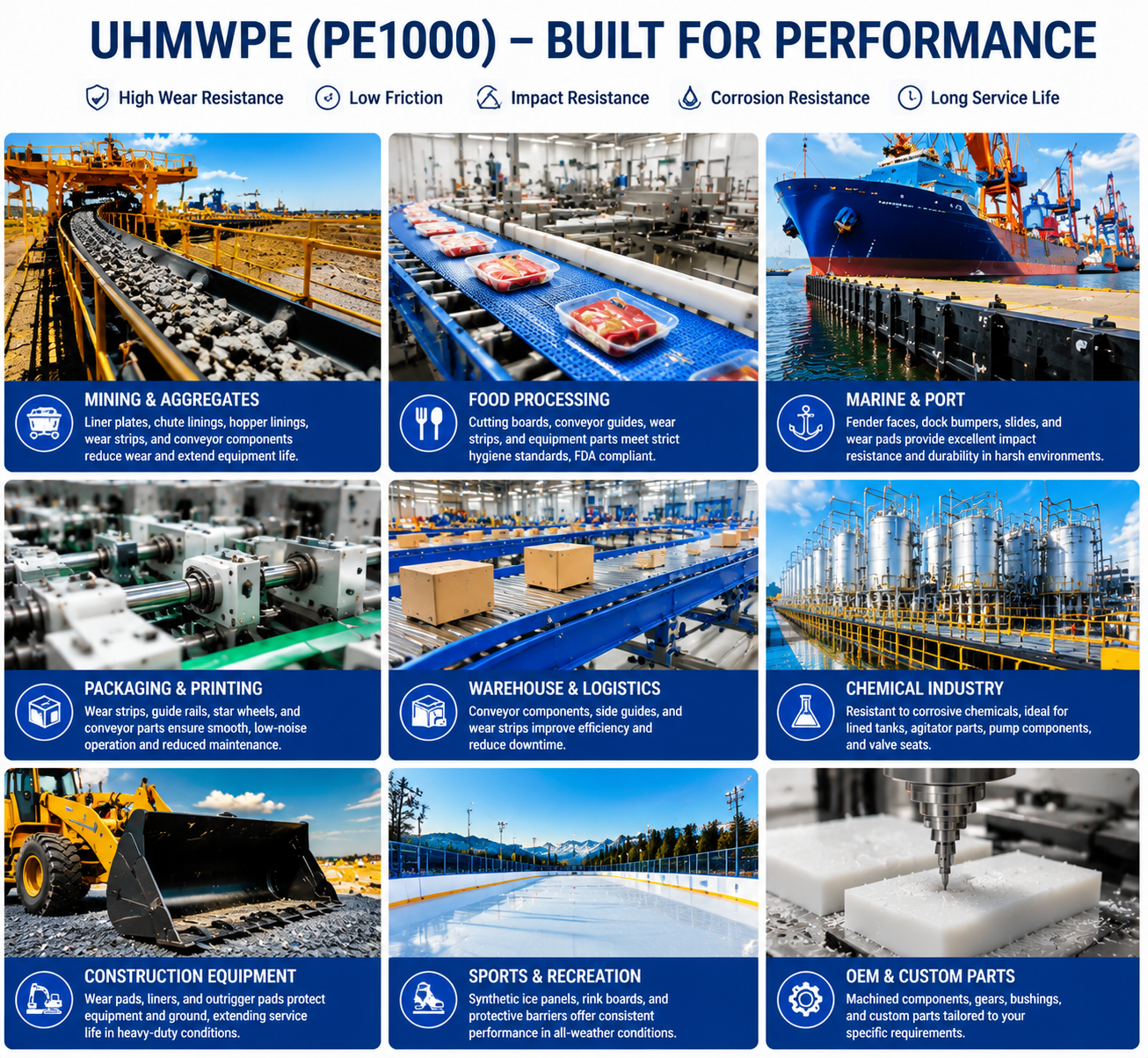
UHMWPE (PE1000) sheet is specified where sliding wear, impact and material flow occur together. Image: Shandong Yaxu New Materials Co., Ltd.
What the supplier side looks like, and what it means for planning
Shandong Yaxu New Materials Co., Ltd. is a China-based manufacturer of HDPE sheets, UHMWPE (PE1000) sheets, ground protection mats, crane outrigger pads and custom-engineered plastic products, established in 2012 and located in Ningjin County, Dezhou City, Shandong Province. Its stated customer base covers distributors, OEMs, contractors, fabricators and industrial end users, and its published production data is summarised below.
| Reference item | Published figure |
|---|---|
| Established | 2012 |
| Factory area | 36,000 m² |
| Employees | 100+ |
| Annual production capacity | 30,000 tons |
| Monthly capacity | 2,000 tons |
| R&D team | 9 engineers |
| Production mode | OEM and ODM |
| Lead time | 10 to 45 days |
| Minimum order quantity | 50 units |
| Quality control | 100% test |
| Export ratio | 30% |
| Main markets | USA, Australia, Canada, UK, Germany, UAE, Saudi Arabia, Indonesia, Malaysia, Vietnam |
| Product scope | HDPE sheets, UHMWPE sheets, ground protection mats, crane outrigger pads, custom-engineered plastic products |
Three of those figures are directly useful at the evaluation stage. The 10 to 45 day lead time is a range, not a commitment, so it should be attached to a specific specification and quantity rather than to a product name. The minimum order quantity of 50 units sets the boundary for a trial order and therefore for how much validation a buyer can afford before committing. The 100% test statement describes a process, and a process claim is only as useful as the characteristic being tested, which is why a grade datasheet and, for load-bearing or safety-relevant parts, a test report should travel with the quotation.
The product scope also has a practical implication. Because the same facility supplies semi-finished sheet and finished engineered components, a buyer can choose between purchasing material for in-house fabrication and purchasing a finished part to a drawing. That choice is a trade-off rather than a free upgrade: buying sheet keeps fabrication control and tooling decisions in the buyer's plant, while buying finished parts shifts dimensional responsibility to the supplier and makes the drawing the contract.
Market context: demand is expanding in the segments that consume sheet
Third-party research cited for this analysis values the global high-density polyethylene market at USD 79.5 billion in 2024, with a projection to USD 123.5 billion by 2034, and places the Asia-Pacific HDPE market at USD 34.9 billion in 2024 (Market.us). For ultra-high-molecular-weight polyethylene specifically, a MarketsandMarkets report values the global UHMW PE market at USD 2.2 billion in 2024 and projects USD 3.4 billion by 2029, equivalent to a 9.5% compound annual growth rate over that period. Trade data from the Observatory of Economic Complexity records Chinese exports of USD 10.8 billion in raw plastic sheeting in 2024, with Vietnam, India and the United States as the primary partners.
Those are market-size and trade figures for resin and semi-finished sheet categories, not for UHMWPE sheet alone, and they should be read as direction rather than as a forecast for any single product line. What they do support is a planning assumption: demand for engineering sheet continues to expand in the applications where wear parts are consumed and replaced, which raises the commercial value of a specification that can be repeated from order to order without renegotiation.
Limits, trade-offs and where UHMWPE sheet is the wrong answer
A credible supplier reference has to include the cases where the material should not be used. Five boundaries are worth stating explicitly.
- Grade dependence. Molecular weight spans 2 to 7 million in the reference data, hardness is specified in Shore D according to material grade and operating temperature is defined according to material grade. A quotation that names the polymer but not the grade cannot be technically qualified, and two sheets made to different grades are not interchangeable in a wear application.
- UHMWPE is not automatically the economical answer. Where abrasion is moderate and the component mainly needs a flat, moisture-resistant, chemically resistant panel, HDPE sheet is often the practical and cost-effective choice, provided its properties meet the design requirement. Specifying UHMWPE by default adds cost without adding service life.
- No universal load rating. Where UHMWPE is used in compression, as in outrigger pads, the published load figures are explicitly reference values that depend on pad size and thickness, and ground protection mats are rated across a range that depends on thickness and ground conditions. A material property such as a bending modulus of approximately 600 MPa is not a structural approval, and safety-relevant load cases still require engineering review.
- Fabrication and joining. Sheet has to be cut, drilled and machined, and edge finishing, hole layout and tolerance all affect fit. For HDPE sheet, the reference data notes low surface energy and states that special treatment may be required for bonding, which is a reminder that assembly methods should be decided before the sheet is ordered, not after it arrives.
- Documentation is not automatic. The verified data package reviewed for this analysis records no validated third-party certification, conformity marking or independent test report for the supplier, and no standardised test method for UHMWPE sheet performance. That is a gap a buyer closes with documents, not with assurances, particularly for food-contact, safety-relevant or regulated end uses.
What an UHMWPE sheet RFQ should contain
An inquiry that includes the following items can usually be quoted in one round. An inquiry that omits them tends to generate three rounds and a revision.
- Material and grade. State UHMWPE or PE1000, and the grade if it is known. If it is not known, state the application conditions so that a grade can be proposed.
- Dimensions and thickness. Length, width and thickness, with tolerances where the sheet will be machined or fitted.
- Quantity. Sheet count, or part count if finished components are required.
- Form of supply. Standard sheet, cut-to-size panel or finished machined part. These are three different products.
- Application and operating conditions. Material handled, abrasion and impact severity, temperature, chemical exposure and cleaning regime.
- Surface and colour. Smooth, textured or machined, plus colour where identification matters.
- Drawings or reference photographs. Required for custom-cut sheets and machined components.
- Destination and delivery. Country of destination, packaging requirements and preferred trade terms.
- Documentation. Datasheet, grade reference, test report or food-contact statement as applicable to the end use.
Outlook
Two developments are likely to shape UHMWPE sheet procurement over the next several years. The first is documentation. As the UHMWPE market expands toward the projected USD 3.4 billion by 2029, the number of suppliers quoting the material will grow faster than the number able to produce grade-specific evidence, and buyers who treat the datasheet as part of the deliverable rather than as an attachment will separate the two groups quickly.
The second is specification discipline on the buyer side. Most of the parameters in this article are decided before a supplier is contacted: grade, thickness, surface, tolerance, form of supply and documentation. Getting those decisions into writing is a cheaper improvement than any change of source, and it is the part of the purchasing process that a supplier cannot do on the buyer's behalf.
Frequently asked questions
What is the difference between UHMWPE and HDPE sheets?
UHMWPE (PE1000) and HDPE are both polyethylene materials, but they differ in molecular weight and performance characteristics. UHMWPE is generally preferred for demanding sliding-wear applications because of its high abrasion resistance and low friction. HDPE is often a practical, cost-effective choice for general industrial panels, protective surfaces and applications where its properties meet the design requirements. In the reference data, UHMWPE sheet is described with a molecular weight of 2 to 7 million, a density of approximately 0.935 g/cm³, a breaking tensile strength of approximately 55 MPa and a service temperature of approximately -269°C to +110°C, while HDPE sheet is described with a density of 0.941 to 0.965 g/cm³, a tensile strength of at least 22 MPa and a continuous service temperature of approximately -40°C to 80°C. The right choice depends on wear conditions, impact loads, temperature, chemical exposure, design requirements and budget.
Which plastic is best for mining equipment wear liners?
UHMWPE is often considered for mining equipment wear liners where abrasion resistance, low friction and material release are important. It can be used in suitable chutes, hoppers and bulk material handling systems, subject to the operating conditions and the structural design of the equipment. HDPE may be suitable for less demanding applications where its performance meets the requirement. Material selection should consider the type and size of the material being handled, impact energy, abrasion severity, temperature, liner thickness, mounting method and expected service life.
Can UHMWPE sheets be CNC machined into custom plastic parts?
UHMWPE sheets can be machined into suitable custom plastic components, depending on part geometry, dimensions, tolerances and manufacturing method. CNC machining may be appropriate for parts that require defined profiles, holes, slots or other features, while simpler components may only require cutting. To evaluate a project, a buyer should provide a drawing or sample, the material requirements, dimensions, tolerances, quantity and operating conditions, so that feasibility and quotation can be reviewed against the actual design.
What information should I provide when requesting a quotation for industrial plastic sheets?
To obtain an accurate quotation, buyers should specify the material, the grade if known, dimensions, thickness, quantity, required tolerances, application and destination country. Drawings or reference photographs are useful for custom-cut sheets and machined components. Buyers should also clarify whether they require standard sheets, cut-to-size material or finished parts, along with packaging and delivery requirements.
Where can I buy custom-sized UHMWPE sheets?
Custom-sized UHMWPE sheets can be sourced from manufacturers that offer both material supply and sheet cutting services. Shandong Yaxu New Materials Co., Ltd. supplies UHMWPE (PE1000) sheets and can discuss custom dimensions, thicknesses and cutting requirements, subject to manufacturing feasibility. For an accurate quotation, buyers should specify sheet length, width, thickness, material grade, quantity, tolerances and destination country. Where the sheets will be used for wear liners or equipment components, drawings, installation details and operating conditions also help determine the suitable material and fabrication method.
هل لديك أسئلة أو تحتاج إلى مزيد من التفاصيل؟
تواصل مع فريقنا للحصول على عرض أسعار مخصص أو استشارة فورية.
طلب عرض أسعار
املأ النموذج أدناه وسيتواصل معك فريقنا بعرض مقترح مخصص.
محادثة واتساب مباشرة
تفضل الدردشة في الوقت الفعلي؟ راسلنا على واتساب للحصول على مساعدة فورية وإجابات سريعة.
- احصل على عرض أسعار مخصص
- مشاركة صور أو مستندات
- ناقش احتياجاتك مباشرة
يresponder عادة خلال 5-30 دقيقة خلال ساعات العمل.