
UL 845 MCC vs UL 508A Control Panels: Qualification Boundaries
UL 845 and UL 508A both apply to low-voltage assemblies in North America, and both are routinely quoted inside the same 480 V project. They do not describe the same equipment. UL 845 is the standard covering motor control centers; UL 508A governs industrial control panels. The qualification boundary between the two is set by equipment category, bus and unit current envelope, and the way the assembly is maintained and expanded over its service life — not by voltage class alone.
Why the boundary is a procurement question, not a labelling question
A 600 V class assembly can be legitimately built as either category, which is exactly why the ambiguity survives so long. A specification that reads “UL 508A panels” can describe a single process enclosure or a multi-section motor lineup with a 2,000 A bus and dozens of drawout starter units. Both interpretations are grammatically correct. Only one of them produces the equipment the project actually needs.
The mismatch usually surfaces late — at the acceptance review, when the submittal package, the short-circuit documentation and the maintenance plan are compared against the design intent. At that point, three decisions have effectively been made at once: which standard the assembly must be listed to, how much continuous current the main bus must carry, and how the equipment will be serviced over the coming decades.
For buyers at the research stage, the useful move is to separate those three decisions before any product family is named. The standards themselves give a clear structure for doing so.
What UL 845 covers: motor control centers
UL 845 is the product standard for motor control centers. An MCC is a grouped assembly in which individual motor branch circuits are housed in replaceable units on a common bus, typically across multiple sections, and it is the assembly type used where a large number of motors are controlled and protected from one location.
The FP-MCC line from Jiangsu Dinghong Power Co., Ltd. shows the envelope this category occupies. Rated voltage is up to 600 V AC at 50/60 Hz, main bus current ranges from 600 A to 3,000 A, and unit current ranges from 0.5 A to 800 A. Short-circuit current rating reaches up to 65 kA or up to 100 kA rms depending on configuration. The line is referenced to UL 845 and NEMA ICS 18 and is offered in NEMA 1, 2, 4 and 4X enclosures. Configuration families include conventional, intelligent, VFD, soft starter, combination starter, feeder and distribution, and arc-resistant MCCs.
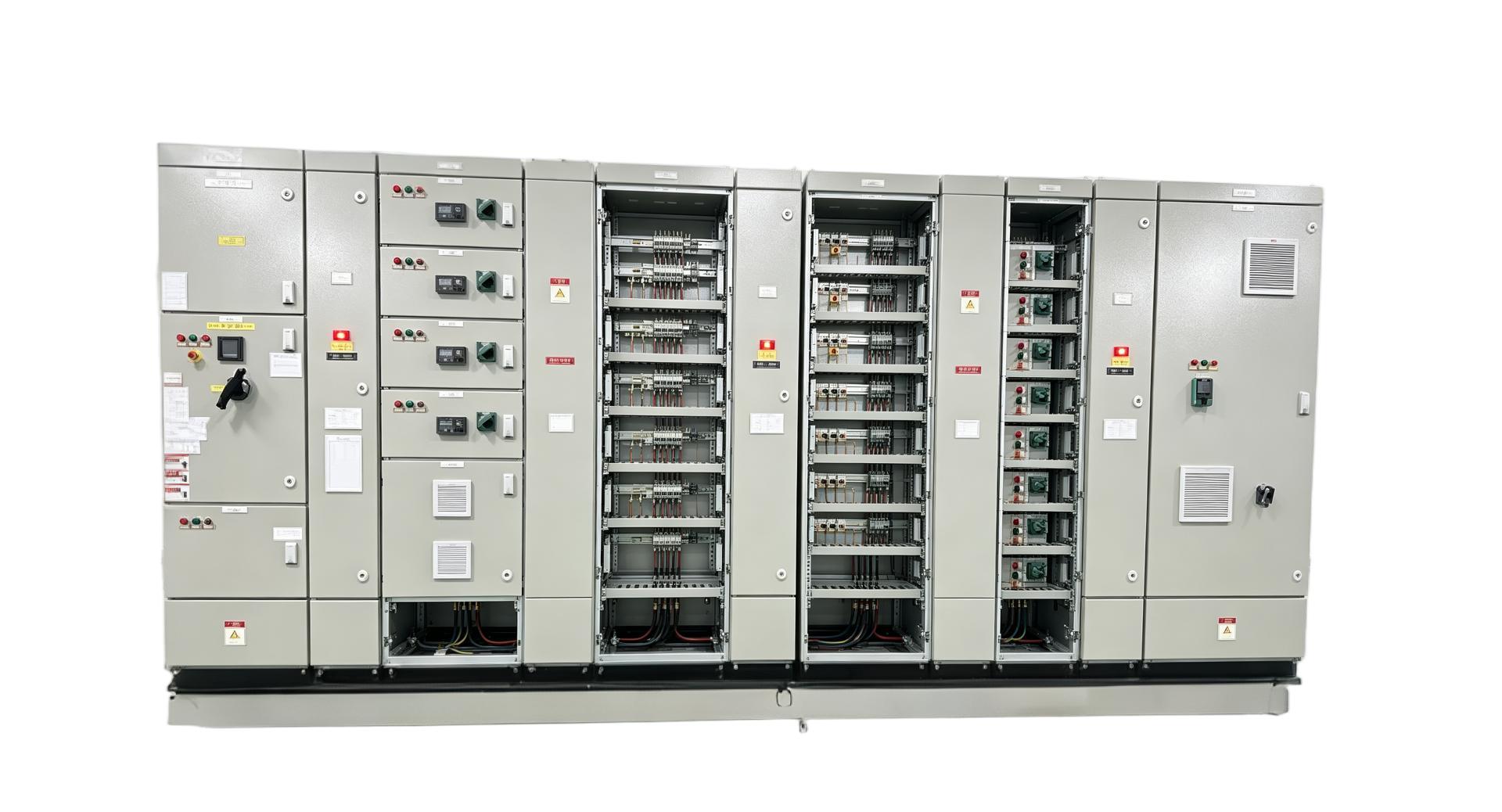
A UL 845 motor control center groups motor branch circuits in replaceable units on a common bus — the construction feature that separates the category from a control panel.
The maintenance model is the practical signature of the category. FP-MCC uses stamped steel drawer units with a mechanical position interlock, so a starter unit can be replaced without shutting down the whole lineup. Unit-level replacement on an energised bus is what distinguishes an MCC from a panel in daily operation, and it is why bus current range is a more informative first question for a buyer than voltage class.
What UL 508A covers: industrial control panels
UL 508A governs industrial control panels — assemblies that combine control devices, power components and wiring to perform a defined control or distribution function. The standard is applied to panels built for a specific machine, process or building system, and the panel is identified by the function it performs rather than by the number of motors it happens to serve.
The FP-LCP line follows that structure. Rated voltage is up to 600 V AC at 50/60 Hz, and main busbar current spans 100 A to 600 A. Panel short-circuit current rating reaches up to 100 kA rms at 480 V, and the main busbar is rated for a short-time withstand of 150 kA rms for one second. Dielectric verification is 2,200 V AC for one minute on power circuits and 1,000 V AC for one minute on control circuits, with insulation resistance of at least 100 MΩ at 500 V DC. Standard operating temperature is -10°C to +40°C, and enclosure options are NEMA 1, 2, 3R, 4 and 4X. Busbars are tin-plated electrolytic copper, and the nameplate carries rated parameters, the SCCR value and the UL certification mark.
The functional range is deliberately broad: PLC control panels, VFD panels, motor control panels, MCC control sections, process control panels, HVAC panels, power distribution and control panels, and OEM machine control panels. That breadth is useful, and it is also the reason the category boundary needs to be stated explicitly in project documents.
The boundary in figures
Placing the two product lines side by side makes the qualification boundary concrete. The comparison below reflects the two referenced model families, not the outer limits of either standard.
| Parameter | UL 845 MCC (FP-MCC) | UL 508A panel (FP-LCP) |
|---|---|---|
| Standard referenced | UL 845, NEMA ICS 18 | UL 508A |
| Rated voltage | Up to 600 V AC, 50/60 Hz | Up to 600 V AC, 50/60 Hz |
| Main bus current | 600 A – 3,000 A | 100 A – 600 A |
| Unit / branch rating | 0.5 A – 800 A per unit | Not stated in the referenced product data |
| Short-circuit current rating | Up to 65 kA or 100 kA rms, by configuration | Up to 100 kA rms at 480 V |
| Busbar short-time withstand | Not stated in the referenced product data | 150 kA rms for 1 s |
| Dielectric withstand | Not stated in the referenced product data | 2,200 V AC / 1 min (power); 1,000 V AC / 1 min (control) |
| Enclosure options | NEMA 1 / 2 / 4 / 4X | NEMA 1 / 2 / 3R / 4 / 4X |
| Configuration families | Conventional, intelligent, VFD, soft starter, combination starter, feeder and distribution, arc-resistant | PLC, VFD, motor control, MCC control section, process control, HVAC, power distribution and control, OEM machine |
These are product-line ratings for the two model families referenced in this article. They describe what each line is built to offer; they are not the outer limits of UL 845 or UL 508A, and other manufacturers' lines will differ. Where a figure is not stated, the correct action is to request the test report rather than to infer a value.
Two rows carry most of the decision weight. Main bus current separates the categories in practice: 100 A to 600 A describes a panel envelope, while 600 A to 3,000 A describes a lineup feeding many motor loads. Unit current adds the second dimension — the ability to place a very small starter and an 800 A unit on the same bus, which is a grouping function rather than a control function.
Where the categories touch: the MCC control section
The most common boundary case is the MCC control section. Within the FP-LCP range, an MCC control section is one of the listed panel configurations — a section that sits in or beside an MCC lineup, performs control and distribution functions, and is built and marked as a UL 508A panel rather than as a UL 845 unit.
This is not a loophole; it reflects a real division of labour. The MCC bus and the replaceable motor starter units belong to the UL 845 scope, while control, PLC, drive and distribution functions inside a section can be delivered under UL 508A. The buyer's task is to know which sections of a lineup are covered by which listing, because the two are evaluated, documented and marked differently. A single-line diagram that treats an entire lineup as one listed assembly will not survive a close review at acceptance.
SCCR is the shared language — and the most common misreading
Short-circuit current rating is the one number both standards express in the same terms, and it is where comparisons go wrong most often.
SCCR is a property of the assembly as built, including the specific protective devices, bus bracing and internal wiring inside it. The FP-LCP panel line reaches up to 100 kA rms at 480 V, while the FP-MCC line is rated up to 65 kA or up to 100 kA rms depending on configuration. It is tempting to read those figures as a ranking. They are not a ranking. A 600 A panel and a 3,000 A MCC can carry the same short-circuit rating, because bus ampacity and short-circuit strength are separate engineering properties and neither is a proxy for the other.
The correct sequence for a specifier is: establish the available fault current at the point of installation, require the assembly's marked SCCR to meet or exceed it, then confirm that the protective devices inside are coordinated with that rating. The FP-LCP nameplate carries the SCCR value alongside rated parameters and the UL certification mark, which makes verification straightforward at the receiving inspection. In an MCC lineup, the same discipline applies section by section.
Dielectric withstand: what the number proves and what it does not
Each UL 508A panel in the FP-LCP line is dielectric-tested at 2,200 V AC for one minute on power circuits and 1,000 V AC for one minute on control circuits, with insulation resistance verified at 500 V DC to at least 100 MΩ.
These are production tests on the finished assembly. They demonstrate that a specific panel's insulation system held during a specific test at a specific moment. They are not evidence that the assembly is qualified under UL 845, and they do not substitute for an MCC evaluation, because the two standards address different constructions, different bus arrangements and different maintenance assumptions.
Buyers occasionally accept a dielectric test report in place of a listing document, since both arrive as printed sheets. They answer different questions, and a project that relies on the wrong one discovers the gap at commissioning rather than at quotation.
Four checks that resolve the category before it is quoted
- Describe the function first. If the assembly exists to group and protect many motor branch circuits on a shared bus, it is MCC territory. If it exists to control a defined machine, process or building system inside one enclosure, it is panel territory.
- Check the bus and unit current. Main bus current of 100 A to 600 A sits inside the panel envelope; 600 A to 3,000 A with unit ratings from 0.5 A to 800 A corresponds to the MCC envelope.
- Decide the maintenance model. Drawout unit replacement during operation implies MCC construction. Component-level service inside a single enclosure implies a panel.
- Fix the documentation at order stage. Request the listing reference, the marked SCCR, the internal component list and the nameplate data sheet, and confirm which sections of a lineup are covered by which listing.
Application fit: where each category is normally specified
Motor control centers
The FP-MCC line is designed for industrial motor control and power distribution and is intended for industrial production, mining, water treatment, HVAC, food and beverage processing, and port material handling. Typical applications include production lines, mining conveyor systems, water treatment plants, HVAC systems, food and beverage processing lines, and port material handling equipment. These are environments where many motors start and stop on a shared bus and where a stoppage affects throughput, which is why unit-level replacement carries real operational value.
Industrial control panels
The FP-LCP line is designed for industrial control panel applications and is intended for industrial automation production lines and control systems, manufacturing, water and wastewater treatment, oil and gas, chemical and petrochemical production, food and beverage lines, mining and metallurgy, HVAC and building automation, and renewable energy including solar and energy storage control systems. The dominant use case is a defined control function — a machine, a process line, a treatment stage — where the panel is specified alongside the equipment it controls.
When both appear in one project
Many projects require both categories inside the same footprint. The FP-EH E-House is an integrated modular enclosure that accommodates a full range of medium-voltage and low-voltage equipment, including metal-clad switchgear, MCC and transformers, and is intended for Tier III and Tier IV data center outdoor power distribution systems as well as industrial parks, remote field infrastructure, ports, oil and gas projects, mining, utility-scale solar and wind plants, and energy-storage stations. Inside a prefabricated enclosure, the boundary between MCC and control panel has to be documented in the design package rather than resolved on site, because field modification of a factory-assembled unit is far more costly than a revised drawing.
Market direction
Two shifts are visible across low-voltage project delivery, and both raise the cost of getting the category wrong.
The first is the move toward factory-integrated assemblies. Where MCCs, panels and switchgear are delivered pre-assembled and pre-tested — the FP-EH E-House is completed with a full factory acceptance test before shipment — the acceptance burden shifts from the site to the factory. That is a net gain for schedule and quality, but it also means a category error becomes a factory defect rather than a field adjustment, which makes specification clarity more valuable than it used to be.
The second is documentation-led procurement. Increasingly, buyers compare submittals on marked SCCR, nameplate data and listing references rather than on the equipment photograph. Manufacturers that already publish those values in a structured form are easier to compare and easier to accept; those that do not create verification work further down the line. Neither shift changes the standards themselves, but both make the boundaries between them more consequential.
Where the boundaries do not help: honest limits
A clear category framework is useful, but it has edges that buyers should see before they commit.
- Both standards stop at low voltage. The referenced MCC and panel lines are rated up to 600 V AC at 50/60 Hz. Equipment above that level belongs to medium-voltage categories evaluated against different standards — the 38 kV metal-clad switchgear line, for example, is referenced to ANSI/IEEE C37.20.2 and UL 347 for the 38 kV class. Metal-enclosed low-voltage power circuit breaker switchgear is a separate category again, covered by UL 1558 with a described scope of not more than 1,000 V nominal AC.
- A panel cannot absorb an MCC workload. Where the assembly needs a main bus above 600 A, a large number of replaceable motor units, or drawout maintenance during operation, a UL 508A panel is outside its practical envelope. This is a scope limit, not a quality judgement, and forcing the substitution usually reappears as a service problem rather than an electrical one.
- An MCC is poor value for a single process enclosure. Applying a lineup-scale assembly to one machine or one control function adds cost and footprint without adding capability, because the grouping function it is designed around is not being used.
- One value is not stated in the referenced MCC data. The FP-MCC product data does not state a dielectric withstand figure. A buyer who needs that number for a specification must request the test report; it should not be inferred from the panel line.
- Enclosure options differ. NEMA 3R appears in the panel line but not in the referenced MCC line, so an outdoor application needs its enclosure strategy settled at the category stage rather than after the standard is chosen.
- The listing applies to the assembly as configured. Substituting a protective device or a starter unit inside a listed assembly can change the SCCR and require re-evaluation. Post-award component changes are the most common way a compliant design becomes a documentation problem.
Future outlook
The practical trend is toward earlier category decisions and later flexibility. Prefabricated and containerised power distribution keeps expanding because it shortens site work and concentrates testing in a controlled environment, and that model rewards projects whose specification already distinguishes MCC scope from panel scope. Buyers are also asking for the marked SCCR, the component list and the test documentation as standard submittal items rather than as exceptions.
For manufacturers, the differentiator is less about adding product types and more about being legible: a clear statement of which standard each line is referenced to, which ratings are declared on the nameplate, and which figures are configuration-dependent. On that measure, the boundary between UL 845 and UL 508A is not a technicality to be smoothed over. It is the first thing a serious buyer will check.
Frequently asked questions
What is the difference between a UL 845 MCC and a UL 508A control panel?
UL 845 is the standard covering motor control centers, which group multiple motor branch circuits in replaceable units on a common bus, typically across multiple sections. UL 508A governs industrial control panels, which combine control and power components to perform a defined function inside a panel enclosure. The categories differ in function, main bus current range, maintenance model and the way the finished assembly is documented and marked.
Which standard applies to a 480 V assembly with motor starters?
Voltage alone does not decide it. A 480 V assembly whose purpose is to group and protect many motor branch circuits on a common bus, with replaceable starter units and main bus current in the 600 A to 3,000 A range, corresponds to the motor control center category under UL 845. A 480 V assembly that performs a defined control, drive or distribution function within a single panel envelope, with main busbar current in the 100 A to 600 A range, corresponds to the industrial control panel category under UL 508A.
Can a UL 508A panel replace a motor control center?
Not where the MCC requirements exceed the panel envelope. The referenced UL 508A panel line covers main busbar current from 100 A to 600 A, while the UL 845 MCC line covers 600 A to 3,000 A with unit ratings from 0.5 A to 800 A and drawout unit replacement. Panels can perform motor control functions, and MCC control sections are a listed panel configuration, but a panel is not a substitute for a lineup whose bus current, unit count or maintenance model requires MCC construction.
Does a higher SCCR mean a more capable assembly?
No. SCCR describes the short-circuit current an assembly can withstand as built, and it is independent of continuous current capability. In the referenced data the UL 508A panel line reaches up to 100 kA rms at 480 V, while the UL 845 MCC line is rated up to 65 kA or up to 100 kA rms depending on configuration, even though their main bus current ranges differ by a factor of several. Both values matter and neither substitutes for the other.
What documentation confirms which standard a delivered assembly was built to?
The nameplate, the listing reference and the declared ratings. The UL 508A panel nameplate carries rated parameters, the SCCR value and the UL certification mark, while the MCC line is referenced to UL 845 and NEMA ICS 18. Buyers should also obtain the marked SCCR, the internal component list and, where a dielectric value is required, the test report — the referenced MCC product data does not state a dielectric withstand figure.
At what voltage do UL 845 and UL 508A stop applying?
Both are low-voltage categories, and the referenced product lines are rated up to 600 V AC at 50/60 Hz. Equipment above that level belongs to medium-voltage categories evaluated under different standards; the 38 kV metal-clad switchgear line, for example, is referenced to ANSI/IEEE C37.20.2 and UL 347 for the 38 kV class. Metal-enclosed low-voltage power circuit breaker switchgear is a separate category again, covered by UL 1558 with a described scope of not more than 1,000 V nominal AC.
About the manufacturer referenced in this article
Jiangsu Dinghong Power Co., Ltd. is a power transmission and distribution equipment manufacturer based in Hai'an City, Nantong, Jiangsu Province, China, with global marketing operations in Suzhou. Founded in 2018, the company operates a 20,708 m² manufacturing facility with approximately 120 employees, a 30-engineer R&D team and annual production capacity of 1,000 units. Export business accounts for 80% of total sales, with a strategic focus on the U.S. market. The company holds ISO 9001, ISO 14001 and ISO 45001 certification and runs ERP-based closed-loop control across procurement, production, processing and delivery, with a multi-level inspection process covering incoming material, critical production steps and full finished-product testing before shipment.
Its North American UL-referenced portfolio spans several distinct categories, which is why the boundaries discussed here are operational rather than theoretical: UL 845 motor control centers (FP-MCC), UL 508A industrial control panels (FP-LCP), UL 1558 low-voltage switchgear (FP-LSG), UL 891 switchboards (FP-LSB), UL 67 panelboards (FP-LPB), UL Listed medium-voltage switchgear (FP-MVSG-38), 38 kV C-GIS switchgear (FP-C-GIS), 27 kV and 38 kV metal-clad switchgear (FP-MCS), medium-voltage RMU switchgear (FP-RMU-38), and transformers including 35 kV oil-immersed and dry-type units. The company also provides E-House prefabricated substation solutions for U.S. projects.
A full product and capability overview is available in the company brochure: Jiangsu Dinghong Power Co., Ltd. product brochure (PDF).
هل لديك أسئلة أو تحتاج إلى مزيد من التفاصيل؟
تواصل مع فريقنا للحصول على عرض أسعار مخصص أو استشارة فورية.
طلب عرض أسعار
املأ النموذج أدناه وسيتواصل معك فريقنا بعرض مقترح مخصص.
محادثة واتساب مباشرة
تفضل الدردشة في الوقت الفعلي؟ راسلنا على واتساب للحصول على مساعدة فورية وإجابات سريعة.
- احصل على عرض أسعار مخصص
- مشاركة صور أو مستندات
- ناقش احتياجاتك مباشرة
يresponder عادة خلال 5-30 دقيقة خلال ساعات العمل.