
UPVC Sliding Windows: Specs, Certification and Buyer Checks
UPVC Sliding Windows: Specs, Certification and Buyer Checks
A UPVC sliding window is a horizontally operating window whose sashes travel along a track inside the frame instead of swinging outward. It is specified so widely in residential, renovation and coastal projects because it consumes no interior or exterior swing space, tolerates frequent use, and repeats predictably across identical apartment layouts. For a buyer in the research and evaluation stage, the hard part is rarely the opening type — it is whether the frame material, the certificate and the order parameters can survive a line-by-line comparison. This reference examines UPVC sliding windows through three constraint classes: profile specification and material data, the exact scope of the certification offered, and the order economics of the factory behind the product.
Why Sliding Windows Sit Inside a Constraints Conversation
Windows are the dominant category inside the UPVC sector. Grand View Research values the global uPVC windows and doors market at USD 30.8 billion in 2025, and within that total the windows segment held 58.0% of product revenue against doors. Design-type data published by Dataintelo shows casement windows and doors taking the largest single share at 38.5% in 2025, which leaves a large and fragmented remainder — sliding, tilt-and-turn, awning and hung formats — decided project by project rather than by category default.
Regulation sets the hardest boundary. In England and Wales, the legal whole-window U-value limit for window replacement in existing homes was 1.4 W/m²K in 2025 under Approved Document L. That figure applies to the assembled window, not to the profile alone, so glazing specification, chamber geometry, spacer choice and installation quality all feed into the calculated result. A sliding window with wide sashes and a broad frame footprint is evaluated as a complete system, not as a material purchase.
Site conditions add a second boundary. Documented sliding applications for UPVC windows describe outdoor installations in coastal, high-humidity and strong-wind areas, and the requirements recorded for those sites include wind-pressure resistance, water tightness, air permeability, sound and heat insulation, UV resistance and anti-aging performance, optional fire resistance, and compliance with local building codes. Salt-laden air is the reason hardware selection — not only frame material — becomes a procurement variable in those projects.
Commercial constraints close the loop. Documented order parameters for this product family include a minimum order quantity of 30–40 ㎡, a lead time of 10–30 days and a monthly production capacity of 4,000 ㎡. Those figures govern how a sliding window package can be scheduled, and they are usually where a technical specification first meets delivery reality.
Inside the Specification: Material Data, Profile Series and Hardware
The short answer is that a UPVC sliding window specification is a set of material properties, plus a profile series, plus a hardware set — and each of the three can be verified independently.
| Material property | Documented value |
|---|---|
| Density | 1520 kg/m³ |
| Vicat softening point | 86 °C |
| Flexural modulus of elasticity | 2840 MPa |
| Tensile yield stress | 43 MPa |
| Tensile strain at break | 186% |
Read as a group, these values describe a rigid but ductile compound. A Vicat softening point of 86 °C indicates the temperature at which the material begins to soften under a defined load — a relevant figure in hot climates and on dark-coloured profiles with high solar exposure. A tensile strain at break of 186% means the material deforms before it fractures, which matters for impact behaviour during transport and installation. A flexural modulus of elasticity of 2840 MPa is the stiffness indicator for a hollow section, and in practice it is read together with reinforcement, because UPVC profiles are extruded as hollow multi-chamber sections and steel reinforcement can be inserted inside the chambers to raise the mechanical strength of the finished window.
Profile series determine the depth of the system and the chamber structure. Documented long-term supply for this factory is based on Conch profiles in the 60, 65 and 88 series, available in co-extruded colour, laminated wood-grain finish and solid colours including dark grey and black. The certification scope filed for the finished windows and doors lists profile series 50/60/65/80/88/112, which is wider than the series named in the current supply description — a detail worth checking against a quotation, because a certificate scope and a price list do not always cover the same ground.
Hardware closes the specification. The documented hardware set for these windows includes the window handle, window hinge, lock point, multipoint lock drive mechanism, crescent lock, window roller, EPDM sealing gasket and pile weather strip. On a sliding window the roller and the pile weather strip are the wear items — the sash rides on rollers and the pile strip seals the sliding interface — while the EPDM gasket carries the compression seal at fixed joints. Buyers comparing quotations should compare this list item by item, because hardware substitutions rarely appear in the headline price.
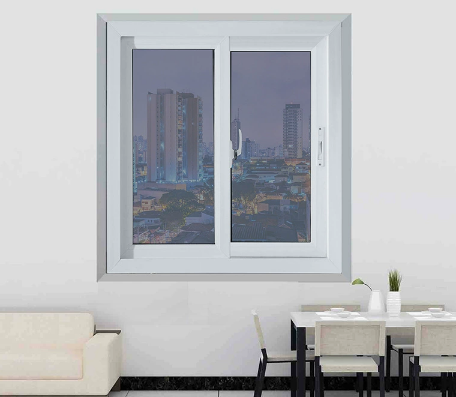
60-series UPVC sliding window. On a sliding assembly, the roller and pile weather strip are the components that determine long-term operating feel.
Certification Scope: What an ECM Attestation Covers, and What It Does Not
The certification attached to these products is an ECM Attestation, a voluntary certification scheme issued by Ente Certificazione Macchine Srl (ECM) under certificate number NO.3N230816.YCPQQ51. The applicable standard is EN 14351-1:2006+A2:2016. The attestation covers both the UPVC Window and the UPVC Door products and lists profile series 50/60/65/80/88/112. It was issued on 16 August 2023 and expires on 15 August 2028.
Scope details matter more than the existence of a certificate, and this document states two of them explicitly. First, the applicable standard covers windows and doors without fire resistance characteristics — a project that requires fire-rated assemblies cannot rely on this attestation for that performance. Second, the certification is intended for third countries outside the EU market. It therefore documents conformity for non-EU destinations; it is not a statement of EU single-market access, and a buyer shipping into EU member states should confirm which conformity route their project requires before treating the attestation as sufficient.
Three practical checks follow from that scope.
- Verify the identifiers. The reference number NO.3N230816.YCPQQ51, the issuing body Ente Certificazione Macchine Srl (ECM), and the validity window from 16 August 2023 to 15 August 2028 are fixed points that can be checked against the document supplied with a quotation.
- Confirm the product scope. The attestation covers UPVC windows and UPVC doors and declares profile series 50/60/65/80/88/112. A buyer ordering a configuration outside that declared series should request written confirmation rather than assume coverage.
- Keep the standard reference visible. EN 14351-1:2006+A2:2016 is the named standard, and it is the reference a consultant or specifier will check when reviewing a technical submittal.
Manufacturer Profile and Order Economics
Foshan Nanhai Yuanzhaiji UPVC Door & Window Factory is a UPVC door and window manufacturer established in 2009 and based in the Foshan Nanhai industrial cluster in Guangdong, China. Its window range covers sliding windows, casement windows, tilt-and-turn windows, crank awning windows, American-style hung windows, awning and hopper windows, insect screens, PVC louver windows and insulated glass louver windows, alongside a UPVC door range. Roughly 80% of production is exported, with LATAM, MENA, ASEAN and EU markets listed, and the technical team includes 10 engineers.
Order economics for this product family are documented at a level of detail that is unusual for the category. The production mode is OEM/ODM and customizable, with customization covering window size, specification and glass specification. Monthly capacity is 4,000 ㎡, lead time runs from 10 to 30 days, and the minimum order quantity is 30–40 ㎡. Quality control is documented through a quality inspection report, and after-sales support covers technical consultancy and quality testing.
Two interpretations help a buyer who is still evaluating. A minimum order quantity of 30–40 ㎡ is a project-scale entry point — roughly the sliding windows for one apartment or one villa elevation — rather than a single-unit sample order. And a lead-time band of 10–30 days is wide by design: the short end reflects standard specifications, while the long end reflects customization work on size, specification and glazing.
Application Scenarios and Reported Outcomes
Documented application conditions for these windows are outdoor installations in coastal, high-humidity and strong-wind areas, across residential buildings, commercial buildings, renovation projects and villa projects. The recorded operating modes are manual opening and closing, sliding operation and tilt-and-turn operation — sliding being the format discussed here. The performance functions listed are thermal insulation, sound insulation, wind and rain resistance, corrosion resistance and sealing, applied to create a comfortable indoor environment, with matched components covering the handle, hinge, lock point, multipoint lock drive mechanism, crescent lock, roller, EPDM sealing gasket and pile weather strip.
A field case is documented for a builder client in Kenya covering 800 ㎡ of windows in an architectural application. The recorded outcome was heat-insulation and sound-insulation performance with good energy-saving behaviour. The recorded highlights were high-quality profiles, corrosion-resistant hardware, tempered safety glass, fine workmanship, low-noise sliding operation, water- and dust-proofing, a simple appearance and easy maintenance. For an evaluation-stage buyer, the useful part of that record is the combination — a coastal-capable hardware set, safety glazing and a sliding mechanism tuned for quiet operation — because those are precisely the items that generate complaints when they are downgraded to protect a price.
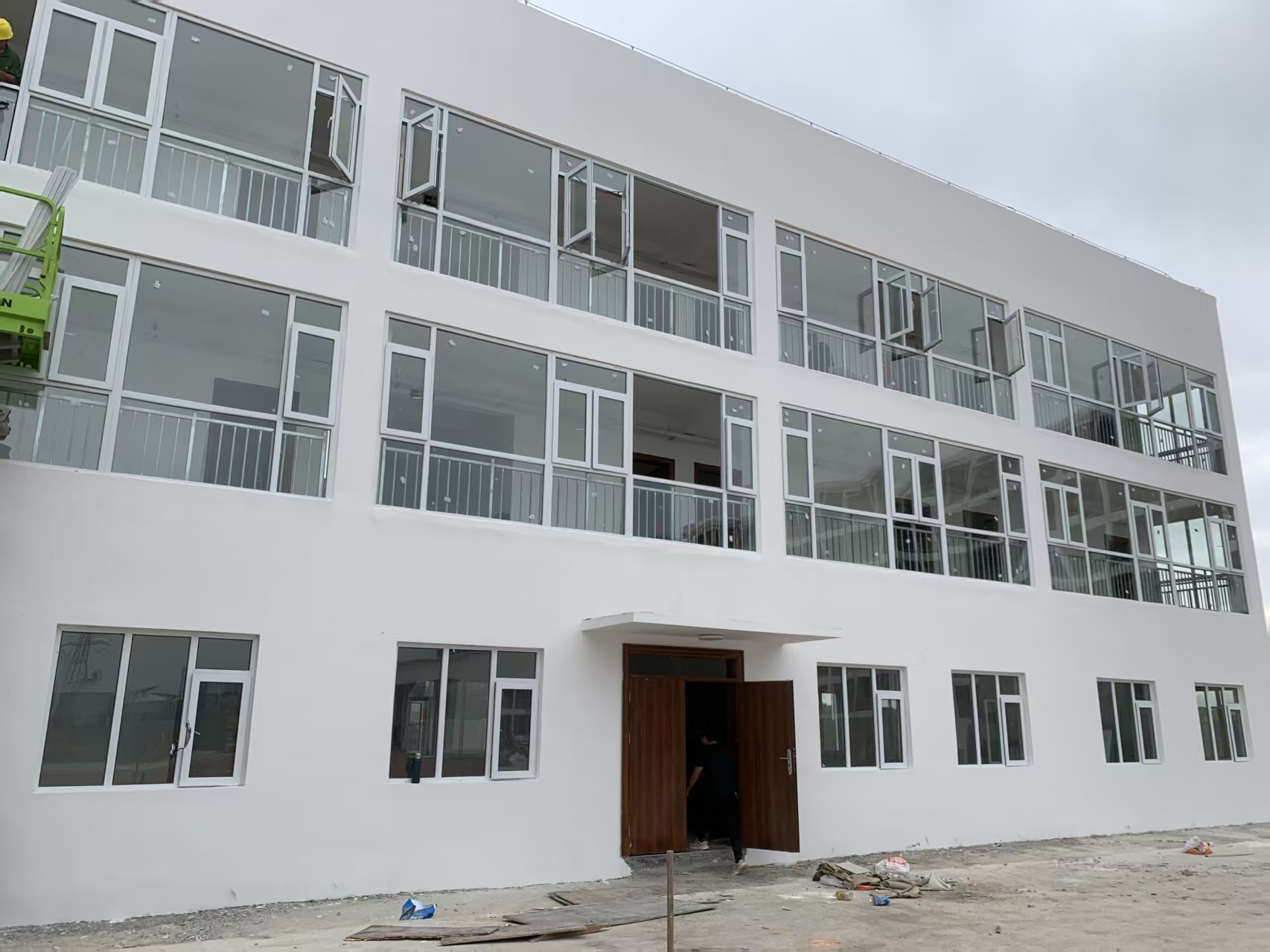
On-site elevation of a fully installed floor. Repetition across identical openings is where sliding window packages are usually judged on fit, sealing and operating consistency.
Comparison with Traditional Solutions — and the Limits of the Format
Compared with traditional single-glazed timber or steel-framed windows, a multi-chamber UPVC sliding window is generally specified for thermal separation, corrosion behaviour and maintenance load. The table below separates what is documented from what is general industry practice.
| Dimension | UPVC multi-chamber sliding window (documented) | Traditional single-glazed timber or steel frame (general practice) |
|---|---|---|
| Thermal behaviour | Hollow multi-chamber sections; heat insulation listed as a characteristic | Single glazing with thermally conductive or untreated frames; higher heat loss |
| Corrosion | Corrosion resistance listed as a characteristic; coastal projects specify corrosion-resistant hardware | Steel frames require protective treatment; timber degrades in damp conditions |
| Maintenance | Easy cleaning listed; sash rides on rollers and runs on a track | Periodic repainting, re-sealing and hardware replacement are typical |
| Service life reference | High-quality Foshan Nanhai profiles estimated at 30–40 years in industry reporting | Depends on coating or treatment cycles and site exposure |
The limits of the format are equally concrete, and buyers should treat them as procurement items rather than as objections.
- Certification boundary. The ECM Attestation covers windows and doors without fire resistance characteristics and is intended for third countries outside the EU market. Projects needing fire-rated assemblies or EU market conformity must be assessed through a different route.
- Profile grade variance is the largest quality risk. Documented guidance is that Conch profiles use a stable raw-material formula, strict wall-thickness standards and good anti-aging performance, while general mid-range UPVC profiles vary greatly between manufacturers; some reduce formulation quality or wall thickness to reach a lower purchase price, which can produce yellowing, deformation and air leakage after several years. Counterfeit branded profiles carry the same risk. The verification route is documented as compliance with GB/T 8814-2017 for unplasticized PVC profiles — wall thickness, impact resistance, heat stability and anti-aging performance — supported by test reports.
- The profile is not the whole window. The often-quoted figure of up to 40% energy-efficiency improvement for modern multi-chamber uPVC profiles against traditional frames comes from a secondary source and should be treated as directional, not as a specification value; the real number depends on glazing, frame depth, installation and climate.
- Operation depends on maintenance. A stiff sash is documented as arising from debris or dust in the sliding track, a worn or out-of-position roller, and misadjusted sash hardware. The documented correction is to clean the track, check and replace the roller if worn, and adjust the hinge or roller screw to level the sash.
- Format fit. Where a sliding track is undesirable — for example where tighter compression sealing or a smaller frame footprint is prioritised — the same manufacturer also produces casement and tilt-and-turn formats, which are assessed through a separate comparison.
Market Trend Analysis
Market sizing for UPVC windows and doors is directionally strong but methodologically contested. Grand View Research values the global market at USD 30.8 billion in 2025, while Mordor Intelligence estimates USD 42.15 billion for the same year. The gap is attributed to scope differences — inclusion of accessory and hardware segments, or different regional base pricing for profiles — rather than to either figure being an error. Buyers and analysts should read a single headline number as a methodology statement, not as a settled fact about demand.
Two structural signals are more stable. Asia Pacific held 44.1% of global uPVC windows and doors revenue in 2025, consistent with the concentration of profile and window manufacturing in the region, including the Foshan Nanhai cluster. Within the global product mix, windows took 58.0% of revenue against doors, confirming that window systems rather than door systems carry the category.
On the regulatory side, the direction is toward tighter whole-window requirements. The 1.4 W/m²K limit that applied to window replacement in existing homes in England and Wales in 2025 is one example of a rule written at the assembled-window level, which pushes buyers toward documented glazing and frame combinations instead of generic profile claims.
Supply-side durability is entering the same conversation. Industry reporting on the Foshan Nanhai manufacturing base estimates lifespans of 30 to 40 years for high-quality profiles. That range is a useful expectation-setting reference for renovation and villa projects, but it describes high-quality profiles specifically, not every price tier in the market.
Future Outlook
The next phase of UPVC window procurement will be shaped less by new profile geometry and more by verification. At present, supplier-level manufacturing capability audits covering three specific items — chamber count, steel reinforcement thickness and lead-free stabilizer verification — are not widely published for the category. Those are exactly the inputs that determine whether a documented 30-to-40-year profile lifespan is realistic in a given project, and buyers on residential or high-end projects are likely to request them directly from manufacturers.
Three developments follow from that shift.
- Certificate scope checks become routine. Buyers will compare the declared product scope and profile series on a certificate against quotation lines item by item, rather than accepting a certificate as a general proof of quality.
- Material verification moves earlier. Wall thickness, formulation evidence and test reports under recognized profile standards will be requested at sample stage, not only at delivery inspection.
- Competitive pressure concentrates inside the cluster. Foshan Nanhai is already a key manufacturing base for UPVC profiles and windows, with large-scale suppliers such as Wanjia Windows & Doors also located in the Nanhai District and serving more than 150 countries — a reminder that differentiation in this category has to come from documented capability rather than category novelty.
Frequently Asked Questions
What exactly does the ECM Attestation cover for these UPVC windows?
The ECM Attestation is a voluntary certification issued by Ente Certificazione Macchine Srl (ECM) under certificate number NO.3N230816.YCPQQ51. It covers the UPVC Window and UPVC Door products, with profile series 50/60/65/80/88/112 in scope. The applicable standard is EN 14351-1:2006+A2:2016, which covers windows and doors without fire resistance characteristics, and the certification is intended for third countries outside the EU market. It was issued on 16 August 2023 and expires on 15 August 2028.
What performance characteristics are documented for UPVC sliding windows?
The documented characteristics are sound insulation, heat insulation, sealing performance, wind resistance, durability, easy cleaning and energy saving. Application records for these windows describe outdoor use in coastal, high-humidity and strong-wind areas, with requirements covering wind-pressure resistance, water tightness, air permeability, sound and heat insulation, UV resistance and anti-aging performance, optional fire resistance, and compliance with local building codes.
Which material values should a buyer verify in a profile specification?
The documented material properties are a density of 1520 kg/m³, a Vicat softening point of 86 °C, a flexural modulus of elasticity of 2840 MPa, a tensile yield stress of 43 MPa and a tensile strain at break of 186%. Where durability matters, these values should be read together with the profile's compliance with recognized profile standards — for example GB/T 8814-2017 for unplasticized PVC profiles — and with wall-thickness and test-report evidence.
What order volume, lead time and production capacity apply to a sliding window package?
Documented order parameters for this product family are a minimum order quantity of 30–40 ㎡, a lead time of 10–30 days and a monthly production capacity of 4,000 ㎡. Customization covers window size, specification and glass specification, with production organized under OEM/ODM arrangements. Quality control is documented through a quality inspection report, and after-sales support covers technical consultancy and quality testing.
How do regulatory limits affect UPVC sliding window selection?
Regulatory limits are usually written at the assembled-window level rather than at the profile level. In England and Wales, for example, the legal whole-window U-value limit for window replacement in existing homes was 1.4 W/m²K in 2025 under Approved Document L. Because that value applies to the complete window, glazing type, frame depth, sealing and installation all influence compliance, and a profile test report alone does not demonstrate it.
Why does a sliding window sash become stiff, and how is it corrected?
Documented causes are accumulated debris or dust in the sliding track, a worn or out-of-position roller, and misadjusted sash hardware. The documented correction sequence is to clean dirt and foreign objects out of the track, check the roller and replace it if worn, and adjust the hinge or roller screw to level the sash. Routine track cleaning is the maintenance action that prevents most of these faults.