
UPVC Window Factory Capability: What 3,000 m² and 50,000 Units Prove
UPVC Window Factory Capability: What 3,000 m² and 50,000 Units Prove
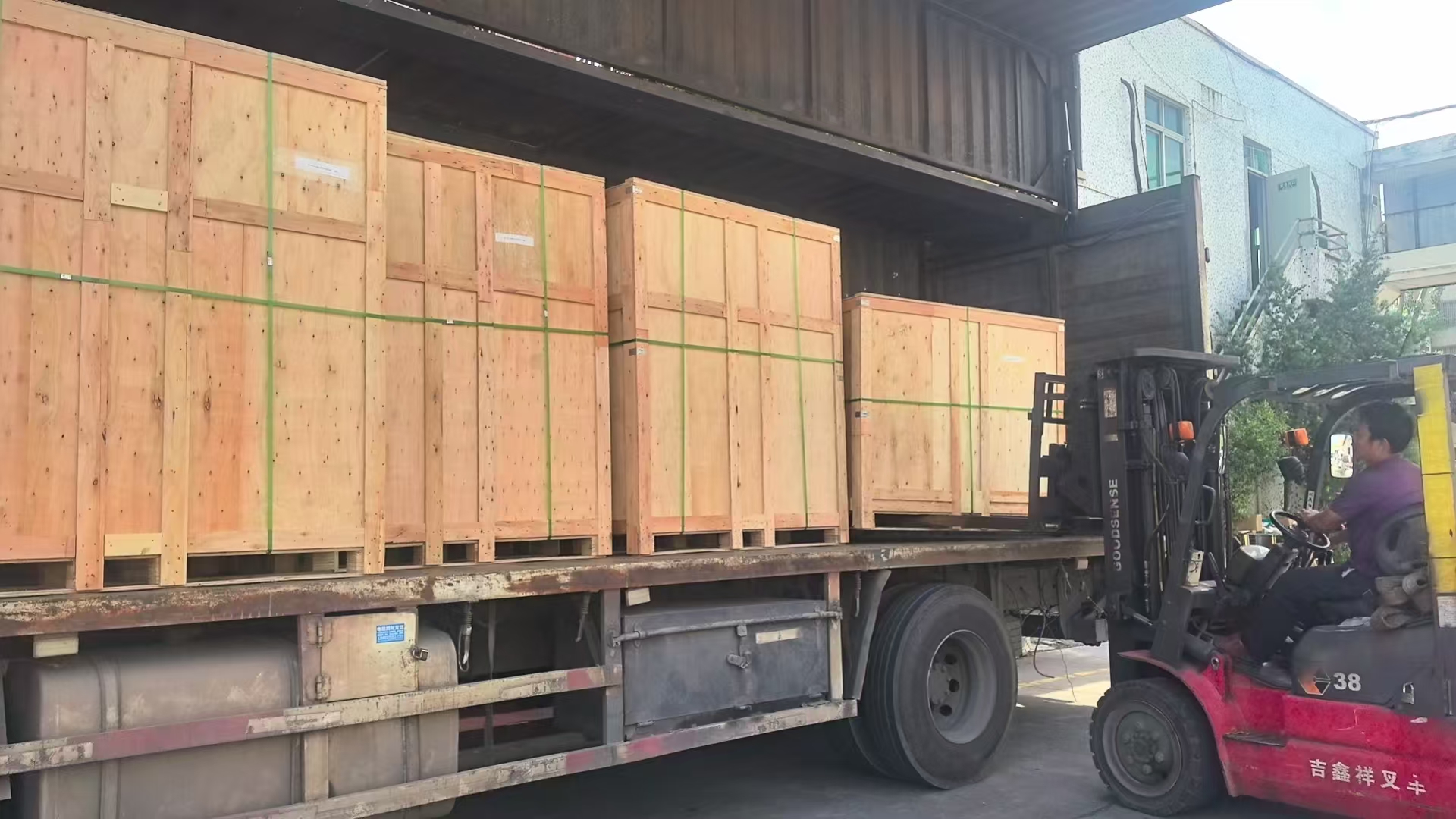
Two numbers sit at the centre of most UPVC window factory claims: floor space and annual output. Foshan Nanhai Yuanzhaiji UPVC Door & Window Factory reports 3,000 m² of plant and 50,000 units of annual capacity, together with a 2009 founding date, approximately 20 employees, a technical and management team of more than 20 people, 10 R&D engineers and an 80% export share. Individually, none of those figures answers a procurement question. Read as a set — and placed beside the scope of an ECM Attestation and a stated acceptance procedure — they become statements a buyer can test.
That is the purpose of this analysis: not to argue that one factory is the right choice, but to show how a buyer at the evaluation stage can convert factory capability claims into verifiable checks before a deposit is paid and before goods leave the plant. The distinction matters because capability claims describe a system — floor area, people, throughput, paperwork — that a buyer usually cannot see until the first order is already in production.
Why capability claims resist verification
A product claim can be settled with a sample. A capability claim cannot. Three ambiguities recur across supplier documentation, and all three appear in the figures above.
- Units. Plant area may mean total site area or covered production area; annual output may be counted in window units or in square metres of finished product. The two conventions produce very different-looking numbers for the same plant.
- Scope. A headcount of about 20 can describe production staff only, or everyone on site. A technical and management team of more than 20 people describes a different population again, and a 10-engineer R&D team may sit inside one figure or be additional to it.
- Documents. A certificate carries meaning only with its number, standard, product scope and validity dates attached. A photograph of a certificate is not the same thing as a certificate checked against the issuing body.
None of this implies misrepresentation. It implies that supplier records are written for several audiences at once — catalogues, tender files, trade platforms — and are rarely normalised for a single buyer's decision. Normalising them is the buyer's task, and it is easier once each figure is attached to the question it can answer.
The factory record at a glance
| Item | Reported figure | Originating document |
| Plant area | 3,000 m² | Company record |
| Employees | Approximately 20 | Company record |
| Technical and management team | More than 20 people | Company profile |
| R&D engineers | 10 | Company record |
| Annual output | 50,000 units | Company record |
| Monthly capacity | 4,000 m² of windows and doors | Capability record |
| Operating history | Founded 2009 — more than 15 years by 2026 | Company record |
| Export share | 80%, across LATAM, MENA, ASEAN and the EU | Company record |
| Certification | ECM Attestation NO.3N230816.YCPQQ51, EN 14351-1:2006+A2:2016, valid 16 Aug 2023 to 15 Aug 2028 | Ente Certificazione Macchine Srl |
| Order parameters | Minimum order 30–40 m²; typical lead time 10–30 days | Capability record |
| Acceptance | Pre-shipment photo inspection or on-site inspection | Procurement record |
Only one line in that table originates outside the company's own paperwork: the ECM Attestation, issued by Ente Certificazione Macchine Srl. Even that line needs checking against the issuing body, because scope and validity — not the fact of certification — decide whether it applies to a particular order.
What 3,000 m² of plant establishes, and what it does not
UPVC window fabrication passes through recognisable zones, and the factory's own production images name three of them: a material cutting area, a welding and assembly area, and a goods storage area. Cutting, frame and sash welding, hardware fitting, glazing and packing all draw on the same floor, so a compact plant has to allocate space deliberately between them rather than letting any one function expand.
In UPVC construction more broadly, profile sections are cut to length, frames and sashes are welded, and hardware, gaskets and glazing are fitted; multi-chamber profiles can accept steel reinforcement to raise mechanical strength. The activities surrounding that core — insulated glass assembly, reinforcement cutting, hardware pre-assembly, and finished-goods buffering before inspection — are what decide how much of a given floor area becomes output rather than storage. The record supplied here does not state which of those activities are handled in-house, which makes it the first practical question rather than a footnote.
What 3,000 m² does not establish is layout efficiency. Two plants of identical area can differ substantially in throughput depending on line configuration, work-in-progress discipline and how much space is surrendered to goods awaiting inspection. Area is a capacity input, never a capacity proof.
Reading 50,000 units a year alongside 4,000 m² a month
The record states annual output as 50,000 units and monthly capacity as 4,000 m² of UPVC windows and doors. These are different units of account, and the arithmetic that joins them is worth performing openly in front of the buyer.
Twelve months at 4,000 m² gives 48,000 m² a year, a straightforward multiplication. If that annual output corresponds to the same 50,000 units, the implied average is slightly under one square metre per unit. Separately, spreading 50,000 units across an assumed 250-working-day year gives roughly 200 units per working day. Both results are calculated illustrations rather than measured output: the working calendar is not disclosed, and neither unit mix nor model distribution is stated. Their value is diagnostic. They show that a buyer should ask for the unit-to-area conversion the factory actually uses, because scheduling, packing capacity and inspection time all follow from that conversion.
Practical implications follow from the same numbers. An order of 30–40 m² sits far below one month's stated capacity, so minimum order size is not the binding constraint it would be at a much smaller plant; what matters is queue position in a given month. A lead time of 10–30 days describes a range, and the range is itself information: the low end usually reflects standard profiles and glass already in stock, the high end reflects custom size, specification or glass. The question worth asking is which end applies to a specific configuration, and what inputs — approved drawings, glass, hardware — must be confirmed before production begins.
Headcount, technical team and R&D: reading 20, 20+ and 10 together
The company record lists approximately 20 employees; the company profile describes a professional technical and management team of more than 20 people and an R&D team of 10 engineers. Read side by side, those statements suggest that the employee figure refers to a narrower population than total headcount. Buyers should confirm which definition applies before using headcount as a scale indicator, because the difference changes the ratio of technical support to production capacity by a wide margin.
The R&D figure matters more in custom work than in catalogue supply. Customisation is stated as window size, specification and glass specification, and OEM and ODM services are offered. Custom size and specification mean shop drawings, tolerance decisions and glass build-ups that need engineering sign-off; ODM means the factory contributes design input rather than only executing a buyer's drawings. In practice the useful question is procedural rather than numerical: who approves the drawing that production will build to, and is that person available during the order rather than only during quotation? A 10-engineer team is meaningful only if it sits in that loop.
What the ECM Attestation covers, and when it expires
The factory holds ECM Attestation NO.3N230816.YCPQQ51, issued by Ente Certificazione Macchine Srl (ECM) on 16 August 2023 and valid to 15 August 2028. It is a voluntary certification referencing EN 14351-1:2006+A2:2016 and covering UPVC windows and doors across profile series 50, 60, 65, 80, 88 and 112. The stated market scope is the part buyers most often skim: the attestation is intended for third countries outside the EU market.
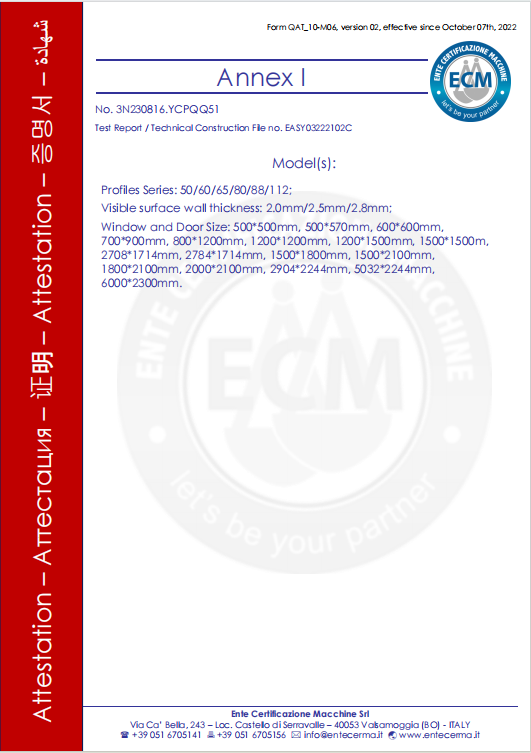
Three consequences follow. First, the document is a third-party attestation tied to a named standard and a defined product scope, which makes it more checkable than a self-declared quality statement — but only if the order falls inside that scope. A window built on a profile series not listed, or a configuration outside the certified product family, is not automatically covered by a certificate that governs the family as a whole. Second, the third-country wording is a scope limit rather than a marketing phrase: a buyer who needs EU market-access documentation for a project inside the EU should treat this attestation as supporting evidence, not as the document that settles the question. Third, the 2028 expiry is a planning date. Verification means checking the number with ECM, confirming that the scope matches the order, and confirming validity at the shipment date rather than at the quotation date.
Acceptance evidence: pre-shipment photos or on-site inspection
Acceptance is stated as pre-shipment inspection via photographs, or on-site inspection, with payment by bank transfer and delivery terms FOB or CIF. Which method fits depends on what the buyer is trying to control.
Photo inspection works when the checklist is written before production and agreed in advance: one elevation photograph per model, close-ups of corner welds, hardware markings, gasket seating, glass spacer and labelling, quantity by model, and loading photographs showing packing and container stowage. Its weakness is equally clear. A photograph confirms what the camera was pointed at, under the lighting chosen, and cannot confirm dimensional accuracy or performance. On-site inspection costs more and settles more: dimensions can be measured, sashes cycled by hand, and a sample opened if both parties agree. For a first order, a custom profile or glass specification, or a high-value shipment, on-site inspection is the stronger control; for repeat orders of unchanged models, a fixed photographic checklist is proportionate.
Neither route replaces a test report. The record names a quality inspection report as part of quality control, so the sensible follow-up is to ask what that report contains and which characteristics it records, rather than to assume it covers the performance values a project specification may require.
Where this capability fits: products, projects and export mix
Production is stated to cover UPVC sliding windows, casement windows and casement doors, alongside a wider catalogue of tilt-and-turn, crank awning, American-style hung, awning, hopper and fully-opening windows, insect screens, louver windows and insulated glass louver windows. Custom glass specification and custom window size are available, and orders start at 30–40 m².
The application context supplied for these products is outdoor use in coastal, high-humidity and strong-wind areas, across residential, commercial, renovation and villa projects. That framing is consistent with how UPVC is normally specified: the profile does not corrode, sealing depends on gaskets and hardware as much as on the frame, and thermal and acoustic behaviour depend heavily on the glazing package and on installation quality.
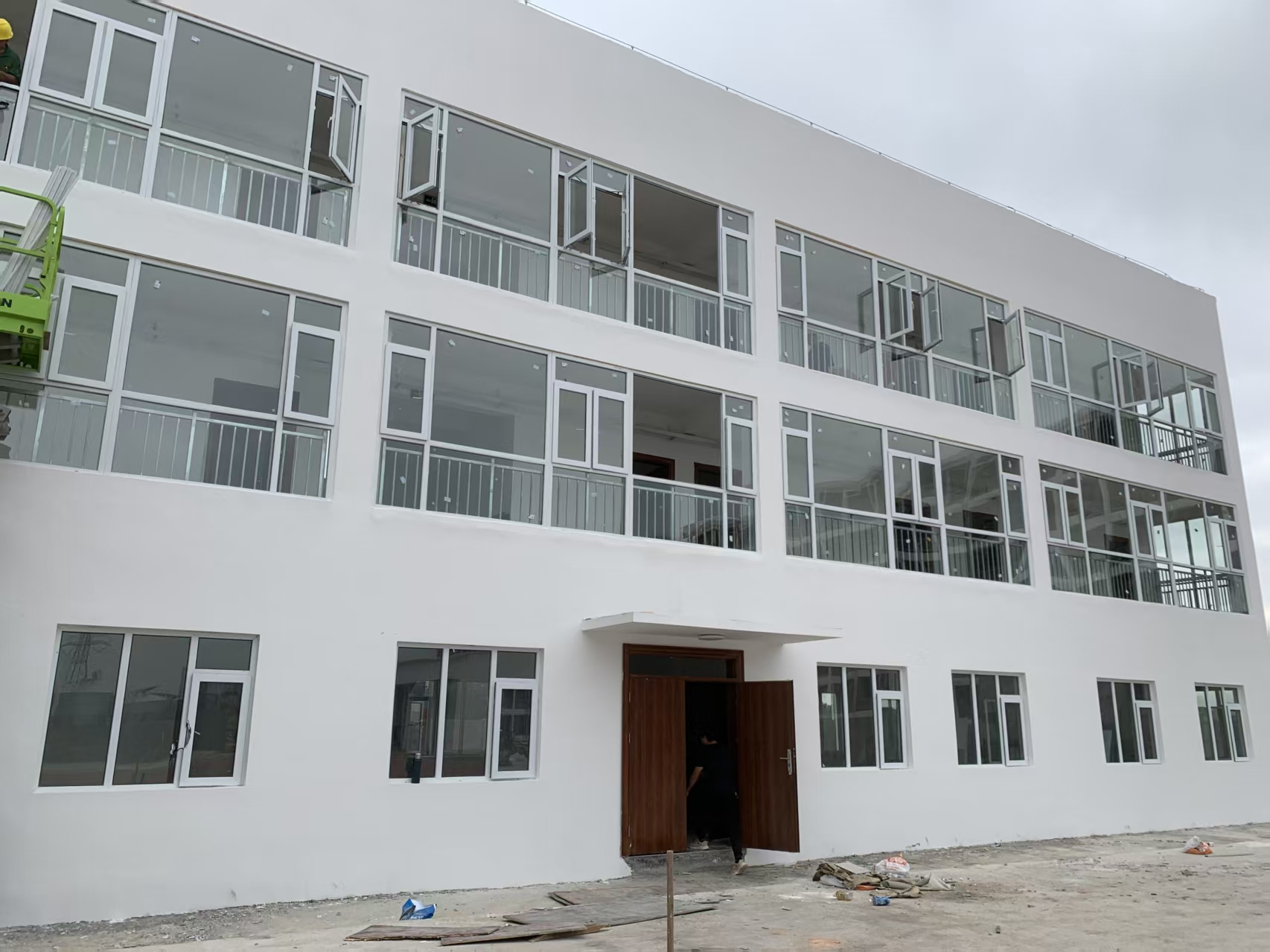
The factory's own case record lists a builders' project in Kenya covering 800 m² of architectural windows, with company-reported results on heat and sound insulation. Its evidentiary weight is limited, since a company case record is not independent verification of measured performance, but it is useful for scale: 800 m² sits well inside a stated monthly capacity of 4,000 m², which is the order profile this capability appears built around.
An 80% export share across LATAM, MENA, ASEAN and the EU indicates export orientation and repeated handling of more than one market's paperwork. It does not indicate volume per market, and it is not a quality measure. Buyers should ask which markets their specific configuration has shipped to and which documentation package travels with it, rather than reading the headline percentage as proof of fit for their own jurisdiction.
Market context: what published figures support
Grand View Research valued the global uPVC windows and doors market at USD 30.8 billion in 2025, while Mordor Intelligence estimates USD 42.15 billion for the same year. The gap is instructive rather than embarrassing: it illustrates the theme of this article. Published totals differ by methodology, so no single market figure should be treated as a precise input to a supplier decision. The same Grand View dataset attributes 44.1% of 2025 revenue to Asia Pacific and 58.0% of product revenue to windows, while Dataintelo places casement windows and doors at 38.5% of design-type share.
Regulation supplies a sharper data point. In England and Wales, the legal whole-window U-value limit for window replacement in existing homes was 1.4 W/m²K in 2025 under Approved Document L, according to a 2025 industry guide published with BFRC material. An industry publication also describes Foshan Nanhai as a key manufacturing base for UPVC profiles and windows, estimating high-quality profile lifespans at 30 to 40 years — an industry estimate, not a test result for a specific product. No growth forecast is asserted here: the supplied dataset contains 2025 values, and a report title referencing 2033 is not itself a figure.
None of these numbers tells a buyer whether a particular factory can build a particular window. They establish the setting: a large Asia-Pacific manufacturing base, windows dominating product revenue, casement designs the largest single design type, and at least one major market attaching a legal number to whole-window thermal performance. That combination is why documents — scope, standard, validity — have become a procurement input rather than a formality.
Comparing evidence types
| Evidence type | Example in this record | What it settles | What it leaves open |
| Self-declared figures | 3,000 m², 50,000 units, about 20 staff, 80% export | The factory's own account of its scale and orientation | Unit definitions, layout efficiency, model mix |
| Third-party attestation | ECM Attestation NO.3N230816.YCPQQ51 | A named body attested a defined product scope against a named standard, until a stated date | Configurations outside scope; installation performance; EU market access |
| Process acceptance | Pre-shipment photos; on-site inspection | Conformity of what was produced and packed to an agreed checklist | Dimensional accuracy from photographs; performance values |
| Company case record | 800 m² builders' project in Kenya | Order scale the factory reports having handled | Independent confirmation of the reported outcomes |
Fit boundaries: where this profile needs extra checks
A useful capability assessment states where a supplier's evidence runs out, not only where it is strong. Four boundaries apply to this record.
- Large single-phase volumes. A requirement approaching or exceeding 4,000 m² in one delivery window needs a written scheduling commitment, because stated monthly capacity is not the same as available capacity in a chosen month.
- EU market access. The attestation is expressly intended for third countries outside the EU market. Projects needing EU-facing documentation require additional evidence, and that gap should be identified at evaluation rather than at shipment.
- Configuration-specific performance. Thermal, acoustic and impact values depend on the glazing build-up, reinforcement and hardware of the ordered assembly. Ask which test documentation covers that assembly, since attestation scope covers a product family rather than every variant.
- In-house versus bought-in scope. Glass specification is customisable, but the record does not state whether insulated glass units, reinforcement cutting and hardware pre-assembly are performed in-house. That answer determines how many suppliers sit between the buyer and the finished window.
A restrained next step for an evaluating buyer is to request three items together: a copy of the ECM attestation for direct verification, the factory's own unit-to-area conversion used behind its capacity figures, and a written acceptance checklist covering the models in the enquiry. Those three documents test different claims and are cheap to obtain.
Outlook to 2028
The clearest dated milestone in the record is 15 August 2028, when the ECM Attestation expires. Buyers planning multi-year programmes should treat that date as a review checkpoint and ask how renewal is handled and what document would support shipments after it. The 2025 whole-window U-value limit in England and Wales illustrates a wider pattern: performance requirements are increasingly expressed as numbers attached to whole assemblies, which pushes procurement toward attested, configuration-specific evidence rather than general material claims.
What can be said conditionally is narrower than a forecast. Factories able to show scope-matched attestation, a defined acceptance procedure, and capacity arithmetic that survives a buyer's questions will be easier to keep on a shortlist than factories that answer with adjectives. Whether a given factory suits a given project still depends on the configuration, the market and the delivery window — three variables no headline figure resolves.
Frequently asked questions
How can a buyer verify a UPVC factory's stated annual capacity?
Cross-check the units first. A factory stating 50,000 units a year and 4,000 m² a month is using two different measures, so ask for the average unit size used to convert between them, the working calendar behind the annual figure, and the model mix assumed. Then test the answer against order-level scheduling: a 30–40 m² minimum order inside 4,000 m² of monthly capacity says little about queue position in a busy month. Pre-shipment photographs or an on-site visit confirm output that exists, not output that is planned.
What does ECM Attestation NO.3N230816.YCPQQ51 actually cover?
It is a voluntary certification issued by Ente Certificazione Macchine Srl on 16 August 2023 and valid to 15 August 2028, referencing EN 14351-1:2006+A2:2016 and covering UPVC windows and doors in profile series 50, 60, 65, 80, 88 and 112. Its stated market scope is third countries outside the EU market. Verification means checking the number with ECM, confirming the ordered configuration falls within the listed scope, and confirming validity at the shipment date.
Does an 80% export share prove product quality?
No. It records the share of output sold outside the domestic market and, in this case, the regions served: LATAM, MENA, ASEAN and the EU. It indicates export orientation and repeated handling of export documentation. Quality evidence comes from scope-matched attestation, inspection results and the buyer's own acceptance checks. The percentage does not substitute for any of those, and it does not disclose volume per market.
Is pre-shipment photo inspection or on-site inspection more reliable?
They control different risks. A photographic checklist agreed before production records quantity, appearance, hardware markings, gasket seating, labelling and loading at low cost, and suits repeat orders of unchanged models. On-site inspection allows dimensions to be measured and sashes to be operated, and suits first orders, custom specifications or high-value shipments. Neither confirms performance values such as thermal or acoustic ratings, which depend on test documentation for the configuration ordered.
What order size and lead time apply to custom UPVC windows?
The stated minimum order is 30–40 m² and the typical production lead time is 10–30 days. Customisation covers window size, specification and glass specification, and OEM and ODM services are available. Because the lead-time range spans a factor of three, the useful question is which end applies to a given configuration and which inputs — approved shop drawings, glass, hardware — must be confirmed before production starts.
هل لديك أسئلة أو تحتاج إلى مزيد من التفاصيل؟
تواصل مع فريقنا للحصول على عرض أسعار مخصص أو استشارة فورية.
طلب عرض أسعار
املأ النموذج أدناه وسيتواصل معك فريقنا بعرض مقترح مخصص.
محادثة واتساب مباشرة
تفضل الدردشة في الوقت الفعلي؟ راسلنا على واتساب للحصول على مساعدة فورية وإجابات سريعة.
- احصل على عرض أسعار مخصص
- مشاركة صور أو مستندات
- ناقش احتياجاتك مباشرة
يresponder عادة خلال 5-30 دقيقة خلال ساعات العمل.