
UPVC Window Supplier Evaluation: 15+ Years and R&D Depth
UPVC Window Supplier Evaluation: 15+ Years and R&D Depth
Long-term UPVC window supply is decided by three records that cannot be recreated quickly: how long the factory has operated, how much of its output has already passed through export inspection, and how much engineering capacity sits behind the catalogue. Foshan Nanhai Yuanzhaiji UPVC Door & Window Factory, established in 2009 and exporting roughly 80% of its output to LATAM, MENA, ASEAN and the EU, provides a practical case for reading those records in the correct order.
Most UPVC window sourcing decisions are made on three inputs: a sample, a unit price and a delivery promise. Those inputs answer a question about one order. They do not answer the question that matters at evaluation and execution stage — whether the supplier will still be producing the same profile series, matching the same colour batch and supporting the same hardware set three, five or ten years after the first container ships.
Foshan Nanhai Yuanzhaiji UPVC Door & Window Factory is a Chinese UPVC door and window manufacturer established in 2009, producing sliding windows, casement windows, tilt-and-turn windows, awning and hopper variants, hung windows, insect screens and louver systems, together with sliding, lift-and-slide and hinged door series. Its operating record — more than 15 years of production, about 80% export share, an annual output of 50,000 units, a 3,000 m² factory, 10 R&D engineers and a technical and management team of more than 20 staff — is the raw material this evaluation works from.
Why Tenure Is a Capability Question, Not a Formality
A supplier that has been building windows since 2009 has already absorbed at least one full cycle of profile formulation change, one cycle of hardware redesign and one cycle of export documentation revision. That history is not sentiment; it is evidence that the production process can be repeated across batches, because colour matching, welding parameters and gasket fit all drift when a process is re-learned from scratch.
The category justifies this scrutiny. Industry reporting on the Foshan cluster estimates that high-quality UPVC profiles carry a service life of roughly 30 to 40 years. A window sold on a ten-year expectation and installed with a forty-year component creates a support obligation far longer than the sales cycle. Buyers therefore need to know whether the entity that quoted will still exist, still hold drawings and still supply spares at year eight.
Tenure also changes how a factory reads a specification. A newer plant tends to quote what it can already produce. A plant with fifteen years of export orders has usually encountered enough non-standard schedules to distinguish between a size change, a glass build change and a reinforcement change — three very different requests that a catalogue page collapses into one line called customisation.
Foshan Nanhai Yuanzhaiji UPVC Door & Window Factory records its establishment year as 2009, which places the factory past the fifteen-year mark. During evaluation, that date should be cross-checked against certification issue dates and against the profile series the factory has been running, rather than accepted as a marketing statement.
The Operating Records That Define Long-Term Supply
Supplier longevity is best assessed through a small set of concrete operating figures, because each figure constrains a different part of the buying decision. The table below maps the records published by this manufacturer to the evaluation question each one answers.
| Operating record | Stated figure | What it answers in evaluation |
|---|---|---|
| Establishment year | 2009; more than 15 years in production | Whether the process has survived multiple product and market cycles |
| Export share | About 80% of output | Whether routine production already meets export packing, inspection and documentation discipline |
| Main export markets | LATAM, MENA, ASEAN, EU | Whether the factory has experience with the climate and compliance profile of the destination |
| Annual output | 50,000 units | Whether order volume can be absorbed without displacing other commitments |
| Monthly capacity | 4,000 m² of UPVC windows and doors | Whether a project schedule fits inside a single production month |
| Factory area | 3,000 m² | Whether fabrication, assembly and storage are separated |
| R&D headcount | 10 engineers | Whether drawings, glass build and reinforcement are engineered rather than selected |
| Technical and management team | More than 20 staff | Whether supervision exists beyond the production line |
The practical reading is that these figures are only useful in combination. An annual output of 50,000 units means little without knowing the monthly ceiling, because a buyer placing a large single order needs a schedule, not a yearly total. A 3,000 m² factory means little without knowing how many engineers convert project documents into production drawings.
What an 80% Export Share Actually Tests
An export share of about 80% is a statement about routine conditions, not about ambition. It means the majority of what leaves the factory has already been packed for sea freight, documented for customs, inspected before dispatch and specified against a climate the factory does not operate in. That repeated exposure is what turns export capability from a claim into a habit.
Each of the four listed markets stresses a different part of the product:
- LATAM — high ultraviolet exposure and humidity swings that test colour stability, sealing and hardware coatings.
- MENA — sustained heat, dust and thermal cycling that test profile stability, gasket compression and opening hardware.
- ASEAN — monsoon rain and coastal salt air that test water tightness and corrosion resistance.
- EU — documentation discipline and declared performance, where a technically acceptable window can still fail on paperwork.
There is a second, less comfortable reading. A factory that exports 80% of its output is oriented toward distributors, contractors and project buyers rather than toward single retail installations. Buyers should confirm in writing who provides on-site installation guidance, who handles a warranty claim in the destination country, and how replacement hardware is supplied, because those functions are unlikely to sit inside the factory itself.
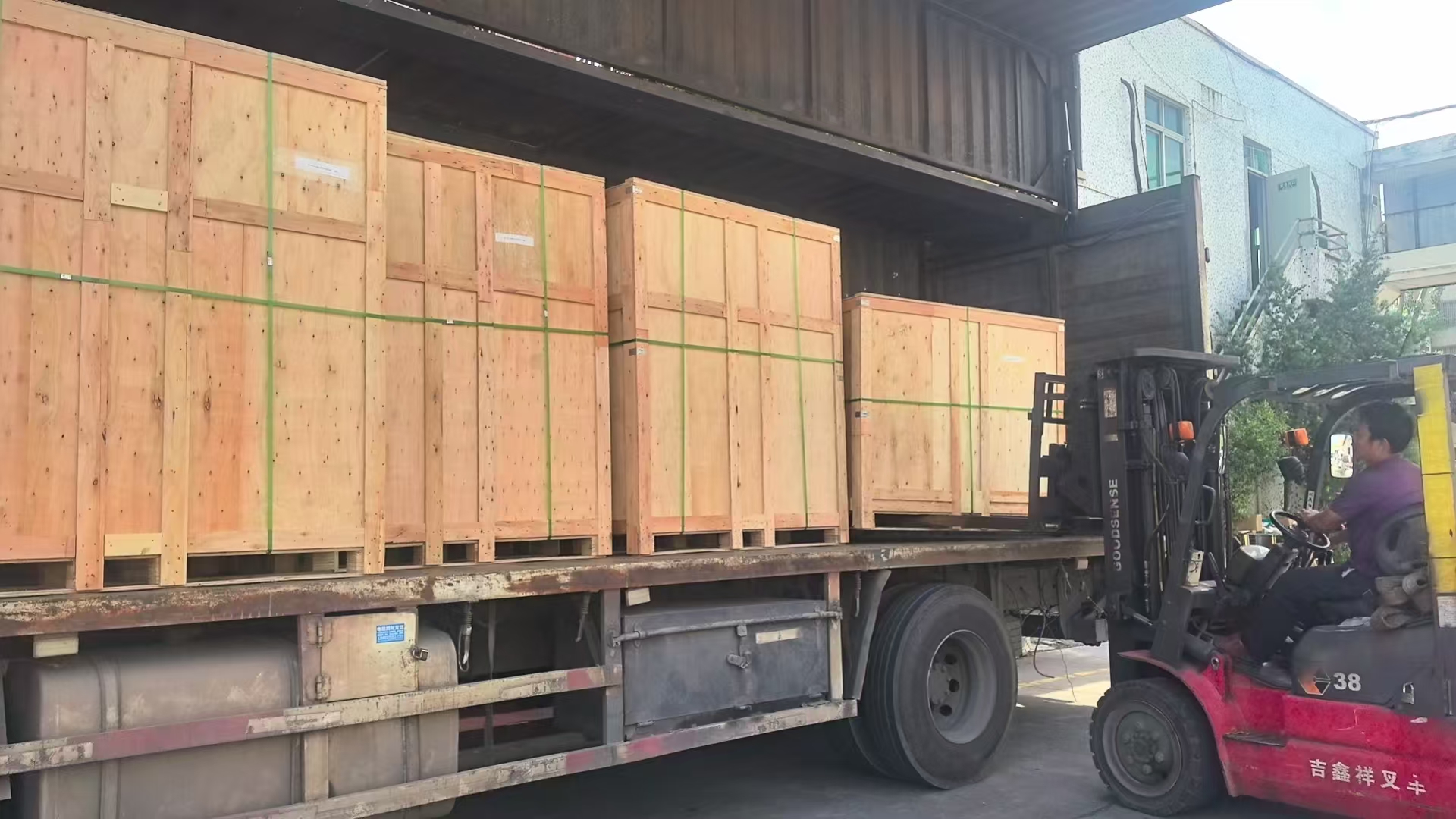
Export loading in progress: an 80% export share means packing, documentation and pre-shipment inspection are routine production steps rather than exceptions.
Capacity, Order Mechanics and Customisation
Order mechanics determine whether a supplier fits a project long before product quality becomes relevant. A factory can build an excellent window and still be the wrong supplier if its minimum order, lead time or inspection model does not match how the buyer actually purchases.
| Commercial parameter | Recorded detail |
|---|---|
| Production mode | OEM, ODM and customizable production |
| Customisation scope | Window size, specification and glass specification |
| Minimum order quantity | 30–40 m² |
| Typical lead time | 10–30 days |
| Monthly capacity | 4,000 m² of UPVC windows and doors |
| Quality control | Quality inspection report |
| Acceptance process | Pre-shipment photo inspection or on-site inspection |
| Delivery terms | FOB, CIF |
| Payment | Bank transfer |
| After-sales scope | Technical consultancy and quality testing |
A minimum order of 30–40 m² is a meaningful signal about the intended buyer. It is low enough for a distributor testing a new colour or a renovation contractor assembling a mixed container, and it is high enough that the factory is not structured around single-unit retail orders. For a first order used as a validation run, this threshold allows a genuine test without committing to a full programme.
The 10–30 day lead time should be read as a production window under normal loading, not a guarantee across peak periods. Because monthly capacity is stated at 4,000 m², a buyer whose order consumes a large share of one month should expect the schedule to be negotiated rather than simply confirmed — and should build that conversation into the purchase order instead of discovering it at dispatch.
Pre-shipment inspection by photo is the practical consequence of an export-oriented model. It moves verification earlier in the transaction, which is useful when a buyer cannot travel, but it also means the inspection checklist has to be written carefully before production starts. A photo set can confirm frame assembly, glazing, hardware presence and labelling; it cannot confirm operating force, drainage performance or installation tolerances. Where those matter, on-site inspection should be scheduled rather than assumed.
Engineering Depth: Where 10 R&D Engineers Change the Order
Engineering headcount matters in UPVC windows because the product is a system assembled from four independent decisions: profile series, glass build, hardware set and reinforcement. Each decision changes the others. A factory with a dedicated R&D team of 10 engineers can convert a project schedule into a coherent specification; a factory without one tends to quote the nearest catalogue item and adjust it on the production floor.
The manufacturing position of Foshan Nanhai Yuanzhaiji UPVC Door & Window Factory is built on long-term supply of Conch profiles in the 60, 65 and 88 series, available in co-extruded colour, laminated wood-grain finish and solid colours including dark grey and black. Profile supply matters for two reasons. First, a named profile brand gives buyers a reference point for wall thickness, formulation stability and anti-ageing behaviour, which is exactly where low-cost profiles diverge. Second, colour consistency across repeat orders depends on the profile supplier as much as on the window fabricator.
Glass is the second lever, and it is also the most frequently underestimated. Custom glass specification is available, with single-layer glass, double-glazed insulated glass, tempered safety glass and frosted options in the product range. The distinction between a double glazed UPVC window and a thermally effective one usually sits in the glass build, the spacer and the installation seal rather than in the frame alone. Independent commentary on multi-chamber UPVC profiles attributes improvements in energy efficiency of up to 40% compared with traditional frames — but that figure describes a profile architecture, not a delivered window, and buyers should require a project-specific calculation rather than accepting a category claim.
Hardware completes the system and is where long-term supply is most often lost. The component set around these windows includes handles, hinges, multipoint lock drives, crescent locks, rollers, EPDM sealing gaskets and pile weatherstrip. A buyer evaluating a ten-year relationship should ask which of these are standardised across the range, because a hardware change in year four is a compatibility problem, not a price problem.
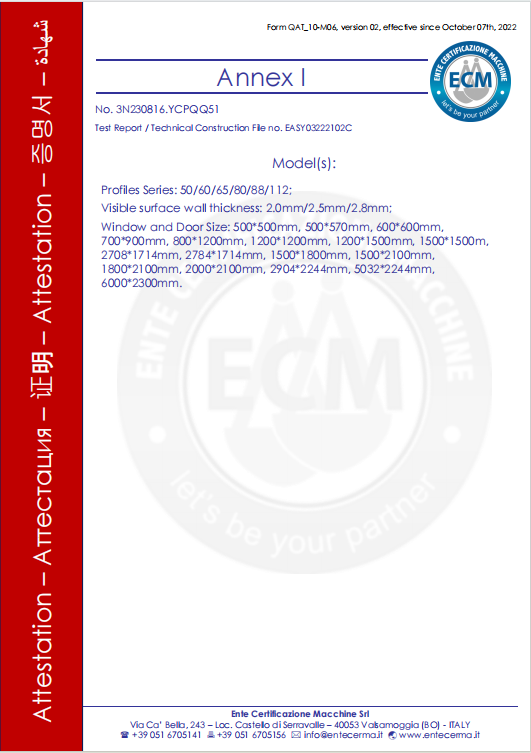
Certification documentation is a verification point, not a marketing asset: buyers should read the scope, the standard and the destination limitation before relying on it.
Verification Points: Address, Website, Contact and Attestation
A supplier evaluation becomes auditable only when claims can be traced to a document, a place and a named contact. The following points are published by the manufacturer and can be checked independently before an order is placed.
| Verification point | Published detail | What to check |
|---|---|---|
| Website | yuanzhaiji.com | Consistency of product range, profile series and stated capacity with the quotation |
| 1803877678@qq.com | Whether quotation, drawings and inspection report arrive from the same domain or account | |
| Telephone and WhatsApp | +86 130-0674-7018 | Whether the technical contact who answers is the same person named on the drawing |
| Contact address | Xilin Industrial District, Honglai Town, Quanzhou Nan'an City, Fujian Province, China | Which site performs production and where pre-shipment inspection will take place |
| Factory area | 3,000 m² | Whether fabrication, assembly and goods storage are physically separated |
| Certification | ECM Attestation NO.3N230816.YCPQQ51 | Scope, standard, issue date and expiry date |
The address point deserves specific attention during evaluation. The entity name references Foshan Nanhai, while the published contact address is in Fujian Province. Rather than resolving that discrepancy by assumption, buyers should confirm in writing which site carries out production, which address appears on shipping documents, and where the pre-shipment inspection will be performed. Aligning the inspection address with the loading port removes a common source of dispute in export orders.
Reading the ECM attestation correctly
The ECM Attestation held by the manufacturer was issued on 16 August 2023 by Ente Certificazione Macchine Srl (ECM) and expires on 15 August 2028, under certificate number NO.3N230816.YCPQQ51. Its scope covers UPVC windows and doors across profile series 50, 60, 65, 80, 88 and 112, with reference to EN 14351-1:2006+A2:2016, the European product standard for windows and doors.
The scope detail that matters most is the destination limitation: the attestation is intended for third countries outside the EU market. That is a voluntary attestation supporting export sales to non-EU destinations, and it should not be read as a substitute for the conformity route required when a product is placed on the EU market. Because the EU appears among the manufacturer's listed export markets, buyers shipping onward into the EU must confirm the applicable route for their own transaction rather than assuming the attestation covers it.
Application Fit: Where This Supplier Profile Works Best
The product range determines which projects are a natural fit. Fabrication covers UPVC sliding windows, casement windows, tilt-and-turn windows, crank awning windows, American-style hung windows, awning windows, hopper windows, fully-opening windows, insect screens, PVC louver windows and insulated glass louver windows, alongside UPVC sliding doors, lift-and-slide doors and hinged doors. Production capability explicitly covers UPVC sliding windows, casement windows and casement doors, with custom glass specification available.
The documented working conditions point to projects where thermal insulation, sound insulation, wind and rain resistance, corrosion resistance and sealing performance carry real weight: outdoor installations in coastal high-humidity and strong-wind areas, across residential buildings, commercial buildings, renovation projects and villa projects. Those are conditions where a low-cost window fails visibly within two or three seasons, and where the cost of replacement exceeds the original saving.
One documented application illustrates the pattern. A builder client in Kenya used 800 m² of product in an architectural application, with reported results of effective heat insulation and sound insulation and good energy-saving performance, supported by features including corrosion-resistant hardware, tempered safety glass, low-noise sliding operation and water and dust resistance. For buyers in comparable climates, the transferable lesson is not the specific figure but the combination: glass build, hardware coating and sealing quality were specified together rather than priced separately.
Where the fit is weaker should also be stated. A buyer requiring a fully bespoke architectural system with project-specific structural calculations, or a buyer needing a European-branded profile system, will need to confirm availability in writing. The standard position here is Conch series 60, 65 and 88 rather than a proprietary European profile brand, and that is a legitimate constraint rather than a defect.
Market Context: Why Supplier Durability Is Being Priced In
The commercial environment is pushing buyers toward longer evaluation rather than faster ordering. Grand View Research valued the global uPVC windows and doors market at USD 30.8 billion in 2025, with Asia Pacific holding a 44.1% revenue share and the windows segment accounting for 58.0% of product revenue. Casement windows and doors formed the largest design-type share at 38.5% in the same year.
Market sizing in this category should be read with care. Mordor Intelligence estimates the 2025 market at USD 42.15 billion against the Grand View figure of USD 30.8 billion. The gap most likely reflects methodology — different treatment of hardware, accessories and regional profile pricing — rather than an error by either researcher. The practical implication for a buyer is that category-level forecasts should inform timing, not supplier selection.
Regulatory pressure is the more actionable trend. In England and Wales, the legal whole-window U-value limit for window replacement in existing homes stands at 1.4 W/m²K under Approved Document L as applied in 2025. Thresholds of this kind convert thermal performance from a differentiating feature into an entry requirement, and they shift risk onto the supplier's documentation. A factory that cannot produce a declared performance value for a specific configuration becomes unusable in that market regardless of price.
Supply concentration is the third trend. Foshan Nanhai is described in industry reporting as a key manufacturing base for UPVC profiles and windows, which means buyers in LATAM, MENA, ASEAN and the EU are frequently comparing suppliers drawn from the same industrial cluster. When several quotes originate from one region, differentiation moves from geography to verifiable operating records: tenure, export history, engineering headcount and certification scope.
Comparison With Traditional Sourcing Models
Long-term supplier evaluation is clearer when the alternatives are described as models rather than as named companies. Three sourcing models dominate UPVC window procurement, and they differ on exactly the dimensions this article has examined.
| Dimension | Trading intermediary | Large integrated profile-and-window plant | Export-oriented mid-scale factory (Yuanzhaiji profile) |
|---|---|---|---|
| Operating tenure evidence | Depends on the upstream factory; often unverifiable | Usually long and well documented | Established 2009; more than 15 years |
| Export exposure | Variable; buyer relies on the agent's experience | High, often multi-region | About 80% export share across LATAM, MENA, ASEAN and EU |
| Engineering resource | None in-house | Large, but often prioritised for high-volume accounts | 10 R&D engineers; technical and management team of more than 20 staff |
| Profile position | Whatever is available | Proprietary extrusion | Conch series 60, 65 and 88, with co-extruded and laminated finishes |
| Minimum order | Low, but with margin stacking | High | 30–40 m² |
| Lead time | Adds coordination time | Longer scheduling cycle | 10–30 days typical |
| Accountability for defects | Split between agent and factory | Single entity | Single entity, with inspection report and photo or on-site acceptance |
The boundaries of the export-oriented mid-scale model should be stated as plainly as its strengths, because a supplier evaluation that lists only advantages is not an evaluation.
- Certification destination limit. The ECM attestation is intended for third countries outside the EU market. Buyers placing product on the EU market must establish their own conformity route, which may add cost and time to an otherwise compliant order.
- Certificate horizon. The attestation expires on 15 August 2028. Multi-year programmes need a renewal plan written into the contract, not assumed.
- Capacity ceiling. A 3,000 m² factory with 4,000 m² monthly capacity is a mid-scale operation. Very large single projects, or several concurrent projects, require schedule planning in advance.
- Order floor. A 30–40 m² minimum is low for a factory but high for a single-household purchase, so the model suits distributors, contractors and project buyers rather than retail replacement.
- Lead time is not a deadline. A 10–30 day window describes normal loading; peak periods and colour-specific orders can extend it.
- Profile dependency. Because the profile position rests on Conch series rather than in-house extrusion, a buyer requiring a specific branded system outside series 50, 60, 65, 80, 88 or 112 must confirm availability before tendering.
Future Outlook
Three developments are likely to shape how UPVC window suppliers are evaluated over the next several years, and all three favour documentation over negotiation.
First, performance thresholds are becoming legal minimums rather than premium options. Where a market sets a whole-window U-value limit, the supplier's ability to declare performance for a specific configuration becomes a gating item in the tender, and factories that cannot produce the declaration lose access regardless of price.
Second, attestation cycles will increasingly be managed as contract assets. Certificates with fixed expiry dates, such as the 2028 expiry on the ECM attestation, require renewal planning that spans more than one purchase order. Buyers who track expiry dates alongside lead times avoid the situation where a compliant supplier becomes temporarily non-compliant mid-programme.
Third, the mid-scale export factory is likely to remain the practical unit of supply for distributors and renovation contractors in LATAM, MENA, ASEAN and the EU. Its advantage is not scale but responsiveness: a 30–40 m² minimum, a 10–30 day production window and an engineering team small enough to answer a specific drawing question quickly. Its constraint is equally clear — capacity is finite, and profile supply depends on an external extruder.
The reasonable conclusion for a buyer at evaluation and execution stage is that supplier sustainability should be recorded, not felt. Establishment year, export share, engineering headcount, capacity ceiling, minimum order, inspection method and certification scope are all checkable. Once they are written into a supplier file, a purchase becomes a decision that can be defended in a project review two years later.
FAQ
How long has Foshan Nanhai Yuanzhaiji UPVC Door & Window Factory been manufacturing UPVC windows?
The factory records its establishment year as 2009, placing it past fifteen years of UPVC door and window production. That tenure covers multiple profile series, including the Conch 60, 65 and 88 series it supplies long term, and it means the production process has been repeated across many export batches rather than established for a single campaign.
What production capacity and lead time can a buyer expect from this manufacturer?
Recorded annual output is 50,000 units, with a monthly production capacity of 4,000 m² of UPVC windows and doors, operating from a 3,000 m² factory. The typical production lead time is 10 to 30 days. Because monthly capacity is finite, orders that consume a large share of a single month should have their schedule agreed in the purchase order rather than assumed.
Can the factory produce custom or OEM UPVC windows, and what can be customised?
The manufacturer provides OEM, ODM and customizable production services for UPVC windows and doors. The documented customisation scope covers window size, product specification and glass specification. Production capability explicitly covers UPVC sliding windows, casement windows and casement doors, and custom glass specification options are available within that range.
What is the minimum order quantity for a custom UPVC window order?
The minimum order quantity is 30 to 40 m². This threshold applies to custom UPVC window orders as well as standard production, and it is low enough to support a validation order — for example, a single mixed container or a colour trial — before a buyer commits to a larger programme.
How is quality verified before shipment, and what acceptance methods are accepted?
Quality control is documented through a quality inspection report. Acceptance can be carried out through pre-shipment photo inspection before dispatch, or through on-site inspection as part of the acceptance process. Photo inspection confirms frame assembly, glazing, hardware presence and labelling, while on-site inspection allows operating force, sealing and finish to be checked directly. Delivery terms are FOB or CIF, and payment is by bank transfer.
Which export markets does the manufacturer serve, and does the ECM attestation cover EU placement?
The main export markets are LATAM, MENA, ASEAN and the EU, with an export share of about 80% of output. The ECM Attestation, certificate NO.3N230816.YCPQQ51 issued on 16 August 2023 and valid to 15 August 2028, references EN 14351-1:2006+A2:2016 and covers UPVC windows and doors across profile series 50, 60, 65, 80, 88 and 112. Its stated scope is intended for third countries outside the EU market, so buyers placing product on the EU market must confirm the applicable conformity route separately for their own transaction.
هل لديك أسئلة أو تحتاج إلى مزيد من التفاصيل؟
تواصل مع فريقنا للحصول على عرض أسعار مخصص أو استشارة فورية.
طلب عرض أسعار
املأ النموذج أدناه وسيتواصل معك فريقنا بعرض مقترح مخصص.
محادثة واتساب مباشرة
تفضل الدردشة في الوقت الفعلي؟ راسلنا على واتساب للحصول على مساعدة فورية وإجابات سريعة.
- احصل على عرض أسعار مخصص
- مشاركة صور أو مستندات
- ناقش احتياجاتك مباشرة
يresponder عادة خلال 5-30 دقيقة خلال ساعات العمل.