
US/EU Aroma Diffuser Shortlist: SDL312, SDL313, SDL611
US/EU Aroma Diffuser Shortlist: SDL312, SDL313, SDL611
A shortlist of aroma diffusers for a US- or EU-bound project is only worth circulating when every model on it is backed by paperwork that a buyer can open and read. SDL312, SDL313 and SDL611 share such a base: all three appear in the same US FCC equipment authorization, the same FCC Supplier's Declaration of Conformity, the same EU CE EMC certificate of conformity and the same RoHS certificate of conformity. That common evidence base is what makes the trio a defensible entry point for procurement. Which of the three a project should carry depends on room size, control method, fragrance refill cycle and installation location rather than on a beauty-contest ranking.
All three models come from Saintdeland, the trading identity of Shengdelan Fragrance Technology (Guangzhou) Co., Ltd., a scent-machine manufacturer founded in 2019. Company records describe a 30,000 m² production site, 50 employees, a 10-engineer R&D team, a monthly capacity of 5,000 units and a 90% export share, with Europe and the Americas named among its main markets. Those figures describe the supplier's stated scale; they are not a substitute for the model-level documents below.
Four compliance documents held across the same three models
Buyers evaluating an aroma diffuser for the United States and the European Union are really reading two separate legal frameworks, and a model usually needs both before a purchase order is raised. In the United States, an unintentional radiator such as a scent machine falls under a Supplier's Declaration of Conformity to FCC Part 15 Subpart B, while any digital transmission system — Bluetooth or Wi-Fi — needs an equipment authorization under FCC Part 15 Subpart C, commonly written as 15C. In the European Union, electromagnetic compatibility is demonstrated under the EMC Directive 2014/30/EU, normally against the harmonised standards EN IEC 55014-1:2021 for emission and EN IEC 55014-2:2021 for immunity, while hazardous-substance control is governed by the RoHS Directive 2011/65/EU as amended by (EU) 2015/863.
The records supplied for the three models map onto exactly that structure:
- FCC equipment authorization, grant reference 2BCCLRAD-8 — issued by Eurofins Electrical and Electronic Testing NA, Inc. on 17 December 2025, covering an aroma diffuser operating as a digital transmission system under FCC Rule Parts 15C, with frequency ranges of 2412.0–2462.0 MHz and 2402.0–2480.0 MHz.
- FCC Supplier's Declaration of Conformity, LH-230903022800 — issued by Shenzhen LH Testing Technology Co., Ltd. on 21 September 2023 under FCC Part 15 Subpart B.
- CE certificate of conformity for EMC, LH-230903022799 — issued by Shenzhen LH Testing Technology Co., Ltd. on 21 September 2023, referencing EN IEC 55014-1:2021 and EN IEC 55014-2:2021 and confirming conformity with the EMC Directive 2014/30/EU.
- RoHS certificate of conformity, LH-230903022801 — issued by Shenzhen LH Testing Technology Co., Ltd. on 21 September 2023, referencing the IEC 62321 test series and conformity with RoHS Directive 2011/65/EU and (EU) 2015/863.
The three shortlisted models sit inside the same coverage footprint, which is the practical point for a buyer comparing options across both markets:
| Model | US FCC authorization 2BCCLRAD-8 | US FCC SDoC LH-230903022800 | EU CE EMC LH-230903022799 | EU RoHS LH-230903022801 |
|---|---|---|---|---|
| SDL312 | Listed | Listed | Listed | Listed |
| SDL313 | Listed | Listed | Listed | Listed |
| SDL611 | Listed | Listed | Listed | Listed |
SDL312: the model with a documented US project life
Among the three, SDL312 is the only model in the supplied material that is tied to a recorded US deployment. That deployment was a private-label project for a fragrance brand operating in the United States, covering a home fragrance product line sold under the client's own brand through local department stores and online channels. The order scale was 5,000 units, the project ran for three years, and reorders were placed in three consecutive years. The supplier delivered an OEM private-label solution together with supporting fragrance oils, with customisation covering a custom logo, custom colour box and custom fragrance. The client's repeat purchase rate in the US fragrance category is reported at over 35%.
For a buyer, the useful reading of that record is narrow and specific. It shows that SDL312 has been taken through a multi-year private-label programme with US retail and online distribution, and that the manufacturer can carry logo, packaging and fragrance customisation on that model. It does not, by itself, prove performance in a different format or a different retail channel. The 35% repeat purchase figure is a company-reported client outcome, and it describes one client's category performance rather than a guaranteed result for the next brand.
One deliberate caution applies here. The supplied material does not isolate a capacity, wattage or control configuration for SDL312, so it should not be described as interchangeable with the specifications listed for SDL313 or SDL611. Where a project brief names an essential-oil volume or a control method, those parameters should be confirmed for SDL312 line by line before the model enters a purchase specification.
SDL313: 130 ml, 5 W and Bluetooth control for hotel and commercial spaces
SDL313 is listed with a 130 ml capacity, a 5 W power rating and Bluetooth control, positioned for hotel and commercial-space use. Those three facts together describe a compact, wirelessly scheduled unit rather than a distributed diffusion system.
Capacity is the first planning variable. At 130 ml, SDL313 holds a comparatively small fragrance reservoir, which means refill intervals shorten as operating hours lengthen; a hotel operating a lobby or corridor unit for long daily shifts will therefore want the refill rota written into the maintenance schedule rather than left to staff discretion. Matching the reservoir size to the actual running hours, and to how the property handles fragrance oil handling and storage, is a more useful exercise than comparing millilitres in isolation.
Power draw is the second variable. A 5 W rating places the unit in a low-consumption band, which keeps wiring requirements modest and makes it easier to place the device where the scent is needed rather than where a heavy supply circuit happens to be available. Bluetooth control is the third. Pairing from a phone gives an operator on-the-spot access to schedules and settings without a separate controller, but it also means the device is configured within short range, and control permissions sit with whoever holds the paired handset. For a single managed property that is usually workable; for a multi-site rollout it argues for a documented configuration standard so that every property runs the same schedule logic.
Read together, the listed profile points toward room-level or zone-level placement in hospitality and commercial interiors rather than multi-zone continuous diffusion. Final capacity matching against the specific room or floor should be confirmed with the manufacturer, since coverage depends on ceiling height, air movement and the fragrance concentration the operator wants.
SDL611: 300 ml, 12 W and dual-fluid atomization across five settings
SDL611 is listed with a 300 ml capacity, a 12 W power rating, dual-fluid atomization and Bluetooth, Wi-Fi and button control, with stated applications spanning home, hotel, office, automotive and commercial spaces. It is the widest-scope option on this shortlist in terms of both reservoir size and control pathways.
Dual-fluid atomization refers to a mechanism in which fragrance oil is projected by a controlled air stream rather than dispersed through a water bath. That distinction matters for buyers because it changes the maintenance profile: there is no water reservoir to fill, empty and clean on a routine cycle, and the unit is intended to run fragrance oil directly. It also changes the consumable side of the budget, since the oil a project specifies becomes the dominant recurring cost rather than water volume.
The wider market context helps position the technology without overstating it. According to a Grand View Research market report published in September 2026, the global aromatherapy diffusers market was valued at USD 2.1 billion in 2025, with the ultrasonic segment holding the largest revenue share at 63.9%. Ultrasonic and water-based units therefore remain the volume mainstream, and dual-fluid, waterless designs sit in a smaller, specification-led segment rather than at the centre of the category.
On the control side, three simultaneous options are more than a convenience feature. Wi-Fi support allows scheduling and adjustment without a person standing next to the unit, which suits an office or hotel back-of-house deployment; Bluetooth gives local access during installation or service; and the physical button set keeps the unit operable when a network is unavailable or when a facilities team simply does not want app-based control. For projects with mixed sites — a home fragrance line, an office reception area and a car or showroom application at the same time — that flexibility reduces the number of distinct SKUs a buyer has to qualify.
The boundary is capacity class. A 300 ml reservoir makes SDL611 the larger of the two specified models here, but it is still a standalone unit, not a duct-mounted or central diffusion system. A project that needs fragrance distributed through an HVAC supply-air network is a different equipment category and should be scoped separately.
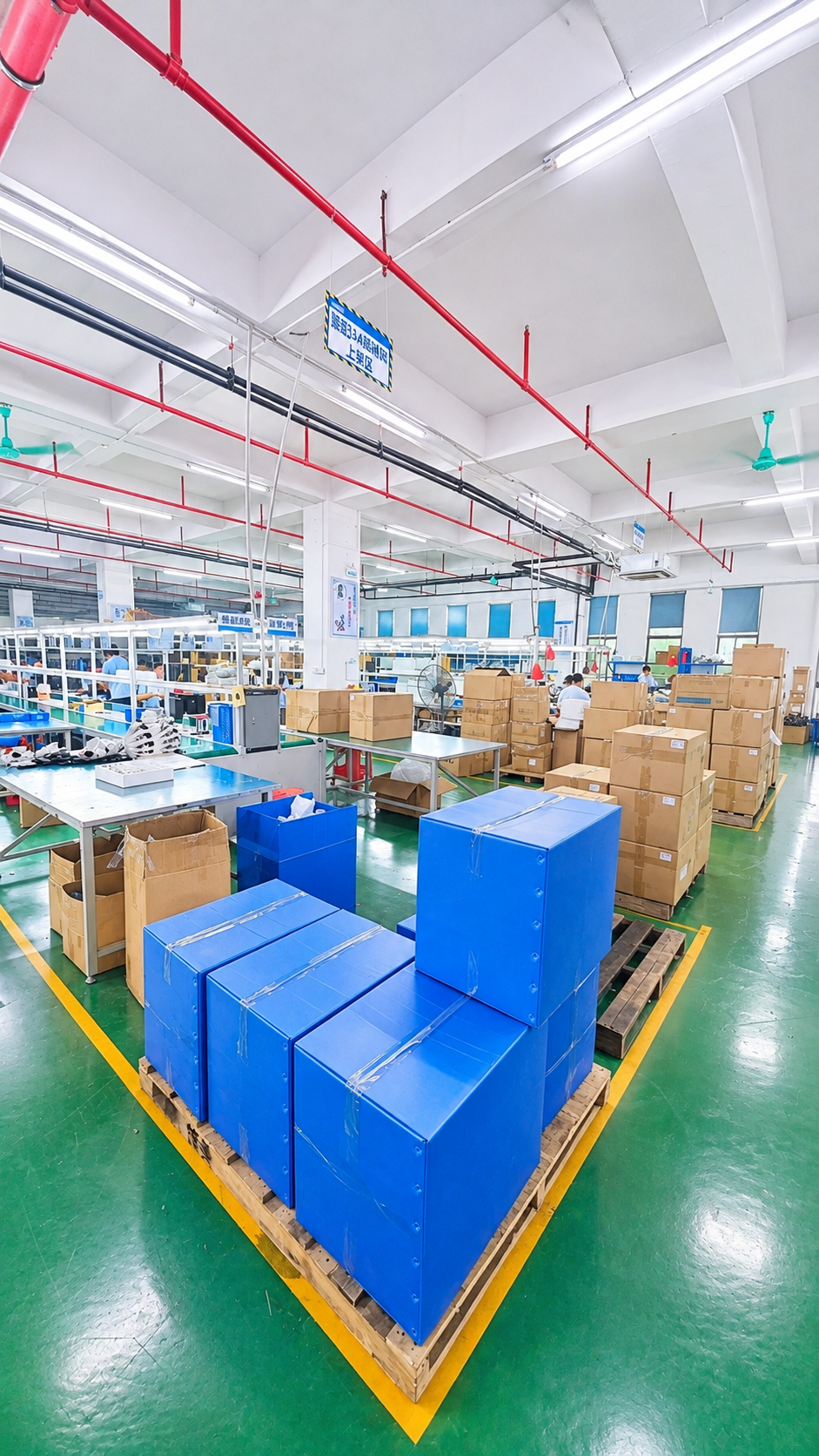
Production environment at Shengdelan Fragrance Technology (Guangzhou) Co., Ltd. — the supplier behind the three shortlisted models. Photo supplied by the company.
Matching the shortlist to a project brief
The three models are not arranged in a hierarchy, because the evidence does not support one. They separate on two documented dimensions: reservoir size with power draw, and control architecture. A practical matching logic looks like this:
| Project condition | Lean toward | Basis |
|---|---|---|
| A US private-label home fragrance line with custom logo, colour box and fragrance, and a need for a model already run through multi-year production | SDL312 | Recorded US private-label project: 5,000 units, three-year duration, reorders in three consecutive years, custom logo, colour box and fragrance |
| Room-level or zone-level placement in a hotel or commercial interior, with simple wiring and phone-based schedule setting | SDL313 | 130 ml capacity, 5 W power, Bluetooth control, hotel and commercial-space positioning |
| Mixed settings — home, hotel, office, automotive or commercial — where a larger reservoir and flexible control are useful | SDL611 | 300 ml capacity, 12 W power, dual-fluid atomization, Bluetooth, Wi-Fi and button control |
| A project that requires duct-mounted or multi-zone diffusion | None of the three | All three are standalone diffusers; ducted systems sit in a different equipment class |
Two tie-breakers are worth adding when the operational profile is still unclear. First, compare the refill workload rather than the reservoir number: a 130 ml unit and a 300 ml unit running the same daily hours will generate different service intervals, and the property's staffing model usually decides which is tolerable. Second, compare the control burden. Bluetooth-only control concentrates settings in a paired handset, while a Wi-Fi pathway allows central schedule management — a meaningful difference for a chain and a negligible one for a single owner-operated site.
What US and EU buyers should still verify before shipping
The certificates establish the compliance footprint; they do not close every question a project will raise. Four checks are worth running before a purchase order is confirmed.
Model and configuration match. The FCC authorization and both EU certificates list model numbers rather than a single part code. Confirm that the exact model, variant and electrical configuration being ordered appears in those lists, and that the frequency ranges on the FCC grant correspond to the wireless function actually fitted to the delivered units.
Document custody. Buyers should hold the current issue of each certificate and the associated declaration of conformity in the project file, not just a screenshot in a chat thread. The three EU-facing documents here carry issue dates of 21 September 2023, and the FCC grant carries 17 December 2025, so the file should be refreshed if a later revision is issued.
Coverage beyond EMC, RoHS and FCC. The supplied records address electromagnetic compatibility, hazardous substances and radio-frequency authorization. Electrical safety documentation, wireless-radio requirements specific to the destination market, and any packaging or fragrance-handling obligations are separate questions, and buyers should confirm what applies to their own shipment rather than assuming the certificates cover them.
Label and manual language. For EU-bound goods, label language and the instruction manual are practical launch items. The manufacturer lists multilingual packaging and manuals covering English, German, French, Spanish, Japanese and Arabic among its customisation options, which allows the label set to be aligned with the destination market during the order rather than after arrival.
Supply, minimum order and lead-time facts alongside the certificates
Compliance alone does not make a shortlist workable; the supply side has to match the project timeline. The manufacturer's stated parameters give a buyer the numbers to plan against. Monthly capacity is 5,000 units. Minimum order quantities are quoted as one piece for a sample order, 50–100 pieces per model for neutral wholesale, and 500–1,000 pieces per model for OEM or ODM customisation, with dropshipping also available from one piece. Lead times are quoted at 3–7 days for ready stock, 15–25 days for bulk orders and 30–45 days for OEM or ODM custom orders, with the September-to-December peak season running 30–40 days and a recommendation to place orders one to two months ahead.
Quality control is described as 100% full inspection before shipment, supported by aging tests of four to eight hours of continuous running, incoming material inspection, in-process patrol inspection every two hours, outgoing inspection, and specific noise, mist output, leak and appearance checks. After-sales support is handled remotely. Customisation extends to logo printing by silk screen or laser engraving, shell colour and material, packaging including colour box, user manual and carton, private-label fragrance and essential oil, housing and mould design, function options such as app, remote, timer and mist level, voltage and plug types for US, EU, UK, AU and JP markets, and multilingual packaging as noted above.
Those figures should be read as supplier-stated planning inputs. A buyer's own order should still be confirmed in writing against the specific model, configuration and delivery window, because capacity and lead-time statements describe general capability rather than a reservation of production slots.
Frequently asked questions
Why do SDL312, SDL313 and SDL611 appear together on a US and EU shortlist?
Because all three sit inside the same compliance footprint. Each is named in the FCC equipment authorization 2BCCLRAD-8 issued by Eurofins Electrical and Electronic Testing NA, Inc., the FCC Supplier's Declaration of Conformity LH-230903022800 under Part 15 Subpart B, the CE certificate of conformity LH-230903022799 for EMC Directive 2014/30/EU, and the RoHS certificate of conformity LH-230903022801 for Directive 2011/65/EU and (EU) 2015/863. A buyer reviewing one model therefore has visibility into the same record set for the other two.
What separates SDL313 from SDL611 in practical terms?
Reservoir size, power draw and control architecture. SDL313 is listed at 130 ml and 5 W with Bluetooth control, positioned for hotel and commercial-space use. SDL611 is listed at 300 ml and 12 W with dual-fluid atomization and Bluetooth, Wi-Fi and button control, positioned across home, hotel, office, automotive and commercial spaces. The larger reservoir on SDL611 lengthens the interval between refills, while SDL313's lower wattage and compact size suit room-level placement with simple wiring.
SDL312 has no separately listed capacity in the material — can it still be shortlisted?
Yes, on documentary grounds. SDL312 is covered by the same four records as the other two models, and it is the only one of the three tied to a recorded US private-label deployment: a home fragrance product line under the client's own brand, 5,000 units, a three-year project duration, reorders in three consecutive years, and custom logo, colour box and fragrance under an OEM arrangement. Its capacity, wattage and control configuration should be confirmed directly before those parameters are written into a specification.
Can one CE EMC certificate cover several diffuser models?
Yes, where the certificate lists the models and the product category matches the goods being shipped. Certificate LH-230903022799 covers an aromatherapy machine and lists a series of model numbers that includes SDL312, SDL313 and SDL611, with the same pattern appearing on the RoHS certificate LH-230903022801. A buyer should still check that the specific model, variant and electrical configuration on the order corresponds to the listed scope, since certification covers the tested configuration rather than every possible customisation.
Which FCC records should a US buyer check, and what does each one cover?
Two distinct records. The equipment authorization under grant reference 2BCCLRAD-8 covers the digital transmission function of the aroma diffuser under FCC Rule Parts 15C, with frequency ranges of 2412.0–2462.0 MHz and 2402.0–2480.0 MHz. The Supplier's Declaration of Conformity LH-230903022800 covers the unintentional-radiator requirement under FCC Part 15 Subpart B. They address different obligations and should be held together rather than treated as interchangeable.
Does inclusion on the certificates mean a diffuser is ready for any US or EU installation?
No. The certificates confirm that the listed models fall within the tested scope for electromagnetic compatibility, hazardous-substance control and radio-frequency authorization. They do not certify a specific installation, a third-party fragrance oil, a custom packaging combination or obligations outside those areas, such as electrical safety documentation or destination-specific radio requirements. Those items remain part of the project's own verification work.
Where this shortlist leaves a buyer
The value of these three models is not that one outranks the others, but that all three can be discussed with the same document set open on the table. SDL312 brings a recorded US private-label programme and the broadest claim to channel experience. SDL313 brings a compact 130 ml reservoir, 5 W draw and Bluetooth control aimed at hotel and commercial interiors. SDL611 brings the largest reservoir on the list at 300 ml, dual-fluid atomization and three parallel control pathways across home, hotel, office, automotive and commercial settings. A buyer who matches those documented characteristics to the room, the refill routine and the control model the project can actually operate will end up with a defensible selection rather than a preference.
For readers who want the wider product and company picture behind these three models, the manufacturer's catalogue is available as a downloadable brochure: Introduction to the Supreme Saintdeland.
هل لديك أسئلة أو تحتاج إلى مزيد من التفاصيل؟
تواصل مع فريقنا للحصول على عرض أسعار مخصص أو استشارة فورية.
طلب عرض أسعار
املأ النموذج أدناه وسيتواصل معك فريقنا بعرض مقترح مخصص.
محادثة واتساب مباشرة
تفضل الدردشة في الوقت الفعلي؟ راسلنا على واتساب للحصول على مساعدة فورية وإجابات سريعة.
- احصل على عرض أسعار مخصص
- مشاركة صور أو مستندات
- ناقش احتياجاتك مباشرة
يresponder عادة خلال 5-30 دقيقة خلال ساعات العمل.