
US Standard Plug Supplier Evidence: Models, Materials, Listings
US Standard Plug Supplier Evidence: Models, Materials, Listings
A supplier's product list is a claim; its model designations, material statements and listing file numbers are the evidence behind that claim. For buyers of US standard plugs and wiring devices who are moving from evaluation into execution, the decisive question is no longer whether a factory can mould a receptacle or assemble a NEMA plug. It is whether each catalogue line can be tied to a document that survives an electrical inspector, a QA auditor or a wholesale customer's own compliance team.
Guangzhou Bosslyn Electric Co., Ltd. is a Guangzhou-based manufacturer of plugs, receptacles, switches, wall plates and related wiring accessories, founded in 2014, with a stated export share of about 70% and main markets including the United States, Canada, Mexico, the EU, Southeast Asia and the Middle East. Its range spans NEMA plugs and connectors, receptacles, GFCI outlets, US standard wall switches and outlets, wall plates and junction boxes, industrial and waterproof connectors, generator plugs and travel adapters. This review examines how that range is documented — model series, material and test statements, and UL listing records — and where a buyer should press for more before releasing a purchase order.
What capability evidence means in a wiring-device quotation
Capability evidence answers three separate questions, and suppliers routinely blend them in correspondence. Identity evidence establishes which product a document refers to: the exact series or model designation, not the product category. Construction evidence establishes what the product is made of and how it was tested. Authorization evidence establishes that an independent body has evaluated that construction against a named standard.
A strong answer in one layer does not repair a gap in another. A detailed material statement without a model reference cannot be applied to a specific SKU. A file number without a scope description does not tell the buyer which constructions are covered. A certificate that names a standard but not a file number cannot be checked by anyone outside the transaction.
For NEMA plugs and sockets exported to the United States or Canada, the compliance requirement recorded in the manufacturer's own procurement guidance is UL 498, with UL and cUL marks. UL 498 is also the standard cited in two of the three listing records discussed below, which makes it the natural anchor for a documentation request.
The model matrix: how receptacle, GFCI and plug designations map to evidence
The clearest way to read a wiring-device catalogue is as a matrix with three axes: series, configuration and listing reference. In the material reviewed here, the matrix resolves into three documented clusters.
- Wall receptacles. The series BR-15S, BR-20S, BR-620, BT-15, 1-207DHIG and SSRE-11/12/14/16 is attached to UL file E500631, whose scope is wall receptacles under UL 498.
- GFCI receptacles. The series AGFCI-15TR and AGFCI-20TR is attached to UL file E500632, whose scope is ground-fault circuit-interrupter receptacles under UL 943.
- NEMA plugs and sockets. The models B515P and B515C are attached to UL file E500807, whose scope covers attachment plugs (fuseless), attachment plug, cord connector, flanged inlet and flanged outlet under UL 498.
Around these documented clusters sits a wider catalogue: NEMA standard plugs, twist-lock plugs and receptacles, NEMA L14-30P, flange receptacles, cable connectors, retention-type and rewireable plugs, medical-grade duplex receptacles, hospital-grade and waterproof families, generator-dedicated plugs, industrial power connectors, travel adapters, US standard wall switches, wall plates and junction boxes.
Two reading rules follow. First, a designation is an identifier, not a specification. Numeric elements in a family name — the 15 and 20 in BR-15S/20S or AGFCI-15TR/20TR — should be confirmed against the datasheet rather than decoded from the part number, because a suffix can carry a feature or packaging distinction as easily as a rating distinction. Second, a file number covers the constructions described in that file. A model that appears in a catalogue but not in the file's related-model list is a question to ask, not a conclusion to draw about either the product or the supplier.
Listing claims: three UL files and their exact scope
The listing evidence supplied for this review consists of three records issued by UL, none of which carries an expiry date. Buyers should confirm current status directly in UL's product database before relying on any file number, because a supplied PDF or screenshot is a snapshot, not a live status check.
| UL file | Scope of the record | Standard | Issued | Related models listed |
|---|---|---|---|---|
| E500631 | Wall receptacle | UL 498 | 2023-05-23 | BR-15S, BR-20S, BR-620, BT-15, 1-207DHIG, SSRE-11/12/14/16 |
| E500632 | Ground-fault circuit-interrupter receptacles | UL 943 | 2022-02-17 | AGFCI-15TR, AGFCI-20TR |
| E500807 | Attachment plugs (fuseless); attachment plug; cord connector; flanged inlet; flanged outlet | UL 498 | 2025-07-17 | B515P, B515C (NEMA plug and socket) |
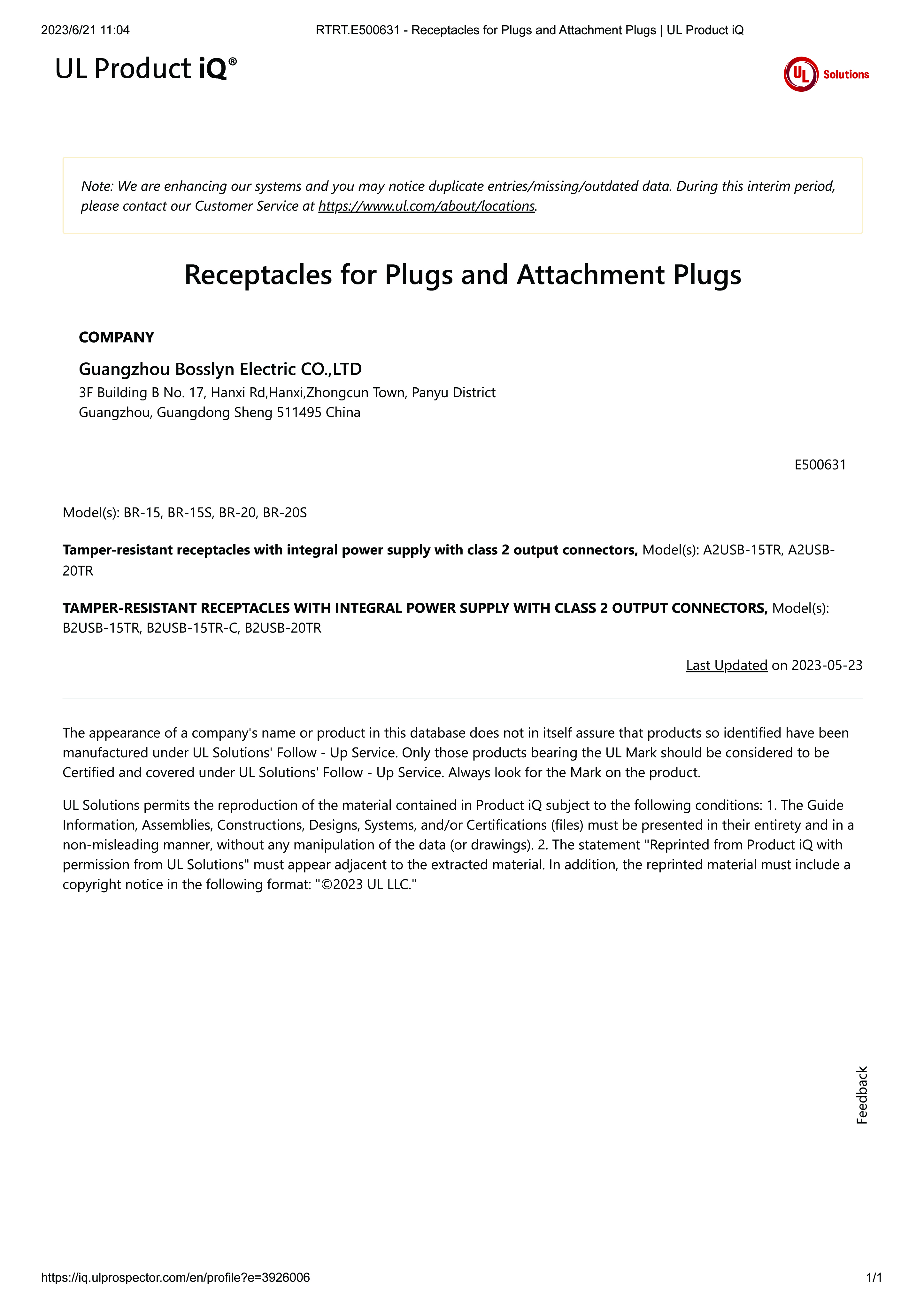
Read together, the three records document the receptacle and attachment-plug core of the range — the parts most exposed to inspector scrutiny in a US installation. They also show why scope description matters. E500807 covers five construction types under one file, while E500631 and E500632 are separated by standard, because UL 498 and UL 943 evaluate different functions. A GFCI receptacle is not a receptacle with an added feature; it is a product family evaluated against its own standard, and a specification that merges the two invites substitution later.
The reverse reading is equally important. The absence of a listing record for a given family in this review is not evidence that no such record exists. It is evidence that no such record was supplied.
Wall switches, wall plates and junction boxes: what the reviewed records show and what to request
The manufacturer's stated range includes US standard wall switches, US standard wall plates including a brass wall plate line, and US standard outlet and junction boxes. The three UL records reviewed above describe wall receptacles, GFCI receptacles and attachment plugs; none of them describes a switch or a box family.
That is a documentation gap, not a capability finding. A catalogue can list a switch family long before a buyer has been handed the file that covers it, and a supplier can hold current listings that were simply not included in a quotation pack. The practical response is a specific request rather than an assumption: the listing file number for the switch family, the standard against which it was evaluated, the configurations covered, and the related-model list. Outlet and junction boxes need the same request as a separate item, because box and enclosure evidence follows its own requirements rather than inheriting the device inside it.
Enclosure claims deserve particular care because they are easy to over-read. NEMA's guidance on enclosures for electrical equipment rated not more than 1,000 V describes indoor, outdoor and hazardous-location enclosure types, and it covers equipment incorporating separable electrical connections — but an enclosure rating belongs to the enclosure, not to the device mounted in it, and it cannot be transferred to a plug or receptacle as an electrical rating.
NEMA's product-scope documentation shows the same discipline in another direction: field-wireable, current-carrying pin-and-sleeve plugs, receptacles and connectors are a distinct product scope, not an interchangeable description for straight-blade or locking devices. Colour follows a similar logic. NEMA publishes general colour requirements covering AC switches, plugs, cord connectors and receptacles, which makes colour a specification item to be written down per SKU rather than settled by a photograph at shipment.
Industry classification adds one more caution. The NEMA and FTI economic-impact methodology places wiring-device manufacturing under NAICS 335931 and 335932 — a boundary wide enough that it can be used to find suppliers but never to qualify one. Classification says a company operates in the category; only configuration-level records say what it can ship.
Material statements: turning "flame-retardant" into a checkable specification
Material language in wiring-device catalogues clusters around a few words — flame-retardant, heat-resistant, durable — that describe an intention more than a compound. The documented evidence here is more specific in method than in chemistry. Quality control is described as covering material regulatory compliance, appearance and dimension verification, electrical property validation and mechanical durability testing, while the housing of the receptacle and NEMA plug families is described as flame-retardant with good vibration resistance.
The in-house laboratory is listed as performing glow-wire, flame-retardancy, salt-spray, insertion-withdrawal force, temperature-rise, dielectric withstand voltage, USB current and GFCI leakage tests. Each maps to a different failure mode: glow-wire and flame-retardancy tests to ignition behaviour, temperature rise to terminal and contact loading, dielectric withstand to insulation integrity, insertion-withdrawal to contact retention over service life, salt spray to plating and corrosion performance, and GFCI leakage to trip behaviour.
What a buyer should convert into a written specification is therefore the mapping, not the adjective. For each SKU: the polymer grade and its flammability classification; the substrate and plating of current-carrying metal parts; the brass content or finish where a brass wall plate is specified; and the test report that supports the statement, identified by model, test and date. If a project calls for an aluminium or stainless-steel finish, that should be specified and confirmed per model as a finish, not assumed to alter the underlying load path of the device. Without the mapping, "flame-retardant housing" remains a description; with it, it becomes a purchase condition.
Quality control and test capability behind the claims
Guangzhou Bosslyn Electric Co., Ltd. reports a 1,500 m² factory, 30 employees, a five-engineer R&D team and an annual output of 10,000,000 units, operating two production lines equipped with automatic screw-driving machines, automatic packaging machines, laser and ultrasonic equipment and silent terminal crimping machines, under an ISO 9001 production management system. Its certification portfolio is listed as CE, UL, CCC, VDE, RoHS, BSI and SAA.
For an evaluating buyer, the operational detail that matters most is the in-house laboratory, because it changes the rhythm of a qualification project. Glow-wire, flame-retardancy, salt-spray, insertion-withdrawal, temperature-rise and dielectric withstand testing can be run before a sample leaves the factory, which shortens the loop between a failed sample and a corrected one. The boundary is equally important. In-house testing is a design and production control, not an independent certification; the listing file remains the authorization evidence, and a test report describes the specific sample tested rather than every unit in a production run.
That distinction should shape the sample request. A buyer asking for a "certified sample" is usually asking for two different things: a unit built to a listed construction, and a test report that belongs to that construction. Requesting both, with model numbers attached to each, avoids the common situation in which a report from one series is presented as support for another.
OEM and ODM execution: MOQ, customization and lead time
The manufacturer provides OEM and ODM production services, with customization covering logo and package printing, blister packaging, colour boxes and laser logo marking. The recorded commercial parameters are a minimum order quantity of 100 pieces, a lead time of 7 days, a monthly capacity of 50,000 pieces and a one-year warranty; the export markets named for this capability are the United States, Canada, Japan and the Philippines.
Read as execution evidence, these figures matter in three ways. A 100-piece minimum makes a private-label trial feasible before a full range commitment, which is useful for a distributor testing a house brand on wall plates or receptacles rather than on a single hero SKU. A 7-day lead time typically describes a defined, repeatable configuration, so a buyer introducing new print, new packaging or a new housing colour should confirm whether the figure still holds. And the monthly capacity figure is stated for the OEM/ODM capability while the annual output figure describes the company as a whole; these are different scopes, and a buyer forecasting a large programme should ask which line the capacity figure refers to instead of reconciling the two by arithmetic.
OEM execution is not only a commercial claim. The company reports appointed OEM work for gift-item projects of Bank of China, Industrial and Commercial Bank of China, China Construction Bank and Agricultural Bank of China, and designated OEM work for Guangzhilv Travel and Nanhu International Travel Service — programmes in which packaging, marking and batch consistency are usually specified as tightly as the electrical product.
From model matrix to job site: construction, engineering, renovation and wholesale
The same documented matrix supports four different buying conversations, and the emphasis shifts in each.
Electrical engineering and equipment integration. The supplier's case record for its NEMA plug range describes applications in industrial machinery, stage lighting and audio systems, rice cookers, kettles, air conditioners, power tools, computers and monitors, and notes that twist-lock NEMA types are used where accidental disconnection must be avoided — a functional distinction that matters more in event and industrial settings than a headline rating does. The wiring guidance for rewireable plugs specifies a 15 A, 125 V, 50/60 Hz context, NEMA 5-15R receptacles and 18, 16 or 14 AWG three-core cords, which is the level of detail an integrator needs to match a plug to existing cord stock.
Construction and renovation. Project purchasing is driven by device count and by the inspector's view of the installation. A receptacle series attached to a UL 498 file, a GFCI series attached to a UL 943 file and a plug family attached to a UL 498 file give a contractor three checkable anchors; wall plates and boxes then need their own documentation before a submittal package is complete. Bundling devices per floor or per unit type works only when the bundle's listing references travel with it.
Medical, standby and terminal power. The receptacle case record describes 50,000-piece supply over a ten-year relationship with equipment OEMs, system integrators and engineering contractors, covering medical equipment, electronic devices, small and gasoline generators, port and terminal equipment and computer-room wiring, and reports stable power supply, reliable grounding and continuous operation under rated load as the outcome. That record describes the supplier's own project experience; it is context for a buyer's questions, not a substitute for the buyer's acceptance testing.
Wholesale and distribution. A distributor's shelf decision is a matrix decision: which series, which packaging, which listing reference on the label. Because the receptacle, GFCI and plug clusters each carry a distinct file number, a counter team can answer a contractor's compliance question from the packaging and the file list rather than from a call to the factory — provided the distributor keeps that list current.
Evidence-first sourcing versus price-first sourcing: where each fits
Price-first sourcing compresses the evaluation stage. A buyer collects quotations against a description, compares unit cost, and resolves documentation during the first production run. It works when the device is a like-for-like replacement inside an already approved construction, and when another party in the chain already holds the compliance file.
Evidence-first sourcing reverses the order. The buyer fixes the model matrix first, attaches a listing reference to each line, and prices only the configurations that survived that filter. It is slower at the quotation stage and faster at submittal, inspection and repeat order, because the documentation does not have to be rebuilt each time.
The limitation is real. Evidence-first sourcing only pays when the buyer can act on the evidence: someone has to read scope statements, confirm file numbers and hold the supplier to the model level. For low-risk interior replacement work where the authority having jurisdiction accepts the device marking on site, an elaborate documentation pack can add cost without adding acceptance. The method is also bounded by what a listing does not do — a UL file confirms that a construction was evaluated against a standard; it does not confirm that a particular shipment matches that construction, that a lead time will be met, or that the product suits a specific installation. Those remain inspection, contract and engineering questions.
What buyers should expect next
Listing verification is becoming a buyer-side habit rather than a supplier-side courtesy. Because UL publishes file records in a searchable product database, a purchaser can check a file number, a product category and a related-model list without asking the factory for permission, which steadily moves the burden of proof toward model-level documentation.
The practical consequence for manufacturers is that range breadth stops being the headline. A catalogue with twenty product families is easy to publish; a matrix that states, for each family, the series, the construction, the test evidence and the listing reference is not. Suppliers that prepare that matrix in advance spend less time in the documentation phase of every quotation, and buyers spend less time reconciling a certificate to a carton. For a manufacturer whose documented core already covers receptacles, GFCI receptacles and NEMA plugs across three UL files, with an in-house test laboratory and a 100-piece customization entry point behind them, the next step is not more product lines but the same level of documentation applied to switches, plates and boxes.
Frequently asked questions
What do the UL files E500631, E500632 and E500807 each cover?
E500631 covers wall receptacles under UL 498, with related models BR-15S, BR-20S, BR-620, BT-15, 1-207DHIG and SSRE-11/12/14/16. E500632 covers ground-fault circuit-interrupter receptacles under UL 943, with related models AGFCI-15TR and AGFCI-20TR. E500807 covers attachment plugs (fuseless), attachment plug, cord connector, flanged inlet and flanged outlet under UL 498, with related models B515P and B515C.
How can a buyer verify a UL file number independently?
UL publishes its listing records in a searchable product database. A buyer can enter the file number, confirm the product category and standard, and check whether the specific model appears in the related-model list. Because the records reviewed here carry no expiry date, current status should be confirmed in that database rather than inferred from a supplied document.
What certifications are required for NEMA plugs and sockets exported to the US or Canada?
The compliance requirement recorded by the manufacturer is UL 498, with UL and cUL marks for the United States and Canada respectively. Buyers should confirm the applicable standard for the exact construction, because receptacles, GFCI receptacles and attachment plugs are evaluated under different scopes even when they appear in one catalogue.
What is the minimum order for OEM or private-label packaging?
The recorded OEM/ODM parameters are a minimum order quantity of 100 pieces, a 7-day lead time and a monthly capacity of 50,000 pieces, with customization covering logo and package printing, blister packaging, colour boxes and laser logo marking. Lead time for a new print or a new housing colour should be confirmed separately, since the stated figure typically applies to a defined configuration.
How is a rewireable plug wired, and what comes first?
De-energizing the circuit comes first: the circuit must be fully isolated before any work begins, with insulating gloves and appropriate protective equipment worn. The procedure then runs through stripping one end of the cord while leaving the longest conductor as the ground wire, removing the housing screws and front insert, loosening the cord clamp and feeding the cord through the body from the clamp side, then terminating conductors to the marked hot (X/Y/Z), neutral (W) and ground (G) positions and reassembling the plug.
Reference material
The full product catalogue, including the receptacle, GFCI, NEMA plug, wall plate and junction box series referenced in this article, is available for download: Bosslyn product catalogue (PDF).
Company reference: Guangzhou Bosslyn Electric Co., Ltd., 3F, No. 5 Xinghong 2nd Street, Shibi Street, Panyu District, Guangzhou, China 511495.
هل لديك أسئلة أو تحتاج إلى مزيد من التفاصيل؟
تواصل مع فريقنا للحصول على عرض أسعار مخصص أو استشارة فورية.
طلب عرض أسعار
املأ النموذج أدناه وسيتواصل معك فريقنا بعرض مقترح مخصص.
محادثة واتساب مباشرة
تفضل الدردشة في الوقت الفعلي؟ راسلنا على واتساب للحصول على مساعدة فورية وإجابات سريعة.
- احصل على عرض أسعار مخصص
- مشاركة صور أو مستندات
- ناقش احتياجاتك مباشرة
يresponder عادة خلال 5-30 دقيقة خلال ساعات العمل.