
USB 3.0 vs HDMI/SDI: TCHD-X6 and 8.42MP Buyer Guide
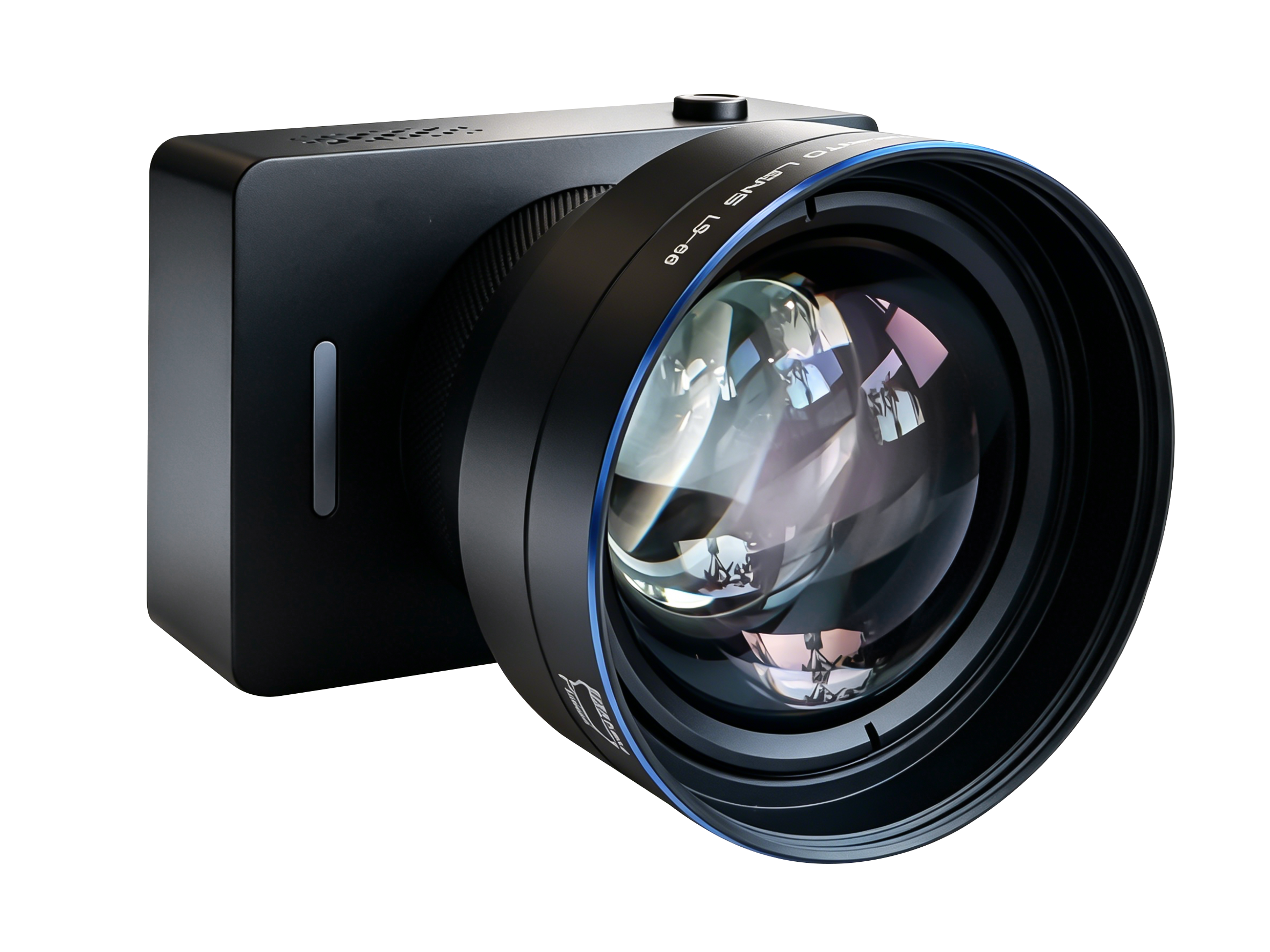
TCHD-X6 delivers 4K video over a single Type-C USB 3.0 connection, with no HDMI or SDI output.
A live streaming camera is usually shortlisted on image quality and then rejected on connectivity. The sensor, the frame rate and the tracking features decide how the picture looks; the output interface decides whether that picture can reach the production system in the room at all. Two cameras from the same manufacturer can look almost identical on a product page and still belong to two different workflows — one assumes a computer is the production hub, the other assumes baseband video and a hardware switcher.
That is the practical line between the TCHD-X6 and the 8.42MP 4K PTZ models in the TCHD Video range. The TCHD-X6 is a USB-first live streaming camera: video leaves the device through a Type-C USB 3.0 interface, and the camera does not provide HDMI or SDI output. The 8.42MP PTZ family — represented here by the TC-980S, alongside the TC420 and TCHD-T3 — carries HDMI, SDI, USB 3.0 and a wired LAN port, with optional PoE+ power and SDI transmission specified for 1080P60 over cable runs up to 100 m. This article sets out a buyer decision framework for choosing between those two positions.
Why the interface decision comes first
Interface choice is an operations decision, not a specification detail. It determines which switcher is used, which cable is pulled through the ceiling, how many operators are needed, and which software has to be running for the stream to exist. Buyers who select a camera before mapping the signal path frequently end up adding converters, capture devices or a second camera — costs that never appear on the camera quotation.
TCHD Digital Video Technology Development (Beijing) Ltd. is a Beijing-based manufacturer established in 2005 that produces live streaming cameras, video capture cards, video converters, video encoders and video switchers as standardised video hardware, together with application systems for live streaming, recording and education delivery. The company operates a 10,000 m² manufacturing facility with approximately 50 staff, an R&D team of 10 engineers, an annual production capacity of 4,000 units, and export business accounting for 20% of sales, with major markets in the EU, USA and Asia. Because the same company builds USB-only cameras, multi-interface PTZ cameras and the capture and switching hardware that sits behind them, the interface difference between its models is a deliberate product decision rather than a limitation of capability.
What USB 3.0 with UVC and UAC actually delivers
USB 3.0 output is not simply a port swap. When a camera implements the UVC (USB Video Class) and UAC (USB Audio Class) protocols, the operating system recognises it as a standard video and audio device. The TCHD-X6 supports UVC v1.1 and UAC 1.0, is compatible with both USB 3.0 and USB 2.0, supports raw video output as well as encoded video output, requires no driver installation, and is powered through the same Type-C interface it uses for video.
The operational consequence is that integration risk shifts from hardware to software. There is no capture card to install, no SDI matrix to patch, and no separate power supply to mount. The camera appears inside the streaming or conferencing application, and the computer handles encoding, scenes, overlays and delivery. For single-operator e-commerce live selling, classroom capture, lecture streaming and small corporate meeting rooms — where the streaming application is already the production tool — this removes an entire hardware layer from the room.
The same design has a boundary that buyers should plan around. Because video and power share one USB connection, the host computer becomes a single point of dependency, and the camera's effective operating position is tied to the length and quality of the USB run and to the host's ability to decode the incoming stream. The published interface list for the TCHD-X6 covers USB only — HDMI, SDI, RS232/RS485 and LAN control interfaces are not part of that specification. A room that needs baseband video into a hardware switcher, or remote control over serial or network protocols, is not an X6 room.
TCHD-X6 in detail
The TCHD-X6 is classified as a live streaming camera and as an e-commerce streaming camera and education teaching camera, with stated applications across e-commerce streaming, education teaching, event streaming, broadcasting and medical use. Its image chain is built around a 1″ CMOS 50MP sensor with a field of view of 85.3° diagonal (4:3), 72.8° horizontal and 57.8° vertical, and it measures 74 × 52 × 35 mm in a plastic and glass housing.
Four features are worth separating from the specification list, because they change how the camera is used rather than how it looks on paper:
- Focus and tracking. The X6 uses advanced focusing algorithms with TOF module assistance for fast, accurate and stable focus, and can also achieve rapid face autofocus without the TOF module. It supports facial tracking, with personalised configuration of the AI facial tracking model to sharpen focus on specific faces.
- Low-light behaviour. The CMOS sensor is specified with an ultra-high signal-to-noise ratio, and the camera applies both 2D and 3D noise reduction algorithms to keep the image clean in very low light.
- Interchangeable lenses and HDR. The lens is interchangeable; the camera can be fitted with an external 4.8× macro lens or a 58 mm portrait lens. HDR is supported, and colour can be tuned independently across 24 colour tones and their saturation levels, with adjustment of red, green, blue, yellow, orange, warm tones, highlights and shadows, plus four image versions: Standard, De-Red, Fairer and Professional.
- Orientation and formats. The X6 supports both landscape and portrait output modes without changing the mounting. MJPEG output covers 4K@30fps, 4K@25fps, 4K@15fps, 1080P@30/25/15fps and 720P@30/25/15fps. YUV (YUY2) output covers 1080p@60fps — which is interpolated, not native — plus 1080p@30/25/15fps and 720p@30/25/15fps.
What HDMI, SDI and LAN add to the workflow
HDMI and SDI carry baseband video that can be routed directly into switchers, monitors, recorders and transmission equipment without a computer in the path. SDI adds a locking connector and long cable runs, which is why it survives in broadcast and large-venue work; on the TCHD Video PTZ models, SDI is specified to carry 1080P60 over cable runs of up to 100 m. LAN adds a third path: the camera becomes a network device that can be controlled and streamed over IP, and on the higher models it can also be powered over Ethernet.
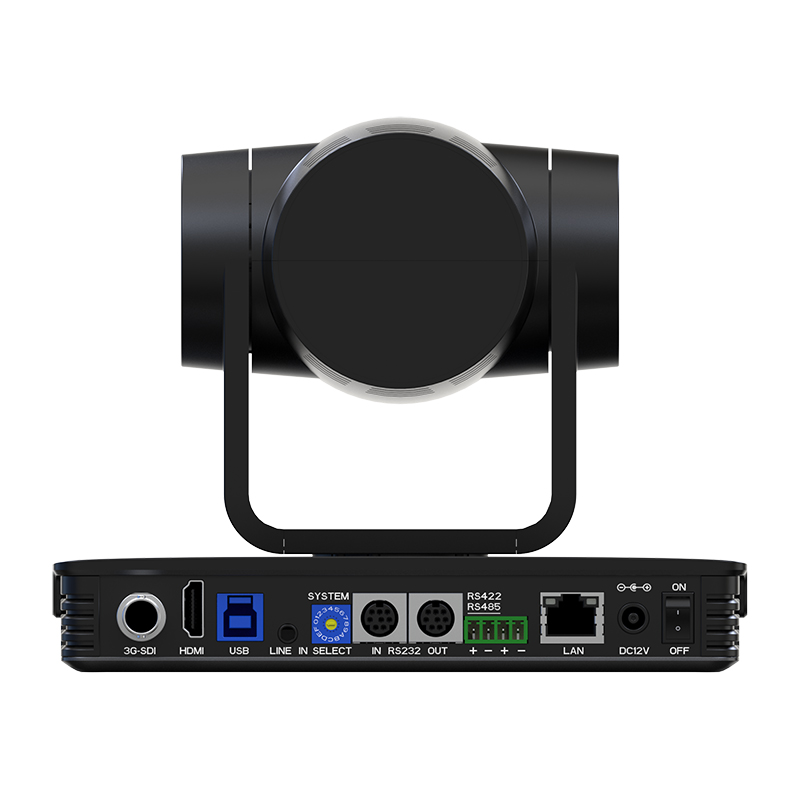
Multi-interface PTZ models combine HDMI, SDI, USB 3.0 and LAN in one chassis, allowing baseband and IP workflows in the same room.
The 8.42MP 4K PTZ family: TC-980S
The TC-980S is positioned as a PTZ camera for the broadcasting industry, also used in event streaming, education training, medical teaching and video conferencing. It uses a 1/2.8-inch high-quality CMOS sensor with 8.42M effective pixels in a 16:9 frame, and is offered with 12X, 20X or 30X optical zoom depending on variant, each with 16X digital zoom. Video output covers HDMI up to 3840 × 2160 and 1920 × 1080P60, SDI at 1920 × 1080P60 with 1080i and 720P support, USB 3.0, and LAN with H.264/H.265 main and sub streams.
Its interface set is the defining feature for multi-camera work: HDMI, SDI, LAN with support for PoE+ power supply, USB 3.0, audio input, RS232-IN, RS232-OUT, RS485 and DC12V power. Network protocols include RTSP, RTMP, ONVIF, GB/T28181 and SRT, with NDI and Dante AV available as options. Control runs over VISCA, Pelco-D and Pelco-P, or network VISCA, and up to 255 presets can be stored. Minimum illumination is 0.5 lux at F1.8 with AGC on, digital noise reduction is 2D and 3D, and an ultra-low-light mode is available in the video adjustment set. Monocular tracking supports real-time, stage and area tracking plus intelligent framing, with a maximum tracking distance of up to 18 m. Total power consumption is ≤18 W.
TC420: 4K HDMI with 1080P SDI
The TC420 sits in the same multi-interface logic at a different price and performance point. It is classified as a PTZ and video conference camera for education teaching, e-commerce streaming, medical training, event streaming and broadcasting. HDMI output reaches 4KP30 and 1080P60; SDI covers 1080P60 and 720P60; USB 3.0 supports YUY2, NV12, MJPG and H.264 in main and sub streams; and the LAN port is a 10M/100M/1000M adaptive Ethernet port with PoE power supply support and audio/video output. Interfaces include HDMI, SDI, LAN (PoE), USB 3.0, audio in, RS232-IN, RS232-OUT, RS422 (compatible with RS485) and DC12V. Optical zoom is 12X with 15X digital zoom, pan range is -170° to +170° and tilt range is -30° to +90°, with up to 255 presets, 0.5 lux minimum illumination, 2D and 3D digital noise reduction, and power consumption below 12 W.
TCHD-T3: the 1080P bridge
The TCHD-T3 is a 1080P camera for education teaching, e-commerce streaming and medical training. It supports 1080P@60/50/30/25fps, 1080i@60/50fps and 720P@60/50fps from a 1/2.8-inch CMOS sensor with 2.07M effective pixels, with a 12x lens at f3.5–42.3 mm and F1.8–F2.8, 16x digital zoom, and 2D and 3D digital noise reduction. Its interfaces are one HDMI 1.4b output, one USB 3.0 Type-C and one USB 2.0 Type-A port, a 3.5 mm audio line input, and one RJ45 10M/100M adaptive Ethernet port with PoE support. It supports UVC 1.1–1.5, UVC PTZ control, RTSP, RTMP, ONVIF and multicast protocols, with up to 255 presets and a dedicated vertical/horizontal screen button.
Interface and output comparison at a glance
| Buyer criterion | TCHD-X6 | TC-980S (8.42MP) | TC420 | TCHD-T3 |
|---|---|---|---|---|
| Primary video out | Type-C USB 3.0 (USB 2.0 compatible) | HDMI, SDI, USB 3.0, LAN | HDMI, SDI, USB 3.0, LAN | HDMI 1.4b, USB 3.0 Type-C, USB 2.0 Type-A, RJ45 |
| HDMI / SDI availability | None (no HDMI or SDI output) | HDMI up to 3840×2160; SDI 1080P60 | HDMI up to 4KP30; SDI 1080P60 | HDMI 1.4b up to 1080P60; no SDI |
| Sensor / effective pixels | 1″ CMOS 50MP | 1/2.8″ CMOS, 8.42M, 16:9 | 1/2.8″ CMOS | 1/2.8″ CMOS, 2.07M |
| Optical zoom / lens | Interchangeable lens; 4.8× macro or 58 mm portrait option | 12X / 20X / 30X by variant, 16X digital | 12X optical, 15X digital | 12x optical, 16x digital |
| Control interfaces | USB / UVC, driver-free | RS232-IN/OUT, RS485, VISCA, Pelco-D/P, network VISCA | RS232-IN/OUT, RS422 (RS485 compatible) | UVC PTZ over USB |
| Power | Via USB Type-C | DC12V, ≤18 W | DC12V, <12 W | DC12V (JEITA jack) |
| Noise reduction | 2D & 3D | 2D & 3D | 2D & 3D | 2D & 3D |
| Best-fit workflow | Single-operator e-commerce, classroom capture, computer-based streaming | Broadcast and large-venue PTZ with baseband plus IP | Conference, education and event PTZ with mixed outputs | 1080P classroom and e-commerce PTZ with USB and LAN |
Five decision criteria that settle the choice
1. Interface fit: who owns the production
If the production is owned by software on a computer — OBS, conferencing clients, lecture capture platforms — the USB-first design is sufficient and cheaper to deploy. If the production is owned by a hardware switcher, a control room, or a transmission chain that expects baseband video, the multi-interface models are the correct starting point. The question is not which interface is better, but which device is expected to be the signal source of record.
2. Resolution and frame rate: read the format column honestly
Headline resolution hides the format that delivers it. On the TCHD-X6, 4K is delivered in MJPEG at up to 30fps, while full-frame YUV (YUY2) tops out lower, with 1080p@60fps offered as an interpolated format. Buyers who need native 1080P60 uncompressed for keying, colour-critical work or low-latency routing should treat the interpolated line as a convenience format, not as a native capture mode. On the PTZ models, HDMI carries up to 3840 × 2160 on the TC-980S and up to 4KP30 on the TC420, while SDI on both is specified at 1080P60 — 4K is not available over SDI on these models. Where 4K and long SDI cable runs are both required, the signal path needs an HDMI route or a network route.
3. Lighting, noise reduction and colour control
Low-light performance is a system property, not a single number. The X6 pairs an ultra-high signal-to-noise sensor with 2D and 3D noise reduction, HDR, and fine-grained colour control across 24 colour tones with independent saturation adjustment and four selectable image versions. The TC-980S specifies 0.5 lux minimum illumination with 2D and 3D noise reduction, an ultra-low-light mode in its video adjustment set, and white balance adjustable between 2400K and 7100K in 100K steps. The TC420 and TCHD-T3 both specify 0.5 lux and 2D/3D noise reduction at a lower price point. Rooms with mixed daylight and stage lighting will benefit most from the colour and HDR controls rather than from the resolution figure.
4. Portrait or landscape output
Vertical delivery is now a first-class requirement rather than an afterthought. The TCHD-X6 supports both landscape and portrait output modes. The TCHD-T3 provides a vertical/horizontal screen button, and the TC-980S and TC420 support horizontal and vertical flip in their video adjustment sets. Buyers delivering to vertical-first platforms should confirm that the intended camera supports portrait output natively, rather than cropping a landscape frame in software and losing sensor area.
5. Control, certification and deployment evidence
Serial and network control matter in multi-camera rooms. The TC-980S supports VISCA, Pelco-D and Pelco-P over RS232/RS485 plus network VISCA; the TC420 supports VISCA, Pelco-D and Pelco-P over RS232 and RS422; the TCHD-T3 supports UVC PTZ over USB. The TCHD-X6 is controlled through its USB/UVC connection. Where a joystick controller or a room control system must drive presets, this difference is decisive.
Certification and manufacturing evidence to verify
Certification is where a camera buyer can move from specification claims to verifiable facts. In the TCHD Video range, CE EMC is documented for the TC420, and ISO 9001 quality management is cited for the manufacturing operation. The 8.42MP PTZ line is documented alongside ISO 9001 and ISO 14001, together with a teaching deployment of 20 units that has been in service for two years — a reference point that answers the durability question better than a datasheet can.
Buyers with medical training, surgical teaching or clinical applications should also check the regulatory classification that applies to the complete installation. Medical electrical equipment, including surgical cameras, must comply with the IEC 60601-1 series for basic safety and essential performance. A camera used inside a medical electrical system is subject to that framework regardless of which streaming interface it uses, and the correct question for a supplier is not only whether the camera carries a certificate, but whether the intended system configuration has been assessed. Buyers should request the certificate scope, the issuing body and the report reference before placing the order, and confirm the scope covers the exact model variant being purchased.
Commercial checks before the purchase order
Interface and image performance decide whether a camera can do the job; commercial terms decide whether the order can be executed. Four points are worth confirming in writing:
- Minimum order quantity. The MOQ is 1 unit, which allows a single-unit evaluation or a small pilot room before a wider rollout.
- Payment terms. Orders are transacted on full prepayment, which affects cash-flow planning for multi-room projects.
- Pre-shipment test acceptance. Pre-shipment test acceptance is part of the process, so buyers should define the acceptance criteria — resolution, frame rate, focus behaviour, noise reduction, interface output and control response — before the units are packed, not after they arrive.
- Delivery terms. FOB and C&F delivery are both available, and the choice changes the buyer's responsibility for freight, insurance and import clearance.
Where these cameras fit — and where they do not
A decision framework is only useful if it states boundaries. Three are worth stating plainly.
The TCHD-X6 cannot feed a baseband chain. With no HDMI and no SDI output, it cannot be plugged directly into a hardware switcher, a broadcast router or an SDI transmission link. It is a computer-attached camera, and every workflow it serves must include a computer that decodes and re-encodes the stream. That is an efficient architecture in e-commerce, classroom and conferencing rooms, and the wrong architecture in a baseband control room.
4K over USB is compressed and host-dependent. MJPEG at 4K@30fps is an encoded format, and the host computer performs the decoding. On lower-powered machines, the practical frame rate and the number of simultaneous streams may be limited by the host rather than by the camera, which is a planning consideration for multi-camera rooms built around USB.
SDI on these PTZ models stops at 1080P60. 4K is available over HDMI, USB and LAN on the TC-980S and over HDMI and USB on the TC420, but not over SDI. Projects that specify 4K over long SDI runs need a different signal plan. Additionally, NDI and Dante AV on the TC-980S are options rather than standard inclusions, and PoE+ power is similarly optional — both should be confirmed at order stage.
Compared with a traditional broadcast solution, the trade-off is straightforward. A traditional chain pairs an SDI-only camera with a hardware switcher, dedicated cabling and an operator, and it delivers predictable latency and resilient signal transport in exchange for higher cost, more equipment and longer installation time. The hybrid approach used by these PTZ models keeps the baseband path available while adding USB and IP, so a single camera can serve a hardware switcher on event days and a network stream for overflow rooms. The USB-first approach used by the TCHD-X6 removes the switcher, the cabling and the operator entirely, at the cost of a hard dependency on the host computer and the loss of baseband output.
Market direction: why interface flexibility is being priced in
The demand context supports the multi-path design trend. The global live streaming camera market was projected at USD 3.35 billion in 2025, growing at a CAGR of 8.8% to reach USD 7.79 billion by 2035. Within the conference camera segment, PTZ cameras were estimated to account for 38.5% of global revenue in 2025, and video conferencing hardware accounted for 46% of total video conferencing market revenue in 2024 — a reminder that the physical camera remains a substantial share of the category's value even as software attracts attention.
Manufacturing capacity follows the same direction. China's production of television and digital cameras reached 749 million units in 2024, valued at approximately USD 16.5 billion. Buyers should note that market growth estimates vary by definition: published PTZ camera CAGR figures range from 7.8% to 15.9% depending on how individual research firms define the segment, so a single growth number should not be treated as settled fact. What is consistent across those sources is direction, not precision.
Future outlook
Three shifts are likely to shape camera procurement over the next few buying cycles. First, IP protocols continue to move from accessory to primary path: RTSP, RTMP, ONVIF, GB/T28181 and SRT are already standard on the PTZ models, with NDI and Dante AV positioned as options, which suggests that network delivery will absorb more of the workflow that SDI occupies today. Second, compression quality over USB and LAN will keep improving, narrowing the perceived gap between a compressed 4K USB stream and a baseband signal for non-critical applications. Third, certification and evidence will continue to be requested earlier in the buying process, particularly where cameras enter education, healthcare or public infrastructure projects, because the regulatory question is a property of the installation rather than of the camera alone.
For buyers, the practical implication is that a mixed-interface camera has an extended useful life: it can join a baseband room today and a networked room later without replacement. A USB-only camera remains the fastest and lowest-cost route into computer-based production — provided the workflow genuinely stays computer-based.
Quick reference for procurement files
- TCHD-X6: USB Type-C 3.0, UVC 1.1 / UAC 1.0, no HDMI or SDI, 4K MJPEG at up to 30fps, 1080p60 interpolated YUV, AI facial tracking, HDR, interchangeable lens, landscape and portrait output.
- TC-980S: 8.42M effective pixels, 1/2.8″ CMOS, 12X/20X/30X optical zoom, HDMI up to 3840×2160, SDI 1080P60, USB 3.0, LAN with optional PoE+, tracking up to 18 m, ≤18 W.
- TC420: HDMI up to 4KP30, SDI 1080P60, USB 3.0, LAN with PoE, 12X optical zoom, RS232/RS422 control, <12 W, CE EMC documented.
- TCHD-T3: 1080P60, HDMI 1.4b, USB 3.0 Type-C and USB 2.0 Type-A, RJ45 with PoE, UVC PTZ, vertical/horizontal screen switch.
- Commercial: MOQ 1 unit, full prepayment, pre-shipment test acceptance, FOB or C&F delivery.
FAQ
What is the difference between USB 3.0 and HDMI/SDI output on a live streaming camera?
USB 3.0 output with UVC and UAC protocols presents the camera to a computer as a standard video and audio device, so the computer becomes the production hub and no capture card or hardware switcher is required in the path. HDMI and SDI output baseband video that can be routed directly to switchers, monitors, recorders and transmission equipment. In the TCHD Video range, the TCHD-X6 uses USB only, while the TC-980S and TC420 provide HDMI, SDI, USB 3.0 and LAN.
Does the TCHD-X6 have HDMI or SDI output?
No. The TCHD-X6 does not provide HDMI or SDI output. Video is delivered through a Type-C USB 3.0 interface that is also compatible with USB 2.0, and the device is powered through the same USB Type-C interface. It supports UVC v1.1 and UAC 1.0 and requires no driver installation.
What resolution and frame rate can the TCHD-X6 deliver?
In MJPEG the TCHD-X6 outputs 4K@30fps, 4K@25fps, 4K@15fps, 1080P@30/25/15fps and 720P@30/25/15fps. In YUV (YUY2) it outputs 1080p@60fps, which is interpolated, together with 1080p@30/25/15fps and 720p@30/25/15fps. Buyers requiring native, uncompressed 1080P60 should treat the interpolated YUV mode as a convenience format rather than a native capture mode.
Which TCHD Video models support SDI over long cable runs?
Both the TC-980S and the TC420 provide SDI output at 1080P60, and the SDI output on these models is specified for 1080P60 transmission over cable runs of up to 100 m. Neither model provides 4K over SDI; 4K output on the TC-980S is available over HDMI, USB 3.0 and LAN, and on the TC420 over HDMI and USB 3.0.
What certification and deployment evidence can a buyer verify?
CE EMC is documented for the TC420, and ISO 9001 quality management is cited for the manufacturing operation. The 8.42MP PTZ line is documented alongside ISO 9001 and ISO 14001, together with a teaching deployment of 20 units that has been in service for two years. Where cameras form part of a medical electrical installation, the IEC 60601-1 series for basic safety and essential performance applies to the system, and buyers should confirm the certificate scope covers the specific model variant and system configuration.
What are the commercial terms for ordering these cameras?
Orders are accepted with a minimum order quantity of 1 unit, on full prepayment, with pre-shipment test acceptance and delivery available on FOB or C&F terms. Buyers should define pre-shipment acceptance criteria in writing — covering resolution, frame rate, focus behaviour, noise reduction, interface output and control response — before units are packed.
Can a USB-only camera be used for broadcasting work?
A USB-only camera such as the TCHD-X6 can be used in broadcast workflows where a computer performs encoding, streaming and delivery to platforms, and where no baseband hand-off is required. It cannot feed a hardware switcher or an SDI transmission chain directly, because HDMI and SDI output are not provided. Where the workflow requires baseband video, a multi-interface model such as the TC-980S, TC420 or TCHD-T3 is the appropriate choice.
TCHD Video publishes a full product catalogue covering live streaming cameras, capture cards, converters, encoders and switchers, available for download here: TCHD Product Catalog 2025. Company website: www.tchdvideohk.com. Procurement enquiries: sales@tchdvideo.com, +86-13910334207.