
USB Cable Compliance Maze: Navigating UL, CE, FCC and RoHS for Global Export
USB Cable Compliance Maze: Navigating UL, CE, FCC and RoHS for Global Export
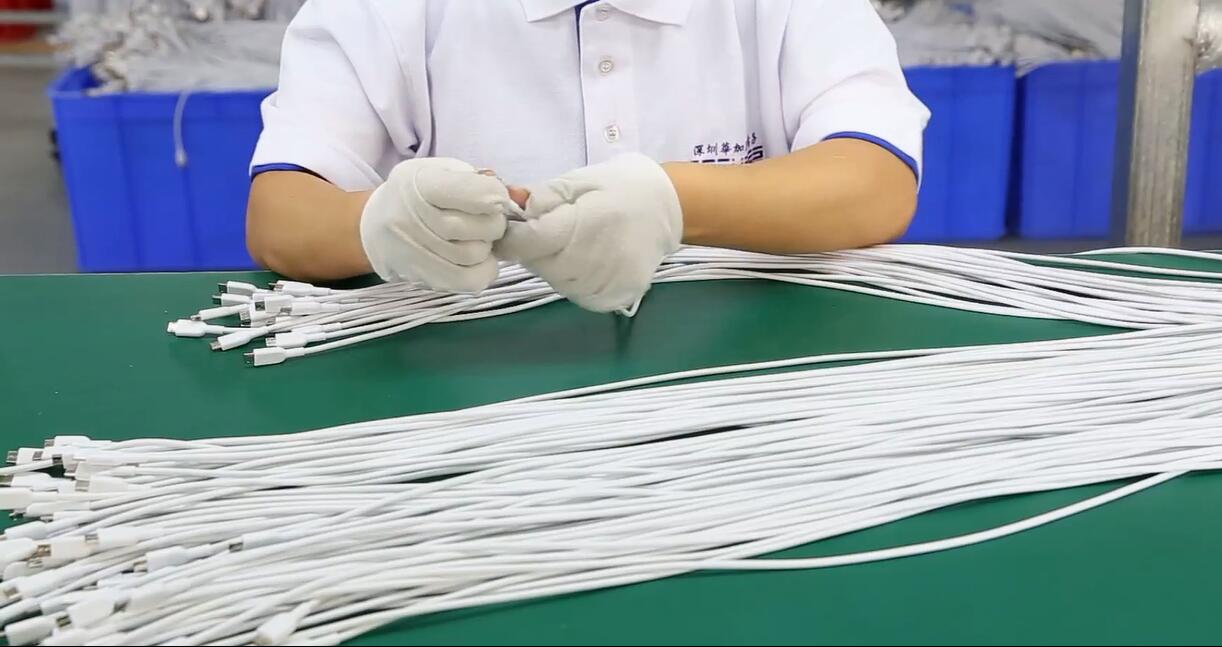
Cable production floor: compliance for export is decided long before the shipping carton is sealed.
A USB cable can pass every functional test a buyer runs and still be blocked at the border, removed from an online listing, or rejected in a tender — because the problem is rarely the cable itself. It is the evidence behind it. For importers, distributors and private-label brand owners, compliance has quietly become a discovery-stage question: it determines which suppliers are worth shortlisting before price, samples or packaging are even discussed.
This reference maps the four marks that appear most often in USB cable requests for quotation — UL, CE, FCC and RoHS — separating what each one actually covers from what buyers frequently assume it covers. It then examines how a manufacturer's quality-control system and configuration control translate into documentation that survives a marketplace audit, using the EU, North America, the Middle East and Asia as the reference export lanes.
Why compliance moved to the front of the sourcing conversation
Regulatory and marketplace pressure in the two largest destination markets has shifted cable compliance from a shipping detail to a selection criterion. Three developments explain most of the change.
- The EU Common Charger Directive. Since 28 December 2024, the European Union has required handheld mobile phones, tablets and cameras sold in the EU to use a USB Type-C charging port and to comply with EN IEC 62680-1-3:2022 (European Commission / UL Solutions).
- USB Power Delivery in the same market. Fast-charging devices in the EU that support USB Power Delivery must comply with EN IEC 62680-1-2:2022 (USB-IF / IEC).
- Marketplace enforcement in the United States. Amazon US requires USB Type-C cables to meet the UL 9990 safety standard for ICT power cables, and non-compliant listings risk removal (UL Solutions / Amazon policy).
Substance restrictions add a second layer. RoHS-type rules limit the use of specified hazardous substances in electrical and electronic products across the EU and a growing set of other markets, which pushes material declarations — not just performance data — into the procurement file.
The commercial stakes explain why this matters to sourcing teams. The global USB cable market was estimated at USD 21.2 billion in 2024 and projected to reach approximately USD 88.6 billion by 2033 (DataHorizzon Research), while KBV Research projects a CAGR of 17.3% through 2031. Published estimates vary by scope — Dataintelo puts 2025 at roughly USD 28.6 billion, and KBV Research works from a USD 19.2 billion 2023 base — so buyers should treat any single market figure as directional rather than precise. What is consistent across sources is growth, and growth is what brings compliance enforcement with it.
The four marks, decoded
The four marks answer four different questions. Treating them as interchangeable is where most sourcing misunderstandings begin.
| Mark | Where it matters | What it actually covers | Evidence a buyer should see | Typical failure point |
|---|---|---|---|---|
| UL | North America, and marketplace channels | Product safety certification for ICT power cables; UL 9990 is the standard Amazon US applies to USB Type-C cables | Test report from an accredited laboratory naming the exact model and configuration | The report describes a different model, connector or jacket than the one shipping |
| CE | EU / EEA | Conformity marking for applicable product directives, including RoHS and electromagnetic compatibility requirements | Declaration of Conformity naming manufacturer, product, directives and standards, backed by a technical file | A logo without an underlying technical file; two suppliers can claim CE with very different evidence depth |
| FCC | United States | Equipment authorization for electronic products with respect to radio-frequency and electromagnetic considerations | Clarity on which party holds the authorization for the device, charger or assembly the cable is sold with | Confusion about responsibility — a passive cable is not the same thing as the electronics it connects |
| RoHS | EU and multiple markets with equivalent substance rules | Restriction of specified hazardous substances, including lead, mercury, cadmium, hexavalent chromium, and certain brominated flame retardants and phthalates | Material declarations from compound and plating suppliers, not a retroactive statement from the assembler | A jacket compound change made for cost or availability without updating the declaration |
Where compliance is actually decided: materials and construction
Compliance is largely fixed at the design and material stage, long before a test report exists. For a USB cable, the decisions that matter most are the jacket compound, the conductor, the connector combination and the molding process.
Jacketing is where substance restrictions bite hardest. PVC, TPE, silicone and nylon braided constructions each involve different plasticizers, stabilizers and — where applicable — flame retardants. Material declarations therefore have to be collected from compound suppliers upstream, not written by the cable assembler after the fact. A substitution made for cost or availability reasons can invalidate a substance declaration even when the finished cable looks identical on the outside.
The conductor side is more stable. High-purity tinned copper cores are the industry norm for the charging and data requirements of current accessories, and plating choices are well established. Performance parameters, however, are configuration-specific: cables in this category are commonly specified at 480 Mbps data transfer, with charging capability ranging from 1A–2.4A in entry-level builds up to 6A and 120W or 240W fast charging in higher-tier constructions. Working temperature ranges vary by material — from -10 °C to 60 °C for standard PVC builds, -10 °C to 70 °C for nylon braided designs, and -20 °C to 70 °C for silicone and sealed waterproof constructions.
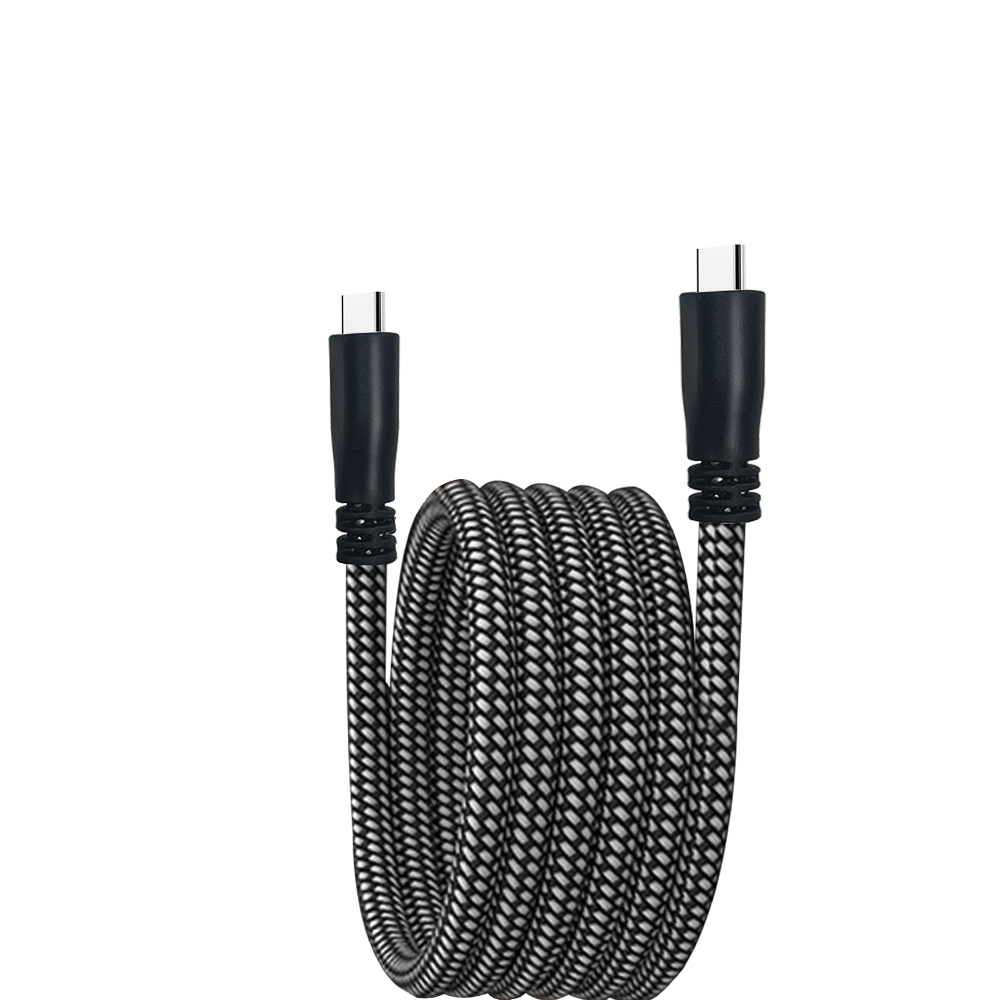
CB-Nylon construction: PVC inner layer with a nylon braided shell and tinned pure copper core — material choices that also determine which substance declarations apply.
A certificate covers a configuration, not a product category
Test evidence is scoped to a specific build: interface combination, conductor construction, jacket material, molding process and any printed branding. A change in any one of those elements can move a shipped product outside the scope of the file that was tested.
A cable verified as USB-A to Type-C in a nylon braid is not automatically covered by the same report when it is reworked into USB-C to Lightning in silicone, or when a customer logo is added to the connector housing for a private-label program. This is the point where OEM and ODM programs most often develop a compliance gap: the customization that wins the order is frequently the same change that requires re-verification.
The mitigation is procedural rather than technical. Freeze the bill of materials before testing. Treat any post-test change — connector, compound, molding, printing — as a re-test trigger rather than a note for the file. And confirm in writing which configuration the supplier's documentation actually names.
What belongs in the buyer's evidence file
| Document | What it establishes | Question to ask the supplier |
|---|---|---|
| Test report (safety / type test) | That a named configuration was assessed against a defined standard | Does the report name the exact model, connector combination and jacket that will ship? |
| Declaration of Conformity | That the manufacturer accepts responsibility for applicable EU directives and standards | Which directives and standards are listed, and does a technical file exist behind the declaration? |
| Material declarations | That jacket, plating and insulation materials comply with substance restrictions | Do the declarations come from the compound supplier, and are they dated after the last material change? |
| Authorization responsibility statement | Which party holds FCC authorization for the associated device, charger or assembly | Who is the responsible party, and does the scope cover the way the cable is sold? |
| Change-control note | How custom logo printing, connector changes or packaging changes affect the compliance file | Does this change require re-testing, or a documentation update only? |
How an export-focused manufacturer operationalizes this
DongGuan Focuses Electronics Technology Co., Ltd. designs, produces and globally distributes high-performance data cables, USB solutions and audio accessories from a 6,000-square-meter manufacturing facility in Tangxia Town, Dongguan, Guangdong, China, close to Shenzhen Port. The company employs approximately 150 people, including an R&D team of six engineers, and reports that roughly 90% of its output is exported, with the EU, North America and Asia as its main markets.
Quality control is the mechanism that connects those export lanes to the compliance file. Focuses maintains a rigorous control system intended to ensure every cable meets applicable international standards — in practice, the operational counterpart of the documents a buyer receives. Because the same facility produces both standard and customized builds, configuration control is what keeps test evidence aligned with what actually leaves the loading dock.
| Model | Jacket / material | Power & current | Data | Working temperature | Notable feature |
|---|---|---|---|---|---|
| CB-PVC | PVC outer sheath, pure copper conductor | 1A–2.4A | 480 Mbps | -10 °C to 60 °C | Entry-tier charging and data build; custom logo accepted |
| CB-Nylon | PVC inner layer with nylon braided shell; tinned pure copper core | 120W / 240W, up to 6A | 480 Mbps | -10 °C to 70 °C | Abrasion resistance for retail and accessory programs |
| CB-TPE | Eco-friendly TPE; tinned copper core | 120W / 240W, up to 6A | Charging and data sync | — | Soft, flexible and wear-resistant |
| CB-SILICONE | Soft food-grade silicone sheath; high-purity tinned copper core | 120W / 240W, up to 6A | 480 Mbps | -20 °C to 70 °C | Skin-friendly, odorless, anti-kink and anti-freezing |
| CB-Waterproof | Silicone, TPE or nylon braided options; high-purity tinned copper core | 120W / 240W, up to 6A | 480 Mbps | -20 °C to 70 °C | IPX7 waterproof and dustproof, sealed integrated molding |
Interface options across the range are USB-A or USB-C to Type-C, Lightning or Micro USB, with lengths of 0.3 m, 1 m, 1.5 m and 2 m (0.5 m to 2 m for CB-PVC). Custom logo printing is supported across the line — which is precisely the point at which a buyer should confirm how the ordered configuration maps to the supplier's test documentation, and whether the supplier treats a logo or connector change as a documentation update or a re-test trigger.
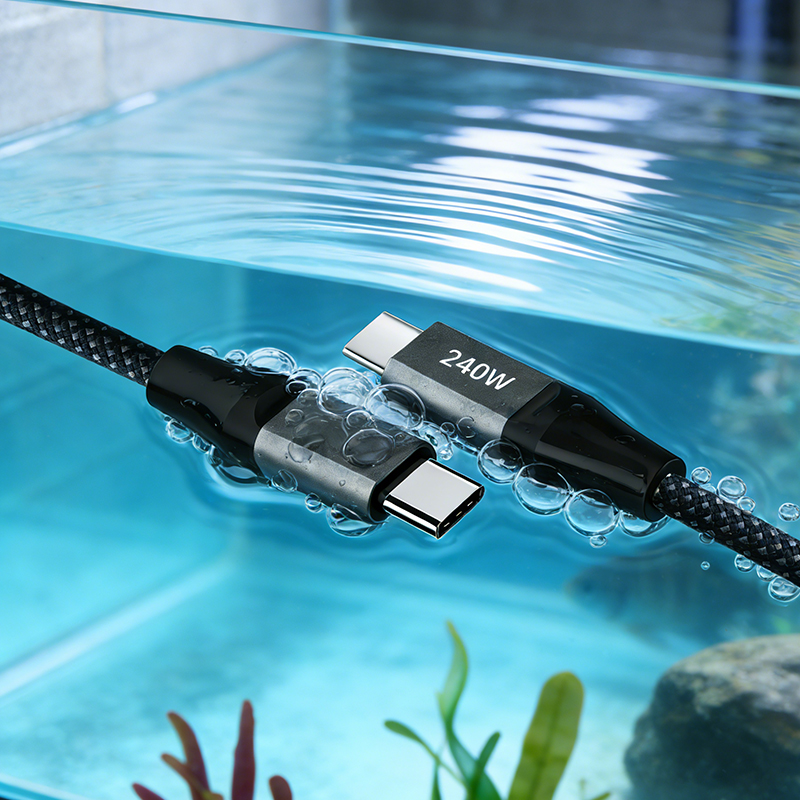
CB-Waterproof: IPX7 sealed integrated molding, rated from -20 °C to 70 °C for humid, sweaty and rainy environments.
Field deployment described by the company includes digital accessory wholesalers and corporate gift purchasers in Indonesia, the United States, Germany and the United Kingdom. Recorded application scenarios span the United States, Germany, the United Kingdom, France, Sweden, Japan, South Korea, Indonesia, the Philippines, Bangladesh, Chile, Mexico and the UAE — a spread that covers three distinct regulatory environments rather than a single export lane.
Application fit: where these cables are used, and why the specification matters
Compliance questions rarely arrive on their own. They arrive attached to a use case, and the use case usually determines which part of the specification is worth defending.
- Consumer electronics retail and mobile accessory wholesale. Plug-and-play charging and data transfer for smartphones, tablets, laptops, power banks, wireless chargers and smart wearables, where consistent documentation across repeat orders matters more than any single parameter.
- E-commerce and digital gift programs. Custom logo printing and packaging variations are common, making configuration control the compliance-critical activity rather than the cable design itself.
- Demanding environments. Daily indoor use, outdoor travel, humid bathrooms, sweaty sports scenes, low-temperature outdoor use and rainy conditions are all recorded operating conditions for this product category. Where those conditions apply, IPX7 sealing and a -20 °C low-temperature rating become the specification choices that distinguish a suitable build from a generic one.
Market trend analysis
Interface convergence is the clearest structural trend. The USB Type-C segment held a dominant 41.2% share of USB cable sales in 2025 (Dataintelo), and Asia Pacific led global USB cable revenue in the same year at USD 12.3 billion, approximately 43% of the total market (Dataintelo). Convergence simplifies port strategy for buyers, but it raises the documentation burden: when a single interface dominates, marketplaces and regulators can enforce requirements on it far more efficiently than they can across five competing connectors.
Three consequences follow for procurement teams. First, compliance evidence is becoming an entry gate rather than a differentiator — the UL 9990 marketplace requirement is an early example of channel policy doing the work that regulation does elsewhere. Second, buyers are shifting from catalog specifications to evidence files, because specifications are easy to copy and documentation is not. Third, the growth rate cited by KBV Research — 17.3% CAGR through 2031 — means supplier capacity and supplier documentation systems will both be tested at higher volumes than they handle today.
Limits: what certification does not tell you
Certification-based assurance has real boundaries, and buyers who treat a mark as a complete quality signal tend to be disappointed at the wrong moment.
- Compliance is not durability. UL 9990 addresses safety characteristics of ICT power cables. It does not predict how many bend cycles a strain relief will survive in a backpack, a vehicle or a rental fleet.
- Self-declaration varies in depth. Because CE rests on manufacturer documentation, two suppliers can both state compliance while holding evidence of very different quality. The declaration is only as strong as the technical file behind it.
- Scope does not travel automatically. A verified configuration does not extend to customized variants. Logo printing, connector changes or a jacket substitution can each place a shipped product outside the tested scope.
- A cable manufacturer cannot self-issue third-party certifications. Safety testing is performed by accredited laboratories, and FCC authorization sits with the responsible party for the electronic device or charger. The manufacturer's job is consistency and documentation, not the certificate itself.
- Regional schemes diverge. Meeting EU and North American requirements does not automatically satisfy every Middle East or Asian import scheme, where documentation expectations and enforcement practices differ. A supplier serving all three lanes needs configuration and paperwork discipline, not a single global sticker.
Future outlook
The direction of travel is toward fewer interfaces, higher power levels and more third-party verification. USB Type-C dominance makes standardized testing cheaper and marketplace enforcement easier, which means the practical bottleneck shifts from engineering to documentation. Buyers should expect compliance files to become a standing part of supplier evaluation rather than a one-time request, and manufacturers should expect configuration control to be audited rather than assumed. In a category growing at a double-digit rate, the suppliers that scale will be the ones whose paperwork scales with them.
FAQ
What do UL, CE, FCC and RoHS each cover for a USB cable?
UL relates to product safety certification for ICT power cables, and UL 9990 is the standard Amazon US applies to USB Type-C cables. CE is the EU conformity marking, supported by a manufacturer's declaration and technical documentation covering applicable directives such as RoHS and electromagnetic compatibility requirements. FCC covers equipment authorization for electronic products in the United States with respect to radio-frequency and electromagnetic considerations. RoHS restricts specified hazardous substances — including lead, mercury, cadmium, hexavalent chromium, and certain brominated flame retardants and phthalates — in materials.
Is UL 9990 required for every USB-C cable sold in the United States?
UL 9990 is not a universal legal requirement for all cables sold in the United States. It is a standard that marketplace channels such as Amazon US apply to USB Type-C cables, with non-compliance risking listing removal (UL Solutions / Amazon policy). Whether it applies to a given order therefore depends on the sales channel rather than on federal law alone.
Do all USB cables exported to the EU have to be USB Type-C?
No. The EU Common Charger Directive requirement that handheld mobile phones, tablets and cameras use a USB Type-C charging port and comply with EN IEC 62680-1-3:2022 applies to those device categories sold after 28 December 2024. Fast-charging devices supporting USB Power Delivery must comply with EN IEC 62680-1-2:2022. Cables supplied into that ecosystem need to support the interface and power requirements of the devices they accompany, while Micro USB, Lightning and USB-A interfaces remain in use in other product categories and other markets.
How does RoHS affect USB cable material selection?
Substance restrictions apply to the materials used in the cable, which puts jacketing compounds, insulation and plating under scrutiny. PVC, TPE, silicone and nylon braided constructions each involve different plasticizers, stabilizers and, where applicable, flame retardants. That is why material declarations are normally collected from compound suppliers rather than issued by the cable assembler, and why a compound substitution can invalidate a declaration even when the finished cable appears unchanged.
Can a supplier's existing certification cover a customized cable with a new logo or connector?
Usually not automatically. Test evidence and declarations are scoped to a defined configuration, including interface combination, conductor construction, jacket material, molding process and printed branding. Adding a custom logo, changing a connector combination or switching a jacket compound can place the shipped product outside that scope. Buyers should confirm in writing whether the supplier treats the change as a documentation update or as a trigger for re-testing.
What should a buyer collect before placing a bulk USB cable order?
A test report naming the exact model and configuration; a Declaration of Conformity listing applicable directives and standards; material declarations covering jackets, insulation and plating; clarity on which party holds FCC authorization for the associated device, charger or assembly; and a written statement describing how OEM customization affects the compliance file. Together these documents establish whether the supplier can support repeat orders without undocumented changes between shipments.