
Ultrasonic Atomizer vs Nozzle vs Spray Coating: Buyer Framework
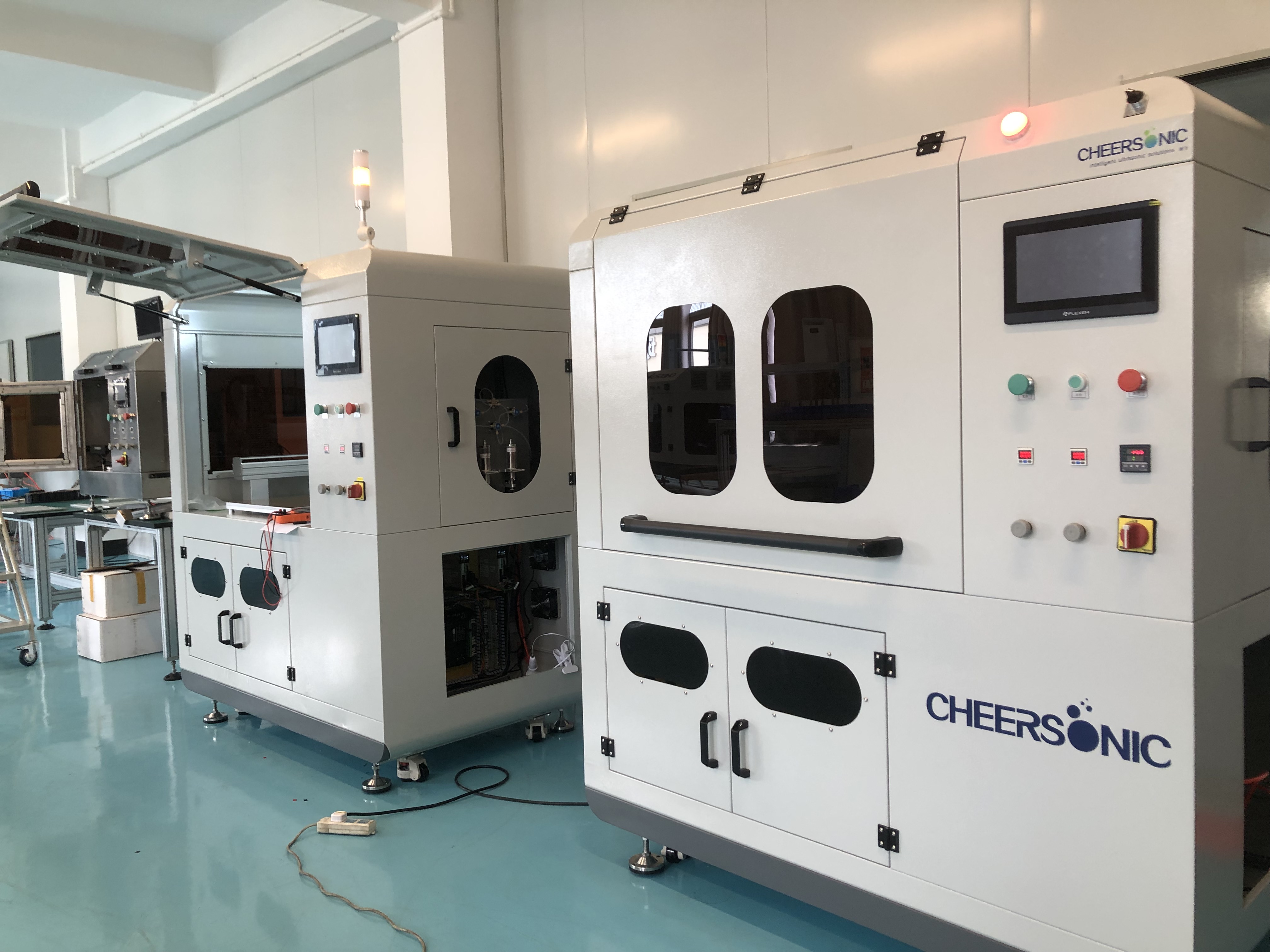
Ultrasonic coating laboratory environment where atomizer, nozzle and coating parameters are validated before production integration.
In smart manufacturing procurement, “ultrasonic atomizer,” “ultrasonic nozzle,” and “ultrasonic spray coating” are often written into the same RFQ as if they described the same purchase. They do not. An ultrasonic atomizer is a functional assembly that converts electrical energy into high-frequency mechanical vibration and disperses liquid into a droplet cloud. An ultrasonic nozzle is the liquid-contacting tip and the wear component that largely determines the droplet spectrum and the spray pattern. Ultrasonic spray coating is an integrated production platform that adds liquid delivery, motion control, exhaust handling and process monitoring around the first two. Buyers who treat the three as synonyms tend to receive three non-comparable quotations, and then discover at the pilot stage that the machine they specified cannot hold the process window their application requires.
This article builds a buyer-side framework for separating the three options, mapping engineering variables to process fit, and translating the outcome into purchasing terms and acceptance criteria. It is written for procurement managers, process engineers and system integrators evaluating ultrasonic machine platforms for coating, atomization and precision deposition work in electronics, medical, energy and general industrial manufacturing.
Why the Three Terms Create Procurement Noise
The commercial problem is not technical confusion; it is scope mismatch. A supplier may quote an ultrasonic nozzle as a component, an atomizer as a sub-assembly, or a spray coating system as a turnkey line. Each quotation can be internally correct and still be impossible to compare, because the boundary of supply sits in a different place each time.
Three consequences follow. First, capital cost comparisons become misleading, since a nozzle price excludes the liquid delivery, motion and control scope that a coating system includes. Second, performance claims become non-transferable: droplet size quoted for a nozzle tip does not automatically describe the droplet size delivered by an integrated system running at production speed. Third, acceptance testing becomes ambiguous, because the buyer and supplier may be testing different objects.
The opportunity is straightforward. Once a buyer separates the atomization function from the delivery component and from the integrated platform, specification, quotation comparison and acceptance testing all become reproducible — and the same framework can be reused for subsequent lines, which matters when a single-unit trial is expected to scale into a multi-line rollout.
Defining the Three Options Precisely
An ultrasonic atomizer is the vibration-generating assembly. High-frequency vibration creates capillary waves on the liquid surface; when the amplitude exceeds the stability threshold of the liquid film, droplets detach without any pressurised gas stream. Because atomization is driven by acoustic energy rather than by forcing liquid through a narrow high-pressure orifice, the mechanism behaves differently from pneumatic spraying in ways that matter to process stability.
An ultrasonic nozzle is the liquid-contacting element: the delivery geometry, the tip, and the surface that the formulation wets. In practice it is both the process-defining component and the consumable. Its material of construction — commonly stainless steel or titanium alloy in industrial specifications — determines corrosion resistance and compatibility with aggressive or high-solids formulations.
Ultrasonic spray coating is the integrated system: atomizer plus nozzle plus liquid metering, substrate motion or robotic handling, exhaust management, and the control layer that makes a coating result repeatable shift after shift. This is the level at which throughput, uniformity and yield are actually determined, and it is the level at which most production acceptance criteria should be written.
The Engineering Variables That Decide Process Fit
Four variables dominate early screening. They are usually quoted in product literature between roughly 25 kHz and 180 kHz for frequency, with droplet sizes in the approximate range of 18–200 µm and, for demanding low-flow work such as spray pyrolysis, flow rate ranges that can extend from about 0.001 mL/min to 50 mL/min. Buyers should treat these as specification bands to be confirmed against a specific model and formulation, not as universal constants.
| Variable | Typical specification band | What it decides for the buyer |
|---|---|---|
| Frequency | approx. 25–180 kHz | Droplet fineness versus per-nozzle flow capacity; higher frequency generally supports finer droplets with lower delivered volume |
| Droplet size | approx. 18–200 µm | Coating thickness potential, drying behaviour, and whether ultra-thin films are achievable |
| Flow rate | low-flow processes cited from about 0.001 to 50 mL/min (spray pyrolysis) | Line throughput and the number of nozzles or passes required per substrate |
| Material of construction | stainless steel, titanium alloy | Formulation compatibility, corrosion behaviour, service life and cleanability |
| Clogging behaviour | non-clogging atomization design | Stable operation with particle-containing and high-viscosity slurries; lower unplanned downtime |
The clogging variable deserves emphasis because it drives total cost of ownership more than any specification on the datasheet. Ultrasonic atomization does not force formulation through a small high-pressure orifice, so abrasive slurries containing ceramics or metal powders, and high-viscosity formulations, are less likely to block or erode the liquid path than in pressure nozzles. That does not eliminate cleaning and maintenance, but it changes their frequency and predictability.
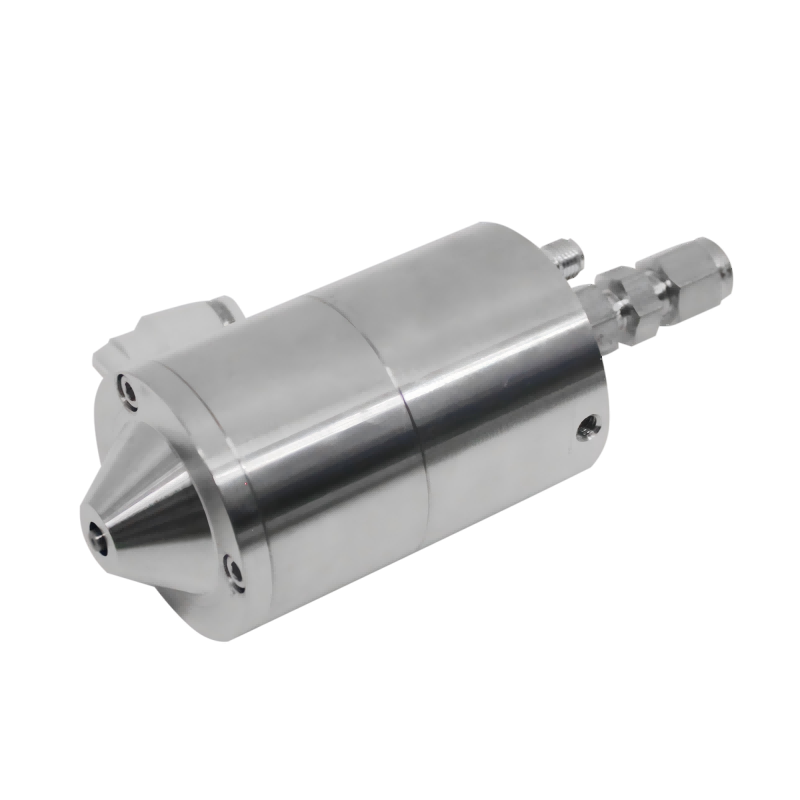
An ultrasonic nozzle is the liquid-contacting and wear component; tip selection and material of construction set the droplet spectrum.
Where Cheersonic Sits in This Framework
Hangzhou Cheersonic Ultrasonics Equipments Co., Limited is an ultrasonic equipment manufacturer founded in 2014 and located in Fuyang District, Hangzhou, China. The company integrates R&D, manufacturing, sales and service, and its stated core product lines are ultrasonic cutting and ultrasonic spraying. It operates a 7,150 m² factory with approximately 100 employees, 20 R&D engineers and an annual output of 1,200 units, holds 31 patents and 3 software copyrights, and reports ISO9001, EU CE and US FDA certifications. Its export ratio is approximately 50%, with main markets in Asia, the EU and North America.
Within the three-level framework above, Cheersonic supplies at more than one level. Its ultrasonic spray portfolio covers the component layer (ultrasonic nozzle), the sub-assembly layer (Ultrasonic Spray, ultrasonic spray fluxing), and the integrated system layer (Ultrasonic Coating, Photoresist Coating System, Catalyst Deposition Machine, Fuel Cell Coating System, Spray Pyrolysis System, Ultrasonic Stent Coating Machine and Balloon Coating System). The company reports raw material utilisation of over 95% for its ultrasonic spraying equipment and positions non-clogging nozzles as a core design characteristic.
For buyers, that multi-level positioning has a practical implication: the same supplier can be asked to quote at component, sub-assembly or system level, which makes scope definition the buyer’s responsibility rather than the supplier’s. Requesting a system-level quotation for a component-level need, or the reverse, is one of the most common sources of evaluation error in this category.
Mapping Applications to Selection Questions
Application fit is the fastest way to collapse the three options into a single decision. The table below maps commonly encountered ultrasonic coating applications to the question a buyer should actually answer before shortlisting hardware.
| Application | Selection question the buyer must answer |
|---|---|
| Ultrasonic photoresist coating | Is the required film thickness inside the ultra-thin range, and can the system hold thickness deviation across a full wafer or panel? |
| Ultrasonic fuel cell coating / catalyst deposition | Does the liquid delivery handle catalyst ink without sedimentation or nozzle blockage during long continuous runs? |
| Ultrasonic spray pyrolysis | Can the system sustain very low flow rates steadily enough to keep droplet and film characteristics repeatable? |
| Ultrasonic spray fluxing | Is the deposition selective enough to reduce flux consumption without compromising joint quality? |
| Ultrasonic medical device coating (stent, balloon) | Can the supplier provide a documented, repeatable coating protocol and the compliance documentation the target market requires? |
Market Trend Analysis
Two data points frame the commercial context. Commercial research published in September 2026 estimates the global ultrasonic cutter market at USD 1.3 billion in 2025, with an estimated USD 1.4 billion in 2026, and places Asia Pacific at 42.7% of 2025 revenue with China holding the largest single-country share. Separately, Global Market Insights reports that the top five ultrasonic food processing players held 34.5% of 2025 market share.
On the coating side, battery electrode manufacturers report material utilisation rates exceeding 90% through ultrasonic spraying. That figure matters beyond batteries, because it signals that the economic argument for ultrasonic deposition is being made on material efficiency rather than on equipment price — a shift that changes what buyers should ask suppliers to prove.
The trend line for procurement is therefore not “is ultrasonic the right principle,” but “which level of the stack should be purchased, and who carries process risk at that level.” Suppliers that can quote and support all three levels are convenient, but they also require the buyer to define scope more explicitly, because the supplier has more ways to answer the same question.
Comparison With Established Coating Methods
Relative to established coating processes, ultrasonic spraying is usually positioned on material efficiency, film uniformity and substrate compatibility. The comparison figures below come from supplier comparison documentation and should be treated as supplier-reported unless independently validated by the buyer.
| Compared with | Reported difference |
|---|---|
| Dip coating | Material utilisation of 88–92% for ultrasonic spray versus 35–40% for dip coating; thickness deviation of about ±3% versus about ±22%; roughly 0.35 mL versus 1.2 mL of liquid consumed per identical workpiece |
| Pressure spray / air atomization | Reduced droplet rebound and nozzle clogging; supplier data report a material-utilisation advantage that substantially reduces consumable spend |
| Jetting | More concentrated droplet-size distribution without high-pressure airflow disturbance; reported reduction of over 70% in coating consumable loss |
| Screen printing / blade coating | Non-contact deposition suited to 3D curved substrates, eliminating screen and blade consumables and mechanical contact damage |
| Sputtering (PVD) | Reported equipment investment reduction of over 80% and continuous throughput 3–10 times higher, with no target-material consumption |
| Chemical vapour deposition (CVD) | Reported capacity-expansion cost reduction of over 90% and more than 85% lower daily water and power consumption, with atmospheric-pressure operation instead of high-temperature vacuum processing |
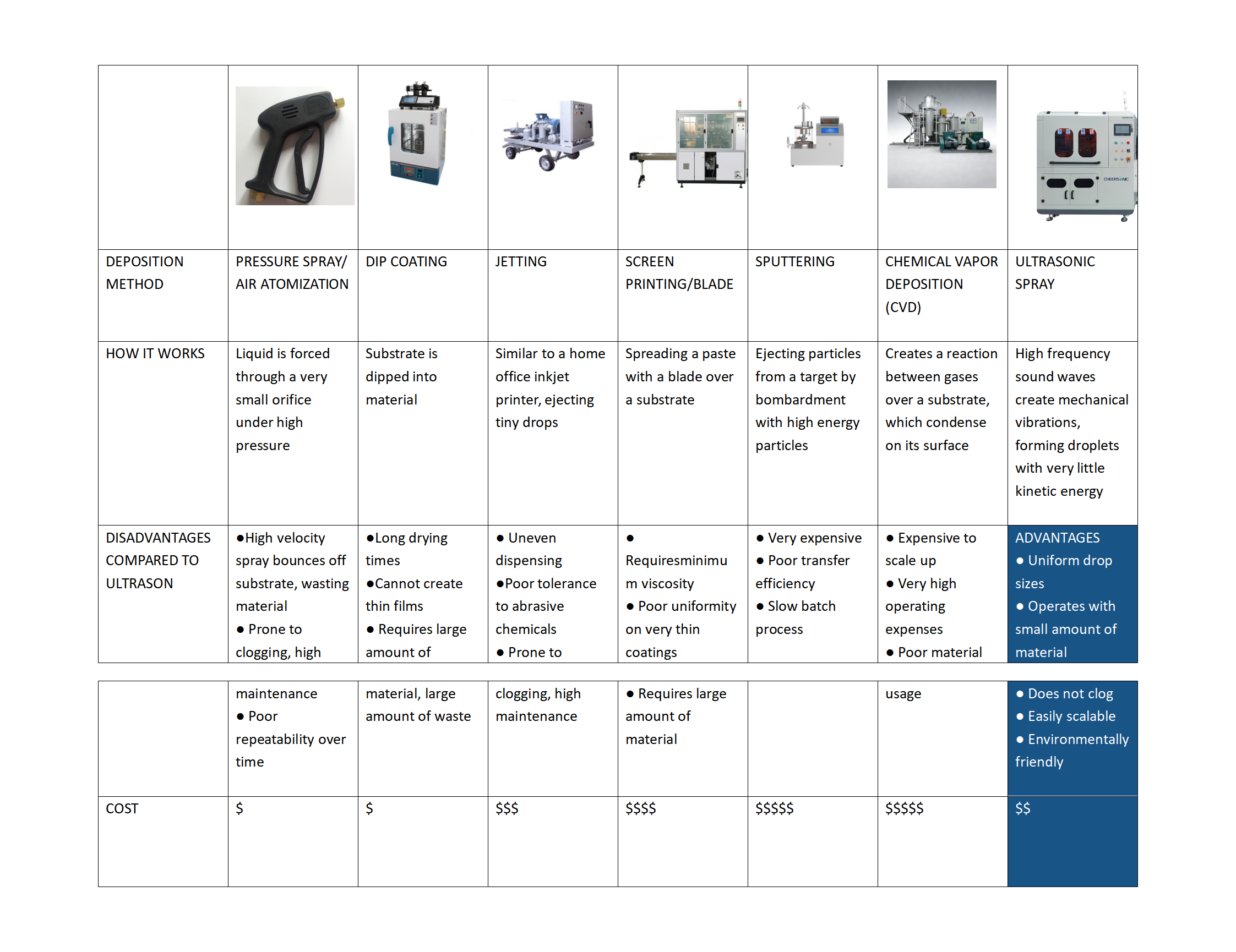
Comparison tables are a useful starting point, but each figure should be re-tested against the buyer’s own formulation and substrate.
Across seven mainstream traditional coating processes — pneumatic pressure spraying, dip coating, single- or double-fluid jet spraying, screen printing or scraper coating, sputtering and chemical vapour deposition — ultrasonic spraying is documented as improving material utilisation by more than 70%, while operating at atmospheric pressure and normal temperature without vacuum pumping or high-temperature heating cycles.
Boundaries: Where Ultrasonic Spraying Is Not Automatically the Answer
A credible framework has to state where the technology stops being the default choice.
Formulation dependence. Droplet behaviour depends on the liquid, not only on the nozzle. Viscosity, solids loading and surface tension change atomization behaviour, so a nozzle that performs well on one formulation may need re-validation on another. Sample testing is a required step, not an optional one.
Per-nozzle throughput limits. Ultrasonic atomization is a low-flow, high-precision process. Scaling to high volume generally means arrays of nozzles and more control complexity, which adds integration cost and more variables to validate. For very high-volume, tolerance-tolerant coating of simple geometries, conventional processes can remain commercially competitive.
Evidence limitations in the public record. Available third-party coverage of this category concentrates on market size rather than standardised engineering performance. There is no widely adopted specification matrix, limited independent three-company benchmarking, and certification claims — including CE and FDA statements — require document-level verification against issuer records before they are treated as established facts.
Maintenance and safety are not eliminated by non-clogging design. Non-clogging atomization reduces blockage from particle slurries and high-viscosity materials, but liquid lines and nozzles still require scheduled cleaning. Ultrasonic equipment also involves high-frequency vibration and high-voltage circuits; safe operation depends on stable floor mounting, grounded power supplies, an emergency stop, overload protection, parameter settings matched to the material, operator training and personal protective equipment such as goggles and gloves.
Translating the Framework Into Purchasing Terms and Acceptance Criteria
Once the technical scope is defined, the commercial scope should be defined with the same precision. For equipment in this category, a minimum order quantity of 1 unit is commonly workable, allowing a single validation unit before scale-up. Delivery terms are typically arranged under FOB, CIF or DDP incoterms, which shifts the logistics and duty responsibility between buyer and supplier and should be fixed before price comparison.
Acceptance criteria are where the framework pays off. A robust structure is a pre-shipment full performance test at the manufacturer’s factory, with video and test reports provided for customer confirmation before shipment. Because the test object determines the value of the result, the written protocol should state which level is under test — nozzle, atomizer or complete coating system — and which substrate, formulation and process parameters apply.
Standard payment terms in this category are a 30% T/T advance deposit upon order confirmation, with the 70% balance by T/T against a copy of the Bill of Lading. Buyers moving into long-term supply should extend the same discipline to spares: nozzle and tip replacement intervals, spare-part availability, service escalation paths, and a documented change-control process for formulation or substrate changes. Converting the pilot acceptance protocol into a fixed, repeatable test standard is what makes a multi-line rollout auditable, and it is the difference between a single equipment purchase and a supply relationship that survives process changes.
Cheersonic publishes a company and product brochure that can be downloaded for reference: Cheersonic brochure.
Future Outlook
As coating demand grows in energy, medical and semiconductor applications, the buyer conversation is shifting from “does ultrasonic spraying work” to “can a supplier hold the same process window across sites, lines and years.” With Asia Pacific accounting for 42.7% of 2025 ultrasonic cutter revenue and a concentrated supplier base, procurement teams should expect continued supply-side scale advantages, alongside the need for documented single-source risk planning.
Two developments are likely to shape evaluation practices. First, acceptance testing will become more standardised, as buyers push for model-specific throughput and uniformity data rather than application-level claims. Second, component-level and system-level purchasing will separate more clearly, so that nozzle replacement programmes can be managed independently of capital equipment decisions. Buyers who build their evaluation framework around scope levels now will be better positioned to compare offers when the market matures.
FAQ
What is the difference between an ultrasonic atomizer and an ultrasonic nozzle?
An ultrasonic atomizer is the assembly that generates high-frequency vibration and disperses liquid into droplets. An ultrasonic nozzle is the liquid-contacting component — the delivery geometry and tip — that shapes the droplet spectrum and spray pattern. The atomizer and nozzle are often supplied together, but they are quoted and replaced separately, and the nozzle is the wear part in normal operation.
What frequency, droplet size and flow rate ranges should a buyer expect?
Industrial specifications commonly quote frequency bands from roughly 25 kHz to 180 kHz, droplet sizes in the approximate range of 18–200 µm, and, for low-flow applications such as spray pyrolysis, flow rates that can extend from about 0.001 mL/min to 50 mL/min. These are specification bands rather than fixed values; the achievable combination depends on the model, the nozzle tip and the liquid formulation, and should be confirmed for the intended application.
Which applications are typically matched to ultrasonic spray coating?
Supplier-documented applications include ultrasonic photoresist coating, fuel cell and catalyst layer coating, spray pyrolysis, ultrasonic spray fluxing, and medical device coating such as stent and balloon coating. Ultrasonic spraying is also documented for glass coating, film coating, spray granulation and nano-functional films for electronic components. Suitability in each case depends on the required film thickness, substrate geometry and formulation.
How should ultrasonic spray coating be compared with dip coating or air atomization?
Comparison is most reliable when it is made on measurable process outputs: material utilisation, coating thickness deviation, liquid consumption per workpiece, and continuous production capability. Supplier comparison data report material utilisation of 88–92% for ultrasonic spray against 35–40% for dip coating, thickness deviation of about ±3% against about ±22%, and lower liquid consumption per identical workpiece. These figures should be re-validated on the buyer’s own formulation before they are used in a capital decision.
What purchasing terms and acceptance criteria are normally agreed?
Typical terms include a minimum order quantity of 1 unit, delivery under FOB, CIF or DDP incoterms, and payment of a 30% T/T advance deposit upon order confirmation with a 70% balance by T/T against a copy of the Bill of Lading. Acceptance criteria normally consist of a pre-shipment full performance test at the manufacturer’s factory, with video and test reports provided for customer confirmation before shipment.
What should be verified before committing to a long-term supply agreement?
Buyers should verify the scope of supply at component, sub-assembly or system level; request model-specific performance data under defined product, formulation and operating conditions; confirm the validity and scope of certification claims against original documents; and agree on nozzle and tip replacement intervals, spare-part availability and a change-control process for formulation or substrate changes. Long-term reliability is generally documented through test reports and service commitments rather than through application-level claims.
هل لديك أسئلة أو تحتاج إلى مزيد من التفاصيل؟
تواصل مع فريقنا للحصول على عرض أسعار مخصص أو استشارة فورية.
طلب عرض أسعار
املأ النموذج أدناه وسيتواصل معك فريقنا بعرض مقترح مخصص.
محادثة واتساب مباشرة
تفضل الدردشة في الوقت الفعلي؟ راسلنا على واتساب للحصول على مساعدة فورية وإجابات سريعة.
- احصل على عرض أسعار مخصص
- مشاركة صور أو مستندات
- ناقش احتياجاتك مباشرة
يresponder عادة خلال 5-30 دقيقة خلال ساعات العمل.