
Ultrasonic Machines Explained: From Cutting to Precision Coating
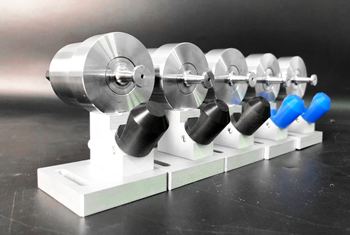
Ultrasonic machines perform manufacturing operations—cutting, slicing, spray coating and joining—by using high-frequency vibration instead of continuous mechanical force or high-pressure air. For most industrial buyers, the term covers the same need even when the equipment differs: clean separation of soft, sticky or fragile products in food processing, and thin, uniform deposition of liquids in coating applications. Both fields have moved from niche laboratory tools to standard production equipment in baking, dairy, medical devices, electronics and energy manufacturing.
One company that illustrates the breadth of the category is Hangzhou Cheersonic Ultrasonics Equipments Co., Limited (Cheersonic), a high-tech enterprise founded in 2014 in Fuyang District, Hangzhou. The company specializes in designing and manufacturing ultrasonic cutting and ultrasonic spraying equipment, operating a 7,150 m² facility with roughly 100 employees, including 20 R&D engineers. Its certifications include ISO9001, EU CE, and US FDA, and about half of its output is exported, with main markets in Asia, the EU and North America.
What an ultrasonic machine actually does
All ultrasonic machines share a common starting point: a transducer converts electrical energy into high-frequency mechanical vibration. From there, the design diverges by function. In an ultrasonic cutting machine, the blade vibrates at around 20 kHz. That vibration creates an air-like barrier between the blade and the product, which reduces friction, prevents sticking and allows clean cuts through products that would normally deform, smear or break under a standard blade. In an ultrasonic spray nozzle, vibration at 25–180 kHz shatters a liquid stream into fine droplets, which are carried to the substrate at low velocity. The result is a mist that can be controlled accurately enough to build films from 20 nm to 100 μm.
Cheersonic organizes its portfolio around these same physical principles. Its main product list covers ultrasonic cutting, ultrasonic slicing, ultrasonic food cutting machines, ultrasonic cake cutting machines, ultrasonic cheese cutting machines, ultrasonic nozzles, Ultrasonic Coating systems, Ultrasonic Spray systems, fuel cell coating systems, spray pyrolysis systems, ultrasonic stent coating machines and photoresist coating systems, among others.
Why manufacturers are moving from conventional methods to ultrasonic
The production problems that ultrasonic equipment solves are visible and measurable. Food processors using steel blades or wire cutters often see cake deformation, cream leakage, filling overflow, crumb waste and frequent downtime for blade cleaning. Coating operations using air atomization struggle with overspray, inconsistent thickness, nozzle clogging and material loss, especially when the liquid is a high-value catalyst, drug solution or nano-functional coating.
Ultrasonic technology offers a different set of trade-offs. Cutting blades that vibrate at ultrasonic frequency produce separation with very little downward force, which is why the technique suits soft, fragile and sticky products. Spray systems that atomize by vibration, not air pressure, produce narrower droplet distributions and can use the coating liquid more completely. The same characteristics also matter in cleanroom and hygienic production, because lower-pressure, non-contact processing reduces contamination risk.
The relevance of these advantages is not limited to one industry. Buyers in the baking, dairy, confectionery, medical, electronics, semiconductor and clean-energy sectors ask a similar question: how to get consistent product quality without wasting expensive material or relying on manual skill.
The main families of ultrasonic machines
Ultrasonic cutting and slicing systems
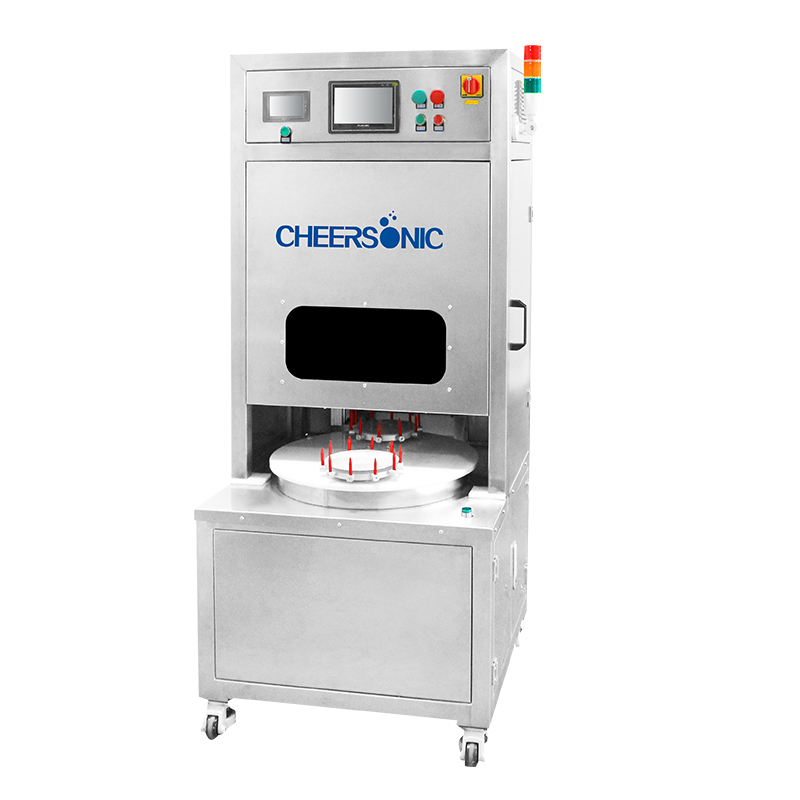
Ultrasonic cutting and slicing machines are built around a vibrating titanium blade. The cutting blade or sonotrode is designed to be food-grade, wear-resistant and non-stick. Cheersonic’s ultrasonic food cutting machine, for example, operates at 20 kHz with a power range of 800–1600 W, a rated input voltage of 208–240 V at 50/60 Hz, a maximum cutting width of 600 mm and a production capacity of 50–1500 pieces per hour. It is rated IP65 washdown compliant, meaning it can be cleaned with water in food production environments. Model families include HFM2300, HFM3100 and the UFM series up to UFM8100C.
These machines are used on room-temperature and frozen products. Cutting accuracy is typically in the range of ±0.5 to 1.0 mm depending on product type. Cheersonic’s ultrasonic slicing models also support production speeds of 80 to 1,500 cakes or pies per hour, which lets bakery and dairy plants scale from manual portioning to continuous inline processing.
Cheese and cake cutting receive specific attention. An ultrasonic cheese cutting machine can handle block, wheel, stick and extruded cheese forms in fixed-weight or catch-weight portioning, with weight-control accuracy of about ±1% typical in the industry. Ultrasonic cake cutters are designed for soft, sticky, layered and cream-filled cakes, producing clean slices without smearing or crushing. The benefit for a bakery is not just appearance; it is also the ability to portion consistently for packaging and to cut frozen desserts without pre-thawing.
Ultrasonic spray and coating systems
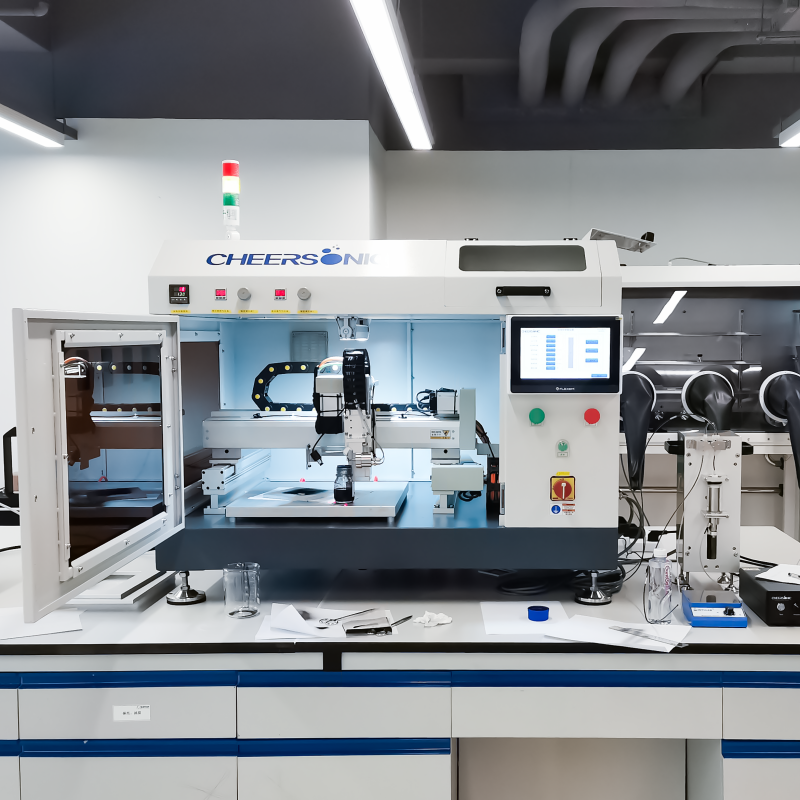
Ultrasonic spray coating systems use an ultrasonic nozzle to atomize liquids into droplets from roughly 18 to 200 μm, with flow rates from 0.001 to 50 mL/min. Because atomization is achieved by high-frequency vibration rather than by forcing liquid through a small orifice under pressure, the nozzle resists clogging. This matters for suspensions and slurries used in catalyst coating, photoresist coating and functional nano-coating.
The advantage for manufacturers is material economy. Ultrasonic spraying equipment can achieve raw material utilization above 95%, compared with the significant overspray associated with pressure spray systems. When the liquid is a bioactive compound or a precious-metal catalyst, the savings are substantial enough to change the economics of a production line.
Cheersonic’s ultrasonic coating platform includes the UAM4000, UAM6000 and fuel-cell-specific UAM8000 system configurations. In addition, the company supplies photoresist coating systems (USP6000, USP6000WS), spray pyrolysis systems (UAM2000, UNC9000), ultrasonic coating laboratory stations and ultrasonic nozzle sets.
Other ultrasonic operations used in smart manufacturing
The same vibration principle appears in ultrasonic fluxless soldering and ultrasonic welding. Cheersonic’s ultrasonic welding machines operate at 35 kHz and are suited to bonding nonwoven textiles with a synthetic-fiber content of at least 60%, with applications in medical protective textiles, apparel, filtration and automotive textiles. The product portfolio also includes ultrasonic dispersion and ultrasonic atomizer lines for liquid processing and research & development.
| Process family | Typical frequency | Reported performance range | Representative industries | Representative Cheersonic models |
|---|---|---|---|---|
| Ultrasonic food cutting | ~20 kHz | 50–1500 pieces/hour; ±0.5–1.0 mm accuracy; IP65 washdown | Bakery, confectionery, dairy, frozen desserts, ready-to-eat food | HFM2300, HFM3100, UFM1000P, UFM2200, UFM8100C |
| Ultrasonic cheese/dairy portioning | 20 kHz | Fixed-weight or catch-weight; ±1% weight control typical | Dairy, cheese manufacturing, industrial food production | CWM100, UFM1000C, UFM2200C, UFM3100W, UFM2300W |
| Ultrasonic coating / spray | 25–180 kHz | 0.001–50 mL/min flow; 18–200 μm droplets; 20 nm–100 μm film; >95% material utilization | Semiconductor, medical device, electronics, battery, fuel cell, solar cell, glass & optics, R&D | UAM4000, UAM6000, UAM8000, UCA/UCW/UCR nozzle series |
| Ultrasonic photoresist coating | 25–180 kHz | High-uniformity edge-to-edge coating; non-clogging atomization | Semiconductor wafers, MEMS, microelectronics, printed electronics | USP6000, USP6000WS |
| Ultrasonic welding / bonding | 35 kHz | Max pressing force 600 N; requires ≥60% synthetic fiber content | Medical & hygiene textiles, apparel, filtration, automotive textiles | USM350–USM550, S20-WP2000, HSW500, HGC500 |
Reading the specifications as a buyer
Some buyers treat ultrasonic machines as one undifferentiated product type. The more practical approach is to interpret specifications as answers to process questions.
In ultrasonic spraying, frequency determines droplet size. Higher frequencies generally produce smaller droplets, so a supplier’s frequency range indicates how much control the system gives over film quality. Flow rate matters for line speed. The combination of small droplets and a low-velocity mist is what allows thin, uniform films on fragile substrates. Film thickness from 20 nm to 100 μm covers very different applications: a nanometer-scale lubricant coating on a medical device is not the same process as a thicker catalyst layer for an electrolyzer, but one well-designed ultrasonic platform can usually handle both if the supplier provides the correct nozzle and delivery configuration.
In ultrasonic cutting, the material and design of the blade matter as much as the power rating. Titanium-alloy blades resist wear and support hygiene requirements. Food-grade machines with IP65 washdown ratings can be cleaned more thoroughly, reducing cross-contamination risk between product changes. Cutting accuracy is a useful indicator because it tells a buyer whether portion weight and package size can be standardized.
OEM flexibility is also part of the purchase decision. A machine that can integrate with an existing conveyor, packaging line or robotic arm has different value than a standalone unit. Cheersonic’s food cutting and slicing lines support inline configurations, robotic handling and servo-controlled touch-screen operation, allowing a production manager to move from manual batch cutting to automated portioning without changing the underlying technology.
Where ultrasonic machines fit in real production environments
Baking and dairy processing
In the baking industry, ultrasonic cutting solves problems that conventional knives cannot handle well: cream leakage, cake deformation, uneven surfaces and high raw-material loss. The cutting principle uses high-frequency micro-vibration to create low-pressure separation, so room-temperature pastries and frozen desserts can both be portioned with less physical force. Applications include chiffon cake, layered cream cake, cheesecake, mousse, brownies, ice-cream cakes and sandwich-filled pastries.
In dairy, ultrasonic cheese cutting machines support portioning of blocks, wheels and sticks of cheese for retail packaging, pizza topping and foodservice. Precision weight portioning means that every slice or block can be controlled within a narrow tolerance, which is important for branded packaged cheese and for export food production. Because ultrasonic blades are non-stick, oil-based dairy products do not build up on the cutting edge as quickly as they do on wire cutters.
Medical device coating
Ultrasonic spray is one of the practical methods for applying functional coatings to small, delicate or complex medical devices. Cheersonic’s spraying equipment is used in preparing coatings for stents, balloons and blood collection tubes, where uniformity and precision affect biocompatibility. The ability to spray without high pressure also lowers the risk of damaging fragile substrates.
Electronics and semiconductor manufacturing
In electronics, ultrasonic spray systems are used to apply photoresist to wafers and micro-electromechanical-system (MEMS) components, as well as nano-functional films for touch screens and circuit boards. The advantage is conformal coverage: an ultrasonic mist can coat stepped, curved and non-planar surfaces more evenly than spin coating. It also avoids the high-speed airflow and static generation that can damage sensitive components.
Clean energy and fuel cells
Fuel-cell and electrolyzer manufacturing requires catalyst layers to be applied with tight thickness control. Ultrasonic fuel cell coating systems deposit catalyst onto proton-exchange membranes, with non-clogging atomization and high uniformity. The same family of equipment supports solar-cell coating, battery layer coatings and spray pyrolysis for transparent conductive oxide films.
Industrial textile processing
A third, less-publicized application is ultrasonic bonding of synthetic textiles. Because the vibration creates localized heat only where needed, machines can weld, seal or sew nonwoven fabrics without thread or adhesives, which matters for medical protective garments, filter media and performance apparel.
Market signals behind ultrasonic equipment demand
Third-party market data points in the same direction as the application list: ultrasonic processing is expanding from a specialized technique into a broader manufacturing category.
- The global ultrasonic cutters market, which includes food cutting applications, was valued at USD 2.8 billion in 2025, with a projected CAGR of 7.2% through 2033, according to Dataintelo.
- The ultrasonic spray systems market was valued at USD 0.5 billion in 2024 and is projected to reach USD 1.2 billion by 2034, according to Market Research Future.
- The narrower ultrasonic spray coating system segment is projected to expand from USD 374.6 million in 2021 to USD 1.201 billion by 2033, according to Cognitive Market Research.
- Medical device coatings, one of the end-markets for ultrasonic spray, were estimated at USD 16.27 billion globally in 2025, with anti-microbial coatings accounting for a 31.8% revenue share, according to Grand View Research.
- Asia Pacific accounted for an estimated 25–38% of global revenue in ultrasonic technology and sensor markets in 2025, according to Fortune Business Insights.
These figures measure slightly different slices of the industry, which is itself a signal. The ultrasonic category is fragmented enough that different reports track cutters, spray systems, coating systems and sensors separately. Buyers should therefore treat each forecast as evidence of growth in a specific segment rather than as a single unified market number.
How ultrasonic machines compare with conventional solutions
| Application | Conventional approach | Ultrasonic alternative | Where ultrasonic is strongest | Known limitation |
|---|---|---|---|---|
| Portioning soft or frozen food | Manual knife, band saw, wire cutter | Vibrating titanium blade | Cheesecake, mousse, layered cake, frozen desserts, cheese | For simple straight cuts of rigid, non-sticky products, a standard saw may be adequate; ultrasonic tooling carries a higher capital cost |
| Applying thin functional films | Air spray, spin coating, dip coating | Ultrasonic atomization and low-velocity mist | Conformal coatings, high-value liquids, fuel-cell catalyst, photoresist | Deposition rates are moderate by design; for very high-volume, thick-layer coating, other methods may still be faster per unit area |
| Textile joining | Sewing with thread, adhesive bonding | Ultrasonic melt-bonding | Disposable medical textiles, synthetic fabrics, seamless apparel | Material must contain at least ~60% synthetic fiber for stable bonding |
An honest assessment of ultrasonic machines should include their boundaries. First, ultrasonic processing is a precision technique, not a universal replacement. A bakery that only cuts identical blocks of firm bread may not need ultrasonic vibration; the value appears when products deform, stick, smear or shatter under mechanical force. Second, line integration decides return on investment. A standalone ultrasonic cutter can improve portion quality, but the biggest gains in labor and throughput come when the machine is connected to conveying, weighing and packaging equipment. Third, coating formulations need to be compatible with ultrasonic atomization. Viscosity, solids loading and solvent behavior should be validated with a supplier laboratory before committing to a large system.
How buyers can verify supplier capability
Because ultrasonic equipment is used in certified industries, supplier evidence matters. Buyers should look for food-grade machine construction, washdown-compliant enclosures for food lines, cleanroom-compatible features for electronics and medical coating, and documented quality systems.
Cheersonic provides a useful reference point for this kind of evaluation. The company holds 31 patents and 3 software copyrights, operates an R&D team of 20 engineers and reports annual production capacity of 1,200 units. Its manufacturing site is used as evidence for scale and its certifications for regulatory access. For a buyer, these facts answer three different questions: does the supplier design its own technology, can it support customization, and can it provide after-sales service over the life of the machine?
The difference between a generic trading firm and an equipment manufacturer appears in exactly these details. A company that can quote blade materials, frequency ranges, flow rates, washdown ratings and integration options is giving the buyer measurable criteria. A company that can only promise “good quality” is not.
Outlook: ultrasonic machines in the next production generation
The direction of new manufacturing investment favors the characteristics that ultrasonic equipment offers. Smart-manufacturing programs emphasize reduced manual handling, digital control and traceability, all of which are present in modern ultrasonic systems with servo touch-screen controls and robotic integration. Energy-related manufacturing demands coating precision to control material cost and cell performance. Food producers need hygienic automation to manage labor shortages and rising quality standards. Medical-device manufacturing needs coating methods that are repeatable and gentle enough for sensitive substrates.
These are not separate trends. They are the same underlying requirement: more precise application of material, with less waste and more consistent output. Ultrasonic machines—whether used for slicing cheesecake, depositing catalyst on a membrane or bonding a medical gown—belong to that requirement.
For buyers at the awareness or research stage, the practical conclusion is straightforward. Instead of asking whether ultrasonic machines are “better” than conventional equipment, define the product problem first. If deformation, sticking, overspray, uniformity or waste is the problem, ultrasonic technology is worth a serious evaluation. If product geometry, material and required throughput align with a simpler mechanical method, that choice can still be correct. What matters is having accurate process specifications and verifiable supplier evidence before the purchase decision.
Frequently asked questions about ultrasonic machines
What is the difference between an ultrasonic cutting machine and an ultrasonic spray coating machine?
An ultrasonic cutting machine uses a vibrating titanium blade at roughly 20 kHz to separate food and other soft products with low mechanical force, producing clean cuts without deformation or sticking. An ultrasonic spray coating machine uses a nozzle vibrating at 25–180 kHz to turn a liquid into fine droplets of 18–200 μm, which are then used to form thin films of 20 nm to 100 μm on substrates. They are different machines built on the same physics of high-frequency vibration.
Which industries commonly use ultrasonic coating systems?
Ultrasonic coating systems are used in semiconductor manufacturing, medical device manufacturing, electronics manufacturing, fuel cell manufacturing, battery manufacturing, solar cell manufacturing, printed electronics and research & development. In medical technology, they are used for stents, balloons and blood collection tubes. In clean energy, they are used for fuel-cell catalyst layers and solar-cell films.
Can ultrasonic cutting handle frozen food without thawing?
Yes. Ultrasonic cutting machines are rated to operate through a temperature range of about -14°C to 40°C, and bakery cutting systems are used for frozen desserts in low-temperature environments. In the baking industry, ultrasonic technology can cut frozen mousse, cheesecake and ice-cream cakes without pre-thawing, which shortens production cycles and preserves product texture.
What cutting accuracy can a buyer expect from an ultrasonic food cutter?
Cutting accuracy depends on the product type and machine configuration, but a common stated range for ultrasonic food cutting is ±0.5 to 1.0 mm. For cheese portioning, fixed-weight and catch-weight cutting systems can achieve weight-control accuracy of about ±1%, a typical industry standard for packaged cheese products.
How much coating material can ultrasonic spraying save?
Ultrasonic spraying equipment is reported to achieve raw material utilization above 95%. Because the mist is directional and low-velocity, overspray is much lower than in conventional air-atomized spray. In addition, ultrasonic nozzles atomize without forcing liquid through a small orifice, which makes the process suitable for suspensions and slurries that would clog pressure nozzles.
Is every product suitable for ultrasonic welding?
No. Ultrasonic welding of textiles requires the material to contain a sufficient proportion of thermoplastic synthetic fiber, commonly at least 60%. The process creates heat through high-frequency mechanical vibration, so pure natural fibers without a synthetic component generally cannot be bonded this way. Product compatibility tests are recommended before committing to a welding line.
Manufacturers seeking additional technical specification detail can download the Cheersonic equipment brochure here: CHEERSONIC brochure (PDF).
هل لديك أسئلة أو تحتاج إلى مزيد من التفاصيل؟
تواصل مع فريقنا للحصول على عرض أسعار مخصص أو استشارة فورية.
طلب عرض أسعار
املأ النموذج أدناه وسيتواصل معك فريقنا بعرض مقترح مخصص.
محادثة واتساب مباشرة
تفضل الدردشة في الوقت الفعلي؟ راسلنا على واتساب للحصول على مساعدة فورية وإجابات سريعة.
- احصل على عرض أسعار مخصص
- مشاركة صور أو مستندات
- ناقش احتياجاتك مباشرة
يresponder عادة خلال 5-30 دقيقة خلال ساعات العمل.