
Understanding AI Sorting Machine Certification: KEYETECH's Framework
Understanding AI Sorting Machine Certification: KEYETECH's Framework
AI color sorters are no longer specified as standalone equipment. In food, agricultural and recycling lines they are installed as process machinery, which means they have to be justified to quality managers, plant engineers and, increasingly, to the buyer's own auditors. That shift has moved certification and compliance documentation to the front of the evaluation stage, often ahead of throughput claims that look similar across suppliers.
Anhui Keye Intelligent Technology Co., Ltd. (KEYETECH) is a useful reference case. Founded in 2011, the company is an AI vision inspection and sorting equipment manufacturer based in Hefei, Anhui, China, operating a 29,000 m² facility with 300 employees, 56 R&D engineers and an annual output of 3,000 units, and it lists the EU, USA and Southeast Asia among its main markets. Its AI sorting range covers agricultural and sideline food, pet food, seasonings, renewable resources and metals. The practical question for a buyer, though, is not what the range contains but what documentation travels with the machine, and how far that documentation actually reaches.
The compliance question buyers should answer first
For an AI sorting machine, compliance is a scope-and-document question rather than a performance claim. Three separate checks usually decide whether a purchase can clear internal approval:
- Scope: does the specific machine fall inside the certified scope, or is it a configuration that has never been assessed?
- Market: does the certificate apply in the country where the machine will operate?
- Process fit: do materials, utilities and installation conditions match the buyer's own quality and safety plan?
Passing one check does not answer the other two. A machine can be certified for machinery safety while still sitting outside a buyer's food-contact documentation expectations; conversely, a supplier can offer detailed process documentation without an externally issued certificate. Buyers in the research and evaluation stages get more from separating these three questions than from comparing headline specifications.
What KEYETECH's CE documentation covers
The certificate record
KEYETECH holds a CE certificate numbered No. 1N260609.AKIT003, issued by Ente Certificazione Macchine Srl. The stated scope of the certificate is 'Inspection Sorting Machine', and the stated market coverage is the EU, US and Middle East. Because the certificate carries a number and a named issuing body, a buyer's compliance team can trace and verify it rather than accept a mark on a datasheet.
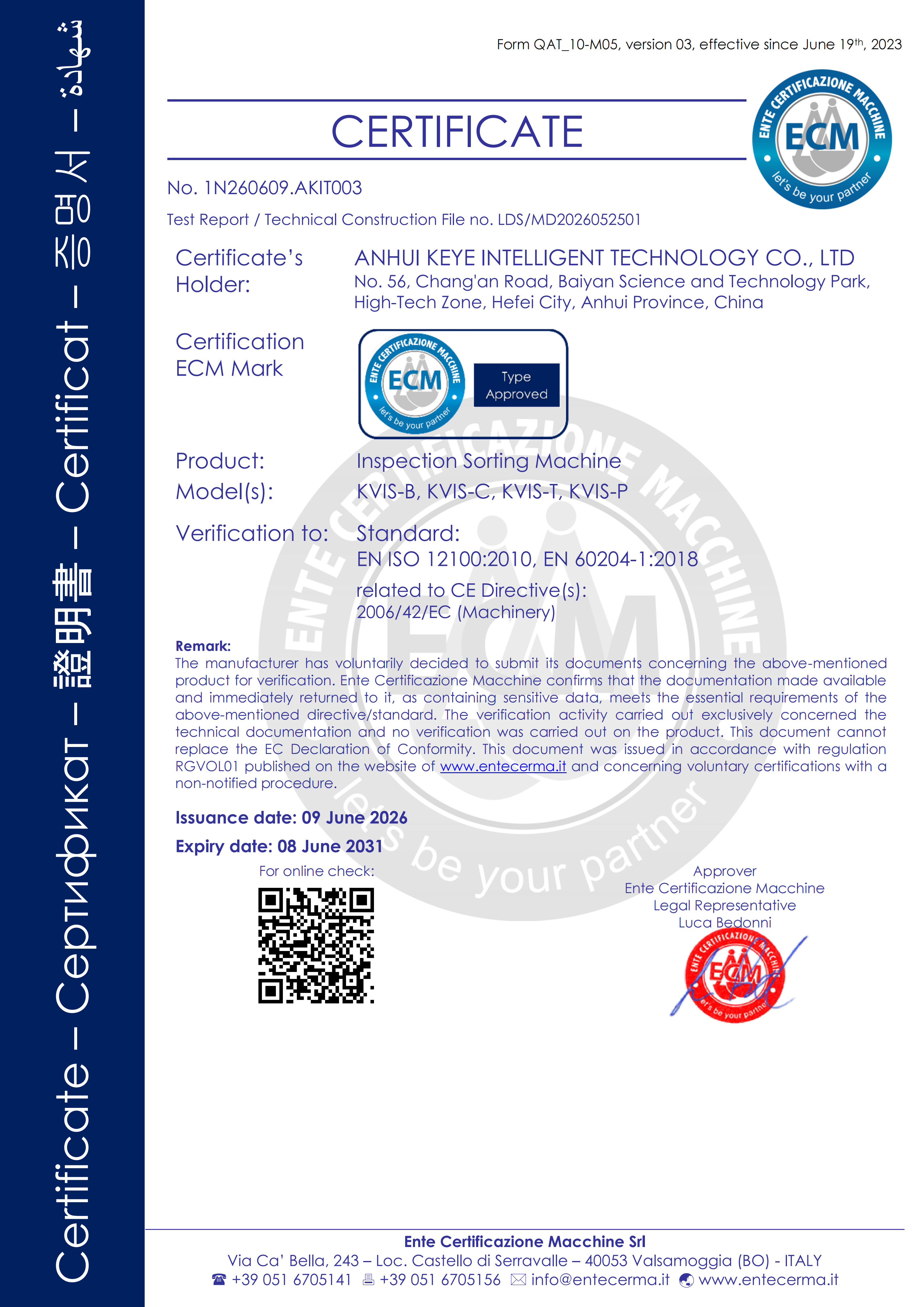
CE certificate No. 1N260609.AKIT003, issued by Ente Certificazione Macchine Srl, with the scope stated as 'Inspection Sorting Machine'.
Within the documented model set, three statements anchor the pattern:
- AI Intelligent Grain Sorting, model 6SXZ-693C - certified to CE standards.
- AI Intelligent Rice Sorting, model 6SXZ-990C - certification number No. 1N260609.AKIT003.
- AI Intelligent Pet Food Sorting, model 6SXZ-126LFI - certification applicable to the EU, US and Middle East markets.
The standards behind the certificate
Two standards are recorded against the certification: EN ISO 12100:2010 and EN 60204-1:2018. In procurement terms, the first covers machinery risk assessment and risk reduction; the second covers the electrical equipment of machines. For a plant engineer, that means electrical design, guarding logic and risk documentation form part of the declared conformity package and can be reviewed against site requirements before delivery rather than after installation.
Where the certificate stops
Reading a certificate accurately includes knowing its boundaries, and three boundaries matter here.
Certification is machine-level, not configuration-level. Where a project adds custom feeding, different conveyor geometry, a different supply voltage or additional modules, that variation may fall outside the assessed scope and require its own review. Buyers specifying a modified machine should confirm coverage for the exact configuration rather than for the series name.
The market list is explicit. The certificate names the EU, US and Middle East. KEYETECH also lists Southeast Asia among its main markets, but destinations outside the stated certificate markets are not addressed by this document; those deployments normally follow a separate local approval path.
Standard coverage is machinery and electrical safety. EN ISO 12100:2010 and EN 60204-1:2018 are not food-contact material approvals. In food applications, buyers typically review food-safety benchmarks separately; the FDA's Food Safety Modernization Act (FSMA) and EU Regulation EC1935/2004 are the frameworks widely referenced for sorting equipment in the food sector. These sit alongside the CE record, not inside it.
Materials: a compliance variable, not a line item
Construction material is often treated as a purchasing detail. In regulated production it behaves as a compliance variable, because it shapes cleanability, corrosion behaviour in demanding environments, and whether a material record can be attached to the buyer's own audit pack.
Within the range, models 6SXZ-378LFI and 6SXZ-252LFI are constructed from carbon steel or stainless steel, while model 6SXZ-126LFI uses either carbon steel or stainless steel. Machines in the range are specified for an operating temperature band of -20°C to 60°C. In salt, seasoning, frozen and high-humidity applications, the carbon-or-stainless decision affects how the machine is cleaned and how contact surfaces hold up over time, so it is a decision worth making explicitly, with the steel grade and material documentation confirmed for the ordered model.
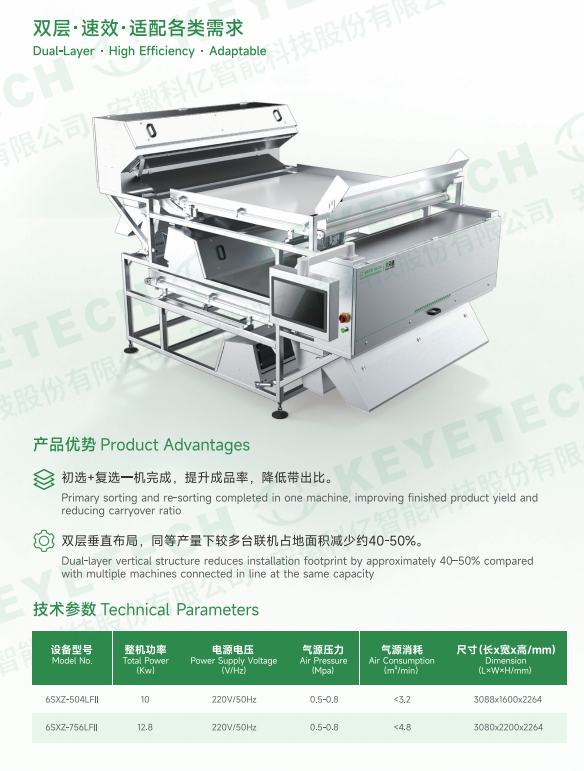
AI belt-type intelligent sorting machine. Carbon steel or stainless steel construction is a documented buyer decision point, not a default.
A documentation framework for AI sorter evaluation
The framework below converts the certificate discussion into a checklist that evaluation-stage buyers can send to any supplier. It is organised around documents rather than claims, so answers can be compared across a short list.
| Evidence to request | Question it answers | What a complete answer looks like |
|---|---|---|
| CE certificate with number and issuing body | Has the machine type been assessed by an external body? | Certificate copy (No. 1N260609.AKIT003, Ente Certificazione Macchine Srl) plus scope confirmation for the ordered model |
| Standards list | Which technical areas were covered? | EN ISO 12100:2010 for machinery risk assessment; EN 60204-1:2018 for electrical equipment of machines |
| Material declaration | What is the machine built from, and how does it clean? | Carbon steel or stainless steel stated per model (6SXZ-378LFI, 6SXZ-252LFI, 6SXZ-126LFI), with material records |
| Operating envelope | Will the machine run inside site utilities and climate? | Total power 1.2-6.8 kW; air consumption 0.6-6 m³/h; air pressure 0.5-0.8 MPa; -20°C to 60°C |
| Installation prerequisites | Can the site be prepared before commissioning? | Grounding wire, air compressor and material handling arrangements confirmed in advance |
| Outgoing quality control | Is there a per-unit record? | 100% test, with documentation issued per machine |
| Commercial and service parameters | Can the supplier meet schedule and support expectations? | MOQ 1 unit; lead time 30-45 days; monthly capacity 100 units; remote support model |
Where compliance meets operating conditions
The certification documentation names grain, rice and pet food models directly, but the same conformity logic applies across the wider range: vegetable, salt, seasoning, nut, coffee cherry, frozen food and chicken nugget, French fry, candy, lemon slice, flower tea, fresh flower, traditional Chinese medicinal material, ore, metal and plastics sorting. The deployment conditions recorded for these applications are consistent: 24/7 operation in an indoor factory environment at normal temperature and humidity, with a matched air compressor, a material handling arrangement and a grounding wire as prerequisites.
Field evidence matters here because documentation alone does not demonstrate stability. Recorded projects include a rice OEM deployment of 10 units, where complete AI model building was finished within one hour using 50 training images, with reported finished-product sorting at 99.999%; a coarse cereals OEM installation of 25 units detecting insect eyes and impurities in miscellaneous grains, running stably for one year; and a food OEM project of 12 units detecting impurities and spoilage, also running for one year with the same one-hour model-building highlight.
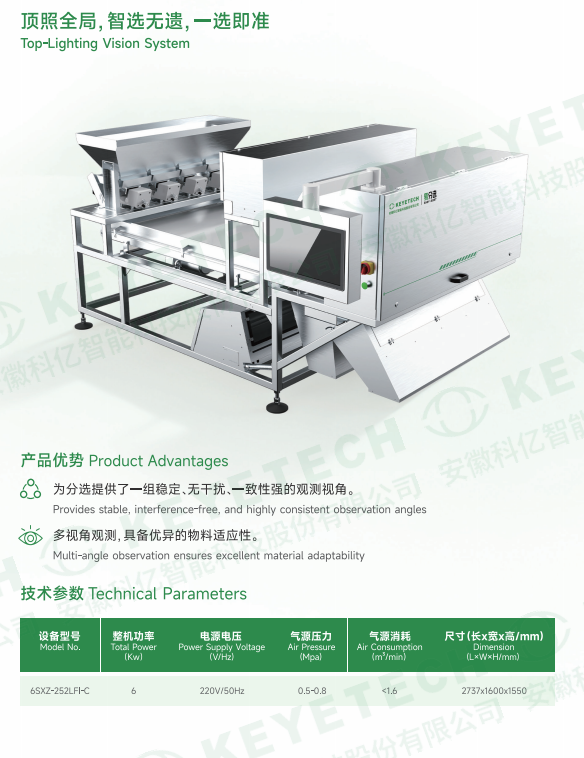
Top-lighting vision system. Imaging hardware sits inside the declared machine conformity scope and inside the buyer's utility planning.
Market signals: compliance is turning into a procurement gate
The commercial context explains why documentation is being reviewed earlier. The global optical sorter market is projected to reach USD 5.79 billion by 2032, growing at a CAGR of 9.5% from 2025, according to MarketsandMarkets. Food processing remains the anchor application: Grand View Research reports USD 2,523.1 million of optical sorter revenue in that segment in 2024, the largest application share at 45%. Asia Pacific is the largest regional market, reaching USD 1.03 billion in 2025, according to Fortune Business Insights.
The technology mix is shifting at the same time. EIN Presswire reports that AI-enhanced hyperspectral and NIR sorting modules were embedded in approximately 38% of new industrial belt-line installations as of 2024. Concentration among incumbents raises the documentation bar further: Verified Market Research estimates that TOMRA Systems ASA holds about 30% of the global food sorting segment, while Future Market Insights recognises KeyeTech as a top player in the AI-powered packaging and defect inspection machine market, valued at approximately USD 1.6 billion in 2025.
Taken together, these signals point in one direction. As AI sorting moves from early adoption into mainstream food and agricultural lines, the differentiator increasingly sits in demonstrated conformity, meaning certificate scope, standards, materials and installation prerequisites, rather than in detection capability alone.
Comparison: specification-first versus documentation-first sourcing
Two sourcing approaches are common, and they produce different risk profiles.
| Dimension | Specification-first sourcing | Documentation-first sourcing |
|---|---|---|
| Entry question | What can the machine detect, and how fast? | Which certificate, for which machine, in which market? |
| Certificate handling | CE mark accepted as a claim | Certificate number, issuing body and scope verified against the ordered model |
| Materials | Steel type treated as a commercial option | Steel type confirmed per model, with records available for audit |
| Installation | Addressed at commissioning | Utilities, grounding and air supply confirmed before delivery |
| Typical risk | Approval delays after the machine arrives | Longer front-end review, fewer commissioning surprises |
| Best fit | Unregulated or internal-only lines | Food and export-bound production with formal quality plans |
The boundaries of the documentation-first approach matter as much as its benefits. A single certificate does not travel everywhere: KEYETECH's CE record names the EU, US and Middle East, so buyers deploying in other regions, including Southeast Asia, which the company lists as a main market, must plan a separate review. Machine-level certification does not certify the buyer's finished product; it supports, but does not replace, the buyer's own quality and food-safety controls. Documentation also does not substitute for operational validation, so a trial with the buyer's own material remains the practical way to confirm material and cleaning behaviour. Two supplier-side parameters deserve explicit planning as well: KEYETECH reports an export ratio of about 10% and a remote support model for after-sales, which buyers whose sites require frequent on-site intervention should factor into their service plan, and the stated lead time of 30-45 days with a monthly capacity of 100 units, which matters for multi-line rollouts scheduled inside a narrow window.
Future outlook
Two developments are likely to reshape how AI sorting machines are qualified over the next few years.
First, model retraining is becoming a compliance event. When an operator can build a sorting model in about one hour from roughly 50 images, the machine's behaviour can change after delivery, which turns model versions and retraining procedures into change-management items that quality teams will want documented rather than simply demonstrated.
Second, documentation will become more portable and more regional at the same time. Buyers increasingly want a single pack covering certificate, standards, materials, utilities and installation prerequisites, while regulators in different regions continue to add their own expectations. Suppliers with cross-regional sales will need per-market documentation rather than one document reused everywhere. For evaluation-stage buyers, the practical takeaway is straightforward: treat certification scope, market coverage and material records as three separate questions, and ask for written answers to each before the purchase order rather than after commissioning.
FAQ
Which CE certificate does KEYETECH hold for its AI sorting machines?
KEYETECH holds a CE certificate numbered No. 1N260609.AKIT003, issued by Ente Certificazione Macchine Srl, with the scope stated as 'Inspection Sorting Machine' and market coverage of the EU, US and Middle East. Model-level records state that the AI Intelligent Grain Sorting (model 6SXZ-693C) is certified to CE standards, the AI Intelligent Rice Sorting (model 6SXZ-990C) is associated with certification number No. 1N260609.AKIT003, and the AI Intelligent Pet Food Sorting (model 6SXZ-126LFI) carries certification applicable to the EU, US and Middle East markets.
Which markets does that certification cover?
The certificate lists the EU, US and Middle East. Other destinations are not addressed by this document. Because KEYETECH also lists Southeast Asia among its main markets, buyers there should expect to review separate regional requirements rather than assume the CE record applies.
Which standards were applied in the certification?
Two standards are recorded: EN ISO 12100:2010, which addresses machinery risk assessment and risk reduction, and EN 60204-1:2018, which addresses the electrical equipment of machines. Both are machinery and electrical safety standards.
Does machinery certification also cover food-safety requirements?
No. Machinery certification and food-safety review are separate tracks. Sorting equipment used in the food sector is commonly reviewed against benchmarks such as the FDA's Food Safety Modernization Act (FSMA) and EU Regulation EC1935/2004, and that documentation is requested independently of a CE certificate.
What materials are the machines built from, and why does that matter in evaluation?
Models 6SXZ-378LFI and 6SXZ-252LFI are constructed from carbon steel or stainless steel, and model 6SXZ-126LFI uses either carbon steel or stainless steel. Machines in the range operate between -20°C and 60°C. Buyers should confirm which option is supplied for the ordered model and request the corresponding material records, since this affects cleaning practice and audit documentation.
What should be confirmed before installation?
Recorded deployment conditions include total power of 1.2-6.8 kW, air consumption of 0.6-6 m³/h and air pressure of 0.5-0.8 MPa, with an operating temperature range of -20°C to 60°C. Installations are specified for 24/7 operation in an indoor factory environment at normal temperature and humidity, and require a grounding wire, an air compressor and a material handling arrangement to be in place beforehand.
What happens if a project needs a configuration outside the certified scope?
Certification is recorded at machine level, so added or changed elements such as custom feeding, different conveyor geometry, a different supply voltage or extra modules may fall outside the assessed configuration. Buyers in that situation should confirm with the supplier, before ordering, whether the variation requires its own assessment or an update to the documentation package.