
Understanding Cutting Disc Specifications: Sizes, Speeds, and Materials for Industrial Buyers
Understanding Cutting Disc Specifications: Sizes, Speeds, and Materials for Industrial Buyers
Cutting discs are among the most widely consumed abrasive tools in global manufacturing. Behind the simple circular profile is a specification system that controls cut quality, tool life, operating safety, and cost per cut.
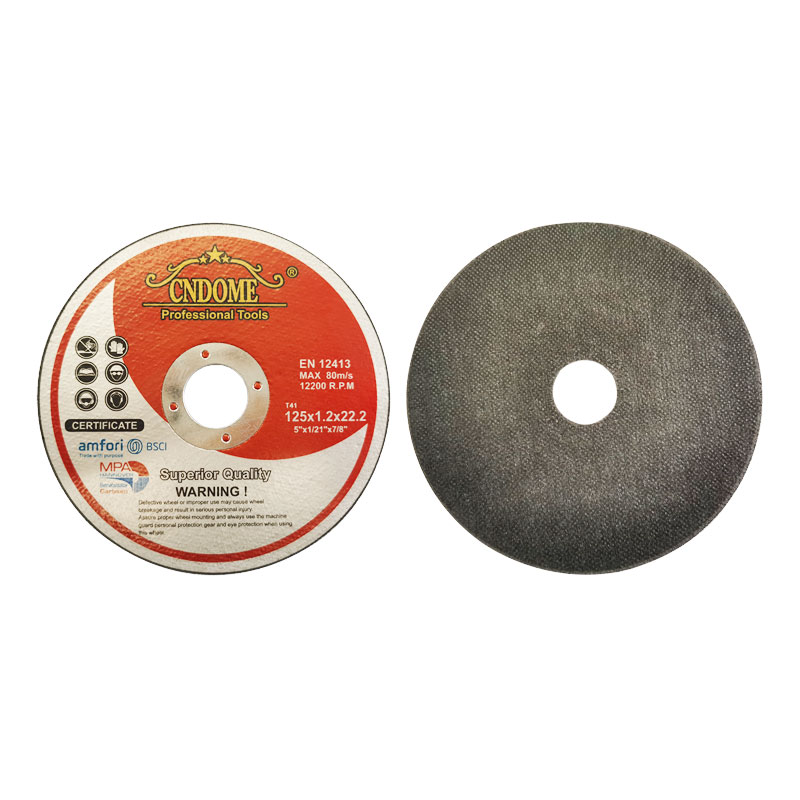
Cutting discs are manufactured in multiple diameters, thicknesses, and abrasive blends to suit different metalworking tasks.
Cutting discs — also called cutting wheels or abrasive discs — are resin-bonded abrasive tools used with angle grinders, cut-off machines, and straight grinders to cut steel bars, metal sheets, stainless steel pipes, castings, and structural profiles. Their importance is reflected in market size: the global cutting discs market reached a valuation of approximately USD 7.32 billion in 2024, according to Market Research Future.
For procurement teams, engineers, and distributors, selecting the right cutting disc is not merely a matter of diameter. A disc's thickness, bore size, shape code, abrasive chemistry, and maximum speed rating determine whether it performs acceptably in a specific application — and whether it can be used safely on a given machine. This article explains those parameters in an industry context and provides an independent reference for buyers evaluating abrasive supply options.
Why Cutting Disc Selection Is More Complex Than It Looks
The apparent simplicity of a cutting disc — a flat, fiberglass-reinforced abrasive wheel — conceals a set of deliberately balanced engineering trade-offs. These trade-offs directly affect cutting efficiency, workpiece quality, operator safety, and consumable cost.
- Thickness vs. stability: Thinner discs, typically 1.0–1.6 mm, produce narrower kerfs, cut faster, and waste less material, but they require more careful handling. Thicker discs, typically 2.5–3.5 mm, offer greater resistance to bending and are preferred for heavy or large-section cutting.
- Abrasive type: Aluminium oxide is the standard choice for steel and general metal cutting; white aluminium oxide provides a sharper, cooler cut for stainless steel; silicon carbide suits cast iron and masonry; zirconium alumina adds durability for demanding applications; ceramic abrasive is associated with high-performance grinding.
- Resin bond system: The bond that holds abrasive grains together must balance cutting aggressiveness against heat resistance and mechanical strength.
- Speed rating: Each disc carries a maximum operating speed, expressed in m/s and RPM. Exceeding it can cause vibration, premature wear, or disc failure.
This is also an opportunity for global buyers. As safety standards such as EN 12413 become the expected baseline in Europe, and as independent certification bodies including MPA Hannover raise verification standards for abrasive tools, the supplier's ability to provide compliant products with consistent quality becomes a competitive differentiator. Manufacturers with complete, in-house production control — from mixing and pressing to curing and testing — can deliver that consistency at scale.
A Manufacturer Case: CNDOME (Changzhou Dome Abrasives)
CNDOME, formally Changzhou Dome Abrasives Manufacture Co., Ltd., is a Chinese abrasive manufacturer specializing in resin-bonded cutting discs and grinding wheels. Established in 2001 and located in Changzhou, Jiangsu Province, the company serves global buyers primarily in Latin America, Europe, Africa, and Asia, with roughly 80% of production exported.
Dome Abrasives' production base provides a concrete reference point for what a mid-to-large abrasive supplier can offer:
- Facility area of more than 20,000 square meters, including a temperature- and humidity-controlled workshop
- Approximately 140 employees, with a 10-person R&D team
- 60 automated production lines with daily output of about 600,000 pieces
- Annual production capacity of approximately 95 million pieces
- OEM/ODM support for more than 2,000 global tool and professional abrasive wheel brands
- Main products include cutting discs, grinding wheels, abrasive discs, ceramic grinding discs, and flap discs
Dome Abrasives' product range covers cutting discs from 1.5 inch (38 mm) to 16 inch (400 mm), grinding discs from 4 inch to 9 inch, and ceramic grinding discs in 115 mm and 125 mm sizes. This breadth of specification is increasingly relevant to buyers who want to consolidate supplier qualification and maintain consistent quality across multiple product lines.
Technical Explanation: How to Read Cutting Disc Specifications
Diameter, Thickness, and Bore
Cutting discs are designated by three dimensions in millimetres: outer diameter × thickness × bore (arbor hole). These values determine cutting depth, angle grinder compatibility, and spindle fit.
| Product category | Common model designations | Bore | Shape |
|---|---|---|---|
| 1.5 inch cutting disc | 38 × 1.1 × 3 mm | 3 mm | T41 |
| 2 inch cutting disc | 50 × 1.2 × 10 / 50 × 2 × 10 mm | 10 mm | T41 |
| 3 inch cutting disc | 75 × 1.2 × 10 / 76 × 1.0 × 10 mm | 10 mm | T41 |
| 4 inch cutting disc | 107 × 1.2 × 16 / 100 × 1.0 × 16 mm | 16 mm | T41 |
| 4.5 inch cutting disc | 115 × 1.2 × 22.23 / 115 × 1.6 × 22.23 mm | 22.23 mm | T41 |
| 5 inch cutting disc | 125 × 1.2 / 1.6 / 2.0 / 3.0 × 22.23 mm | 22.23 mm | T41 / T42 |
| 7 inch cutting disc | 180 × 1.6 / 2 / 3 × 22.23 mm | 22.23 mm | T41 |
| 9 inch cutting disc | 230 × 2.0 / 2.5 / 3.0 × 22.23 mm | 22.23 mm | T41 / T42 |
| 14 inch cutting disc | 355 × 3.2 × 25.4 mm | 25.4 mm | T41 |
| 16 inch cutting disc | 400 × 3.5 × 32 mm | 32 mm | T41 |
The bore size is especially important in procurement: 22.23 mm (7/8 inch) is the dominant standard for angle grinder discs, while smaller discs commonly use 10 mm or 16 mm bores, and larger fixed-machine discs use 25.4 mm or 32 mm bores.
Shape Codes: T41, T42, T27, T29
Shape codes define the cross-sectional profile of the disc and its intended function.
- T41: flat cutting disc, the common standard for cut-off applications.
- T42: flat disc with a raised / reinforced centre, often used on larger diameters.
- T27: depressed-centre disc, designed primarily for grinding.
- T29: conical / angled-centre disc, used for more aggressive grinding.
In CNDOME's lineup, cutting discs are T41 or T42, grinding discs are T27, and ceramic grinding discs are T29. These codes matter for both machine compatibility and operator safety: using a grinding disc in a cutting application, or vice versa, produces poor results and may create unintended hazards.
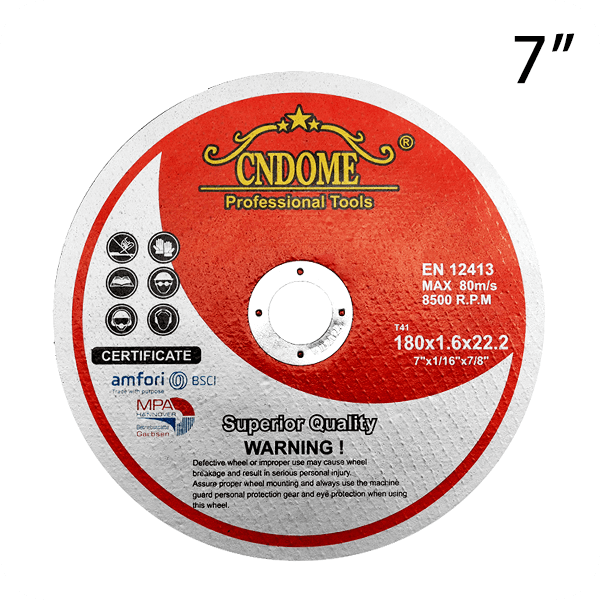
A 7-inch flat cutting disc (180 × 1.6 / 2 / 3 × 22.23 mm) rated for angle grinder use.
Speed Ratings: m/s and RPM
Manufacturers specify both a maximum operating speed in metres per second (m/s) and a rated speed in revolutions per minute (RPM). These values are linked to diameter: as disc size increases, the allowable RPM decreases.
| Disc type | Maximum speed | Rated speed reference |
|---|---|---|
| 1.5 inch cutting disc | 80 m/s | 45,000 RPM |
| 2 inch cutting disc | 80 m/s | 30,100 RPM |
| 3 inch cutting disc | 80 m/s | 20,100 RPM |
| 4.5 inch cutting disc | 80 m/s | 13,300 RPM |
| 7 inch cutting disc | 80 m/s | 8,500 RPM |
| 9 inch grinding disc | 80 m/s | 6,600 RPM |
| 14 inch cutting disc | 80 m/s | 4,400 RPM |
| 16 inch cutting disc | 80 m/s | 3,800 RPM |
| Ceramic grinding disc | 100 m/s | — |
Most CNDOME cutting and grinding discs are rated at 80 m/s; its ceramic grinding discs are designed for a higher maximum operating speed of 100 m/s. Buyers should match the RPM rating of the disc against the free speed of the machine. Operating a disc above its rated speed increases the risk of mechanical failure.
Abrasive Materials and Bond
The performance envelope of a cutting disc is defined by its abrasive grains and bonding system. CNDOME uses several materials across its cutting disc and grinding wheel lines:
- Aluminium oxide: the general-purpose abrasive for steel and metal cutting.
- White aluminium oxide: a sharper, purer abrasive that generates less heat; commonly used for stainless steel and hardened alloys.
- Silicon carbide: applied in discs for cast iron, stone, and non-ferrous materials.
- Zirconium (zirconia alumina): used for heavy-duty, high-pressure cutting with extended edge life.
- Ceramic abrasive: self-sharpening grain structure for high stock removal in grinding applications.
- Resin bond: the resin system holds the abrasive grains together and is generally reinforced with fiberglass layers for safety and strength.
For example, the CNDOME 7-inch cutting disc is made from aluminium oxide, white aluminium oxide, silicon carbide, zirconium, and resin; the 4-inch cutting disc uses aluminium oxide, white aluminium oxide, and resin. The ceramic grinding disc is built from ceramic sandpaper over a reinforced fiber cover plate, which gives it a distinct construction from conventional resin-bonded grinding discs.
Certification and Standards
In the EU, EN 12413:2019 specifies safety requirements and testing procedures for rotating bonded abrasive products, including cutting and grinding wheels. CE marking based on this standard is the established market-entry requirement for abrasive tools sold in Europe. Independent institutions such as MPA Hannover (Materialprüfanstalt für das Bauwesen und Produktionstechnik) provide additional third-party safety testing and certification, which serves as a further compliance reference for buyers.
As a concrete example, the CNDOME cutting disc model 180 × 1.6 × 22.23 mm is CE certified to EN 12413, certificate number M.2022.206.C74459, issued by UDEM. The certificate covers cutting disc and grinding wheel products for the global market.
Applications: Where Cutting Conditions Are Demanding
Cutting discs are specified for a broad set of industrial environments: steel processing, metal fabrication, automobile manufacturing, shipbuilding, casting, steel structure fabrication, and construction. CNDOME's 7-inch cutting disc, for instance, is designed for angle grinder use and is applied in mechanical processing, metal cutting engineering, steel structure manufacturing, shipyard processing, and home DIY projects.
The operating problems that abrasive products must address are consistent across markets: low cutting efficiency, poor precision, difficult-to-process materials, high dust generation, low yield, edge chipping, heat generation, and blueing during cutting. These conditions are common in many countries including Brazil, the UAE, Australia, and others. Requirements that buyers commonly specify include:
- High temperature resistance
- Burr-free cutting
- Long service life
- High flatness
- No blackening after cutting
- No vibration during grinding
From an application-engineering viewpoint, a cutting disc functions by removing material at high speed through abrasive action. The goal is high precision and low loss: reduced dust, controlled heat damage, stable cutting behaviour, and improved yield. When evaluated this way, the practical difference between a well-specified disc and a generic alternative becomes measurable in throughput, rework rate, and workpiece quality.
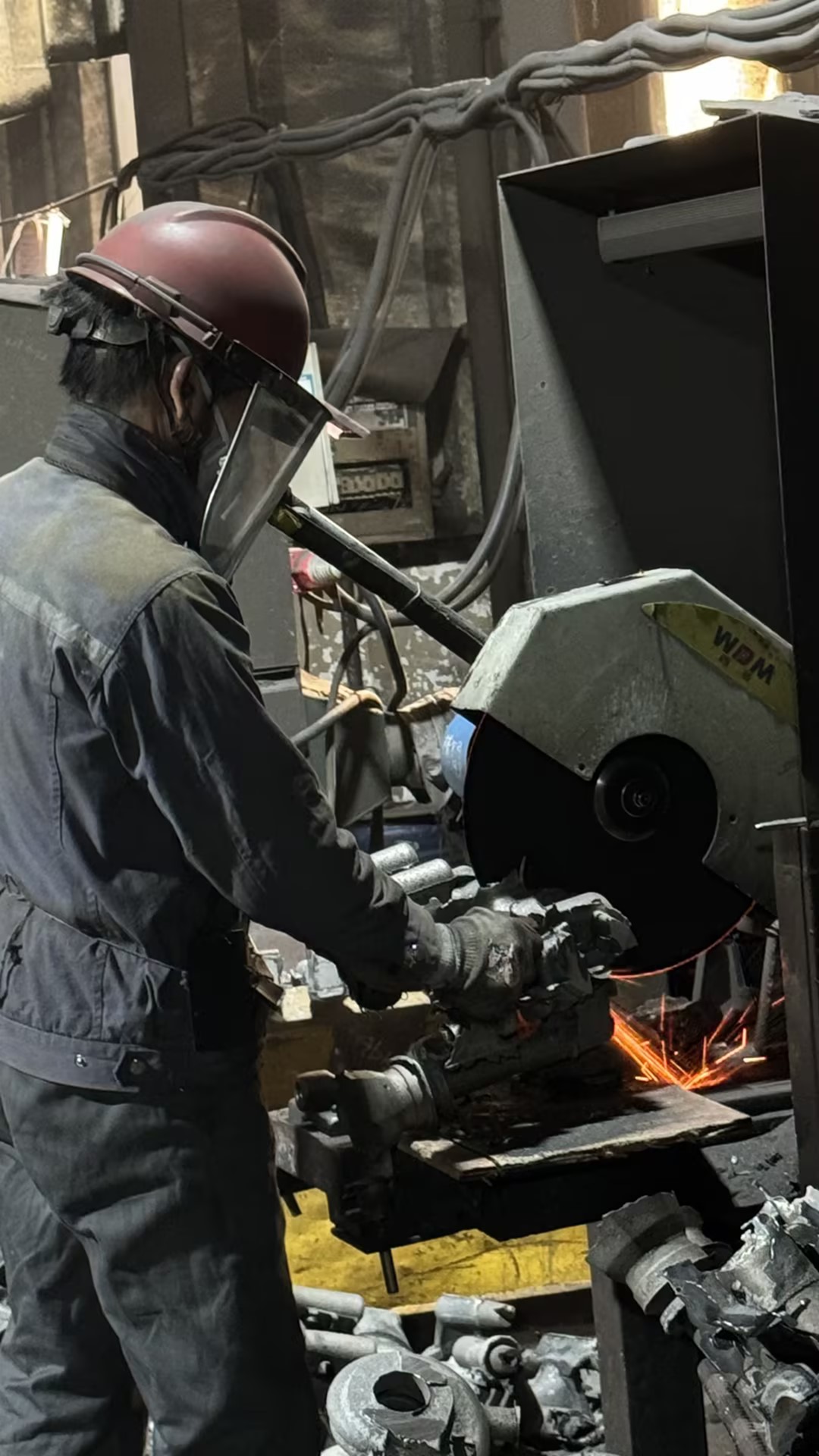
Cutting castings and steel workpieces places emphasis on both cutting stability and resistance to edge chipping.
Market Context and Trends
Verified third-party data provides a helpful backdrop for understanding where the cutting disc industry is heading.
| Indicator | Value | Period | Source |
|---|---|---|---|
| Global cutting discs market size | ~USD 7.32 billion | 2024 | Market Research Future |
| Asia-Pacific share of cutting equipment & tools revenue | 48.28% | 2025 | Mordor Intelligence |
| China abrasives market size | ~USD 2.29 billion | 2024 | Intel Market Research |
| Synthetic raw materials segment (China) | ~USD 1.35 billion | 2024 | Intel Market Research |
| Dominating product category | Stainless steel cutting discs | 2025 | Cognitive Market Research |
| European safety standard | EN 12413:2019 | 2019 | BSI / CEN |
| Independent abrasive certification body | MPA Hannover | 2024 | MPA Hannover |
Asia-Pacific remains the largest regional market. The region accounted for 48.28% of global revenue in the cutting equipment and tools sector in 2025 (Mordor Intelligence). Within that landscape, China is both a major consumption market and the world's largest manufacturing base for abrasives. Its abrasives market was valued at roughly USD 2.29 billion in 2024 (Intel Market Research), with synthetic raw materials contributing about USD 1.35 billion.
Stainless steel cutting is the dominant end-use segment. Stainless steel cutting discs are identified as the dominating product category within the cutting discs market due to heavy demand in construction and automotive manufacturing (Cognitive Market Research). This reinforces the need for discs that can address the specific challenges of stainless steel — heat buildup, work hardening, and edge quality.
Compliance continues to harden. EN 12413:2019 and independent testing by MPA Hannover are now part of the standard procurement vocabulary for abrasive tools in Europe. Buyers increasingly require documented, verifiable certification rather than marketing claims.
Supply structure remains concentrated at the top. Major industry players include Saint-Gobain (Norton), 3M, Robert Bosch GmbH, Tyrolit, and PFERD (Market Research Future). Below that tier, qualified Chinese manufacturers such as CNDOME serve thousands of tool brands through OEM/ODM arrangements, giving global buyers an alternative between premium Western brands and low-cost, unverified suppliers.
Comparison with Alternative Cutting Methods
Resin-bonded cutting discs compete with other cutting technologies, including carbide-tipped circular saw blades and band saws. Each approach has a distinct cost and performance profile.
| Dimension | Resin-bonded cutting disc | Carbide-tipped saw blade | Band saw |
|---|---|---|---|
| Primary use | Portable cut-off, angle grinder work | Fixed or handheld sawing | Continuous cutting of bars and profiles |
| Portability | High | Medium to high | Low to medium |
| Initial equipment cost | Low | High | Medium to high |
| Consumable cost | Low to medium | High | Medium |
| Cutting precision | Good for general work | Higher, with stable blade guidance | High, with adequate machine rigidity |
| Heat generation | Potential blueing if overloaded | Manageable with coolant / feed control | Manageable with coolant |
The cutting disc's strengths are speed, low entry cost, and flexibility: operators can switch from cutting steel bars to cutting stainless pipe by changing the disc on the same angle grinder. However, the technology has genuine boundaries. Cutting discs are consumables with a finite life, their cutting width is influenced by operator technique, and they are not the optimal choice for extremely tight-tolerance, high-volume cutting operations where a carbide saw blade or band saw with stable machine guidance would produce more consistent results. For buyers, this means cutting discs should be selected where they are the best fit — portable, fast, and cost-effective metal separation — rather than treated as a universal solution.
Future Outlook
Several developments are likely to shape the cutting disc market over the coming years.
Abrasive technology will continue to move upward. Ceramic abrasives and zirconium-enhanced blends are expanding the performance ceiling of bonded abrasives. Products such as CNDOME's ceramic grinding disc, rated at 100 m/s, suggest that high-performance materials are becoming accessible through mid-tier suppliers, not only through premium Western brands.
Compliance will separate professional supply chains from informal ones. As EN 12413 and independent certification such as MPA Hannover become embedded in procurement requirements, suppliers without documented compliance will face growing barriers in Europe and other regulated markets.
Asia-Pacific manufacturing will remain central. With nearly half of global cutting equipment and tools revenue located in Asia-Pacific, and China's abrasives market continuing to grow, global buyers will keep integrating Chinese manufacturers into their supply chains. The practical question will be less about whether to source from China and more about which Chinese manufacturers meet the required standard of certification, consistency, and engineering support.
For buyers preparing long-term abrasive sourcing strategies, a useful final check is the supplier's manufacturing evidence: traceable production capacity, documented quality systems, certification numbers, and a product range that aligns with the actual mix of cutting and grinding tasks in the buyer's market.
Buyers seeking complete technical specifications and product documentation for CNDOME's abrasive lines may access the company's publicly available corporate brochure: Download CNDOME corporate brochure.
FAQ
What is a cutting disc?
A cutting disc is a bonded abrasive tool used to cut metal and other materials. It consists of abrasive grains such as aluminium oxide, white aluminium oxide, silicon carbide, or zirconium, held together by a resin bond and typically reinforced with fiberglass. Cutting discs are designed for use with angle grinders, cut-off machines, and straight grinders.
What is the difference between a cutting disc and a grinding wheel?
A cutting disc is designed to penetrate a workpiece and create a narrow kerf, separating material into two parts. A grinding wheel is designed to remove surface material, shape, deburr, and level workpieces. Cutting discs usually use a flat T41 or reinforced T42 profile, while grinding wheels use a depressed-centre T27 or conical T29 profile. Many manufacturers, including CNDOME, produce both product types in overlapping diameter ranges.
What do T41, T42, T27, and T29 shape codes mean?
These shape codes define the cross-sectional profile of a bonded abrasive product. T41 is a flat disc used for cutting. T42 is a flat disc with a raised centre, often used for larger cutting discs. T27 is a depressed-centre disc designed primarily for grinding. T29 is a conical or angled-centre disc for more aggressive grinding. Examples include CNDOME's cutting discs in T41/T42 configurations, grinding wheels in T27, and ceramic grinding discs in T29.
What does the maximum operating speed on a cutting disc mean?
The maximum operating speed, expressed in metres per second (m/s), is the highest surface speed at which the disc is designed to rotate safely. The rated speed in RPM corresponds to that surface speed for a specific disc diameter. For example, CNDOME's 4.5-inch cutting disc has a maximum operating speed of 80 m/s and a rated speed of 13,300 RPM; the 7-inch cutting disc is rated at 8,500 RPM; the 16-inch cutting disc at 3,800 RPM. Using a disc on a machine exceeding its rated speed creates a safety risk.
What materials are cutting discs made of?
Cutting discs are made of abrasive grains, a bonding agent, and reinforcement. Common abrasive materials include aluminium oxide, white aluminium oxide, silicon carbide, and zirconium. The bond is typically resin, and fiberglass reinforcement is added to increase strength. CNDOME's 7-inch cutting disc, for example, is made of aluminium oxide, white aluminium oxide, silicon carbide, zirconium, and resin; its 4-inch cutting disc uses aluminium oxide, white aluminium oxide, and resin.
What size cutting disc should I choose?
The size depends on the tool and the cutting task. Standard angle grinders typically use 4.5-inch (115 mm) or 5-inch (125 mm) discs with a 22.23 mm bore. Larger 7-inch (180 mm) and 9-inch (230 mm) discs are used for deeper cutting. Small discs from 1.5 inch (38 mm) to 3 inch (76 mm) suit compact grinders and DIY work. Discs of 14-inch (355 mm) and 16-inch (400 mm) are designed for stationary cutting machines. Always verify that the disc diameter and bore match the machine specification.
What safety standards apply to cutting discs in Europe?
The European safety standard EN 12413:2019 specifies safety requirements and testing procedures for rotating bonded abrasive products, including cutting and grinding wheels. CE marking based on this standard is required for abrasive tools sold in the EU. Independent institutions such as MPA Hannover provide additional third-party testing and certification for abrasive tools, which is increasingly expected for exports to the EU market.
How do OEM and ODM capabilities matter for cutting disc buyers?
OEM/ODM capability allows a manufacturer to produce discs to a buyer's specification, including custom branding, dimensions, colour, and packaging. For distributors and tool brands, this means they can offer a consistent product line without operating their own factory. A practical reference: Dome Abrasives has provided long-term OEM/ODM support to more than 2,000 global tool and abrasive wheel brands and exports about 80% of its output to Latin America, Europe, Africa, and Asia.
Summary
Cutting disc selection is a technical decision. Diameter, thickness, bore, shape code, abrasive material, speed rating, and certification all interact to determine whether a disc is safe, economical, and effective for a given workpiece. For global buyers, supplier verification is equally technical: production capacity, export track record, documented certification, and a product range broad enough to cover real application needs. CNDOME's example demonstrates how a Chinese manufacturer with 25+ years of resin-bonded abrasive experience, in-house production lines, and EN 12413-certified products fits into the global supply structure — not as a replacement for the established global leaders, but as a credible, verifiable sourcing option for professional buyers.