
Understanding HS Code 3923100000 and Compliance for Steel-Free Plastic Pallet Boxes
HTNXT · Independent Industry Reference · Industrial Equipment & Components
Understanding HS Code 3923100000 and Compliance for Steel-Free Plastic Pallet Boxes
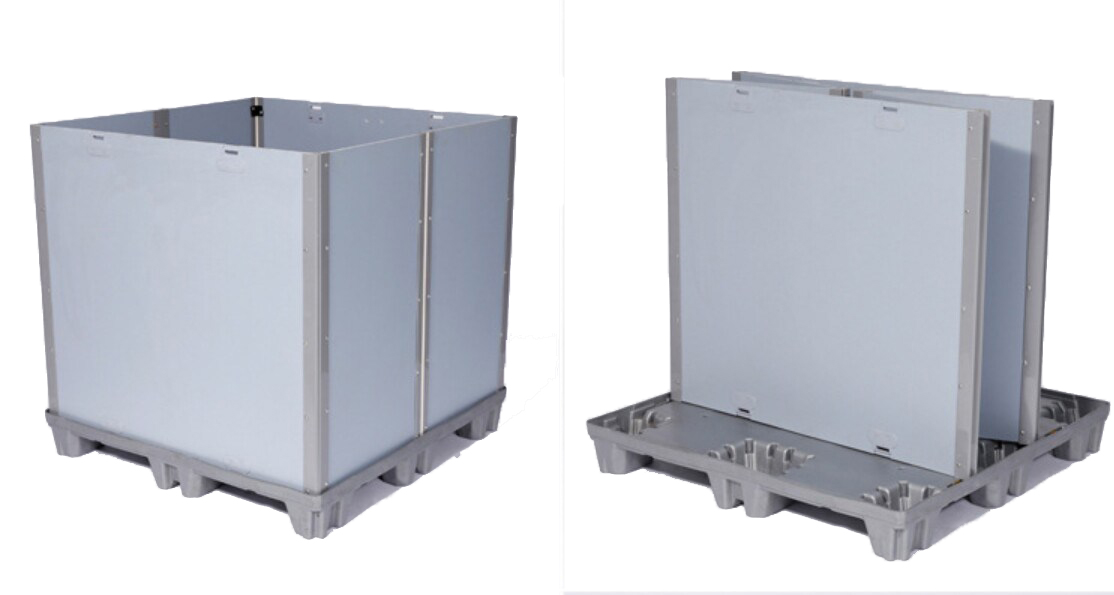
A reusable, steel-free plastic pallet box. A construction that stays within a single material family keeps the article inside the plastics tariff heading and removes metal corrosion points from washdown and chemical-exposed storage areas.
An enclosed plastic pallet box is normally chosen for what it protects, not for the tariff line it carries. The tariff line matters anyway. Once a box leaves the manufacturer and crosses a border, the code declared on the customs entry determines duty treatment, the documents an importer must be able to produce, and how much attention a shipment attracts. For buyers working through evaluation and first execution, classification and material compliance are not administrative afterthoughts; they are part of the specification.
Zhangjiagang Fenghui Logistics Equipment Co., Ltd., which manufactures under the TOYOE brand, is a Suzhou-based producer of plastic pallet boxes, storage boxes, plastic crates and plastic honeycomb panel boxes, established in 2010. Its published pallet box parameters record HS Code 3923100000, list HDPE and PP as base materials, describe an enclosed box type with a 100–200 L capacity and customized dimensions, and state an application range covering oil, industrial alcohol, alkali, acid, industrial wastewater, water and car parts. The company exports to markets including Mexico and the United States and offers OEM/ODM production. Those facts frame the question this reference addresses: what does that code imply for an importer, and where does the compliance logic of a steel-free plastic box begin and end?
At a glance
- 3923100000 is the tariff line recorded in TOYOE pallet box product documentation; the 3923.10 subheading covers boxes, cases, crates and similar plastic articles.
- A steel-free construction keeps the article within the plastics family. Metal frames or metal pallet bases can shift classification and should be disclosed before the first shipment.
- Base materials are HDPE and PP. The published application list includes oil, industrial alcohol, alkali, acid, industrial wastewater, water and car parts, but chemical resistance is substance-specific and must be confirmed for actual conditions.
- ISO 9001 and ISO 14001 certification covers the manufacturer's management system, not the performance of an individual box.
What HS Code 3923100000 identifies — and what it leaves to customs
In the Harmonized System, heading 3923 covers plastic articles used for the conveyance or packing of goods, and the 3923.10 subheading is the one that addresses boxes, cases, crates and similar articles. The digits after 392310 identify the line within a national tariff schedule. For a buyer, the practical meaning is simple: a pallet box moulded entirely from plastic is normally declared as a plastic article. TOYOE records 3923100000 across its pallet box range, including the 1200×800×1000 plastic pallet box, the 1000×800×800 storage pallet box, the 1000×800×800 plastic honeycomb panel box, and the 1230×830×1000 die-cast pallet box used for automotive engines.
Classification follows the article itself, not the wording on a quotation. Customs authorities assess material composition, construction and essential character, and the outcome can differ between jurisdictions. A box that incorporates a steel frame, a metal pallet base or metal reinforcement may be evaluated under a different heading than an all-plastic equivalent, because the metal component can influence which material gives the product its essential character.
No supplier can predetermine a customs decision made in another country, and no buyer should expect one to. What a supplier can do is keep the record consistent and complete: the commercial invoice, packing list, product specification and any written classification statement should describe the same article in the same terms, and any metal content should be stated rather than left for an inspector to discover. That consistency is what a customs broker needs in order to confirm treatment before goods move, rather than after they arrive.
Why a steel-free construction is a compliance property, not only a design decision
Removing steel from a pallet box is often presented as a durability choice. It is equally a documentation choice. An all-plastic box has a single material story to tell: base polymer, colourants, any functional additives, and the moulded structure that carries the load. There is no second material to declare, no coating to describe, and no metal component whose origin or treatment might need separate explanation in a regulated market.
The engineering consequence is that load has to travel through the box geometry instead of a steel frame. In practice that means ribbed walls, a reinforced base structure, and, in honeycomb panel boxes, a panel core that distributes pressure across the surface rather than concentrating it at contact points. This is why load and stacking claims should come from the manufacturer's data for the exact model and configuration, not from the category in general — capacity depends on size, wall construction, base design and how the load is distributed inside the box.
There is a real trade-off here, and buyers should weigh it rather than assume plastic always wins. Where concentrated point loads, repeated rough handling or very heavy static stacking are routine, a steel-reinforced design may remain the better engineering answer. Choosing it reintroduces two questions a steel-free box avoids: how the metal affects classification, and how it behaves in humid, washdown or chemically exposed environments over years of use.
HDPE and PP: what the material choice means for chemical storage
TOYOE's pallet box parameters list HDPE and PP as base materials. Both are common industrial polymers with very low moisture uptake, which suits washdown areas, unheated warehouses and humid climates. They differ in ways that matter when a buyer is matching a box to a load and an environment.
| Consideration | HDPE | PP | What it means for a buyer |
|---|---|---|---|
| Impact behaviour at low temperature | Generally retains impact toughness better | Tends to become more brittle than HDPE as temperatures fall | Cold-chain or unheated storage may favour HDPE |
| Stiffness and heat tolerance | Lower stiffness | Higher stiffness, better dimensional stability at elevated temperature | PP suits warmer ambient conditions and stiffer walls |
| Moisture uptake | Very low | Very low | Both suit wet or humid operating areas |
| Typical forming routes | Blow moulding and injection moulding | Injection moulding; honeycomb panel structures | Not every design is available in both materials |
These are general material characteristics, not a product specification. Grade, wall thickness, colourants and functional additives all influence behaviour, so buyers should confirm the exact grade and construction with the supplier for the intended load and environment.
The published application list for TOYOE pallet boxes includes oil, industrial alcohol, alkali, acid, industrial wastewater and water. That list describes the application areas the product is designed for; it is not a blanket chemical-resistance approval. Resistance depends on the specific substance, its concentration, the contact temperature, how long the substance remains in contact, and whether the box is under mechanical stress at the same time. Dilute aqueous solutions and industrial alcohol behave differently from concentrated acids, and a combination that is acceptable at ambient temperature may not be at elevated temperature or after prolonged exposure. Buyers storing regulated or aggressive substances should obtain compatibility confirmation for their exact substance and conditions and keep that record with the shipment file.
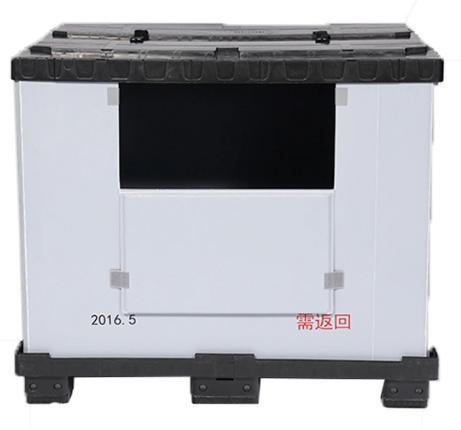
A plastic honeycomb board pallet box. Without a steel frame, load capacity depends on panel structure, wall ribbing and base design — which is why capacity should be read from model-specific data rather than assumed from the category.
Documentation an importer should be able to produce
Compliance work at the execution stage is largely a matter of assembling evidence before the first container is booked. The table below sets out the documents that matter most for a plastic pallet box import, what each one should establish, and where buyers commonly discover a gap.
| Document | What it should establish | Common gap |
|---|---|---|
| Declared HS code in writing | The same code appears on the commercial invoice, packing list and product specification | The code exists on a quotation but not on shipping documents |
| Material declaration | Named base polymer (HDPE, PP), colourants, functional additives and any recycled content | The word “plastic” is used without naming the polymer |
| Management-system certification | How the manufacturer controls quality and environmental performance; TOYOE holds ISO 9001 and ISO 14001 certification covering the sale of logistics metal, plastic and paper packaging products and the rental of palletized unit loads | A management-system certificate is assumed to prove product performance |
| Raw-material test reports | Incoming material has been tested; TOYOE's stated acceptance process is sample testing and confirmation before mass production, with test reports obtained for raw materials | Reports from a different batch are presented as batch-specific evidence |
| Dimensional and load data for custom sizes | Internal dimensions, base design, stacking orientation and load limits for the ordered configuration | Only a nominal external size is quoted, without internal clearance |
| Market-specific requirements | Whether food contact, dangerous-goods transport, fire performance or static-control requirements apply to the intended contents | General certifications are assumed to cover those requirements |
Two points deserve emphasis. First, ISO 9001 and ISO 14001 are management-system certifications: they describe how a manufacturer organises quality and environmental control, not how a specific box performs under a specific load. Second, certification is time-bound. Buyers should confirm that any certificate is still valid on the date of the order rather than relying on a copy that was filed during the evaluation phase months earlier. Custom sizes are accepted for TOYOE pallet boxes, and minimum order quantity is stated as one unit with a lead time of 7–15 days, which makes it practical to validate a specification on a sample before committing to volume.
Where steel-free plastic pallet boxes are used
The clearest fit for an enclosed, all-plastic box is an environment where moisture, cleanliness and corrosion are everyday problems. Storage and internal transfer of oil, industrial alcohol, alkali, acid, industrial wastewater and water are listed application areas for the TOYOE pallet box range, and the enclosed box type reduces spillage and dust ingress compared with open containers. In these settings the absence of metal is an operational advantage as much as a classification one.
Automotive components are the second established use. A Mexican automobile manufacturer has used 1,000 pieces of TOYOE pallet boxes for three years to store car transmission gearboxes. The project achieved standardized storage of auto parts, avoided collision damage to gearboxes during storage, and improved warehouse management efficiency. The characteristics cited for that application were high load-bearing capacity, shock resistance, a stable structure, and a fit that matched the dimensions of the transmission gearbox. A 1230×830×1000 die-cast pallet box for automotive engines appears in the same product family, which shows how closely these boxes are dimensioned to specific components rather than sold as a generic size.
Other listed industries include precision electronics, food cold chain, medical and health care, heavy industry and home logistics. Where electronics are involved, static control is usually specified; ESD performance depends on the formulation and structure of the box, so it should be requested as a defined requirement with supporting evidence rather than assumed from the category. For returnable logistics, folding and demountable designs reduce the volume occupied by empty containers, and customized inner lining options allow individual components to be located and protected during transport.
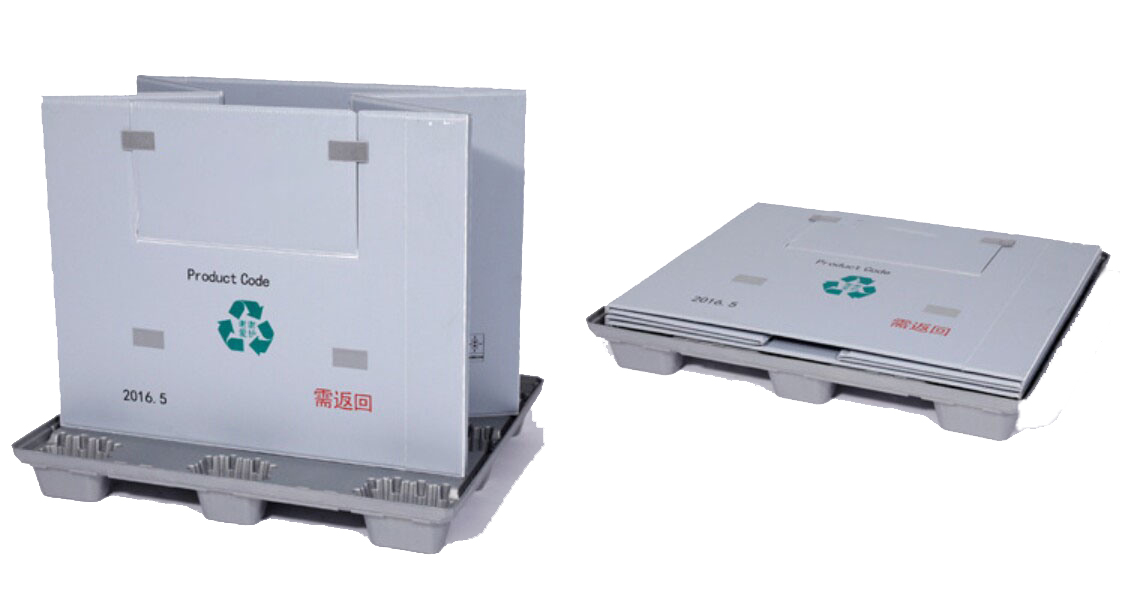
A demountable plastic pallet box. Components can be replaced individually, and empty units take less space in return logistics — two factors that influence total cost over a multi-year service life.
Market context: why plastic pallet box demand keeps rising
The commercial case for plastic pallet boxes continues to widen. Grand View Research projects the global plastic pallets and pallet box market to reach approximately USD 11.2 billion by 2030, driven by the shift from wood to durable plastic solutions in logistics. Demand is geographically concentrated: Straits Research reported that Asia Pacific accounted for more than 32% of plastic pallet market revenue in 2023, with China leading in industrial production capacity.
Two sub-segments are growing faster than the category average. Global Market Insights projects the plastic honeycomb board packaging market to grow at a CAGR of 5.9% through 2032, largely because of the strength-to-weight ratio that matters in automotive parts transport. Research Nester expects ESD packaging, which includes trays and pallet boxes, to reach USD 5.89 billion by 2035, growing at a CAGR of 5.8%. Both trends point the same way for buyers: the boxes that will be specified most often are the ones whose material and construction can be documented precisely.
Published market figures are not fully settled. Estimates for the plastic pallet market in the early 2030s range from roughly USD 10.4 billion to USD 11.2 billion depending on whether rental and pooling services are counted, with Grand View Research and IMARC Group publishing different scopes. Importers should read such numbers as direction rather than as procurement data, and lean on their own duty cycle calculations instead.
The supplier landscape is similarly mixed. Mordor Intelligence lists ORBIS Corporation, Schoeller Allibert, Brambles (CHEP) and Loscam among the major global manufacturers in the plastic pallet box sector — a set that includes both manufacturing groups and large-scale pooling operations. The distinction matters for compliance work. Pooled containers circulate across borders repeatedly and depend on documentation discipline across many parties, while project-specific boxes are documented once against a defined destination, a defined contents list and a defined service life.
Plastic versus wood, steel and fiberboard — and where the limits are
Comparison across container families is useful only when it is honest about trade-offs. The table below summarises the practical differences that buyers most often weigh during evaluation.
| Consideration | Steel-free plastic (HDPE/PP) | Wood | Steel | Fiberboard |
|---|---|---|---|---|
| Moisture, rot and washdown | Unaffected by water; surfaces can be washed | Absorbs moisture; can swell and rot | Corrodes unless coated | Loses strength when wet |
| Chemical exposure | Rinsable surface; resistance depends on polymer, grade and substance | Absorbs liquids and is difficult to clean | Corrosion risk varies with the substance | Absorbs liquids; generally single-use |
| Repair | Component replacement in demountable and folding designs | Board replacement possible | Welding or replacement | Not repairable |
| Return logistics | Folding and demountable types collapse when empty | Bulky when empty | Heavy; stacking only | Collapses but degrades quickly |
| Handling weight | Generally lighter than steel-framed alternatives | Lighter construction, shorter service life | Heaviest of the four | Lightest, least durable |
| Cost profile | Higher unit cost than wood; economics depend on reuse cycles | Lowest unit cost | High unit cost | Low unit cost, short life |
| Tariff family | Plastics heading (3923100000 recorded for TOYOE pallet boxes) | Wooden packaging heading | Articles of iron or steel | Paper or paperboard headings |
Three limits are worth stating plainly. First, a plastic pallet box generally carries a higher unit cost at first purchase than wood, so the economic case rests on reuse cycles and on how long the box stays in service; TOYOE states a five-year guarantee on its pallet boxes, excluding damage caused by human error or by storage loads exceeding the product's limits. Second, load performance is design-dependent: wall structure, base design and box size set the capacity, so figures should come from the manufacturer's data for the exact model rather than from the category. Third, chemical resistance is substance-specific, as described above.
Standards help structure verification but do not replace it. EN 13626:2003 is the primary European standard specifying requirements and test methods for reusable box pallets used in material handling, and it is the reference European buyers most often cite when requesting test evidence. ASTM D1974/D1974M-22, by contrast, addresses the closing, sealing and reinforcing of fiberboard and related container boxes — a different material family — and should not be read as a specification for moulded plastic pallet boxes. Neither standard, and no management-system certificate, decides the tariff line; that follows from the article as presented and the schedule of the importing market.
What changes next
Materials regulation and tariff schedules both move, and they move at different speeds. The direction of travel in most major markets is toward more demanding documentation rather than less: named polymers, additive disclosure, recycled content claims that can be substantiated, and evidence for functional properties such as static control or flame performance where those are specified. For manufacturers, that favours the kind of single-material construction that keeps a record simple. For buyers, it favours suppliers who can answer a technical question with a document rather than with a description.
Warehouse automation is a second pressure point. Automated storage and retrieval systems, conveyor interfaces and robot handling all depend on dimensional consistency and base geometry that repeats from unit to unit, which makes custom sizing a question of tolerance control rather than only of fit. Buyers specifying custom dimensions should therefore define internal dimensions, base design and load orientation in the purchase specification, and confirm them on a sample before scaling.
None of this makes classification simpler. It makes the discipline more valuable: an importer who can produce a consistent code, a named material, a valid certificate and model-specific load data is in a much stronger position when a customs question arises than one who holds a general brochure and a good relationship with a supplier.
FAQ
What does HS Code 3923100000 cover?
3923100000 is the tariff line recorded in TOYOE's published pallet box parameters. It sits within the 3923 family of headings, which covers plastic articles used for the conveyance or packing of goods, and the 3923.10 subheading addresses boxes, cases, crates and similar articles. The trailing digits identify the line within a national tariff schedule, so the duty rate and any additional conditions attached to that line are set by the importing market and should be confirmed against that market's schedule.
Does a steel-free construction change how a plastic pallet box is classified?
It can. Classification follows the material composition and essential character of the article as presented. A pallet box moulded entirely from HDPE or PP — base, walls, hinges and sleeves included — remains a plastic article and is straightforward to declare under a plastics heading. If a steel frame, metal pallet base or metal reinforcement gives the product its essential character, the same product family may be assessed under a different heading in some jurisdictions. The practical control is disclosure: the supplier should state metal content, and the importer's customs broker should confirm treatment before the first shipment.
Which substances can a plastic pallet box hold?
TOYOE's published application list for its pallet boxes includes oil, industrial alcohol, alkali, acid, industrial wastewater, water and car parts, and the box type is enclosed with a capacity range of 100–200 L. That list describes the application areas the product is designed for; it is not a chemical-resistance approval covering every concentration and temperature. Compatibility depends on the specific substance, its concentration, contact temperature, exposure duration and simultaneous mechanical load, so buyers storing regulated or aggressive substances should confirm compatibility for their exact conditions and keep that confirmation on file.
How do HDPE and PP differ for pallet box selection?
Both polymers are listed as base materials for TOYOE pallet boxes, and both have very low moisture uptake. General material behaviour differs in two practical ways: HDPE generally retains impact toughness better at low temperatures, which suits cold environments and handling shock, while PP generally offers higher stiffness and better dimensional stability at elevated temperatures. Forming routes also differ, so not every box design is available in both materials. The material should therefore be selected together with wall construction and load requirement, using the supplier's data for the specific model.
What should an importer verify before scaling a pallet box order?
At minimum: the declared HS code in writing and its consistency across commercial invoice, packing list and product specification; a material declaration that names the base polymer instead of saying “plastic”; the current validity of the supplier's management-system certificates; raw-material test reports together with the sample-confirmation step that precedes mass production; dimensional drawings for custom sizes; and any market-specific requirement that applies to the intended contents. TOYOE's stated acceptance process includes sample testing and confirmation before mass production, with test reports obtained for raw materials, and its minimum order quantity is one unit with a 7–15 day lead time.
What are the limits of steel-free plastic pallet boxes compared with wood or steel?
Three limits are worth stating plainly. Unit cost at first purchase is generally higher than wood, so the economics depend on reuse cycles and service life. Load performance is design-dependent — wall structure, base design and size determine capacity — so figures should come from the manufacturer's data for the exact model rather than from the category. Chemical resistance is substance-specific. Where concentrated point loads or severe handling are routine, a steel-reinforced design may still be the better engineering answer, with the classification and corrosion consequences that follow from that choice.
Manufacturer reference: Zhangjiagang Fenghui Logistics Equipment Co., Ltd. (TOYOE), No. 5 Donghuan Road, Zhaofeng Leyu Town, Zhangjiagang, Suzhou, Jiangsu, China. Product documentation for the TOYOE pallet box range is available as a downloadable brochure: https://cdn.socialarks.com/sbsp/24892/common/2026/0521/6a0e9c4aea871.pdf · Company site: https://www.toyoebox.com