
Underwater to Overland: Matching 130-Degree Lenses and Waterproof Housings to Your Industry
Industry Reference · Scenario Fit for Action Cameras
Underwater to Overland: Matching 130-Degree Lenses and Waterproof Housings to Your Industry
Field of view, housing compatibility, and stabilization level decide whether an action camera earns its place in a program. Matching those three specifications to the environment — rather than to the catalogue page — is where most procurement errors begin.
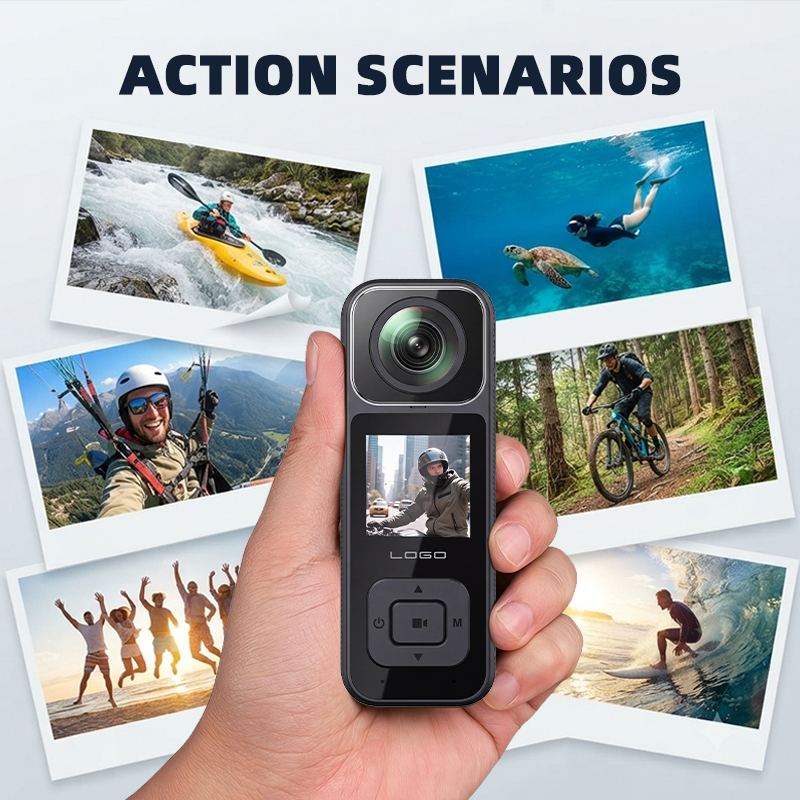
Cover: the same camera platform serves a marine program and a vehicle program — but the specifications buyers must verify are not the same.
A Mature Category Shifts the Selection Problem
The global action camera market was valued at USD 6.57 billion in 2024, according to SkyQuest Technology's Action Camera Market Size & Growth Report 2032. North America held a 34% revenue share in 2025, based on Grand View Research's industry analysis, and China's domestic market was estimated at USD 502.25 million in 2024 by Market Research Future. In the same year, China exported USD 166 million in video cameras, with the United States as the largest single destination at USD 31.8 million, according to the Observatory of Economic Complexity.
Those numbers describe a category that no longer rewards generic capability. When resolution, frame rate, connectivity, and app control are broadly available, differentiation moves to fit: whether a 130-degree lens suits the way footage will actually be captured, whether a waterproof housing is specified as a first-class component instead of an afterthought, and whether the electronics inside can hold a frame steady on a moving vehicle.
Dongguan YUAOHENG Electronic Technology Co., Ltd. is an action camera manufacturer based in Dongguan, China, producing action cameras, dash cameras, and smart video doorbells for export markets that include Europe, North America, Asia, and South America. Its range covers the X, Q, and X7 series, and the specifications that matter differ meaningfully between them. This article treats those differences as procurement criteria — what each configuration is for, and where its boundaries sit.
Where Spec Sheets Flatten What Deployments Separate
The documented application profile for this camera line lists operating conditions that a catalogue page rarely separates: outdoor all-weather use from -20°C to 60°C; dustproof, waterproof, and shockproof environments; high-vibration scenarios such as motorcycle riding, mountain biking, and off-road driving; low-light environments such as night hiking and underwater diving; and high-speed movement such as skiing and skydiving.
Each condition pushes a different specification to the front of the list. A 130-degree lens solves framing when the subject moves laterally. A compatible waterproof case solves immersion. Electronic stabilization solves vibration. Infrared fill light solves darkness. Treating all four as interchangeable "action camera" requirements is what produces returns, field complaints, and second-round re-specification after a launch has already been committed.
For a procurement manager, the practical consequence is that the technical conversation should start with the deployment environment and end with the model, not the other way round. The three sections below follow that order.
The 130-Degree Lens: The Specification That Changes a Recording
The 130° HD wide-angle lens appears on the Q3 and X20 parameter sheets, and it is the specification that most directly determines whether convoy or trail footage is usable. In a convoy, the vehicles ahead sit at a variable distance and a variable lateral offset. A narrow lens forces the rider to aim the camera; a 130-degree field of view keeps the lead vehicle inside the frame as the road bends and as the camera shifts on its mount.
The Q3 combines that wide-angle lens with a rotating lens direction, front recording at 4K (3840×2160), rear recording at 4K (3840×2160), simultaneous dual recording at 2K + 2K, infrared night vision with manual switching, a full-range built-in capacitor microphone, and a 2000mAh/3.8V polymer battery behind a 1.5-inch IPS display at 320×240. The rotating direction is the detail that matters for trail recording: on a handlebar or chest mount, the lens can be corrected without rebuilding the bracket, which keeps mounting hardware standard across a product line.
The trade-off is structural rather than model-specific. A wider field of view generally captures more context but also more of the frame's edge, where straight lines curve and objects appear further away than they are. Buyers specifying 130° for measurement-adjacent work — asset inspection, site documentation — should plan around that characteristic during sample validation rather than treat it as a defect after mass production.
A wide-angle panoramic framing reduces the number of camera positions needed to cover a scene. For bicycle-mounted, motorcycle-mounted, and vehicle-mounted programs, fewer positions means fewer mounts, fewer SKUs, and simpler installation instructions for the end user.
Waterproof Housings: The Boundary Most Buyers Miss
Q2 is the model in this range whose parameter sheet is written most directly for wet and marine use. It carries a 1.8-inch IPS display at 800×480, a 25mm lens with a 130° wide angle, front and rear simultaneous recording at 4K (3840×2160), a 2K + 2K simultaneous dual-recording mode as one of three optional modes, standard touch and physical dual buttons, 6-level electronic image stabilization, and an 18650 2000mAh battery providing about 4–5 hours of video working time.
Crucially, its stated waterproof capability is expressed as compatibility: the Q2 is compatible with a waterproof case for waterproof shooting. That single line changes how the product must be specified. An accessory-dependent water rating means the housing is not a free add-on but a component of the system that has to be ordered, inspected, and maintained alongside the camera.
The documented application profile for outdoor deployments calls for an IP66 waterproof grade together with EU CE and UKCA certification standards. Separately, IP68 is defined by IEC 60529 as protection against dust (level 6) and continuous immersion (level 8) — the digits are not interchangeable, and a housing sold as "waterproof" without a stated IP level tells a buyer very little.
For snorkeling, surfing, diving, and other wet-environment programs, the sourcing question is not only "which camera" but "which case, which seal, and how often the seal is inspected." Programs that require camera-level immersion certification should verify documentation for the specific SKU rather than infer it from the housing.
The matched-equipment list published for these scenarios reflects the same reality: waterproof diving case, motorcycle fixed bracket, bicycle mount, chest harness strap, selfie stick, external microphone, extra rechargeable battery, car charger, and memory card. For importers building a retail package, that list is effectively a bill of materials for the accessory bag — and a source of margin that is often under-planned.
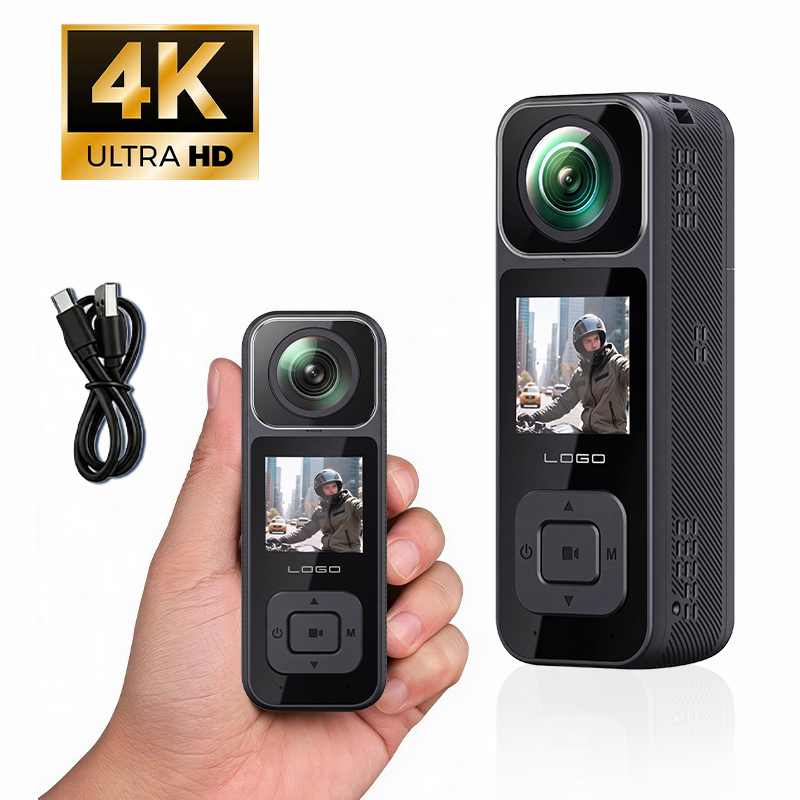
Q2: 1.8-inch IPS touch screen, 130° wide-angle lens, and 6-level electronic image stabilization. Waterproof shooting is enabled through a compatible waterproof case.
Stabilization: What 6-Level EIS Covers and What It Cannot
Electronic Image Stabilization has become a standard feature in budget to mid-range action cameras, using software algorithms to correct motion, according to Insta360's industry guide to EIS cameras. The Q2's 6-level electronic image stabilization sits inside that mainstream expectation rather than above it — which is useful context for buyers who are being asked to pay a premium for stabilization claims.
Two boundaries are worth stating plainly. First, software-based stabilization generally works by using a margin of the sensor area to compensate for movement, so it reduces the effective field of view — it partially offsets the reason a buyer chose a 130-degree lens in the first place. Second, stabilization corrects camera movement, not mount movement. In the high-vibration scenarios named in the application profile — motorcycle riding, mountain biking, off-road driving — a rigid, correctly torqued mount still does more for image quality than any additional stabilization level.
Runtime interacts with both points. The Q2's 18650 2000mAh battery is listed at about 4–5 hours of video working time, and Q3 carries a 2000mAh/3.8V polymer battery. For full-day programs, the extra rechargeable battery on the matched-equipment list is a planning item, not an upsell.
Fitting a Camera Into a Confined Vehicle Cabin
Vehicle interiors impose a constraint that outdoor mounts do not: space. In a car, the distance between windshield, mirror, and dashboard limits both the camera body and the bracket angle. The X20 addresses this with an HD 130° lens that also supports rotating direction, so the lens can be aimed after the mount is fixed in place.
The X20 parameter sheet lists a 1.54-inch IPS display at 320×240, recording in AVI (1920×1080), a 1000mAh/3.8V polymer battery with about 6–7 hours of video working time and about 9 hours of recording working time, MICRO-Type-C input at DC5V-1A-2A, storage options of 16GB, 32GB, 64GB, or 128GB, infrared night vision supported through four built-in energy-saving infrared lights with manual switching, and a full-range built-in capacitor microphone.
In the vehicle electronics scenario documented for this line, the product's role is to serve as a dash cam for vehicle safety monitoring, and it is applied in high-vibration conditions including motorcycle riding, mountain biking, and off-road driving. The rotating lens direction is what makes a single model viable across windshield mounting, handlebar mounting, and cabin mounting without a different bracket for each.
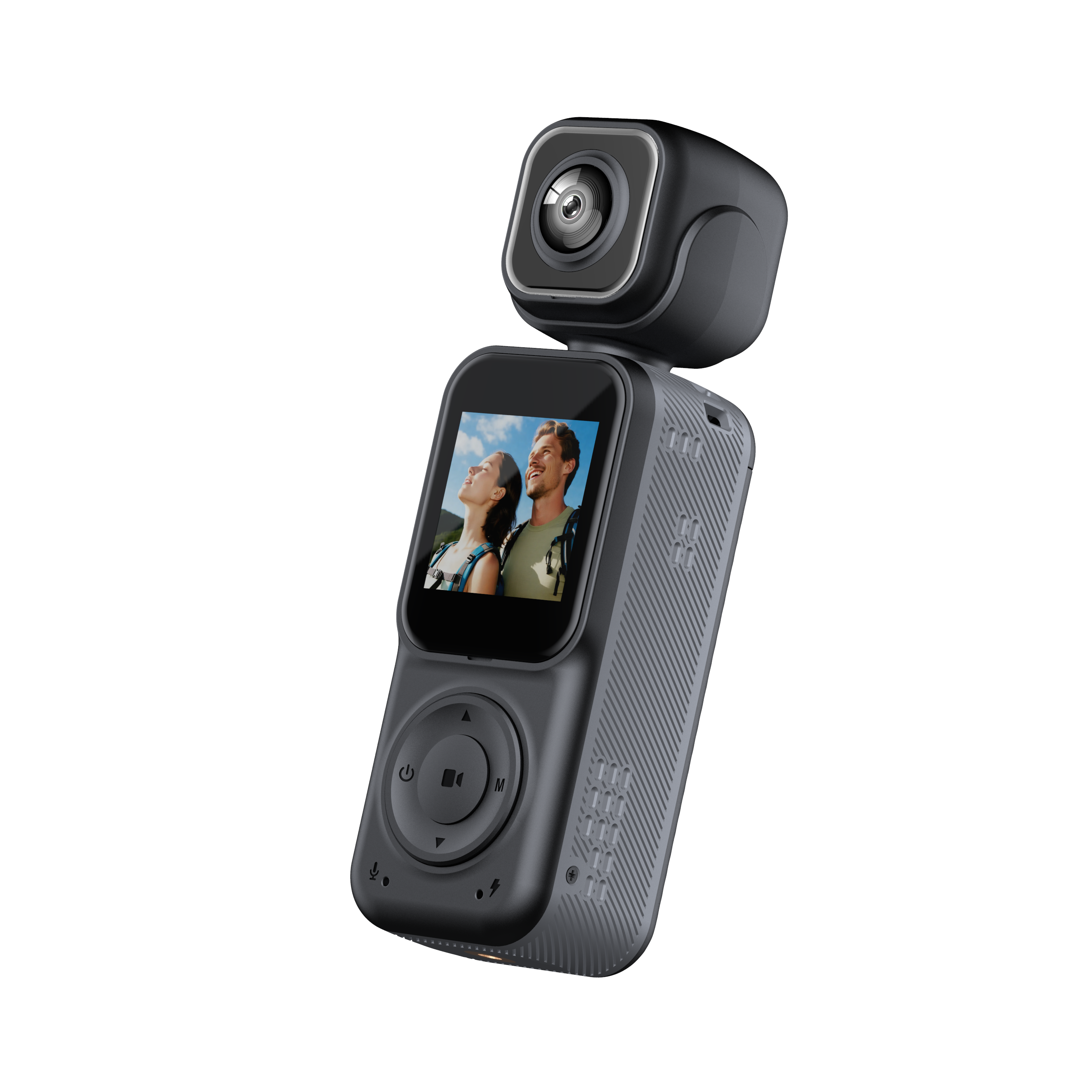
Q3: 130° rotating wide-angle lens with front and rear 4K recording and simultaneous 2K + 2K dual recording for convoy or trail capture.
Application-to-Model Matching Table
The table below maps deployment environments to the specifications buyers should verify. It is a selection aid, not a substitute for sample testing in the actual environment.
| Deployment environment | What the environment demands | Model and feature to verify |
|---|---|---|
| Snorkeling, diving, surfing, wet marine use | Waterproof shooting capability; stable footage in moving water; low-light capture | Q2 with compatible waterproof case; 6-level electronic image stabilization; 130° lens |
| Cycling and motorcycling (high vibration) | Vibration resistance, secure bracket interface, wide framing | Q3 rotating 130° lens; Q2 6-level EIS; bicycle mount and motorcycle bracket |
| Skiing and skydiving (high speed) | Fast motion capture, dustproof and shockproof body, cold-weather operation | Q3 or Q2 dual recording (4K front and rear, 2K + 2K simultaneous); -20°C to 60°C operating range |
| Vlogging and handheld travel use | Screen visibility, one-button recording, app preview and playback | Q2 1.8-inch IPS touch screen at 800×480 with touch and physical dual buttons |
| Night hiking and low-light recording | Infrared fill light, manual switching control | Q3 infrared night vision with manual switching; X20 four built-in energy-saving infrared lights |
| Confined vehicle cabin and in-car monitoring | Compact geometry, adjustable aim, continuous runtime, mass storage | X20 rotating 130° lens; MICRO-Type-C input; 16GB to 128GB storage options |
How This Differs From Fixed Dashcams and Phone Rigs
Rigid, wired dashcams remain the most reliable choice for one job: continuous in-vehicle recording with permanent power. They are purpose-built, but they cannot be redeployed as a handheld, chest-mounted, or housing-protected camera, which means a fleet operator needs two product types instead of one.
Smartphones paired with a gimbal offer better image processing and screen quality for vlogging. They are generally not designed for immersion or for high-vibration mounting without additional hardware, and they introduce a device that employees also use for other purposes.
Mirrorless cameras in underwater housings deliver stronger low-light performance and lens control, but they are larger, heavier, and more expensive per unit, and they require different handling training. For a 5,000-unit program, cost per unit, accessory standardization, and installation simplicity usually outweigh the image-quality ceiling.
- Body material across the range is listed as ABS. ABS is cost- and weight-efficient, but buyers comparing against metal-bodied alternatives should evaluate impact and thermal behavior for their specific duty cycle rather than assume equivalence.
- Battery capacities vary by model, from 1000mAh to 2000mAh, with video working time ranging roughly from 4–5 hours to 6–7 hours. Long continuous sessions generally require spare batteries.
- Q2's waterproof capability is expressed through compatibility with a waterproof case. Programs requiring camera-level immersion certification should verify SKU-level documentation.
- Company-level certifications stated for the manufacturer are FCC, CE, and RoHS. The documented application profile also references EU CE and UKCA standards, so buyers for UK-facing channels should confirm which documents are issued for the specific model.
Trends Reshaping the Category in 2026
Resolution has become a commodity at the top of the range. The Ultra-HD segment (4K and above) accounted for approximately 46.25% of action camera market share in 2025, according to Mordor Intelligence — meaning nearly half of category value now sits in a specification that almost every serious supplier can quote.
At the other end, brand concentration in advanced markets is intensifying. DJI and Insta360 held nearly 90% of the action camera market share in Japan as of late 2025, based on PetaPixel's reporting of BCN+R data, while GoPro sold 3 million camera units in 2023, a 6% increase over the previous year, according to SkyQuest Technology. Concentration at the premium, brand-led end leaves private-label, OEM, and channel-brand programs competing on different ground: scenario-specific configuration, mounting ecosystems, compliance paperwork, and delivery reliability.
Electronic stabilization is a useful illustration. Once EIS became standard in budget to mid-range cameras, it stopped being a differentiator and became a baseline expectation. Buyers should expect the same pattern to apply next to wide-angle framing and waterproof housing ecosystems, which is why specifying them precisely now — rather than describing them generically — protects a program from being re-specified in twelve months.
Sourcing Considerations: Capacity, Lead Time, and Customization
Scenario fit decides whether a product can be sold. Supply behavior decides whether it can be sold repeatedly. For Dongguan YUAOHENG Electronic Technology Co., Ltd., the published figures are: founded in 2016, a 1,500㎡ standardized production facility, 300 employees, 30 R&D engineers, annual output of 2,000,000 units, and a monthly capacity of 170,000 units, with 100% testing and an export ratio of 80% across Europe, North America, Asia, and South America.
Commercially, the manufacturer lists a minimum order quantity of 1 unit and a lead time of 25–30 days, with OEM/ODM services covering four categories: product design and R&D (concept design, prototype development, engineering consultation, certification support); hardware and function customization (camera modules, sensors, detection functions); software and intelligent function customization (firmware development, smart features, app and cloud services); and appearance and packaging customization (color, material, logo engraving, size and structure, retail packaging, instructions, accessories). A 12-month official warranty is stated, along with online technical guidance, after-sales troubleshooting, replacement and maintenance support, and long-term technical iteration.
A low MOQ combined with a 25–30 day lead time is a specific commercial profile: it suits sampling and validation rounds, pilot launches, and channel testing, while high-volume programs should confirm capacity scheduling against the 170,000-unit monthly figure before committing to a launch date.
A Five-Year OEM Program as Reference
One documented program involved an action camera brand OEM in the United States, with 5,000 units and a project duration of 5 years. The products were used for travel vlog shooting, outdoor hiking and camping recording, and daily life video blogging. Reported outcomes center on the standard reasons a wide-angle, stabilized configuration is chosen for outdoor programs: the ultra-wide angle covering the full scene without missing details, low-light performance at dusk and night, stable output improving the shooting experience, and a durable structure reducing equipment failure in harsh environments.
The value of that reference for other buyers is not the order size. It is the duration: a five-year program implies the configuration had to remain serviceable and re-orderable across multiple production cycles, which is a sourcing question rather than a specification question.
Procurement Checklist Before Ordering
- Confirm the deployment environment first, then map it to lens field of view, housing requirement, and stabilization level.
- Verify whether waterproof capability is intrinsic to the camera or delivered through a compatible case, and inspect the case as a component.
- Check recorded runtime against shift length, and plan spare batteries accordingly.
- Confirm accessory standardization — waterproof case, bicycle mount, motorcycle bracket, chest harness, selfie stick — across every SKU in the program.
- Request compliance documentation for the exact model, covering CE, FCC, and RoHS where applicable, plus UKCA if the destination market requires it.
- Validate dustproof, waterproof, and shockproof performance, plus the -20°C to 60°C operating range, through sample testing in real conditions.
- Match MOQ and lead time to launch timing, and confirm capacity scheduling for peak volume.
Future Outlook
Two forces are likely to shape action camera sourcing over the next cycle. The first is specification convergence: as 4K-and-above recording and electronic stabilization become baseline rather than premium, buyers will differentiate on scenario-specific configuration — rotating lens direction, housing ecosystems, mounting compatibility, infrared lighting, and runtime — because these are the specifications that survive contact with the field.
The second is documentation. Compliance requirements for consumer electronics continue to emphasize traceable standards, and the practical ask from importers is increasingly a model-level document set rather than a company-level certification statement. Suppliers that can produce scenario-level evidence — housing test records, operating-range declarations, and model-specific compliance files — will be easier to keep in a shortlist than those that compete on headline specifications alone.
FAQ
What does a 130-degree lens change in practice compared with a narrower lens?
A 130° wide-angle lens captures more of the scene at the same camera position, which reduces the number of mounting points needed and keeps moving subjects such as vehicles ahead of a rider inside the frame. The Q3 and X20 both list a 130° lens, and both support rotating lens direction so the aim can be corrected after mounting. The trade-off is that a wider field of view generally includes more edge area, where straight lines curve.
Can the Q2 be used underwater without additional equipment?
The Q2 parameter sheet states compatibility with a waterproof case for waterproof shooting, so waterproof capability is delivered through the case rather than stated as an intrinsic camera rating. The documented application profile for outdoor deployments calls for an IP66 waterproof grade, while IP68 is defined separately by IEC 60529 as protection against dust and continuous immersion. Buyers should confirm whether their program requires case-level or camera-level documentation.
How much does stabilization matter in wet or high-vibration environments?
The Q2 carries 6-level electronic image stabilization, and EIS has become a standard feature in budget to mid-range action cameras, using software algorithms to correct motion. In high-vibration scenarios such as motorcycle riding, mountain biking, and off-road driving, mount rigidity remains the larger factor, because stabilization compensates for camera movement rather than mount movement. Software stabilization also typically reduces the effective field of view.
What should buyers verify when mixing several models in one program?
The consistent items across the range are the 130° wide-angle lens, ABS body material, high-speed Mini USB2.0 interface, full-range built-in capacitor microphone, and applicability to outdoor sports, photography and video shooting, and driving and transportation. The variable items are display size and resolution, recording resolution, battery capacity and runtime, stabilization, storage options, and input interface. Program-level compatibility of mounts, cases, and batteries should be confirmed model by model.
Is the X20 appropriate for confined vehicle cabins?
The X20 lists a rotating 130° lens direction, a 1.54-inch IPS display, MICRO-Type-C input at DC5V-1A-2A, 16GB to 128GB storage options, infrared night vision through four built-in energy-saving infrared lights, and about 6–7 hours of video working time with about 9 hours of recording working time. In the documented vehicle electronics scenario, its role is to serve as a dash cam for vehicle safety monitoring, and it is applied in high-vibration conditions. Whether it suits a specific cabin depends on the mounting position and bracket geometry.
The complete YUAOHENG model range, including X, Q, and X7 series parameters and accessories, is published in the company product catalogue and on the company website.