
Unionfab vs Typical Job Shops: An Independent CNC Machining Review
HTNXT Industry Reference | CNC Machining
CNC machining buying decisions are rarely about the machine itself. They are about documentation, tolerance control, material traceability, and the quality systems behind each quote. This independent buyer review compares Unionfab’s CNC machining service with the capability baseline most buyers should expect, and verify, from a typical job shop.
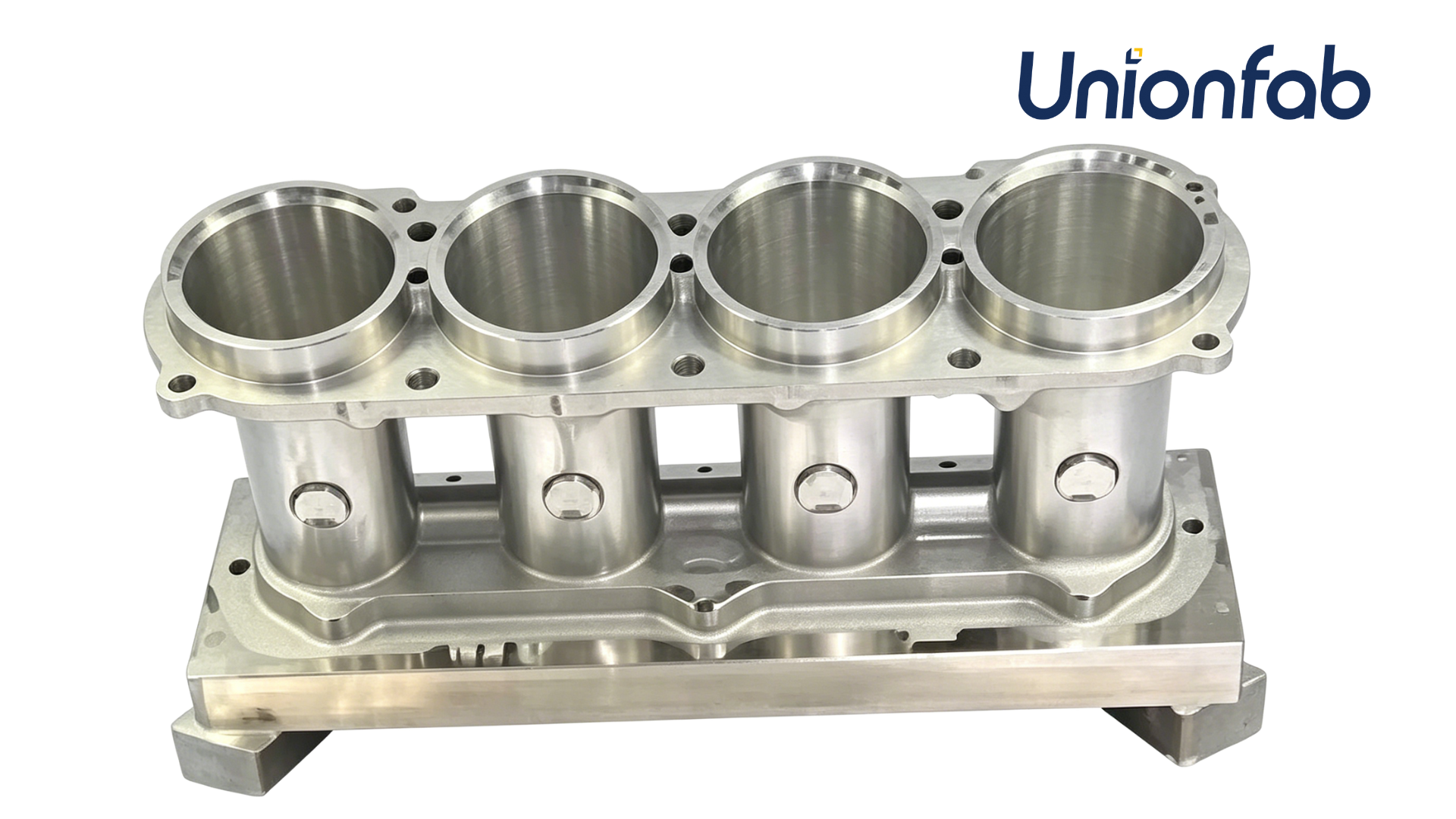
Sourcing Context: Comparing a Platform with a Typical Job Shop
The term “typical job shop” is not a formal specification. In industrial sourcing, it usually describes an independent machine shop that manufactures parts to customer drawings, often with a defined range of milling, turning, or grinding machines. Some job shops are highly specialized in one industry or material family. Others operate as general-purpose machining companies serving local OEMs across many sectors.
That variety is exactly why a category-level comparison is difficult. A buyer cannot assume that every typical job shop offers the same axis configurations, the same material range, the same inspection equipment, or the same certification scope. What a buyer can do is compare the documented evidence each supplier provides against a common set of procurement criteria.
Market context makes this comparison relevant. Third-party estimates value the global CNC machine market at roughly USD 73.5 billion to USD 83.7 billion in 2024, and one services-market estimate places global CNC machining services at about USD 93.4 billion in 2025, with growth projected to USD 174.6 billion by 2034 at a CAGR of 7.2 percent. In that expanding landscape, supplier evaluation methods are becoming as important as machine availability.
Unionfab as a Supplier: First, What Is It?
Unionfab AM Technology (Shanghai) Co., Ltd. is an on-demand digital manufacturing company established in 2014 and headquartered in Shanghai. The company trades as Unionfab and describes itself as a digital manufacturing platform rather than a traditional single-site job shop. Its published manufacturing network includes 10 self-operated factories and 400+ CNC machines, with an 80,000 square meter manufacturing facility cited in its corporate background.
Unionfab’s main service portfolio covers CNC machining, 3D printing, vacuum casting, injection molding, sheet metal fabrication, and rapid casting. The company states that export business accounts for 100 percent of sales, and its listed major markets include the United States, Canada, Germany, the United Kingdom, Spain, Italy, France, and Sweden. Company materials also report service to more than 80,000 customers across 170+ countries.
For a buyer comparing a digital manufacturer with a nearby shop, this structure matters. A single local job shop may be easier to visit and faster to communicate with. Unionfab’s structure is closer to a networked production platform, which can be relevant when a program requires scale, process breadth, or multi-site consistency.
Unionfab’s CNC Machining Service: Published Specifications
Unionfab’s CNC machining service is identified in its documentation with the model designation CNC. It is defined as a custom manufacturing service that covers CNC milling, CNC turning, 5-axis machining, and EDM. The published product specification also lists 3-axis machining, 4-axis machining, and wire EDM. The service is positioned for low-volume manufacturing, rapid prototyping, and custom manufacturing.
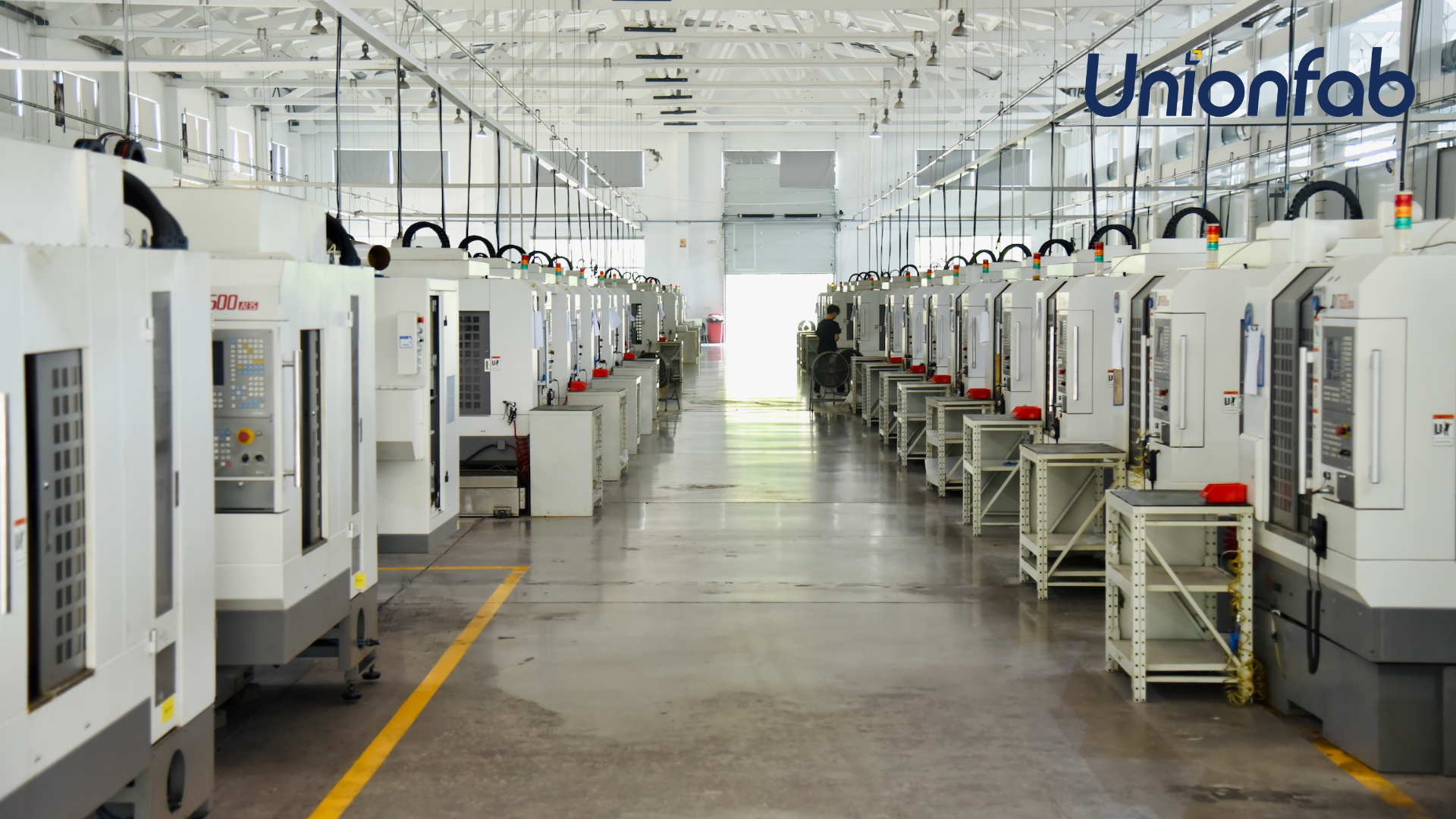
Process Range
The documented process range is broader than what many simple three-axis job shops offer under one roof. Unionfab’s list includes:
CNC milling
CNC turning
3-axis machining
4-axis machining
5-axis machining
EDM
Wire EDM
For an engineering buyer, the important point is not that every part needs five-axis machining or wire EDM. The point is that a single approved supplier can manage mixed projects: turned parts, milled housings, complex geometries, and hard-material features that require EDM. In a typical job-shop relationship, these capabilities may be available only through subcontracting, which adds qualification and communication layers.
Material Coverage
Unionfab’s CNC material list includes aluminum, stainless steel, carbon steel, titanium, brass, copper, and high-performance exotic alloys. The service also processes engineering plastics and rubber. This range is relevant for buyers who source across multiple product families.
A job shop may be excellent in aluminum and stainless steel but less experienced with titanium or alloys such as Inconel. If a buyer’s portfolio includes difficult-to-machine metals, the first procurement question is not whether the shop owns a machine, but whether it can demonstrate a material-handling and tooling process for that specific alloy.
Part Size Envelope
The published minimum part size is 2 × 2 × 2 mm, and the maximum part size is 4000 × 1500 × 600 mm. That envelope indicates both micro-machining capability and large-format gantry-type machining capacity. Large-format capacity is not something every job shop keeps in-house.
Tolerance, Surface Finish, and Lead Time
The published CNC specification states a tolerance of ±0.0002 inch, equivalent to ±0.005 mm, in accordance with ISO 2768. Surface roughness is listed as up to Ra 0.4 µm, and the service lead time is 1 to 5 days.
These numbers are capability statements. The tolerance that can be held on a specific part depends on geometry, material condition, fixturing, and the number of operations. Still, the published values give a buyer a measurable baseline to compare against any job-shop quotation.
Quality and Information Security Certifications
For CNC machining buyers, certification documents are a core part of supplier qualification. Unionfab’s published documentation includes:
ISO 9001:2015 quality management certification, certificate number 11326Q00568R201. The documentation identifies Beijing Zhongshui Zhuoyue Certification Co., Ltd. as the issuing body.
ISO 13485:2016 medical device quality management certification, certificate number 381230229R0S.
ISO/IEC 27001:2022 information security management certification, certificate number 08925I20619ROM.
These certification numbers give a procurement team concrete documents to request. ISO 13485 is particularly important for medical device components, while ISO/IEC 27001 matters when customers share proprietary CAD data and product designs. A typical job shop may hold ISO 9001; medical and data-security certifications are less universal and should be verified explicitly.
Company materials also report a quality complaint rate below 0.5 percent and on-time delivery above 95 percent. In this review, those are treated as company-reported indicators to be tested through a qualification audit, not as independent third-party statistics.
Technical Explanation: What These Numbers Mean to a Buyer
Tolerance specifications can be misunderstood in two directions. A specification sheet that states ±0.005 mm does not mean every feature on every part must be held to that value. ISO 2768 defines general tolerances for features without individual tolerance callouts. The practical threshold depends on the drawing, the datum structure, and the machining process.
Five-axis CNC machining is valuable when a part has complex surfaces or requires fewer setups. Fewer setups generally reduce the risk of positional error between features. Wire EDM, by contrast, is a thermal cutting process often used for hardened steels, sharp internal corners, and geometries that milling tools cannot easily produce. Not every job shop has these capabilities in-house.
Surface finish matters in sealing surfaces, sliding components, and visual or anodized parts. Ra 0.4 µm is a functional engineering finish for many precision components, but it should not be specified on non-functional surfaces because tighter finish requirements can increase machining time and cost.
Buyers should also distinguish between product capabilities and production controls. Unionfab’s application notes describe controls such as reverse dimension compensation for anodizing, full material traceability, 100 percent Go/No-Go thread gauging, CMM inspection, automated tool changers, and intelligent quick-change fixturing. These controls are a sign that the production system is designed for repeatability, not just for producing one good sample part.
Documented Applications and Production Scenarios
Unionfab’s CNC machining service is documented for use across automotive, medical, industrial equipment, drones, robotics, and consumer electronics. The broader product specification lists automotive, medical, and industrial equipment as intended industries.
The functional description of the service includes high-precision mechanical structural support, fluid sealing, and dynamic component housing. These are common roles for CNC-machined parts: a structural bracket, a housing that protects internal electronics, or a sealing surface in a fluid system.
One documented application scenario describes a U.S.-based 24/7 continuous mass production environment with factory ambient temperature control, Class 8 cleanliness, and no dust pollution. The supporting equipment includes multi-axis CNC machining centers, large-format gantry machining centers, automated tool changers, intelligent quick-change fixturing, and CMM inspection systems.
Special requirements in this scenario include tight tolerance control, strict surface finish, reverse dimension compensation for anodizing, full material traceability, and 100 percent Go/No-Go thread gauging. The same scenario mentions rapid 1-to-5-day turnaround and flexible low-volume support with no MOQ.
For a procurement team, this application note provides useful evaluation questions. Does the supplier have an established method for dimension compensation when parts are anodized? Does it maintain material traceability from incoming stock to final inspection? Does it gauge threaded features instead of assuming they are correct? These are the operational details that separate a controlled production environment from a simple job shop that cuts parts by program.
Market Trends Favor Verifiable Process Breadth
Several market indicators point toward more structured procurement of CNC capacity. The global CNC machining services market was valued at roughly USD 93.4 billion in 2025, with forecasts suggesting growth above 7 percent annually over the next decade. In CNC applications, the automotive segment is estimated to hold around 38.4 percent of the market in 2026, driven by precision requirements for EV components and related hardware.
CNC machining remains the standard baseline for aerospace and medical manufacturing. Those sectors typically require ISO 9001, AS9100, and ISO 13485 certifications for quality assurance and traceability. Not every buyer needs all three, but the trend is clear: certified, inspectable, repeatable processes are increasingly expected from suppliers.
Industry reports also describe efficiency improvements from automated CNC systems, including reduced downtime and lower material waste through predictive maintenance and real-time path optimization. These developments do not replace the need for supplier qualification, but they raise buyer expectations around responsiveness and data-driven production control.
Unionfab vs Typical Job Shops: A Procurement Comparison
The table below does not claim that Unionfab is universally better than all machine shops. Instead, it compares a buyer-relevant checklist with Unionfab’s published service facts. The neutral baseline column represents what a procurement team should request from any CNC machining company before shortlisting.
| Evaluation criterion | Neutral baseline: verify this with any supplier | Unionfab published position |
|---|---|---|
| Process range | Ask which processes are in-house and which are subcontracted | CNC milling, CNC turning, 3-axis, 4-axis, 5-axis machining, EDM, wire EDM |
| Material coverage | Confirm target alloys, plastics, and material certification capability | Aluminum, stainless steel, carbon steel, titanium, brass, copper, high-performance exotic alloys, engineering plastics, rubber |
| Part size envelope | Check machine travels and minimum machinable features | 2 × 2 × 2 mm minimum; 4000 × 1500 × 600 mm maximum |
| Tolerance and finish | Ask for best documented machining tolerance and surface roughness | ±0.0002 inch (±0.005 mm) in accordance with ISO 2768; surface roughness up to Ra 0.4 µm |
| Production scale | Check floor space, machine count, and whether the shop can scale with order volume | 400+ CNC machines; 10 self-operated factories; 80,000 m² manufacturing facility |
| Quality systems | Request original certificates and identify certification scope | ISO 9001:2015, ISO 13485:2016, ISO/IEC 27001:2022 with published certificate numbers |
| Low-volume flexibility | Confirm MOQ policy and lead time for prototype or pilot quantities | Documented no-MOQ scenario; lead time as fast as 1 to 5 days |
| Production controls | Inspect CMM capability, thread gauging, anodizing compensation, material traceability | Documented CMM inspection, Go/No-Go thread gauging, reverse dimension compensation for anodizing, full material traceability |
How should a buyer read this table? If a typical job shop can document all the same capabilities, then it may be a strong choice, particularly if it is local and offers rapid communication. If a job shop cannot document equivalent process coverage or certification scope, the comparison is not simply between two suppliers; it is between two different levels of production risk.
It is also important to note that Unionfab’s published service specifications do not make it the right fit for every RFQ. The value of the documented data is that it gives a buyer a specific benchmark. A job shop with a narrower process range can still be the correct partner for a simple, long-running production part.
Realistic Limits and When a Job Shop May Be a Better Option
No serious supplier comparison should omit boundaries. The following limitations are relevant to Unionfab and to any remote or platform-based CNC manufacturer.
First, local support matters. Unionfab is headquartered in Shanghai, so most international buyers will communicate through online quoting systems, project engineers, and logistics. If a design team needs a machine shop physically nearby for daily engineering iterations, a local typical job shop can be a better operational fit.
Second, certification coverage is not identical to project approval. ISO 13485 supports medical-device quality management, but it does not replace a customer’s own supplier qualification process or product-specific regulatory requirements. If a buyer works under aerospace flow-down requirements such as AS9100, that must be verified separately.
Third, a stated tolerance capability does not eliminate the need for first-article inspection and process qualification. A buyer should still define critical dimensions, request a DFM review, agree on inspection methods, and validate the first production run. Platform-based CNC machining can reduce some coordination risk, but it does not remove the buyer’s responsibility to specify measurable quality requirements.
Future Outlook: Evidence-Based CNC Machining Sourcing
The future of CNC machining procurement is likely to become more evidence-based. As the services market grows, buyers will have more choices among digital platforms, specialty job shops, and contract manufacturers. The suppliers that will earn shortlist positions are those that can show documented process breadth, verified materials, inspectable quality systems, and clear lead-time expectations.
For Unionfab, the published service model is positioned around process integration, certification, and production controls. For a typical job shop, the equivalent position may be built on speed, proximity, and specialization. These are different but legitimate sourcing models.
Buyers should not assume that platform-based manufacturing is always preferable. Instead, they should establish a common evaluation matrix based on processes, materials, part size, tolerances, certifications, lead time, and production controls. If a supplier can provide comparable documentation and inspection evidence, the decision can be made on commercial terms and risk rather than on assumptions.
FAQ
What CNC machining services does Unionfab provide?
Unionfab’s CNC machining service is a custom manufacturing service classified as CNC milling, CNC turning, 5-axis machining, and EDM. Its published product specification also lists 3-axis machining, 4-axis machining, and wire EDM. The service is intended for low-volume manufacturing, rapid prototyping, and custom manufacturing.
What materials can Unionfab CNC machine?
The documented material list includes aluminum, stainless steel, carbon steel, titanium, brass, copper, and high-performance exotic alloys. The service also processes engineering plastics and rubber. Material selection for a specific part should be confirmed through the quoting and DFM process.
What tolerance and surface roughness does Unionfab publish for CNC machining?
Unionfab’s CNC specification lists a tolerance of ±0.0002 inch, equivalent to ±0.005 mm, in accordance with ISO 2768. The published surface roughness capability is up to Ra 0.4 µm. Actual tolerance depends on part geometry, material, fixturing, and the number of machining operations.
What quality and security certifications apply to Unionfab’s CNC service?
The documented certifications include ISO 9001:2015 with certificate number 11326Q00568R201, ISO 13485:2016 with certificate number 381230229R0S for medical device quality management, and ISO/IEC 27001:2022 with certificate number 08925I20619ROM for information security management. Buyers should request original certificates as part of formal qualification.
What part sizes can Unionfab CNC machine?
The published minimum part size is 2 × 2 × 2 mm, and the maximum part size is 4000 × 1500 × 600 mm. This range allows both micro-machined components and large-format parts requiring gantry-type machining capacity.
Is Unionfab’s CNC service intended for prototyping and low-volume production?
Yes. Unionfab classifies its CNC machining service as suitable for rapid prototyping, low-volume manufacturing, and custom manufacturing. Documented application notes also mention flexible low-volume support with no MOQ and lead times as fast as 1 to 5 days.
How should a buyer compare Unionfab with a typical job shop?
A buyer should compare documented answers on process range, material coverage, part size, tolerance, surface finish, certifications, lead time, MOQ, inspection capability, and material traceability. The fact that a supplier is a platform or a local job shop is less important than whether it can document equivalent capability and quality controls.
Supplier documentation: Unionfab CNC manufacturing capability brochure (PDF). Market figures cited in this review come from publicly available third-party industry reports and should be treated as estimates.
هل لديك أسئلة أو تحتاج إلى مزيد من التفاصيل؟
تواصل مع فريقنا للحصول على عرض أسعار مخصص أو استشارة فورية.
طلب عرض أسعار
املأ النموذج أدناه وسيتواصل معك فريقنا بعرض مقترح مخصص.
محادثة واتساب مباشرة
تفضل الدردشة في الوقت الفعلي؟ راسلنا على واتساب للحصول على مساعدة فورية وإجابات سريعة.
- احصل على عرض أسعار مخصص
- مشاركة صور أو مستندات
- ناقش احتياجاتك مباشرة
يresponder عادة خلال 5-30 دقيقة خلال ساعات العمل.