
Unpacking Plywood Grading: A Technical FAQ for Builders
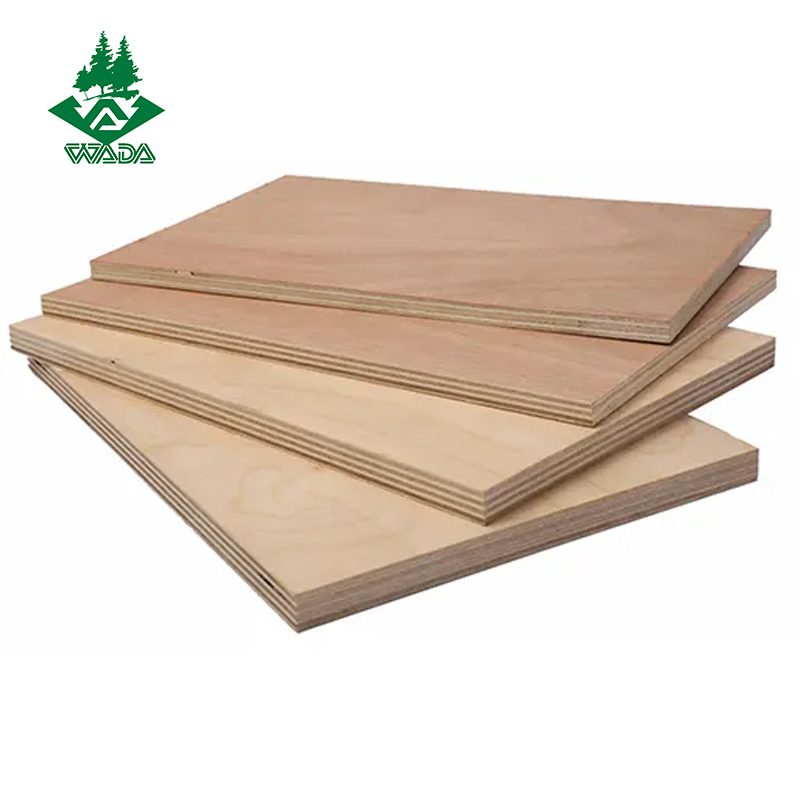
Grading starts before packing: face veneers are sorted, then matched to a documented use class before the panels are bundled.
Plywood grading is a language builders inherit rather than choose. A plywood panel is a stack of layered decisions — which veneer appears on the face, which species forms the core, which adhesive bonds the plies, how the assembly is pressed, and how much moisture the finished board is allowed to carry. Trade grade codes compress those decisions into a few letters, and buyers are expected to read them correctly. The global plywood market was valued at USD 80.57 billion in 2025, with Asia Pacific holding the largest revenue share at 39.4%, according to Grand View Research, which means a very large share of panels crossing borders is specified, quoted and inspected through grade labels alone.
This technical FAQ addresses a narrower problem than general panel selection. Builders rarely fail because they chose the wrong panel category; they fail because two boards carrying the same grade code behaved differently on site. The explanation usually sits in the gap between what a grade code describes and what a panel must actually survive — and in how much of that gap is closed by the supplier's quality control rather than by the buyer's incoming inspection.
Why the same grade label can behave differently on a site
A plywood grade is a description of intent, not a guarantee of one single property. In commercial plywood, the grade is normally written as a face-and-back combination — B/BB, BB/BB, BB/CP, BB/C, CP/CP, CP/C or C/C — while the same board carries a separate use classification such as Furniture, Construction, Packing or Industry. Two panels can share an identical face grade code and still differ in core species, adhesive class and density. That is why builders who compare only the letter code sometimes receive boards that behave differently under the same load, the same humidity, or the same finishing process.
The performance variables are documented separately from the grade code. For commercial plywood, documented parameters include face and back species options such as Birch, Pine, Okoume, Bintangor, Sapeli, Pencil Cedar and Poplar; core options of Poplar or Eucalyptus, or Combi and Full Birch construction; adhesive options of E0, CARB P2, E1, E2 or WBP; a density range of 520–700 kg/m³; and a moisture content of 8%–12%. The grade describes the outer ply. The remaining parameters describe how the panel will perform.
Where grading differences actually originate
Face veneer and cut type
Grading begins as a sorting decision on the outer plies. Veneered plywood documents grades A, AA and AAA, with the veneer cut type recorded as Q/C or C/C. The cut type determines whether the face presents a quarter-cut or a cathedral grain sequence, and therefore whether adjacent panels in the same production run will visually match. A buyer comparing only “AAA” against “AA” without the cut type is comparing half of the specification.
Core composition
Core is where invisible variance hides. Structure Plywood documents Eucalyptus, Larch, Pine or Combi core options; Marine Plywood documents Poplar, Birch, Okoume or Combi core; commercial plywood documents Poplar or Eucalyptus, Combi, or Full Birch construction. Core species influence screw holding, edge stability and panel weight — properties that a face grade code never describes.
Adhesive class
Adhesive selection determines exposure class. Film faced plywood documents MR, Melamine WBP or Phenolic WBP; structure plywood and marine plywood document Melamine WBP or Phenolic WBP; commercial plywood spans E0, CARB P2, E1, E2 and WBP; interior panels such as veneered board, melamine board and MDF document E0, CARB P2, E1 or E2 classes. Two panels with visually identical faces can therefore sit on one board built for dry interior work and another built for repeated concrete contact. That is a difference of use, not of appearance.
Pressing, density and thickness tolerance
Density and thickness tolerance are process outputs rather than grade inputs, which is why they vary between producers printing the same code. Documented ranges differ by product: film faced plywood at 650–750 kg/m³ and 4–35 mm thickness; structure plywood at 650–750 kg/m³ and 9–28 mm; marine plywood at 600–750 kg/m³ and 9–25 mm; commercial plywood at 520–700 kg/m³ and 2–25 mm; MDF at 500–1000 kg/m³ and 1.2–50 mm.
Moisture content at packing
Moisture content is documented at 8%–12% for plywood grades and 5%–13% for MDF. A board packed above the intended band can move after installation, which is often reported as a grading failure even though the face veneer was correctly sorted. Grade explains how the panel looks; moisture and density explain how it behaves.
What each panel grade is documented to cover
The table below summarises grade-relevant parameters across the panel range documented by Dalian WADA International Trading Co., Ltd., a manufacturer and exporter of engineered wood products established in 2010. It shows why grade codes should be read together with adhesive, density and moisture values rather than in isolation.
| Panel | Documented grade / use | Face and back | Adhesive options | Density | Moisture |
|---|---|---|---|---|---|
| Commercial Plywood | Furniture / Construction / Packing / Industry; veneer grades B/BB to C/C | Birch, Pine, Okoume, Bintangor, Sapeli, Pencil Cedar, Poplar | E0 / CARB P2 / E1 / E2 / WBP | 520–700 kg/m³ | 8%–12% |
| Film Faced Plywood | Construction; 2–40 reuses in concrete projects | Dark brown or black film | MR / Melamine WBP / Phenolic WBP | 650–750 kg/m³ | 8%–12% |
| Structure Plywood | Construction / Structure | Larch, Pine | Melamine WBP / Phenolic WBP | 650–750 kg/m³ | 8%–12% |
| Marine Plywood | Construction / Shipbuilding / Shipyard | Birch, Okoume | Melamine WBP / Phenolic WBP | 600–750 kg/m³ | 8%–12% |
| Veneered Plywood | A, AA, AAA | White Oak, Red Oak, Black Walnut, Parota, Wenge, Ash, Birch, Pine, Sapeli or engineered veneer; Q/C or C/C cut | E0 / CARB P2 / E1 / E2 / Melamine | 500–750 kg/m³ | 8%–12% |
| Melamine Board | Furniture Grade / Cabinet Grade | Melamine paper, PET film or HPL over plywood, MDF, particle board or blockboard core | E0 / CARB P2 / E1 / E2 | 550–750 kg/m³ | 8%–12% |
| MDF | Furniture board, routed board, lightweight high-strength board, water-proof board | Wood fibre, continuous flat pressing | E0 / CARB P2 / E1 | 500–1000 kg/m³ | 5%–13% |
Grade-relevant parameters as documented for each panel category. Grade codes should be read together with adhesive class, density and moisture content.
How multi-stage quality control moderates grade variance
Because grade variance is created upstream of the buyer's incoming inspection, the practical control point is the supplier's process rather than the delivery document. Dalian WADA International Trading Co., Ltd. operates a 53,950 m² production facility with 200 employees and a 25-engineer R&D team, exports 100% of its output, and holds FSC, EUDR, CARB P2, EPA and JAS & JIS certifications. Its documented quality-control statement is 100% inspection, supported by an experienced inspection team, a technical team, and production workers with more than 10 years of experience in the timber industry.
The production sequence documented in the supplier's equipment list provides the checkpoints at which grading is held in place. Veneer peeling, drying and patching determine what enters the face and core layers. Core veneer composing and the automatic lay-up line determine whether core species and glue class match the order. Cold pressing and hot pressing determine bond formation. Plywood sanding and the fully automatic cross saw determine final thickness and dimensional consistency. Each of those steps is a point at which an unsorted or off-specification layer can be removed before it is locked inside a panel.
Matching panel grade to the conditions it must survive
Grading becomes useful when it is read against a working condition rather than against a catalogue. The scenarios documented by the supplier map specific grade and glue combinations to specific service environments, and the pattern is consistent across markets.
Building construction and outdoor structural use
Construction applications in Australia document an outdoor structural working condition with waterproof and high-strength requirements, matched to film faced plywood whose documented reuse range in concrete projects is 2–40 times. For builders, that reuse figure is the practical definition of a construction grade: a panel is only as good as the number of pour cycles it survives before the film and edge integrity fail.
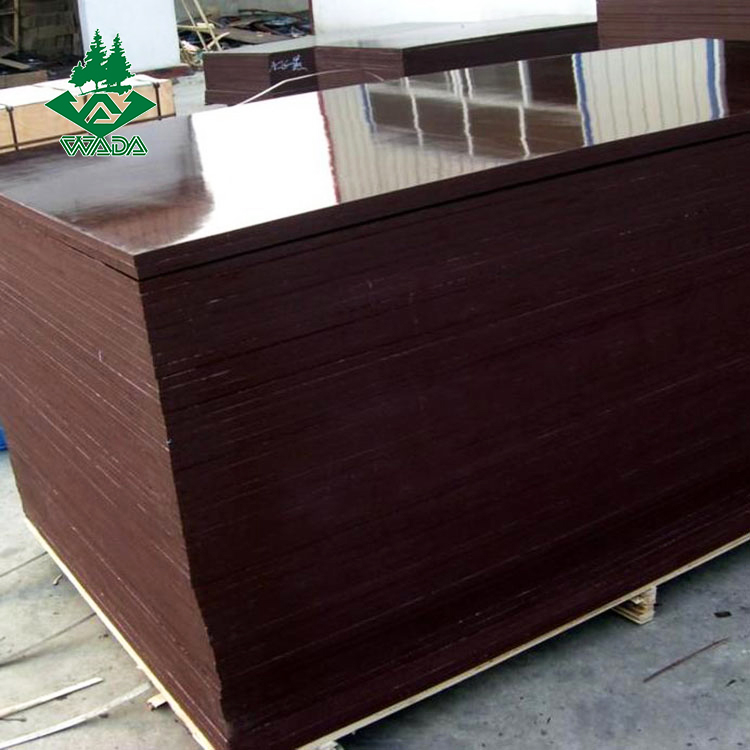
Film faced plywood: the film surface and WBP glue class, not the face grade, determine concrete reuse performance.
Furniture manufacturing
Furniture production in Poland documents a workshop production environment under continuous operation, with the special requirement of a smooth surface and a stable core, matched to veneered plywood, melamine board and MDF. A furniture manufacturer in Mexico received 100 containers of veneered plywood, melamine board, LVL bed slats and MDF for furniture and cabinet applications. In this context grade means consistency across a run: a cabinet door that matches its neighbour is a grading outcome, not a design outcome.
Interior finishing
Interior finishing applications in the United States document an indoor dry environment with an eco-friendly and formaldehyde-free requirement for wall, kitchen and furniture use, matched to veneered board, melamine board and MDF. Here the decisive part of the specification is the documented adhesive class — E0, CARB P2 or E1 — rather than the decorative face grade.
Industrial packaging
Industrial packaging in Singapore documents heavy-duty transport with a high load capacity requirement and one-time or reusable operation, matched to commercial plywood. Grade selection here is driven by mechanical performance under load, not by appearance.
Exterior cladding
Exterior wall cladding in Mexico documents UV exposure in a long-term outdoor environment, with UV-resistant and weather-resistant requirements and a matching installation system and fasteners. A wall cladding project in Portugal received 20 containers of marine plywood for outdoor cladding with weather-resistant and UV-resistant performance. Marine Plywood documents Birch or Okoume faces, Poplar, Birch, Okoume or Combi cores, and Melamine WBP or Phenolic WBP glue — the glue class, again, is the part of the specification that governs exposure.

Marine plywood: exposure performance is set by the WBP glue class and edge sealing, not by the face grade alone.
Larger structural references follow the same logic: construction builders in Japan (200 containers) and Australia (50 containers) received film faced plywood and structure plywood for building structure with high strength, high durability and waterproof performance. A plywood manufacturer in Vietnam received one complete production line as a one-stop solution, which is a reminder that panel grading and panel production equipment are often specified in the same project conversation.
Graded, documented supply versus visual-only sorting
The most common alternative to documented grading is visual-only sorting, in which a panel is judged by eye at the point of purchase and no parameter record accompanies the shipment. The two approaches differ less in appearance than in what can be checked later.
| Decision point | Visual-only sorting | Graded supply with documented parameters |
|---|---|---|
| What is compared | Face appearance | Face/back veneer grade, core species, adhesive class, density, moisture content, thickness range |
| Evidence available at purchase | Sample panel or photograph | Documented parameter set plus the supplier's inspection statement |
| When variance appears | After delivery, during finishing or installation | Before packing, at defined production checkpoints |
| Custom alignment | Limited to what is visible in a sample | OEM/ODM alignment of size, thickness and layout |
| Main limitation | Judgement is not repeatable across shipments | Depends on the supplier's process discipline and documentation accuracy |
Where grading stops being enough
Grading is a purchasing tool, and it has boundaries that buyers should state openly in internal specifications.
- Trade grade codes are commercial conventions rather than one harmonised global standard. Regulatory frameworks sit alongside them: wood-based panels for construction use in the European Union must comply with EN 13986 for CE marking eligibility, and US EPA TSCA Title VI sets formaldehyde emission limits of 0.11 ppm for MDF and 0.05 ppm for hardwood plywood. A grade code does not replace either.
- Multi-stage quality control reduces variance but cannot eliminate it, because veneer, fibre and core species are natural materials with inherent variability. Grade consistency is a process outcome, not a material constant.
- Documented customisation at Dalian WADA International Trading Co., Ltd. covers size, thickness and layout through OEM/ODM service. Lead time is documented at 25–45 days and the minimum order quantity at 1x40' container, which matters for projects with tight procurement windows.
- After-sales service is documented as remote support. Projects that require on-site intervention should plan for that separately rather than assume it is included.
- Grade language does not pre-qualify a panel for a structural design. Where a project has an engineered requirement, the design specification governs and the grade code only confirms which commercial panel category is being supplied.
OEM and ODM: aligning grade specifications to a project
Grading becomes a negotiation when a buyer needs a panel that does not exist as a standard line. The supplier's documented OEM/ODM service covers size, thickness and layout customisation, with monthly capacity stated at 10,000+ CBM of panels and export markets covering South America, the EU, the Middle East and Southeast Asia. In practice, custom grade alignment means agreeing on the parameters a grade code normally leaves implicit: which face grade and cut type, which core species, which adhesive class, which density band and which moisture band the shipment will be inspected against.
The value of that conversation is not the customisation itself but the specification record it produces. When a project specifies face grade, core, glue class, density and moisture content together, the shipment can be checked against a written expectation instead of against a remembered sample.
Market trend analysis
Two data points frame the grading conversation for the coming planning cycle. The global plywood market was valued at USD 80.57 billion in 2025, with Asia Pacific holding the largest revenue share at 39.4%, according to Grand View Research. Over the same horizon, the global MDF market is projected to grow from USD 44.96 billion in 2025 to USD 82.24 billion by 2033 at a CAGR of 8.2%. Panel volume is expanding, and expanding volume puts more weight on written specifications rather than on relationships and sample panels.
The regulatory direction reinforces that shift. Compliance frameworks such as EN 13986 for CE marking and the EPA TSCA Title VI emission limits apply to products rather than to grade labels, so a panel that satisfies a commercial grade code can still fail a market requirement. For builders and importers, the practical consequence is that grade language increasingly needs to travel with a parameter set.
Future outlook
Grading is likely to move further away from a single descriptive code and closer to a short parameter block: face grade and cut type, core species, adhesive class, density band, thickness tolerance and moisture band. Suppliers with multi-stage quality control and documented inspection have an advantage in that environment, because the information buyers need already exists inside their process. For builders, the operational change is small but useful — ask for the parameters alongside the grade, and compare shipments against the written set rather than against the first sample that arrived.
FAQ
1. What does a plywood grade code such as BB/CP actually describe?
It describes the face and back veneer combination on the outer plies, together with the panel's intended use classification — for example Furniture, Construction, Packing or Industry for commercial plywood. The code covers the visible outer layers and the general application class. It does not describe core species, adhesive class, density or moisture content, which are documented as separate parameters.
2. Why can two panels with the same grade code perform differently?
Because grade and performance are specified separately. Two boards can share a B/BB face grade while differing in core composition, adhesive class, density and moisture content. Documented density ranges, for instance, run from 520–700 kg/m³ for commercial plywood and 650–750 kg/m³ for structure plywood. Where those parameters are not compared, identical grade codes can describe panels built for different service conditions.
3. How is plywood grade verified before shipment?
Verification depends on the supplier's process rather than on the buyer's inspection. The documented quality-control statement for Dalian WADA International Trading Co., Ltd. is 100% inspection, carried out by an experienced inspection team, a technical team and workers with more than 10 years of experience in the timber industry, within a production sequence that includes veneer preparation, lay-up, cold and hot pressing, sanding and cross-cutting. The parameters inspected — face grade, glue class, thickness, density and moisture content — determine what the inspection can actually confirm.
4. Can plywood grade specifications be customised for a specific project?
Yes, within documented limits. Dalian WADA International Trading Co., Ltd. provides OEM/ODM service covering size, thickness and layout customisation, with monthly panel capacity stated at 10,000+ CBM, a lead time of 25–45 days and a minimum order quantity of 1x40' container. Customisation aligns the parameters a grade code normally leaves open: face grade, core species, adhesive class, density band and moisture band.
5. What are the limits of plywood grading as a specification tool?
Three limits are worth stating. First, trade grade codes are commercial conventions, not one harmonised global standard, so regulatory requirements such as EN 13986 for CE marking or the EPA TSCA Title VI emission limits of 0.11 ppm for MDF and 0.05 ppm for hardwood plywood apply independently. Second, multi-stage quality control reduces variance but cannot remove it, because wood-based raw materials vary naturally. Third, grade language does not certify a panel for an engineered structural design; the project specification governs there.
This explainer is part of an independent industry reference series on engineered wood panel specification and procurement. A downloadable company and product brochure for Dalian WADA International Trading Co., Ltd. is available at the WADA Group brochure.