
Upholstery Fabric: A Buyer's Guide to Home Textile Specs
Upholstery fabric is the part of the home textile fabric family that carries the most mechanical load and the least tolerance for specification error. It is also the category where buyers most often discover, after the purchase order is placed, that two suppliers quoting the same "sofa fabric" are not selling the same material at all. This reference piece explains what upholstery fabric actually contains, how to read its construction and backing, where it is used, what the current market and compliance signals say, and which limits should be accepted before a specification is locked.
1. Why Upholstery Fabric Is the Hardest-Working Home Textile Category
Within home textile fabric, upholstery fabric is defined by function rather than by fibre. Its documented job is threefold: it covers and protects the sofa base material, it resists repeated friction, and it decorates the space while improving sitting comfort. Unlike a curtain, which hangs and is opened or closed, upholstery fabric is fixed onto a sofa frame and absorbs repeated sitting pressure and friction over years. Curtain fabric and upholstery fabric therefore operate under fundamentally different stress regimes, even when both are woven from the same 100% polyester yarns.
The distinction becomes sharper when working conditions are compared. Industry scenario documentation separates a household condition of low-frequency friction and sunlight exposure from a commercial heavy-duty condition. A residential sofa and a hotel lobby sofa may use visually similar velvet fabric, but they are not exposed to the same number of friction cycles, the same cleaning regime, or the same light load.
The commercial weight of the category is significant. The global home textile market reached USD 144.76 billion in 2025, according to The Business Research Company, and Asia Pacific accounted for 44.17% of that market in 2025 according to Fortune Business Insights. Within that broader frame, Verified Market Research valued the upholstery fabric segment at USD 44.5 billion in 2023. Upholstery fabric is not a niche finish applied to a chair; it is one of the largest single product families in the home textile chain, and it is where specification quality compounds over the life of a piece of furniture.
2. What the Term Covers — and Why It Matters Before Price Comparison
"Upholstery fabric" is an application category, not a single construction. Buyers who compare quotations without first agreeing on the sub-family are often comparing different materials. The main sub-families in active supply include velvet fabric, jacquard fabric, poly linen fabric, polyester linen fabric, and dual-use sofa and dimout fabric. Blended constructions such as polycotton are also used where a cotton-like surface appearance is required, though the specification detail differs by supplier.
Three variables separate these sub-families in practice:
- Surface formation. A jacquard pattern is formed during weaving, whereas velvet-type surfaces are typically created by brushing or by pile-forming finishing. This changes how the surface behaves under abrasion and how colour variation appears across a roll.
- Backing and coating. A bonded back side or a silicon coating changes the end use. The same face fabric can be converted into a sofa fabric or a curtain fabric depending on which finishing route is applied.
- Light-blocking class. Dimout fabric occupies a position between standard decorative fabric and blackout fabric in light-blocking performance. It provides room darkening and noise-reducing functions, but it is not the same product class as blackout fabric, and should not be specified as such.
The construction figures that determine price and durability
Three numbers do most of the work when an upholstery fabric is being specified. The first is yarn construction, written in denier (D), such as 105D × 200D or 1150D × 4500D. Heavier denier generally indicates a coarser, more substantial face. The second is fabric weight in gsm, which is one of the primary cost drivers in woven upholstery. The third is usable width, which determines cutting efficiency; a 150 cm width and a 300 cm width option can change the number of upholstery panels cut from a metre, and therefore the effective cost per finished chair.
None of these three figures, taken alone, describes whether a fabric is suitable for a given application. A 160 gsm brushed upholstery fabric with a bonded back and a 450 gsm jacquard fabric with a looped-pile surface can both be correct choices — for different seating programmes.
3. Where T-LAND TEXTILE Sits in the Upholstery Supply Chain
Suzhou T-land Textile Co., Ltd. (T-LAND TEXTILE) is a home textile fabric manufacturer based in Shengze Town, Wujiang City, Jiangsu, China, an area known as the Silk Capital of China. The company was established in 2014 and specialises in sofa fabrics, curtain fabrics, apparel fabrics and related products, with sofa fabric and curtain fabric as its main product lines. Sofa fabrics serve upholstery and furniture applications; curtain fabrics serve window covering and home decoration applications.
The operating profile that matters to a buyer evaluating a supplier is documented and specific:
| Parameter | Documented figure |
|---|---|
| Establishment | 2014 |
| Manufacturing facility | 5,000 m² |
| Workforce | Approximately 91 employees |
| R&D team | 3 engineers |
| Annual production capacity | 5,000,000 metres of fabric per year |
| Warehouse | 1,500 m² for fabric storage and shipment handling |
| Export share | Approximately 90% of fabric products exported |
| Main market | European Union |
| Certification documented | OEKO-TEX and GRS certification frameworks |
| Order system | Computer-based order instruction system replacing paper-based processing |
| Sampling | Small sample orders accepted to support new fabric item development |
Two of these items deserve separate emphasis because they change what a buyer can ask for. First, the company operates an in-house laboratory for quality testing of each lot across different test items, aimed at meeting different brand requirements. Second, the order instruction flow is computer-based rather than paper-based, which is the mechanism behind batch traceability when a buyer later asks why lot B differs from lot A. A 1,500 m² warehouse supports the storage and dispatch side of the same question.
The scale should be read honestly. A 5,000,000-metre annual capacity and a 91-person workforce describe a mid-sized, export-focused woven fabric manufacturer — not a vertically integrated global brand. For programmes that need consistent repeat bulk and supported development, that size is workable. For programmes that require multi-continent production footprints or in-house chemical finishing at container scale, it is a boundary to acknowledge at the evaluation stage rather than after the first order.
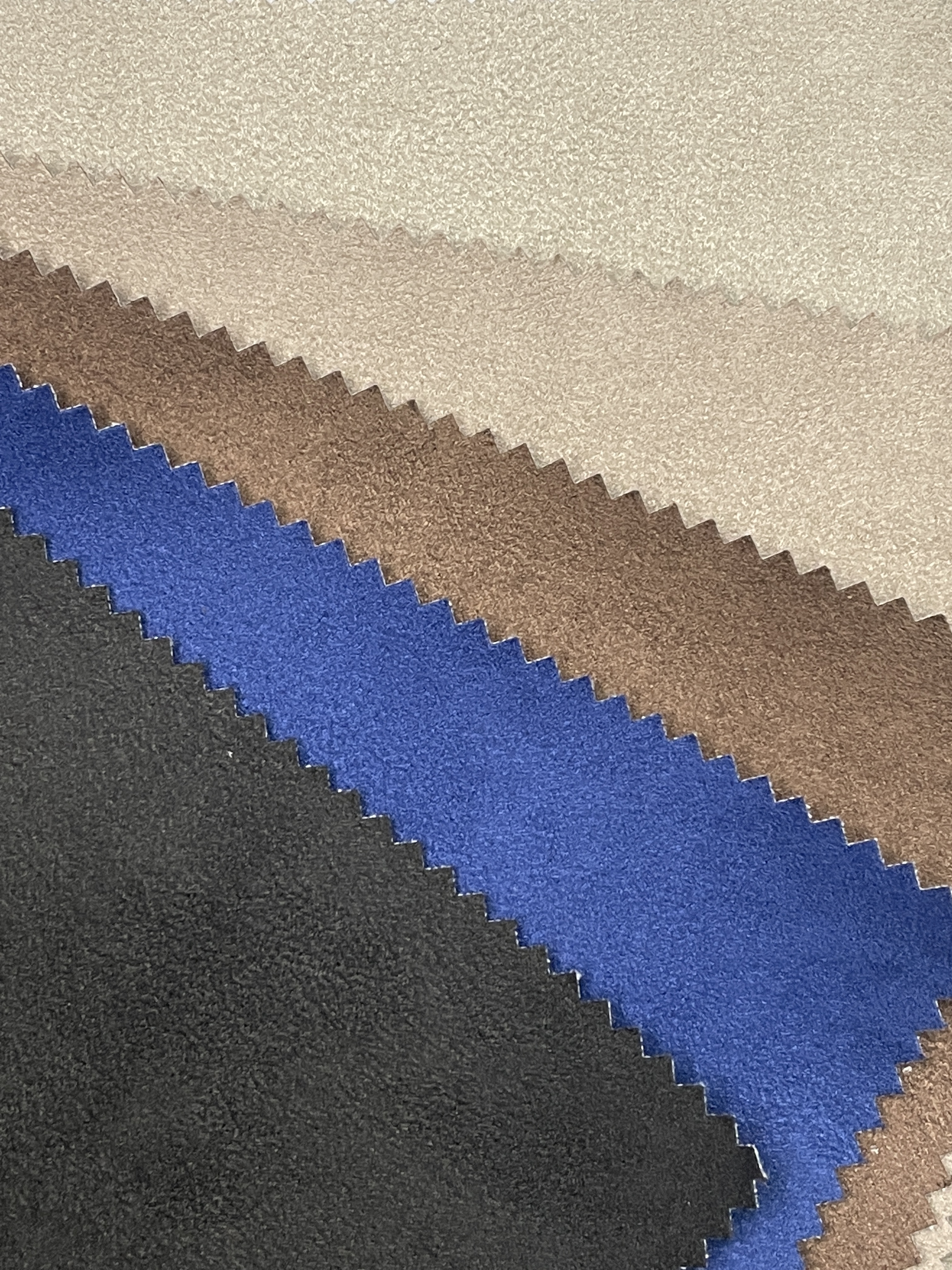
TL0329 is a 100% polyester upholstery fabric (105D × 200D, 160 gsm, 150 cm / 300 cm) with a brushed, suede-like surface and bonded back side.
4. Reading an Upholstery Fabric Range: A Spec-Level Example
The clearest way to understand how upholstery specifications differ is to look at a real range side by side. The table below lists representative sofa and dual-use upholstery fabrics from the T-LAND TEXTILE range, with documented construction, weight, width and surface characteristics.
| Model | Type | Construction | Weight | Width | Documented surface / build |
|---|---|---|---|---|---|
| TL0329 | Upholstery fabric | 105D × 200D | 160 gsm | 150 cm / 300 cm | Brushed surface, suede hand feel, bonded back side |
| TL07410 | Velvet fabric | 350D × 450D | 300 gsm | 150 cm | Chenille quality, soft hand feel, bonded back side |
| TL07377-2 | Velvet fabric | 300D × 600D | 160 gsm | 150 cm | Velvet quality, soft hand feel, bonded back side |
| TL07408 | Jacquard fabric | 1150D × 4500D | 450 gsm | 150 cm | Looped-pile appearance, soft hand feel, bonded back side |
| TL07392 | Jacquard fabric | 900D × 1580D | 280 gsm | 150 cm | Brushed surface, soft hand feel |
| TL07373-1 | Jacquard fabric | 350D × 900D | 220 gsm | 150 cm | Brushed surface, soft hand feel |
| TL12167 | Poly linen fabric | 350D × 350D + 650D | 280 gsm | 150 cm | Linen hand feel, bonded back side |
| TL0415 / TL0469 / TL0484 | Polyester linen fabric | 600D × 600D / 300D × 300D | 230 gsm | 150 cm | Linen hand feel, bonded back side |
| TL07242 | Velvet fabric | 150D × 320D + 200D | 220 gsm | 150 cm | Velvet hand feel |
| TL0901 | Velvet fabric | 160D | 200 gsm | 160 cm | Velvet hand feel |
| TL12199 | Sofa & dimout fabric | 700D × 700D | 300 gsm with backing / 380 gsm with silicon coating | 150 cm / 300 cm | Linen hand feel; non-woven backing for sofa, silicon coating for curtain |
| TL12210 | Poly linen fabric | Bonded two-layer linen-type construction | 385 gsm | 150 cm / 300 cm | Two linen fabrics bonded; room darkening; sofa and cushion suitable |
The range illustrates a structural point about upholstery sourcing: the same supplier can offer a 160 gsm brushed fabric and a 450 gsm jacquard within one portfolio, and both can be correct. The buyer's task is not to find the heaviest fabric available, but to match weight, backing and surface formation to the seating programme, the cleaning regime and the light exposure of the final installation.
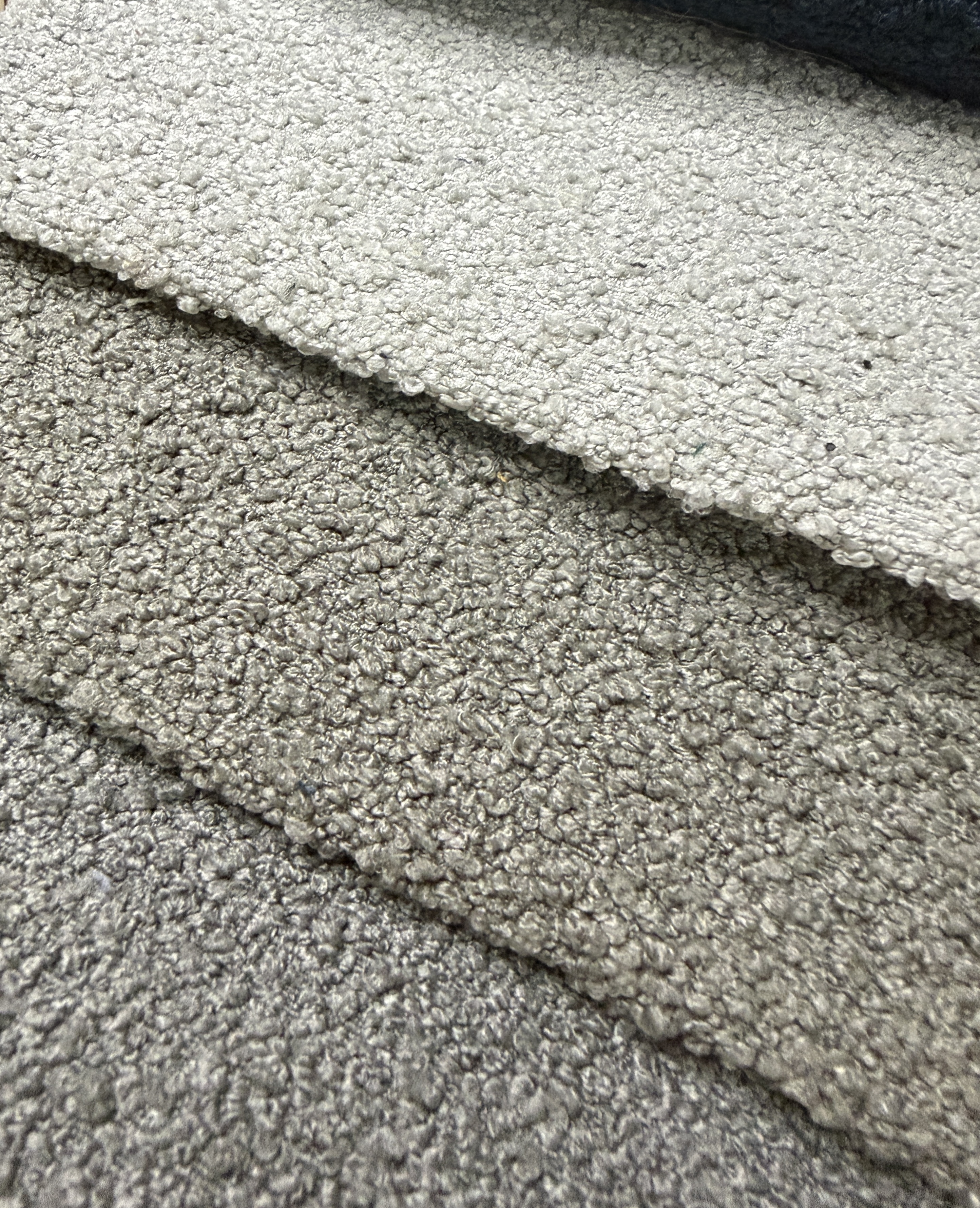
TL07408 is a 100% polyester jacquard sofa fabric (1150D × 4500D, 450 gsm, 150 cm) in which the pattern is formed during weaving, with a bonded back side for sofa and cushion covers.
5. Application: Where Upholstery Fabric Has to Hold Up
Upholstery decisions are usually driven by the project type, because the project type determines the friction and light load. Documented application categories for woven sofa and curtain fabric include residential decoration projects, hotel and B&B projects, office commercial projects, health-care institutions, exhibition and cultural tourism projects, and special soft furnishing customisation for RVs and yachts.
Each of these categories shifts the priority:
- Residential projects. Priority sits with colour matching across a furniture collection, hand feel, and indoor and outdoor suitability. Bonded-back sofa fabrics in the 160–300 gsm band are commonly matched to cushion and sofa programmes.
- Hotel and B&B projects. The load shifts toward durability and cleanability, and flame retardancy frequently enters the specification. Dual-use fabrics such as a curtain and sofa fabric that can be dyed in matching colours reduce the number of suppliers and colour families a project has to manage.
- Office and commercial projects. Heavy-duty friction conditions apply, so abrasion resistance and colour consistency between lots become contractual rather than cosmetic issues.
- Health-care institutions. Cleanability, water-repellent and stain-resistant finishes, and low-formaldehyde eco-standards move to the front of the specification.
- Exhibition, cultural tourism, RV and yacht projects. These combine limited cutting budgets with mixed indoor and outdoor exposure, which is where 300 cm width options and bonding quality become commercially visible.
The recurring special requirements across these categories are documented as flame retardancy, high light fastness, high Martindale wear resistance, anti-pilling, water-repellent and stain-resistant finishing, low-formaldehyde eco-standard, strict batch-to-batch colour difference control, washability, and customised width and gram weight. A supplier that cannot discuss these nine items by name is unlikely to be able to document them by lot.
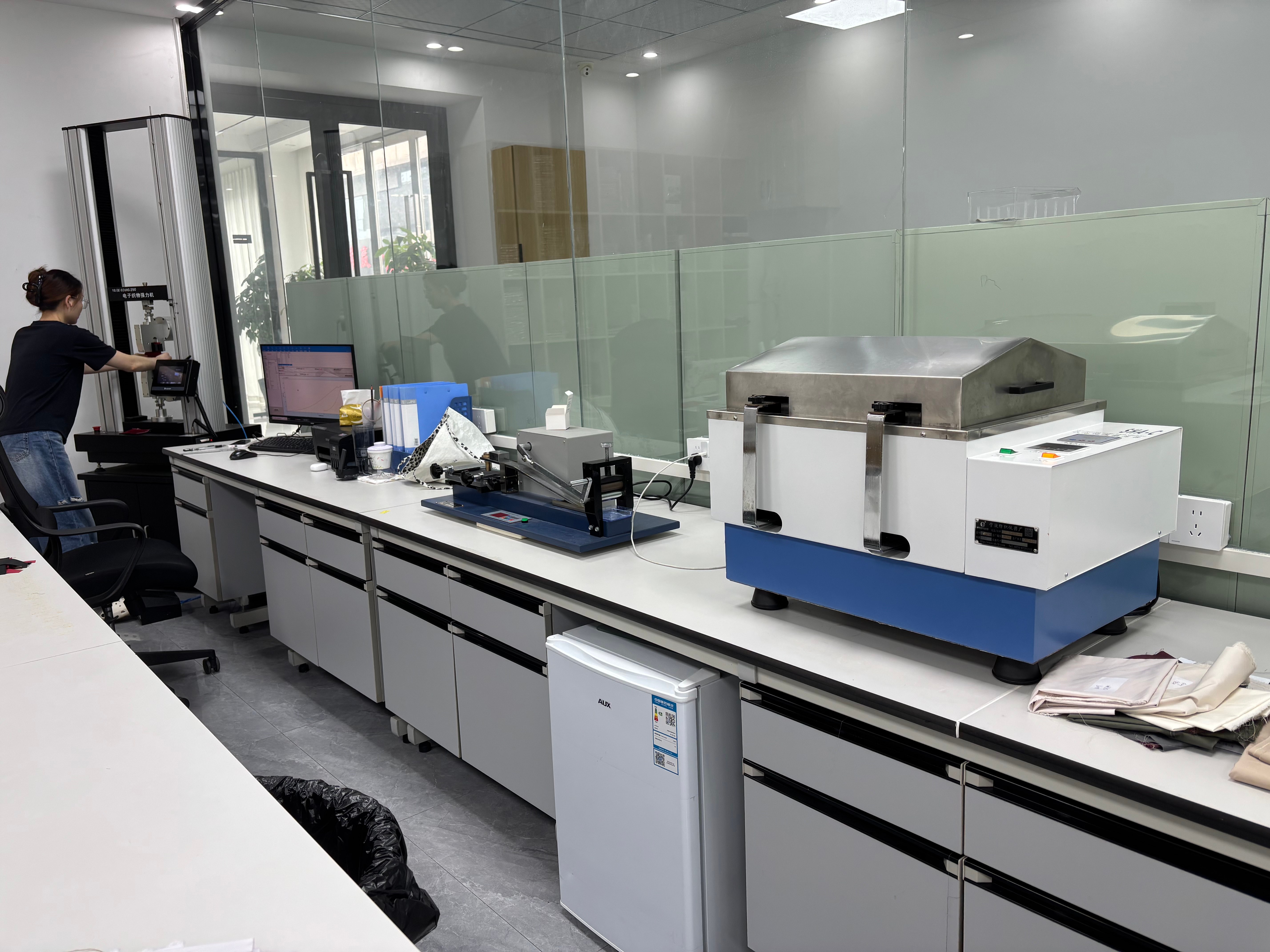
Lot-level testing equipment used in the T-LAND TEXTILE in-house fabric laboratory, which tests each lot against different test items to meet varying brand requirements.
6. Market Signals a Upholstery Buyer Should Already Be Pricing In
Three published data points frame the current supply environment. They do not predict a specific price, but they explain why specification and traceability demands are rising faster than raw volume.
| Signal | Published figure | Source |
|---|---|---|
| Global home textile market size, 2025 | USD 144.76 billion | The Business Research Company |
| Asia Pacific share of home textiles, 2025 | 44.17% | Fortune Business Insights |
| Global upholstery fabric market value, 2023 | USD 44.5 billion | Verified Market Research |
| Global blackout fabric market, 2024 | USD 2.7 billion, projected to USD 3.8 billion by 2030 at a 5.9% CAGR | Strategic Market Research |
| China home textile exports, March 2024 | USD 2,870.94 million | Stellar Market Research |
One data caveat is itself useful to buyers. Published blackout fabric market estimates diverge sharply — one commercial source places the market at USD 2.7 billion in 2024, while other commercial reports suggest figures near USD 10.5 billion. The difference appears to stem from whether "finished curtains" or "raw fabric" is being counted. The same definitional risk applies when a buyer compares supplier quotations: two prices for "dimout" or "blackout" may describe two different product scopes. Fixing the definition before the price comparison is cheaper than discovering the mismatch after delivery.
7. Bonded Upholstery Fabric Compared with Traditional Build-Ups
Traditional upholstery procurement frequently separates the face fabric from its back construction: the buyer sources an unbacked woven fabric and the back is added later by a local laminator or by the furniture factory itself. The alternative — a fabric supplied with the back side already bonded, as with the T-LAND TEXTILE sofa fabric range — moves that step into the weave house. The two approaches trade different risks.
| Dimension | Bonded upholstery fabric supplied ready-backed | Traditional build-up (face fabric plus separate back processing) |
|---|---|---|
| Process steps at the furniture factory | Cut and sew; no lamination stage | Fabric must be laminated or lined before cutting |
| Consistency of the back finish | Back applied under the weave house's own lot control | Depends on a third party's process control |
| Freight profile | Higher shipped weight, because the back is already included | Lighter fabric shipped; weight added near the point of use |
| Air movement through the composite | Typically reduced, because the composite is denser | Typically higher, because the face fabric remains open |
| Re-upholstery and repair | Backing and face are handled as one material | Layers can be separated and replaced independently |
| Failure mode | A bond defect affects both layers at once | A lamination defect is isolated to the finishing step |
Limits worth writing into the specification
A credible upholstery specification states its boundaries, not only its strengths. Four limits are documented and should be accepted deliberately:
- Dimout is not blackout. Dimout fabric provides room darkening and noise reduction, but sits between standard decorative fabric and blackout fabric in light-blocking performance. Where full blackout is the requirement, dimout should not be specified as a substitute.
- Pilling is a physical phenomenon, not automatically a defect. Almost all fabrics may pill. The higher the pilling-resistance grade, the lower the risk. Short-fibre fabrics are more likely to pill than long-fibre fabrics, because repeated friction pulls short fibres out of the yarn and they tangle into visible pills. Looser yarns and higher short-fibre content increase the possibility.
- Coated flame-retardant finishing has a service limit. Both inherent-yarn FR and coating-treated FR are available. Inherent-yarn FR is permanent and washable and is the recommended direction for long-term stable and safe performance in hotel projects. Coated FR is lower cost, but FR performance drops after repeated washing. Where washability is a project requirement, the cost difference is usually smaller than the re-treatment cost.
- Weight is a tolerance, not an absolute. Bulk fabric weight is subject to GSM tolerance in production, and batch-to-batch colour difference control is a managed variable rather than an automatic zero. First-dye-lot sample confirmation exists precisely because these tolerances are real.
On the last point, the control mechanism is documented: a first-dye-lot sample is arranged for confirmation, and mass production starts only after its approval. That is the practical answer to the most common concern in upholstery procurement — whether bulk goods will match the confirmed sample.
8. Compliance Direction Between 2026 and 2027
Regulatory pressure on upholstery and curtain fabric is concentrating in two markets that a Chinese export-oriented weaver and its buyers must both track.
- United Kingdom. The Furniture and Furnishings (Fire) (Safety) Regulations 1988, amended in 2010 and 2025, remain the core regime in 2026 for domestic upholstered products. Separately, BS 5867 is the established UK fire safety standard specifically for curtains and drapes. A sofa fabric and a curtain fabric used in the same project can therefore fall under different testing expectations.
- European Union. The General Product Safety Regulation (GPSR) 2023/988 mandates safety for home textiles, and Digital Product Passports (DPP) are expected for textiles by 2027. The practical consequence is that lot-level traceability — which lot, which construction, which test — stops being an internal quality preference and becomes a documentation requirement.
T-LAND TEXTILE documents OEKO-TEX and GRS certification and supplies products under those certification frameworks, with an in-house laboratory testing each lot against different test items. The computer-based order instruction system is the traceability layer that supports this direction. Buyers preparing for DPP-driven documentation should verify, at the sampling stage, which test records the supplier can actually reissue per lot — not merely which certificates exist as PDFs.
9. Future Outlook
Three shifts are visible from the available evidence. First, the finish, not the fibre, is becoming the differentiator. Nearly every fabric in the T-LAND TEXTILE upholstery range is 100% polyester, yet the same polymer yields a 160 gsm brushed suede, a 300 gsm chenille-backed velvet, and a 450 gsm looped-pile jacquard. As base polymer supply commoditises, backing, brushing, coating and width options carry more of the specification value.
Second, dual-use construction is likely to expand. SoFa-and-curtain fabrics such as TL12199 (non-woven backing for sofa, silicon coating for curtain) and TL12210 (two linen fabrics bonded for room darkening) let a project match curtain and upholstery colours from a single source. For hotel and B&B programmes managing tight colour families, that reduces coordination risk rather than merely reducing unit price.
Third, traceability will move from a marketing claim to a procurement gate. With GPSR 2023/988 in force and DPP expected for textiles by 2027, the suppliers that can reissue lot-level test data will be easier to keep in a shortlist than those that can only present certificates. Mid-sized export weavers with in-house laboratories and digital order systems are better positioned for this shift than their scale alone would suggest — provided they can document it clearly.
Frequently Asked Questions
Will sofa fabric pill?
Almost all fabrics may pill. Pilling forms as surface short fibres are pulled out and tangled by repeated friction, so a lower pilling-resistance grade means a higher risk. Short-fibre fabrics are more likely to pill than long-fibre fabrics. It is a physical fibre phenomenon rather than automatically a product defect, which is why the pilling-resistance grade is the figure to confirm before purchase.
Why do curtains fade after a period of use?
It is mainly caused by insufficient light fastness. Under long-term ultraviolet radiation, dyes decompose through photo-oxidation degradation: UV rays damage the chromophore groups of the dye, and when a fabric has low light fastness the dyes bind poorly with the fibres, producing fading, discolouration and uneven surface colour. The light fastness grade should be confirmed before purchase rather than after installation.
How do you ensure bulk goods are identical to our confirmed sample?
Bulk production is managed against the confirmed sample through a documented conformity-control sequence: a first-dye-lot sample is arranged for confirmation, and mass production starts only after that sample is approved. Solutions with a complete conformity-control system are the ones to prioritise, because bulk-to-sample consistency, colour fastness and lower inconsistency risk all depend on that control step rather than on inspection after shipment.
Is flame-retardant upholstery and curtain fabric inherent-yarn FR or coating-treated FR?
Both technologies are available and they behave differently. Inherent-yarn FR is permanent and washable with a soft hand feel, and it suits hotel projects where long-term stable and safe performance is the goal, with washability as the key selection parameter. Coated FR costs less, but its FR performance drops after repeated washing. The choice therefore follows the project's cleaning regime rather than price alone.